Internal Medicine Day Three
Acupuncture Prescription
1) What should be included?
◦ Point(s): code + number, bilateral or unilateral
◦ Stimulating techniques: needling (reducing, reinforcing,
even); Adjunct techniques (moxa, cupping, etc.)
◦ Time: stimulating time, needle retaining time, courses of
treatment, intervals, etc.
◦ Symbols: = even + = reinforcing - = reducing
∆: cone moxibustion X: stick moxibustion
↓: blood letting O: cupping
*skin needle therapy I ϟ: electro acu
2) How many points are proper in a prescription?
The less, the better. Usually 4 to 6 in the early visits, then
increasing the number 7 to 10 in later treatments
The size depends on the conditions:
◦ Generally, for the case newly-onset, acute, shallow, weak, mild
and simple, use small prescriptions
◦ For the old, stubborn, prolonged, deep, excess, severe and
complicated, use larger prescriptions
3) How frequent and how long should the treatment be given?
Total duration: a course of treatments needs 7 to 10 visits
◦ Frequency of visit:
◦ Once every I to 3 days, or even once a week
◦ Interval: After a course of treatments (a few weeks), an
interval should be given temporarily to rest the patient
Duration of a session:
◦ Duration of needle retaining: 20 to 30 minutes in most cases;
in a special condition, needle may not be retained
◦ Extra time for consolidating result: for a stubborn condition
(chronic pain, anxiety, etc.), extra time may be needed (up to
an hour)
4) When is it a good time to do acupuncture?
For some disorders, if there are some specific time that they
attack or get worse, the treatment should be given before*
Examples:
◦ Menstrual cramps: 1 to 3 days before the period and through
the whole menstruation
◦ Infertility: continuously give the treatment before and through
ovulation
◦ Insomnia: afternoon or evening
◦ Migraines: before the attack if predictable
It is always easier to prevent something, than to fix it after it
occurs
Principle of Point Selection
1. Basic law: To select the point along the meridian(s)
◦ Example: LI channel elbow pain, choose points on the LI channel like LI11
2. Selection of local or nearby points within or around the diseased
area/part:
◦ Ashi point: tender spot
◦ Eyes: BL 1, BL 2, GB 1, ST 1, TE 23, GB 14, GB 20
◦ Nose: ST 3, LI 20, GV 23, BL 7
◦ Ears: TE 21, SI19, GB 2, TE 17, GB 12, GB 20
◦ Mouth and teeth: ST 4, ST 5, ST 6 & ST 7, CV 24
◦ Shoulder: LI 15, TE 14, SI 9, SI 10, LI 14, Jianqian (EX)
◦ Stomach: CV 12, ST 21, ST 25, LR 13
◦ Knee: ST 34 & 35, GB 34, SP 9
◦ Low back: BL 23, BL 52…
3. Selection of distant/distal points:
➢ It often refers to the points below the elbow and knee joints
➢ It is the core of acupuncture prescription
➢ Select the points on the main diseased meridian based on the pattern
➢ Select the point on other related meridians:
➢ a) Biao-Li: e.g., LU-LI, SP-ST…
➢ b) Pathogenically: e.g., Liver Overacting on Spleen
➢ c) with the same name: e.g., GB-TE, LI-ST…
4. Selection of points based on a symptom:
◦ Coma: GV 26, Shixuan (EX)
◦ Sweating: LI 4, KI 7
◦ Insomnia: SP 6, HT 7
◦ Locked or tight jaws: LI 4, ST 6, ST 7,GB 3
◦ Hiccups: PC 6, BL 17
◦ Hypochondriac pain: TE 6, GB 34
◦ Constipation: TE 6, ST 25
◦ Skin itchiness: LI 11, SP 10
◦ Hemorrhoids: BL 57
◦ Etc.
5. Selection of points in specific groupings:
1) Five Shu (Transport) points
2) Lower He-sea points
3) Yuan-primary/source points
4) Luo-connecting points
5) Xi-Cleft points
6) Back-Shu points
7) Front-Mu points
8) Eight influential points
9) Confluent points of the eight extra meridians
10) Crossing points
11) Four Gates points
12) Four Command Points
1) Five Shu(Transport) Points(五输穴) Most Important
Situating between the fingers/toes and
elbows/knees, the 5 shu points represent
the flow of Qi as a river, emerging like a
spring at the Jing-well points and gradually
growing in breadth and depth until it
reaches the He-sea points
The Qi flow through Five Shu Points is from
the extremities to the trunk, which is
different from the cyclical Qi flow of 12
meridians
The progression through the 5 Shu points
(from distal to proximal to the body)
corresponds to the generating cycle of the 5 phases/elements:
◦For Yin meridians: wood-fire-earth-metal-water;
◦For Yang meridians: metal-water-wood-fire-earth.
Five Shu Points
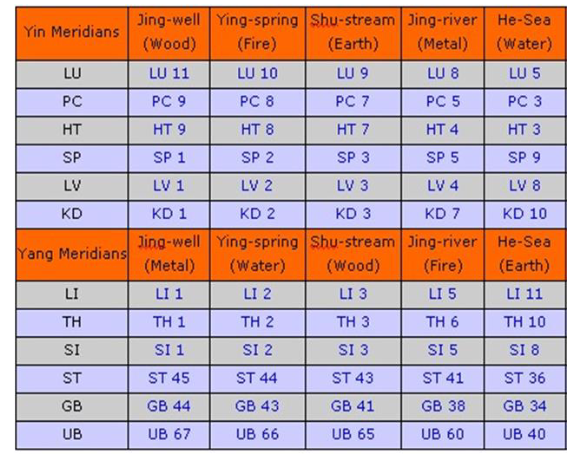
Jing-Well points:
◦ All at tips of fingers or toes LU 11, LI 1, ST 45, SP1, HT 9, SI 1, BL 67, KI 1, PC 9, TE 1, GB44, LR 1
◦ Qi at this point departs and is most superficial
and thinnest; the energy changes polarity from Yin to Yang or vice versa
◦ They have an outward movement that eliminates pathogenic factors
◦ Use these points in acute situations, i.e. to eliminate pathogens quickly.
◦ Clinically: irritability, mental restlessness, anxiety, unconsciousness
Ying-Spring points:
◦Generally located near the metacarpophalangeal or metatarsophalangeal joint: LU 10, LI 2, ST44, SP 2, HT 8, SI 2, BL 66, K I2, PC 8, TE 2, GB 43, LR 2
◦Qi at this point is powerful and full of potential
◦Clinically: febrile diseases to clear heat
Shu-Stream points:
◦ General location: hand yin – around the wrist; hand yang
– on mid-dorsum of hand; foot yin and yang – all on the
feet distal to the ankle except for KI 3 on it
◦ LU 9, LI 3, ST 43, SP 3, HT 7, SI 3, BL 65, KI 3, PC 7, TE 3, GB41, LR 3
◦ Qi at this point is bigger and deeper
◦ Clinically: Bi/Painful obstruction syndromes due to Dampness
Jing-River points:
◦ Generally located proximal to the wrist or ankle: LU 8,
LI 5, ST 41, SP 5, HT 4, SI 5, BL 60, KI 7, PC 5, TE 6, GB 38, LR 4
◦ Qi at this point is much bigger, wider and deeper
◦ Clinically: respiratory diseases
He-Sea points:
◦ Located at the elbow or knee joints: LU 5, PC 3, HT 3,
SP 9, LR 8, KI 10, LI 11, TE 10, SI 8, ST 36, GB 34, BL 40
◦ Qi at this point is vast and deep and collects/unites
◦ Clinically: gastrointestinal/Fu-organ disorders (i.e.
vomiting, diarrhea, constipation and nausea) and skin
conditions (diarrhea due to rebellion of stomach Qi)
Summary of their clinical applications:
◦ Treatment based on the mother-child relationship: ‘reduce
the Child for Excess and reinforce the Mother for Deficiency’.
a) On Main Meridian: e.g. : LU deficiency → reinforce LU 9
(Shu-Stream, earth pt, the mother of metal); LU excess
→ reduce LU 5 (He-Sea, water pt, the child of metal). Tonify earth to generate metal
b) On Other Meridians: e.g., LU deficiency → select its
mother meridian SP/ST: reinforce SP 3 (Shu-Stream,
earth pt, the mother of metal) or ST 36 (He-Sea, earth
pt, the mother of metal); LU excess → select its child
meridian KI/BL: KI 10 (He-Sea, water pt, the child of
metal) or BL 66 (Ying-Spring, water pt, the child of
metal).
Lower He-Sea Points(下合穴)
Lower He-Sea points: 6 in total
◦ They are ST 36*, 37, 39, BL 39, 40* & GB 34* (*overlaps with He-Sea points)
◦ Corresponding to 6 Yang Meridians (6 Fu organs)
◦ Clinical applications:
◦ Generally, for diseases of the relevant Fu organs
◦ Counter-flow Qi and diarrhea, disease of ST and other digestive disorders
◦ Abdominal pain: ST 36- epigastric region, ST 37-sides of navel; ST 39-around the navel; GB 34-hypochondriac region and flanks; BL 40-lower abdomen (bladder area), BL 39-not fixed area
Chapter 4 of MiracuIar Pivot (《灵枢》) says,
"The Lower He-Sea Points of the stomach, large intestine, small
intestine, Triple Energizer, bladder and gallbladder are Zusanli (ST 36),
Shangjuxu (ST 37), Xiajuxu (ST 39), Weiyang (BL 39), Weizhong (BL 40)
and Yanglingquan (GB 34) respectively.
Yuan-Source Points(原穴)
Yuan-Source points: 12 in total
They are located where the Yuan or source Qi resides, surfaces and
lingers
They are: LU 9, LI 4, ST 42, SP 3, HT 7, SI 4, BL 64, KI 3, PC 7, TE 4, GB 40, LR 3
Clinical applications:
◦ Generally they are used to treat and diagnose the disorders of
relevant 12 Zang-Fu organs
◦ Yin meridians: fundamental in tonifying and regulating the Zang organs
◦ Yang meridians: to dispel excess pathogenic factors of the Fu organs
Luo-Connecting Points(络穴)
Luo-Connecting Points: 15 in total
They are LU 7, LI 6, ST 40, SP 4, HT 5, SI 7, BL 58, KI 4, PC 6, TE 5, GB 37,
LR 5, CV 15, GV 1, SP 21
12 on limbs for 12 regular meridians; 3 on trunk for GV, CV and Greater
Luo of Spleen
They are the places where the connecting collaterals split from their
main meridians to connect the Biao-li related meridians together
Clinical applications:
◦ To treat disorders of Biao-li related meridians or Zang-Fu organs
◦ To diagnose the corresponding organ’s diseases
◦ Often combined with the Yuan-Source point
Xi-Cleft Points (郗穴) Acute Problems!!!
Xi-Cleft points: 16 in total
‘Xi’ means cleft, crevice, hole or opening - where the energy of the channel hides deeply, for acute problems
Yang mostly for pain
Yin mostly for bleeding
Xi-Cleft points are located below the elbow or knee joints (except for ST 34)
12 for the regular meridians and 4 for the extra meridians: LU 6, LI 7, ST 34,
SP 8, HT 6, SI 6, BL 63, KI 5, PC 4, TE 7, GB 36, LR 6, KI 8 (Yinqiao), KI 9 (Yinwei),
BL 59 (Yangqiao), GB 35 (Yangwei)
Clinical applications:
◦ Treat acute diseases, esp. acute pain, e.g., acute stomach pain – ST 34Liangqiu)
◦ Yin meridian points have additional action of treating disorders of the blood and to stop bleeding, e.g., hemoptysis (coughing blood) – LU 6 (Kongzui)
◦ Diagnosis: palpation for tenderness on these points can help diagnose the
respective organ’s disorders
Eight Confluent Points (八脉交会穴)
Eight Confluent points: 8 in total
The 8 points are located where the regular meridians
communicate with the 8 extra meridians
Clinical applications:
◦ Activate their respective extra meridians for treatment of
disease
◦ Usually a Confluent point on the upper limb is combined
with a related Confluent point on the lower limbs
(Confluent point + Paired point)
◦ Combinations:
◦ SP 4 Chong + PC 6 Yinwei → Diseases of HT, Chest and ST
◦ SI 3 GV + BL 62 Yangqiao → Diseases of the inner canthus, neck, ear, shoulder, SI and BL
◦ GB 41 Dai + TE 5 Yangwei → Diseases of the outer canthus, back of ear, cheek, neck and shoulder
◦ LU 7 CV + KI 6 Yinqiao → Diseases of respiratory system, throat, chest and diaphragm
Eight Influential Points(八会穴)
Eight Influential points: 8 in total
These 8 points dominate the organs and tissues of the body:
➢ LR 13(Zhangmen): Zang organs;
➢ CV 17(Tanzhong): Qi;
➢ GB 34(Yanglingquan): Sinews/Tendons;
➢ GB 39(Xuanzhong): Marrow;
➢ CV 12(Zhongwan): Fu organs;
➢ BL 17(Geshu): Blood;
➢ BL 11(Dazu): Bones;
➢ LU 9(Taiyuan): Vessels.
Clinical application: treat disorders of respective organ or tissue or energy
Back-Shu Points(背俞穴)
Back-Shu points: 12 in total
•They are where the Qi of the respective Zang-Fu organs is
infused on the back
•They lie 1.5 cun lateral to the midline along the bladder meridian on the back
•Each point is named after its corresponding internal organ
followed by the word ‘Shu’ implying its Qi is ‘transported’ to the point
•They are situated roughly at the same anatomical level as their
related Zang-Fu organs
Back-Shu points: 12 in total
12 Zang-Fu Back-Shu: Others:
◦ BL 13 Feishu (LU) BL 16 Dushu (GV)
◦ BL 14 Jueyinshu (PC) BL 17 Geshu (diaphragm)
◦ BL 15 Xinshu (HT) BL 24 Qihaishu (Sea of Qi)
◦ BL 18 Ganshu (LR) BL 26 Guanyuanshu (Gate of Yuan Qi)
◦ BL 19 Danshu (GB) BL 29 Zhonglushu (midspine)
◦ BL 20 Pishu (SP) BL 30 Baihuanshu (white ring)
◦ BL 21 Weishu (ST) BL 43 Gaohuangshu (vital region)
◦ BL 22 Sanjiaoshu (TE)
◦ BL 23 Shenshu (KI)
◦ BL 25 Dachangshu (LI)
◦ BL 27 Xiaochangshu (SI)
◦ BL 28 Pangguangshu (BL)
Clinical applications:
◦ To diagnose and treat the diseases of corresponding Zang-
Fu organs
◦ They are often combined with corresponding Front-Mu
points in use
◦ Needling depth and directions:
◦ BL 13 to BL 21 – obliquely 0.5 ~ 0.8 cun
◦ BL 22 to BL 28 – perpendicularly 0.5 ~ 1 cun
Front-Mu (Alarm) Points (募穴)
Front-Mu (Alarm) points: 12 in total
•‘Mu’ means to gather or collect
•They are situated on the chest and abdomen near the
anatomical location of corresponding Zang-Fu organs
•The points are the places where the Qi of the respective Zang-
Fu organs is infused and converged
•Clinical applications: to diagnose and treat the disorders of
corresponding internal organs
Front-Mu (Alarm) points: 12 in total
LU 1(Zhongfu): Lung ST 25(Tianshu): Large Intestine
CV 17(Danzhong): Pericardium CV 5(Shimen): Triple Energizer
CV 14(Juque):Heart CV 4(Guanyuan): Small Intestine
LR 13(Zhangmen):Spleen CV 12(Zhongwan): Stomach
GB 25(Jingmen):Kidney CV 3(Zhongji): Bladder
LR 14(Qimen):Liver GB 24(Riyue) : Gallbladder
Crossing Points(交会穴)
Crossing points: about 100 in total
•They locate in the intersection of two or more meridians
•Mainly on the head, face and trunk
•They are used to treat the diseases involving two or more
meridians: origin (which the point belongs to) + intersecting
meridian(s)
•Some of them are very useful: SP 6, GV 14, GB 30…
Four Gates Points(四关穴)
Four Gates Points: 2 in total
•LR 3 + LI 4 of both sides
•To promote the Qi flow of whole body
•Clinical applications: Qi stagnation (mainly Liver Qi) causing
pain, spasm, bloating, etc.
can help the patient pinpoint discomfort
Four Commanding Points(四总穴)
Si Zong-Four Commanding points: 4 in total
◦ ST 36: abdomen
◦ BL 40: lumbar region
◦ LU 7: head and nape
◦ LI 4: face and mouth
◦ Additional 2 points (six commanding):
◦ PC 6: chest and lateral costal region
◦ GV 26: resuscitation
Principles of Point Combination
According to The Meridian Theory
➢On the same meridian
➢On the Biao-Li (exterior-interior) related meridian
➢On the meridian with the same name
According to The Point Distributing Locations
➢Upper and Lower - Upper point first (yang)
➢Front and Back - Do the back first (yang)
➢Left and Right - opposite side can treat the affected side
According to The Specific Grouping
1) Combine the points on the same meridian:
•Based on the pattern, identify the main organ/meridian involved
•Select one or two local points on the meridian
•Select one or two distant points: mostly from the specific point grouping
•Combine the local and distant points (usually 2 to 4 points in total) to form the basic prescription
•Example: headache – Excess Heat in Gallbladder meridian: Local – GB8, GB20 (temple area); Distant – GB43 (Ying-Spring to clear off heat).
2) Combine the point(s) on the Biao-Li (exterior-interior)
related meridian:
•Based on the pattern, identify the main organ/meridian involved
•Identify the Biao-Li (exterior-interior) related meridian
•Select one or two points from this meridian based on the nature of the pattern
•Combine the point(s) with the basic prescription
•Example: headache – Excess Heat in Gallbladder meridian: LR2 (GB-LR are Biao-Li related and it’s a Ying-Spring to help Clear off Heat in GB), combined with GB 8, GB 20, GB 43 in your
basic prescription
3) Combine the point(s) on the meridian with the same name ex: Taiyang
•Based on the pattern, identify the main organ/meridian involved
•Identify the meridian with the same name: LU-SP, PC-LR, HT-KI,
LI-ST, TE-GB, SI-BL
•Select one or two points from this meridian based on the
nature of the pattern
•Combine the point(s) with the basic prescription
•Example: headache – Excess Heat in Gallbladder meridian: TE 5
(GB and TE meridians share the same name, Shaoyang, and this
is a Confluent pt.), combined with GB 8, GB 20, GB 43 in your
basic prescription
Point Combination According to
The Point Distributing Locations
1) Combination of the upper and lower points:
➢Upper: the points on the upper limbs and above the
lumbar level
➢Lower: the points on the lower limbs and below the
lumbar level
◦ Very common in a prescription
◦ Combination of the paired Eight Confluent Points: SP 4-PC6 (morning sickness), SI 3-BL 62, GB 41-TE 5, LU 7-KI 6; PC6-TE6 for constipation
◦ Example: GB 20-LR 2; TE 5-GB 43 for the headache due to Excess Heat in the GB Meridian
Point Combination According to
The Point Distributing Locations
2) Combination of the front and back points on the trunk
(or chest/abdomen and back):
➢Mainly refers to the Front-Mu and Back-Shu points in the specific grouping, but not limited to this:
◦ Often used to treat the disease of Zang-Fu organs
◦ “Double Needling” in Inner Classic
◦ Example: Cough – Lung Qi Deficiency: LU 1 and BL 13;
3) Combination of the left and right points:
•It is common to use the same point bilaterally to increase the effect of the point
•Often refers to the combination of the local point(s) with the distant point on the opposite side of the disorder
•“Miu Needling” in Inner Classic
•Example: Facial paralysis – ST 6 or 4 (local, same side) combined with LI 4 (command of face) on the opposite side (distant)
3. Point Combination According to
The Specific Grouping
1) Combination of the Yuan-Source and Luo-Connecting points:
•Also called “combination of Zhu (Host) and Ke (Guest)
points”, based on the diseased internal organ: “Host”-
Yuan-Source pt. of the main meridian; “Guest” – Luo-
Connecting pt of the Biao-Li related Meridian;
•Extended to the use of any combination of Biao-Li
(exterior-interior) related points
•Example: Diarrhea – Spleen Qi Deficiency: SP 3 (Yuan-
Source of the SP meridian) and ST 40 (Luo-Connecting of
the ST meridian).
2) Combination of the Five Shu Points:
“Reinforcing the Mother for a Deficiency pattern and reducing the Son for an Excess pattern.”
a) On Main Meridian: e.g. : LU deficiency → reinforce LU 9 (Shu-Stream, earth pt, the mother of metal); LU excess → reduce LU 5 (He-Sea, water pt, the child of metal).
b) On Other Meridians: e.g., LU deficiency → select its mother meridian SP/ST: reinforce SP 3 (Shu-Stream, earth pt, the mother of metal) or ST 36
(He-Sea, earth pt, the mother of metal); LU excess → select its child meridian KI/BL: KI 10 (He-Sea, water pt, the child of metal) or BL 66 (Ying Spring, water pt, the child of metal).
3) Combination of the Back-Shu and Front-Mu points:
•To treat the corresponding Zang or Fu organs
•Example: Constipation – LI Qi Stagnation: BL 25 (Back-Shu of the LI) and ST 25 (Front-Mu of the LI).
4) Combination of the Eight Confluent points (upper and
lower):
◦ SP 4 Chong + PC 6 Yinwei → Diseases of HT, Chest and ST
◦ SI 3 GV + BL 62 Yangqiao → Diseases of the inner canthus, neck, ear, shoulder, SI and BL
◦ GB 41 Dai + TE 5 Yangwei → Diseases of the outer canthus, back of ear, cheek, neck and shoulder
◦ LU 7 CV + KI 6 Yinqiao → Diseases of respiratory system, throat, chest and diaphragm
5) Combination of the other specific groups of
points:
◦ Lower He-Sea points
◦ Eight Influential points
◦ Xi-Cleft points
◦ Crossing points
remember the principles