Lesson 2 Micro
The rapid increase in income and living standards is primarily due to technological progress over the past 200 years.
Economic Models
Definition and Importance
Economic Model: A simplified representation of economic processes used to explain, predict, and understand economic behavior and outcomes.
Purpose of Models:
Enables understanding of complex interactions among millions of economic agents.
Helps to see the big picture by omitting unimportant details.
Building an Effective Model
Capture essential features relevant to the question at hand.
Describe how agents act and interact.
Determine outcomes (equilibrium) of these actions.
Analyze effects of changes in conditions on the model outcomes.
Equilibrium: A stable state where variables remain constant unless interfered with by external forces.
Characteristics of a Good Model
Clear and understandable.
Predicts outcomes accurately, aligning with evidence.
Facilitates communication about economic concepts and agreements/disagreements.
Useful for exploring ways to enhance economic functionality.
Decision Making
Decision-Making Model
Key Concepts:
Opportunity Cost: The value of the next best alternative not chosen.
Economic Cost: Direct costs + Opportunity costs.
Economic Rent: Net benefit from the chosen option - opportunity costs.
Reservation option: the next best alternative
Innovation rents: a form of economic rent. The extra profits made by exploiting an invention. Provide incentives for taking action.
Relative prices: the price of one option relative to another, often expressed as a ratio of the two prices. An important factor in determining economic incentives.
Technologies and Innovation
Specialization
Definition: Specialization allows individuals to focus on one or few tasks, enhancing efficiency.
Reasons for Specialization:
Learning by doing.
Differences in ability.
Economies of scale.
Comparative and Absolute Advantage
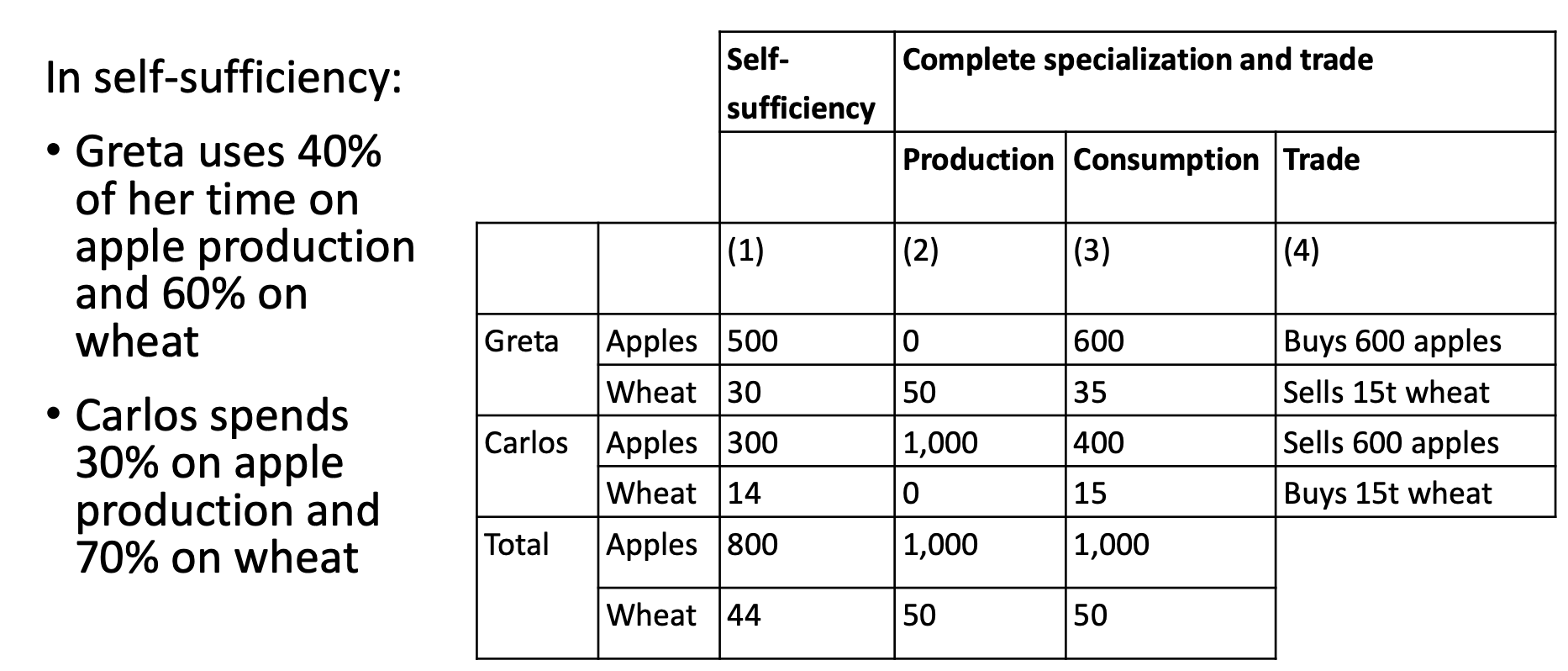
Absolute Advantage: The ability to produce more of a good with the same resources.
Comparative Advantage: The ability to produce a good at a lower opportunity cost than another producer.
at 100%production, greta can produce either 1250 apples or 50t wheat, carlos can produce either 1000 apples or 20t wheat.
Technological Change in Production
Division of labour: specialisation in producing things either within a firm or across society
Production Technology: The processes firms use to convert inputs (labor, raw materials, energy) into outputs.
Factors of Production: Inputs required in the production process.
Production Function: Describes the relationship between inputs used and the output produced.
The Industrial Revolution
Context
The late 18th century marked significant changes in production and technology, boosting wages and transforming economies.
Increased productivity led to changes in labor dynamics and societal norms regarding work.
Factors Influencing Industrial Change
High relative prices of labor compared to energy in Britain.
Technological advancements reduced costs of production, encouraging further innovation.
Climate Change and Economic Models
Impact of Capitalism
The transition to an energy-rich economy using fossil fuels has contributed significantly to climate change.
led to unprecedented increases in per capita income.
Equilibrium: a situation that is self-perpetuating, meaning that there is no tendency for the situation to change unless an external force for change is introduced
Endogenous variables: variables whose values are determined by relationships built into the mode
Exogenous variables: variables whose values are determined outside the model
Ceteris paribus: holding other things equal