Transpiration
Transpiration is the evaporation of water from the surface of the plant.
UPTAKE OF WATER IN ROOTS (1)
root hair cells have a fine extension that extends out into the soil, this provides a large surface area for absorption of water and mineral ions
Root hair cells have thin walls which provides a short diffusion distance
(these are adaptations of root hair cells)
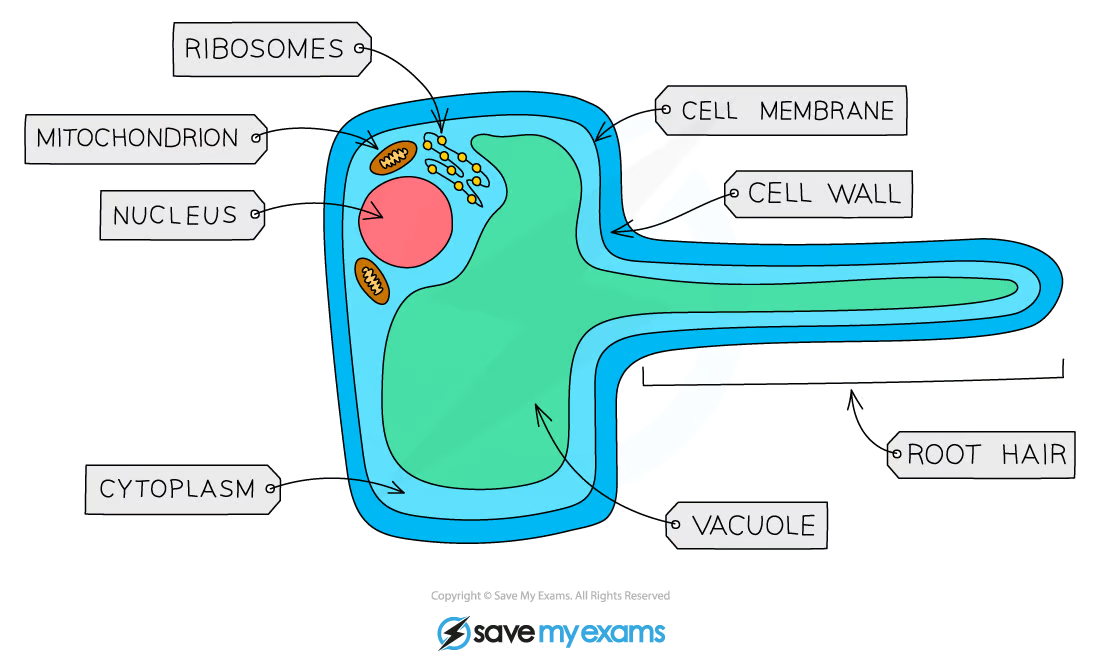
MOVEMENT OF WATER FROM SOIL→ ROOT HAIR CELL→ XYLEM VESSEL (2)
Each root hair is a single specialised cell of the root epidermis. Soil water has a higher water potential so water moves into the root hair cell via osmosis. This water dilutes the contents of the root hair cell and increases it's water potential so water moves from the root hair cell into the root cortex by osmosis, to keep a high water potential gradient, this allows water to be taken up by the xylem in the centre of the root
LOSS OF WATER BY THE LEAVES (3)
Water vapour diffuses out through the stomatal pores of the leaves. Loss of water from the surrounding mesophyll cells sets up a water potential gradient which draws water from the surrounding mesophyll cells
The Xylem vessels supply the leaf mesophyll tissues with water
Transpiration causes water to be pulled up by the xylem in the stem and roots in a continuous column called the transpiration stream
UPTAKE OF MINERAL IONS
Mineral ions are taken up by active transport, unless the concentration of the ion is higher in the soil water (fertiliser added) then the mineral ion can enter by diffusion
Once inside the root the mineral ions pass across the root cortex mainly by diffusion and enter the xylem vessels. They are then carried around the plant in the transpiration stream
Transpiration Stream Functions
supplies water for leaf cells to carry out photosynthesis
carries mineral ions dissolved in water
provides water to keep plant cells turgid
allows evaporation from leaf cell surface which cools the leaf
..
Stomata are mainly found on the underside of leaves as they are not exposed to direct sunlight, this will produce a high rate of diffusion. Also less air movement which reduces water loss
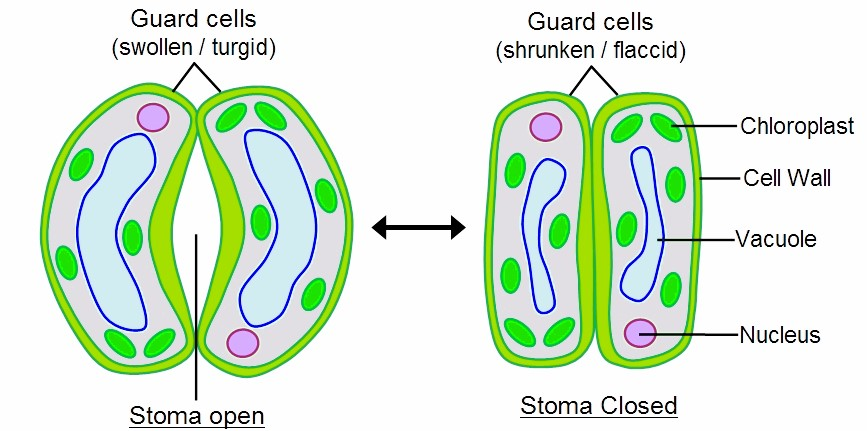 Turgid/Open = less flexible + thicker, H20 enters by osmosis causing vacuoles to expand
Flaccid/Closed = vacuoles shrunk, H20 lost by osmosis
FACTORS AFFECTING RATE OF TRANSPIRATION
Light intensity - rate of transpiration increases in light because of the opening of stomata
Temperature - increase in temperature increases the rate of evaporated water. It provides particles with more heat energy causing particles to move faster
Humidity - when it’s humid, the air contains a higher concentration of water vapour, this reduces diffusion gradient between the leaf and external air. rate of transpiration decreases in humid air and speeds up in dry air
Wind speed - rate of transpiration increases with faster air movement. It maintains a steep diffusion gradient as it removes water vapour from the leaf
POTOMETER
A potometer can be used to test factors of transpiration. For example a fan or hair dryer on a plant shows effect of moving air (wind speed), putting the plant under a bright light or in the dark sees the effects of light intensity.
a simple piece of apparatus which measures the rate of water loss as transpiration or the rate of water uptake
assumption: Rate of water uptake = Rate of water loss
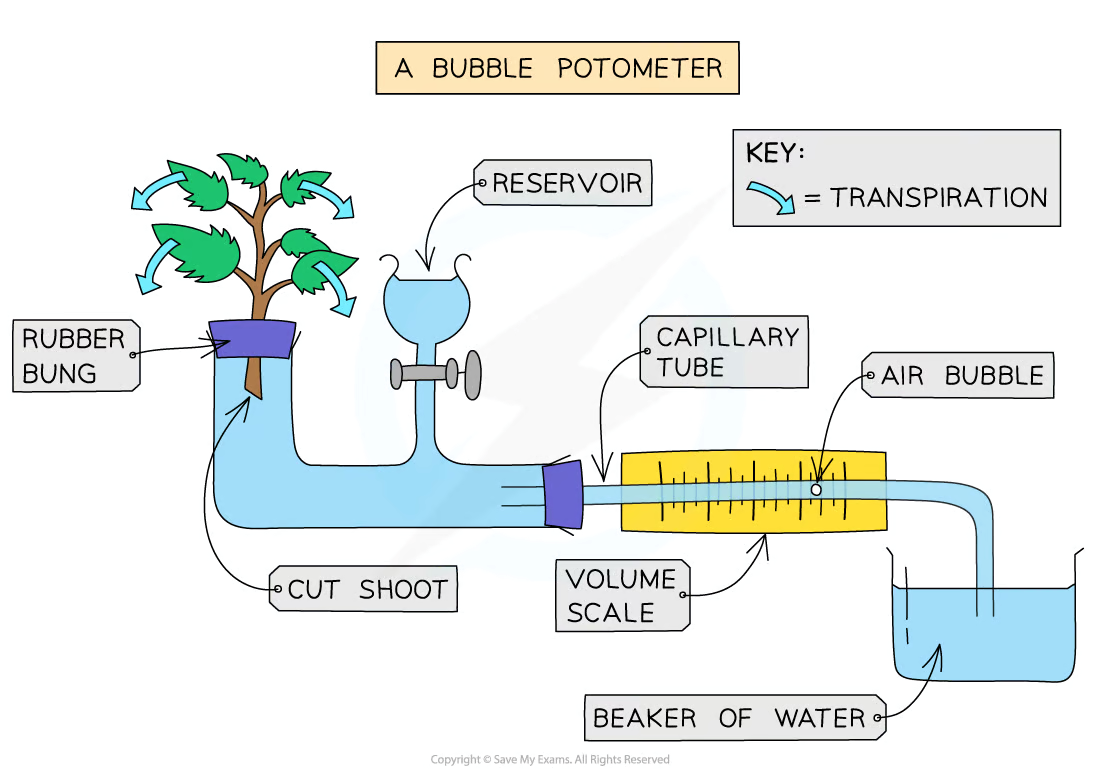 Method
Shoot is cut at a slant under water to prevent air bubble blocking xylem
Shoot is placed in potometer under water and as potometer is removed from the water
Petroleum jelly is placed at the junction of the shoot to prevent leakages
Air bubble is introduced, leaves are dried, and plant is left to acclimatise
Mark position of air bubble at start of scale and leave for 30-60 mins