Hemostasis
Key Vocabulary:
Aggregation: Smaller structures combining to form larger structures.
Clotting Factor: Plasma protein that can activate other clotting factors to produce a clot.
Fibrin: Insoluble plasma protein threads that weave together to form a clot.
Fibrinogen: Soluble plasma protein that can convert to fibrin.
Hemostasis: processes in the blood to help stop bleeding.
Introduction:
The blood system has some self-protection mechanisms built into it. These come into play during bleeding. The stopping of bleeding is called hemostasis. There are three basic mechanisms of hemostasis. These include blood vessel spasm, platelet plug formation and clotting.
Hemostasis
Let’s say there is a damaged blood vessel that is leaking blood.
The first response will be for the vessel to constrict to help stop the bleeding.
Platelets will contact the damaged blood vessel wall and then stick together to form a plug. This is also called platelet aggregation.
Finally, the clotting mechanism will be activated.
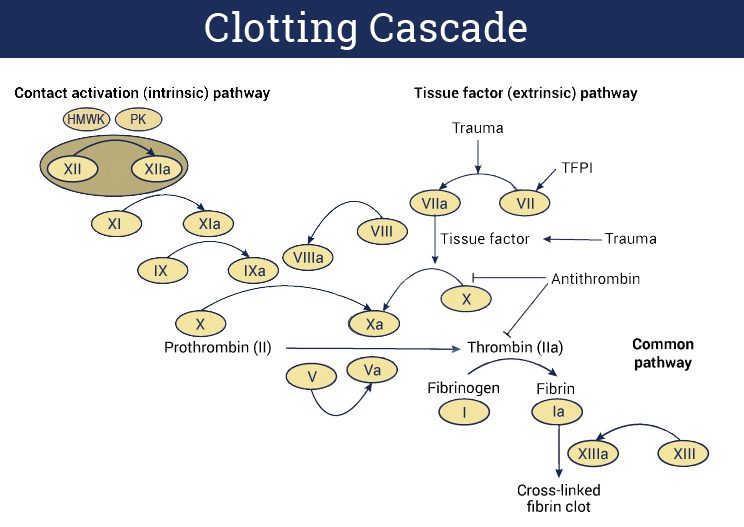
There are 3 pathways in clotting. These are the intrinsic, extrinsic and common pathways.
The intrinsic pathway is activated when blood contacts damaged blood vessels walls or is not moving as in stasis.
This pathway is triggered when blood has not left the vessel.
A series of proteins are activated in the blood in a series of reactions that lead to the common pathway and the formation of a clot.
The extrinsic pathway is triggered when blood leaves a damaged blood vessel, such as in our example. This activates a clotting factor in the tissue surrounding the vessel which then activates a series of clotting factors in the blood that also lead to the common pathway and the formation of a clot.
The common pathway is where the intrinsic and extrinsic pathways converge. This happens at factor 10 and ends with the formation of a fibrin clot.
Fibrin comes from a soluble plasma protein called fibrinogen which is converted to fibrin threads that weave together to form a clot in the last step of the common pathway.
Study the clotting cascade in the following image: