Localization
sound localization- two plans Azimuth (horizontal) and elevation (vertical)
binaural (need two ears)
inter aural time different (ITD)
waves hit nearer ear first, we are sensitive to these small time differences
inter aural intensity difference (IID or ILD)
our head creates a sound shadow, so higher intensity in nearer ear
both azimuth and elevation are relative to head position - more precisely ear level
takes about 0.6 milliseconds for sound to travel width of head - this creates cone of confusion
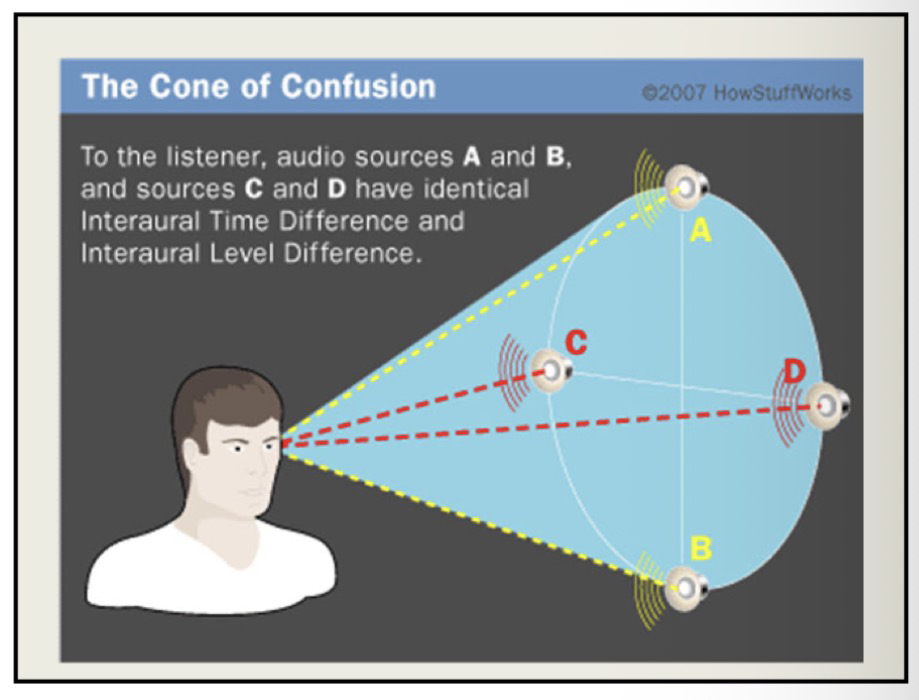
ITD only works for sound below about 1500-1600 hz (depending on size of head) - phase info gets ambiguous if more than one cycle occurs within the time it takes to travel between two ears
Jeffrey’s Neural Coincidence Model: how neuron’s might code for ITD
sound directly ahead - hits ears at the same time
from closer to left ear -different time
Azimuth - IID - good for high frequencies
low frequencies can wrap around the head
high frequencies will hit the head and create sound shadow
sound localization experiment:
two blocks, each w 7 diff frequencies
interaural time difference block
tone onset slightly earlier in one ear than the other
interaural intensity difference block
tone slightly louder in one ear than the other
ITD- basically fit ideal pattern - good localization for low frequencies but not for high
good localization for all frequencies for IID
in the real world IID is caused by sound shadow from head
sound shadow only exists for higher frequencies (low wrap around head)
here we used headphones and IID was programmed into stimulus regardless of frequency, so it always existed and head couldn’t shadow
sound localization in elevation: acoustic cues to sound elevation
pinna shape alters which frequencies get transferred effectively depending on how they hit the folds
funnels duplicate front back symmetry of pinna
spectral cues - the spectrum of the frequencies get modulated by the folds
head related transfer function (HRTS) - pinna and head effect the intensities of different frequencies as a function of elevation
sound localization - distance:
monaural - need one ear - changes in stimulus quality
cues to distance:
loudness - if familiar sound
frequency - high frequencies fade faster as sound travels through air
movement parallax
reflection - higher % of reflected sound for far sounds
auditory pathway:
auditory nerves terminate on cochlear nucleus (in brain stem)
cochlear nucleus
dorsal cochlear nucleus - frequency (what)
ventral cochlear nucleus - sound localization (where)
dorsal/ventral is opposite of vision
from cochlear nucleus → superior olive
superior olive
binaural inputs - sound localization (mostly IIT with some ITD)
from superior olive → inferior colliculus
inferior colliculus
sound localization (ITD)
startle response
then medial geniculate of thalamus → primary auditory cortex
primary auditory cortex (A1)
has tonotopic organization
cortical magnification around speech frequencies
secondary auditory cortex
important role in localization and analysis of complex sounds (speech, object recognition)
tinnitus - phantom perception of ringing in the ears
development : usually begins w hearing loss caused by hair cell damage, cortical input reduced for those frequencies
brain compensates for lack of input by increasing sensitivity
if compensation overshoots, can produce spontaneous activity that is interpreted as sound
activity often occurs in thalamus and primary auditory cortex
created long term changes/strengthening in pathways
auditory thalamus to A1 connections strengthen and have spontaneous finding
strengthens connections between auditory cortex and limbic system (including amygdala)
types of tinnitus
subjective tinnitus - majority of cases - brain firing in absence of sound (steady tone)
rarely - objective tinnitus - if you place a mic in persons ear can hear the sound
vascular issues - turbulent blood flow near the ear causes sound
rhythmic synchronized w heart beat
muscular - involuntary contractions of middle ear muscles
clicking noises
treatment for tinnitus
CBT - doesn’t reduce noise but helps make it less distressing
hearing aids - particularly those w hearing loss and restores audio input, so cuts down on gain due to lack of input
important role of hearing in language - use to communicate w others, communicate w selves
hearing language:
speech frequencies vary from 200 Hz to 8,000 Hz
consonants convey most of the information
most of the energy in spoken language is vowels
consonants alone are just pops and ticks, only make sense when paired with a vowel
conclusions:
poor signal to noise ratio
perceptual units of speech are larger than single letter-phonemes
evidence for feature/phoneme detectors in language
create an ambiguous stimulus
heard as “time” or “dime”
adapt a person to “di” sound - they will hear “time”