AP PSYCHOLOGY UNIT 4
sensation: A process in which our sensory receptors and nervous system receive and represent stimulus energy (bottom-up processing)
bottom-up processing: begins with sense receptors and works up to the brain’s integration of sensory information
top-down processing: information guided by higher-level mental processes, construct perceptions drawing on our experience and expectations
absolute threshold: minimum stimulation needed to detect a particular stimulus 50% of the time
difference threshold: minimum difference between two stimuli required for detection 50% of the time (JND)
signal detection theory:
predicts how and when we detect the presence of a faint stimulus amid background stimulation
assumes there is no single absolute threshold
→ experience, expectations, motivation, level of fatigue
subliminal: when stimuli are below the absolute threshold for conscious awareness (still receiving stimuli)
Weber’s law: to perceive that two different stimuli differ by a constant minimum percentage
1. light intensity 8%
2. weight 2%
3. tone frequency 0.3% (hearing)
sensory adaptation: diminished sensitivity as a consequence of continuous stimulation.
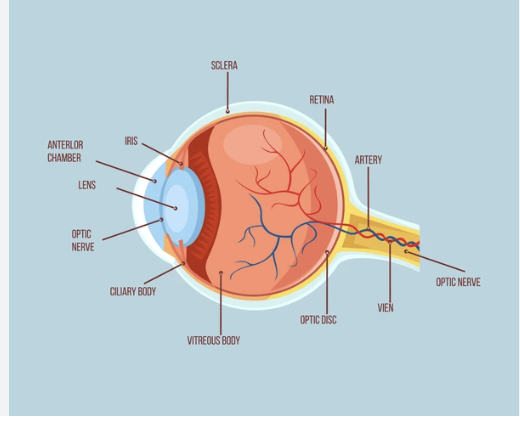
transduction: conversion of energy of one form to another; transforming stimulus energy into neural impulses
wavelength: the distance from the peak of one wave to the peak of the next
iris: eye colour/muscle is key
Lens: controls the amount of sunlight that hits the eye
accommodation: the process by which the eye lens changes shape (leads to near-sightedness, farsightedness, or closer to normal vision)
acuity: sharpness of vision
farsighted: far objects are seen more clearly; behind the retina
nearsided: close objects are seen more clearly; the front of the retina
retina:
1. rods: peripheral retina, detect black, white, and gray; twilight and low light
2. cones: near the center of the retina, fine detail, color vision, daylight or well-lit conditions.
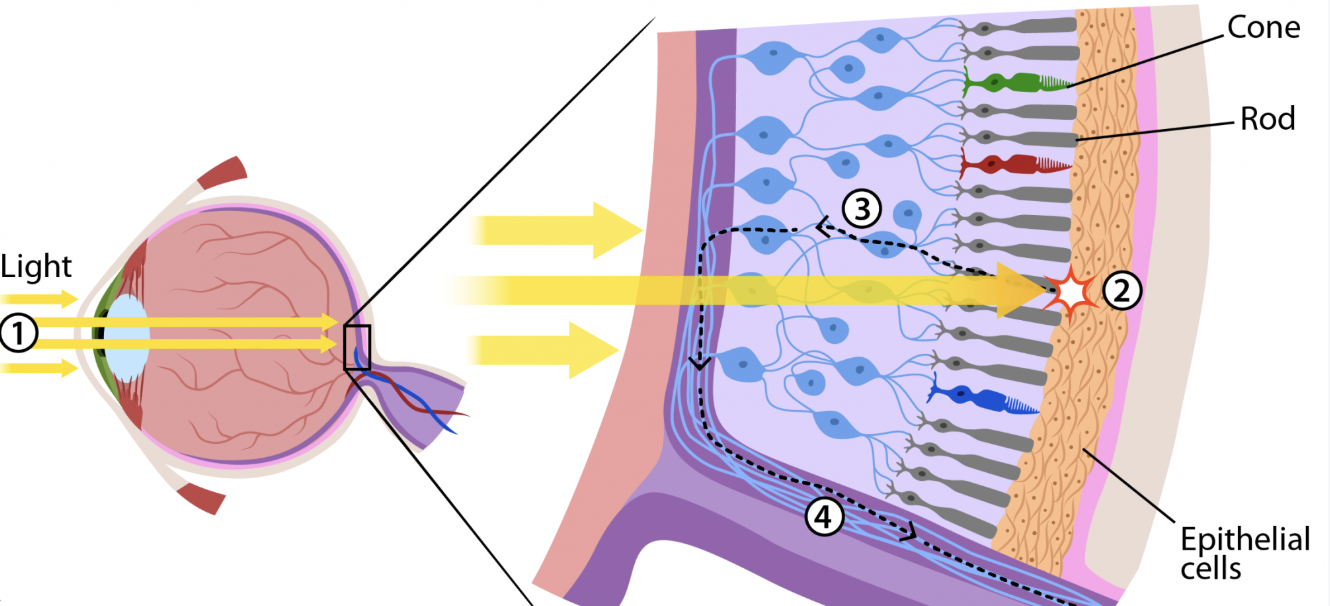
Light enters the eye, triggers photochemical reactions → 2. chemical reaction in turn activates bipolar cells → 3. bipolar cells activate ganglion cells, the axons converge to form the optic nerve, which transmits information. To the visual cortex in the brain’s occipital lobe.
Cones: | center of retina | low sensitivity in dim light |
Rods: | periphery of retina | high sensitivity in dim light |
1879 Thomas Edison invented the lightbulb → increase in cones
blind spot: no receptor cells
optic nerve: TRANSDUCTION
fovea: central point in the retina
transduction: conversion of one form of energy to another
1. ^ thalamus
2. occipital lobe
3. Feature detectors: nerve cells in the brain that respond to specific features. (shape, angles, and movements)
4. parallel processing: simultaneous processing of several aspects of a problem.
5. Abstraction: Brain’s higher-level cells respond to combined information from feature detector cells
vision:
|
trichromatic theory: Young and Helmholtz (three different retinal receptors).
Opponent-process theory: opposing retinal processes enable color vision.
trichromatic → opponent process → after image.
color constancy: perceiving familiar objects as having consistent color, even if changing illumination alters the wavelengths reflected by the object.
Audition:
frequency
pitch: tone’s highness or lowness, depending on frequency.
85 decibels; prolonged exposure to this level or higher will lead to hearing loss.
hearing (audition)
outer ear | middle ear | inner ear |
|
|
|
place theory: theory that links the pitch we hear with the place where the cochlear membrane is stimulated
The frequency theory: the rate of nerve impulses traveling up the auditory nerve matches the frequency of a tone, thus enabling us to sense its pitch.
Hearing loss:
1. equipment
touch/skin sensations:
pressure (only skin sensation with identifiable receptors)
warmth
cold
pain (gate control theory (psychological)) → the theory that the spinal cord contains a neurological “gate” that blocks pain signals or allows them to pass on to the brain
Taste sensations:
sweet
sour
salty
bitter
umami (meaty, tangible)
sensory interaction:
smell of food → influences taste
smell:
1. nasal passage → receptor cells →
2. → olfactory nerve →
3. → olfactory bulb
body position/movement:
kinethesis: sensing the position and movement of individual body parts
vestibular sense: the sense of body movement and position (including the sense of balance)
perception: a process in organizing and interpreting sensory information, enabling us to recognize objects and events (top-down processing)
selective attention: focus of conscious awareness on a particular stimulus
^ change blindness (lack of selective attention)
visual capture: tendency for vision to dominate other senses
gestalt: tendency to integrate pieces of information into meaningful wholes
Grouping: perceptual tendency to organize stimuli into coherent groups:
← Principles:
proximity: nearby figures together
similarity: groups figures that are similar
continuity: perceive continuous patterns
closure: fill in gaps
connectedness: spots, lines, and areas are seen as a unit when connected
figure and (back) ground: organization of the visual field into objects (figures) that stand out from their surroundings
Depth perception: how human beings perceive depth
1. binocular cues:
(a) retinal disparity
Images from the two eyes differ
closer to the object, the larger the disparity
(b) convergence
The two eyes move inward for a near object
2. monocular cues
relative size: the smaller image is more distant
interposition: a closer object blocks the distant object
relative clarity: hazy object seen as more distant
texture: coarse → close | fine → distant
relative brightness: closer objects appear higher
linear perspective: parallel lines converge with distance
Relative height: higher objects are seen as more distant
relative motion: closer objects seem to move faster
——————————————————————————————————————-
Perceptual constancy: perceiving objects as unchanging even as illumination and retinal image change (color, shape, size)
Perceptual adaptation: the ability to adjust to an artificially displaced visual field
Perceptual set (developed based on our environment/exposure): a mental predisposition to perceive one thing and not another.
ex: bus oil story
Human Factors Psychology: explores how people and machines interact, and explores how machines and physical environments can be adapted to human behaviors.
Extra-sensory perception: a controversial claim that our perception can occur apart from sensory input
parapsychology: the study of paranormal phenomena
ESP
Psychokinesis