Entropy
Entropy is a measure of disorder or randomness in a system.
solid = lower entropy
gas = higher entropy
Exothermic reaction gives out energy, while endothermic reactions absorbs energy
Exothermic reaction happens when things go from high energy to lower energy
In contrast, endothermic reactions require an input of energy, leading to a decrease in entropy as the system absorbs energy and becomes more ordered.
An increase in no. of moles = a decrease in entropy.
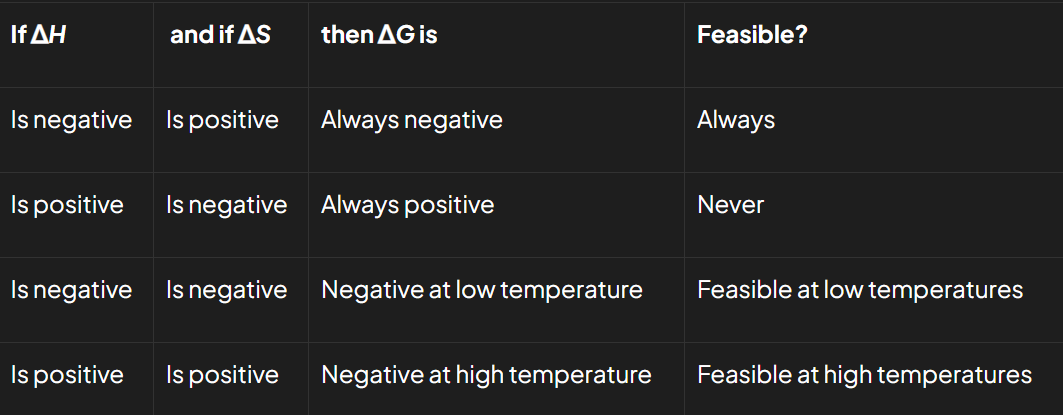
ΔG: The "final answer." If it's:
Negative (< 0), the reaction happens by itself (spontaneous).
Positive (> 0), the reaction doesn’t happen by itself (non-spontaneous).
ΔH: The "heat energy" (enthalpy).
If negative (< 0), heat is released (like a fire—exothermic).
If positive (> 0), heat is absorbed (like boiling water—endothermic).
ΔS: The "messiness factor" (entropy).
If positive (> 0), things get messier (more disorder, like ice melting into water).
If negative (< 0), things get more organised (less disorder, like water freezing into ice).
If the ΔSsystemꝋ is positive:
Both the first and second terms will be negative.
If the ΔSsystemꝋ is negative:
The first term is negative and the second term is positive