2.4 Circular motion in a horizontal plane
when an object experiences a net force of constant magnitude perpendicular (at an angle of 90 degrees) to its velocity, it will undergo uniform circular motion, including circular motion on a horizontal plane and around a banked track, and vertical circular motion
What is circular motion?
- the ball’s speed is constant
- yet, ball’s velocity is constantly changing
- not its magnitude, its direction = always tangenital to the ball’s path
- AKA the ball will carry on in the direction which it was moving when you let go
Centripetal acceleration
- any change in velocity, even if it doesn’t affect an object’s speed = acceleration
- objects in circular motion are experincing acceleration towards the centre = centripetal (‘centre-seeking’)
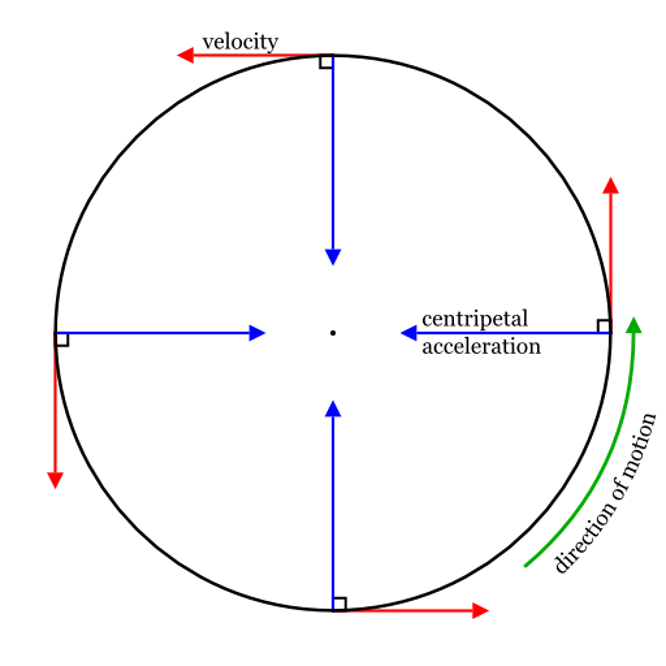
Centripetal force
- centripetal acceleration, according to Newton’s 2nd law must be caused by an unbalanced force that constantly pulls the object towards the centre of the circle: a centripetal force
- can be provided by a number of different forces: tension, gravity, friction and others
Centrifugal force
- if you are rotating (on a ride, or car making sharp turn) you will experience what seems to be an outward force (e.g. pushing you into your harness or the door of the car)
- ‘centre-fleeing’ force and it is a fictitious force (only seems to exist in your frame of reference)
- from the outside, this may be due to inertia (objects ‘want’ to continue in a straight line - direction of tangential velocity)
- experience the centripetal force applied to them in the same way that an object in an elevator experiences apparent weight