External Influences on Business
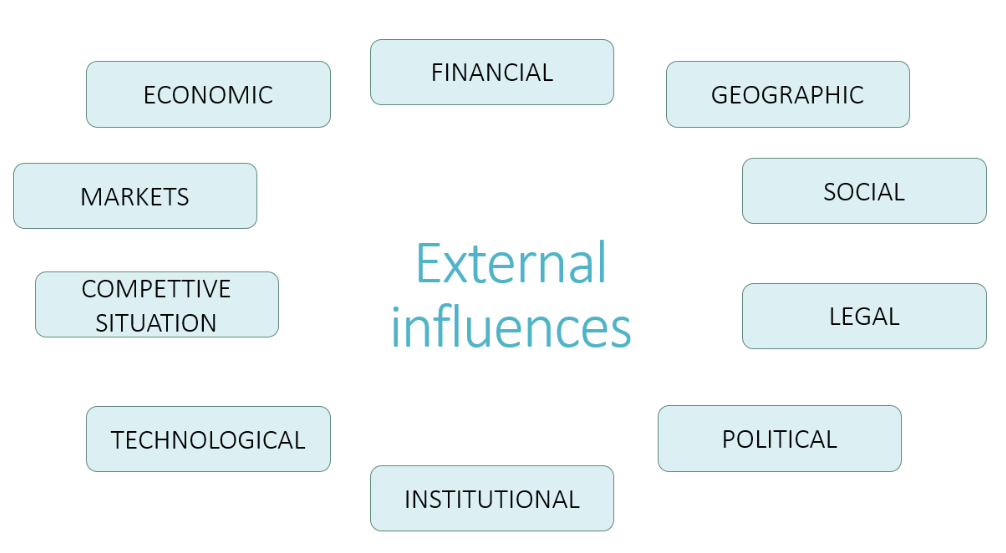
Economic Influence:
A business experiences the economic influence through economics cycles of ‘booms’ and ‘busts’ (the business cycle).
Boom:
higher levels of employment
inflation may increase
wages increase
level of spending by consumers increases
Bust:
unemployment levels rise
inflation may remain stable or fall
wages are less likely to rise
the level of consumer spending often decreases
Financial Influences:
Deregulation; the removal of governement regulation from industry, with the aim to increase competition, improve effciency, innovation.
Australia began the deregulation of its financial system in the 1980s with changes stil occuring today. These changes allow the financial industry to open up to greatre competition.
Globalisation of the world’s financial markets has allow for many large Australian business to use international financial institutions for the raising of finances.
Geographical Influences:
Globalisation has changed the number of products that Australia both buys and sells on the world market as we are no longer limited by national borders.
The two major factors that impact business activity are:
Australia’s geographic location within the Asia-Pacific region
The economic growth in the number of Asian nations, like China
Demography; the study of particular features of the population, including size, age, gender, income, cultural background, and family size.
Changes in these factors (above) leads to major changes in demand levels and the nature of products and services.
Globalisation has resulted in:
Expanded markets
Increased customer expectations
Economies of sacle
Location Flexibility
Cheaper Materials
Diversification
Access to better labour
Social Influences:
This refers to changes in tastes, fashions, and culture which can lead sales, profit, and business growth opportunities. If business fail to respond to these changes it can threaten their stability, sales, profits, and viability.
Three social issues leading to significant change are:
Environmental awareness e.g. donating leftover food to shelters
Work-life balance e.g. WFH, 4-day working week
Workplace diversity e.g. resouce groups, disability programs, inclusive training
Legal Influences:
The level of government regulation is often a controversial issue for business. Currently, small to medium businesses (SMEs) face regulation similar to large businesses. Compliance with these regulation is costly, time-consuming, confusing, and contradictory.
Legislation has been introduced to help cover taxation, industrial relations (what happens in the workplace), work health and safety, equal employment opportunity, anti-discrimination, and protection of the environment.
Competition and Consumer Act 2010 (Cwth) applies to all businesses in Australia and is administered by the Australian Competition and Consumer Comission (ACCC/ the Consumer Watchdog)
Political Influences:
There is an element of politics in most major issues that affect the business environment.
Example: Free Trade
The introduction of free trade removed tarriffs and trade barriers on businesses that were exporting or importing. It also opened up key markets internationally, particularly in Asia.
Overall, it lead to easier export, lower import costs, and stimulates investment.
Institutional Influences:
There are 3 main institutional influences on a business including governemnt, regulatory bodies, and other (i.e. trade unions and employer associations).
Government:
Federal
payment of taxes for employees and businesses with company tax and GST
provision of employee super (retirement fund)
observance of customs regulation
abididng by relevant legislation that would affect business operations
State
provision of employee entitlements (WHS, awards of pay, etc.)
payment of payroll taxes
abiding by relevant state legislation and pollution controls
Local
approving new development and alteration applications
fire and parking regulations
size, location, and shape of business signs.
Regulatory:
NSW Environment Protection Authority (EPA)→ aims to improve environmental performance and waste management for NSW through programs and intiatives. They are governed by the Protection of the Environment Administration Act 1991.
NSW Fair Trading → provide information and assistance to all consumers and business owners on fair and ethical practices.
Australian Securities and Investments Commision (ASIC, Federal)→ monitors market integrity and provides consumer protection in a range of areas and operates the Business Names Registrar.
Australian Competition and Consumer Commission (ACCC, Federal)→ an independant statutory authority that administers the Competition and Consumer act. 2010.
Other:
Employer Associations→ represent the interest of employees and assists in forming policies in line with union activities, negotiating enterprise on behalf of employer, and more.
Trade and industry associations→ national bodies that represent larger gorups of employers (e.g., Australian Chamber of Commerce and Industry, National Farmers Federation, Australian Industry group)
Trade Unions → main aim is to improve wokring conditions and pay rates.
Australian Securities Exchange (ASX)→ operates the share market where companies can raise funds by issuing shares.
Technological Influences:
The innovation of global technologies has increased vastly, which has revolutionised the workplace allowing business to increase efficiency and productivity, create new products, and improve the quality and range of goods and services.
If a business is slow to exploit these technologies then they are likely to fail as they will struggle to keep up with competitors who will gian a greater market share.
Technology has allowed for:
flexible working arrangements
easier and more efficient communicaton and production
Competitive Situation Influences:
Both businesses and consumers benefit from increased competition in the folloing ways:
Businesses:
greater effciency in production
better quality goods and service
cheaper production cost
Consumers:
broader choice of goods and services
range of quality
variety of prices
To be able to capture a larger portion of the market (market share), businesses aim to achieve a sustainble competitive advantage over competitiors. This refers to the ability of a business to develop strategies that will give an ‘edge’ for a sustained period of time.
There are 4 markets that a business could be in:
Monopoly |
| AusPost Sydney Trains |
Oligopoly |
| Banks Oil Companies Car Manufacturers |
Monopolisitc Competition |
| clothing manufacturing local retailing |
Perfect Competition:
large number of small businesses that are the same or similar
little advertising is used to increase market share which is instead achieved through price competiiton
Changes in Markets:
There are 3 changes in markets:
Financial/Capital Markets:
more mobile and flows relatively easily between countries.
The work capital market is very intergrated due to its rapid expansion after the 1970s ( when foreign echange trading controls were phased out)
capital flows to countries where investment opportunities and returns are favourable
Labour Markets:
not been ‘freed up’ as much as other markets due to political barriers
the two main trends are: the movement of a large number of temporary skilled workers across AUS, EU, ASIA and the growing demand for highly trained employees leading to increasing moblility.
Consumer Markets:
growth in the amount and value of world trade
countries now specialise in products that they can produce effciently leading to cheaper prices, increased sales in existing markets, and new consumer markets emerging in developing countries.
improved technologies and communications (e.g., online shopping)