Mesopotamia
- World’s first civilizations formed around the Middle East
- The Fertile Crescent:
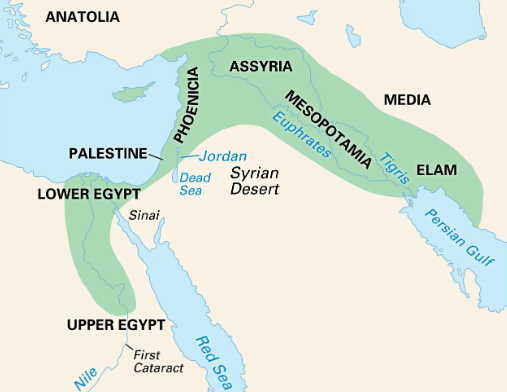
- Area where the Tigris and the Euphrates river flow
- Egypt to Iraq, curving through Turkey, Syria, Lebanon, and Jordan
- Physical features:
- Irrigates of farmland from rivers
- Rivers provided a means of transportation
- Warm climate was good for agriculture
- Deserts and mountains provided isolation from attacks
- Sumer: world’s first true civilization
- Developed in south eastern Mesopotamia - Iraq and Kuwait
- Developed early irrigation methods - dikes and canals
- Characteristics of Sumerian Society
- Used mud bricks to build structures
- Each city was a city state, meaning it was self-governed
- Rulers were responsible for protecting citizens and maintenance
- People paid taxes to fund public work projects
- Polytheistic religion - each city built a temple pyramid - ziggurat
- Hierarchical: organized in different groups of social classes
- Top: rulers and priests
- Middle: merchants and artisans
- Low: farmers and slaves
- Women had more freedoms, but not the same legal rights
- Development of cuneiform: world’s first true writing system
- Developed in 3200 BC
- Recorded trades, wrote stories, laws
- Early Empires of Mesopotamia:
- Akkadia
- conquered the city-states of SUmer, the world’s first empire, short lived
- Babylon
- Led by Hammurabi
- Hammurabi’s code: first example of written legal code
- Led by Hammurabi
- Hitties
- Worked with iron
- Had horse drawn chariots
- Defeated Babylon
- Assyrians
- Had the world’s first library
- Used the same tech as the Hitties (iron, chariots)
- Revival of Babylon
- Chaldeans conquered Assyria
- Persian Empire revolted against Medes and established another empire
- Cyrus the Great: defended with cavalry and warriors (known as the Immortals)
- Fair and just ruler. When he conquered Babylon he freed the Jews
- Darius: reorganized the empire. Instated Zoroastrianism. Fair ruler
- Cyrus the Great: defended with cavalry and warriors (known as the Immortals)