Phylum Arthropoda
Subkingdom Metazoa
Phylum Arthropoda (“Arthro” = Joint & “poda” = foot)
-Most diverse animal group in abundance and distribution.
-80% of all known animal species.
-live in all environments and are tolerable to environmental extremes
-rich fossil history dating to the late Precambrian.
-Eucoelomate protostomes with well-developed organ systems
-Posses distinct segments (tagmata): Head, Thorax & Abdomen
Exoskeleton
• tagmata are fused external segments that form functional units
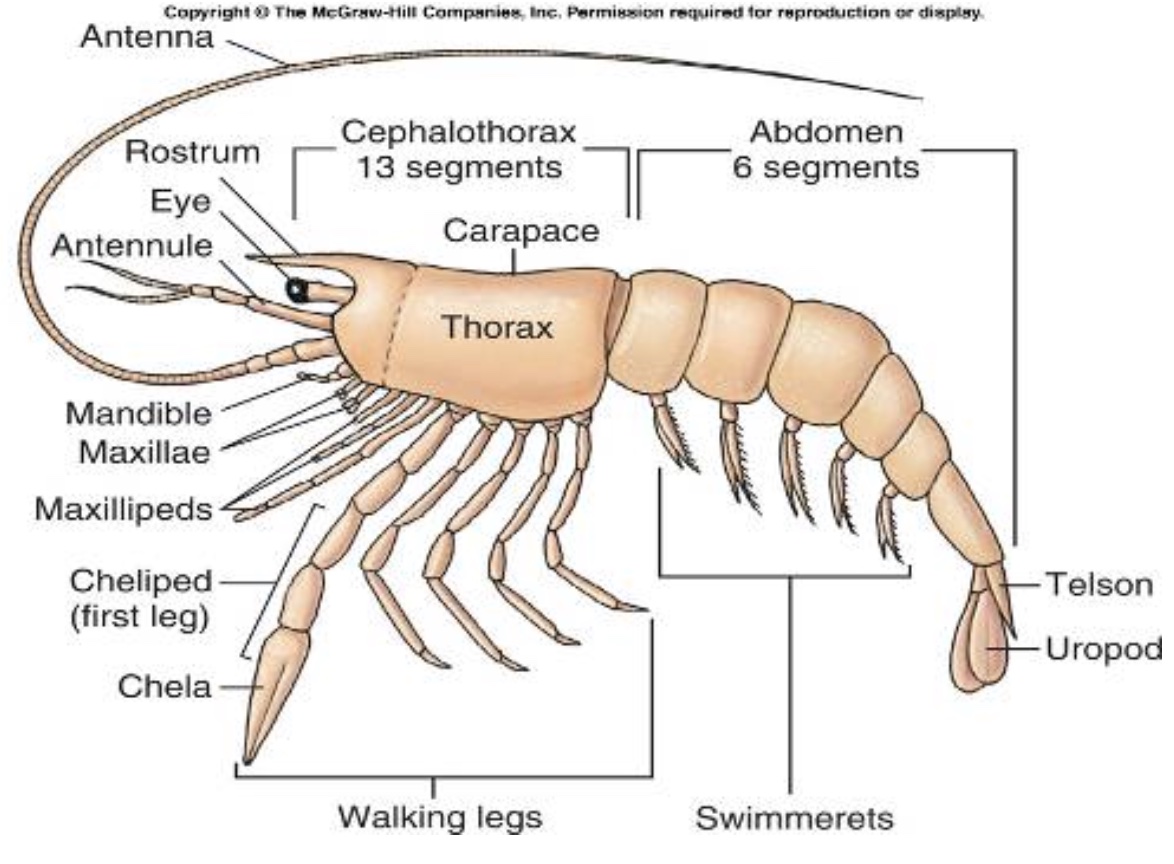
• many with dorsal covering, called carapace that may cover most of the body or just the cephalothorax
• Appendages often highly specialized for division of labor
• Sizes from crab (4+ meter leg span) to mites (0.1 mm long)
• Some are disease causing & consumers of agriculture, others
are pollinators, economically important & human food sources
• All modes of feeding occur; most are carnivorous or herbivorous
Exoskeleton - Cuticle
Functions
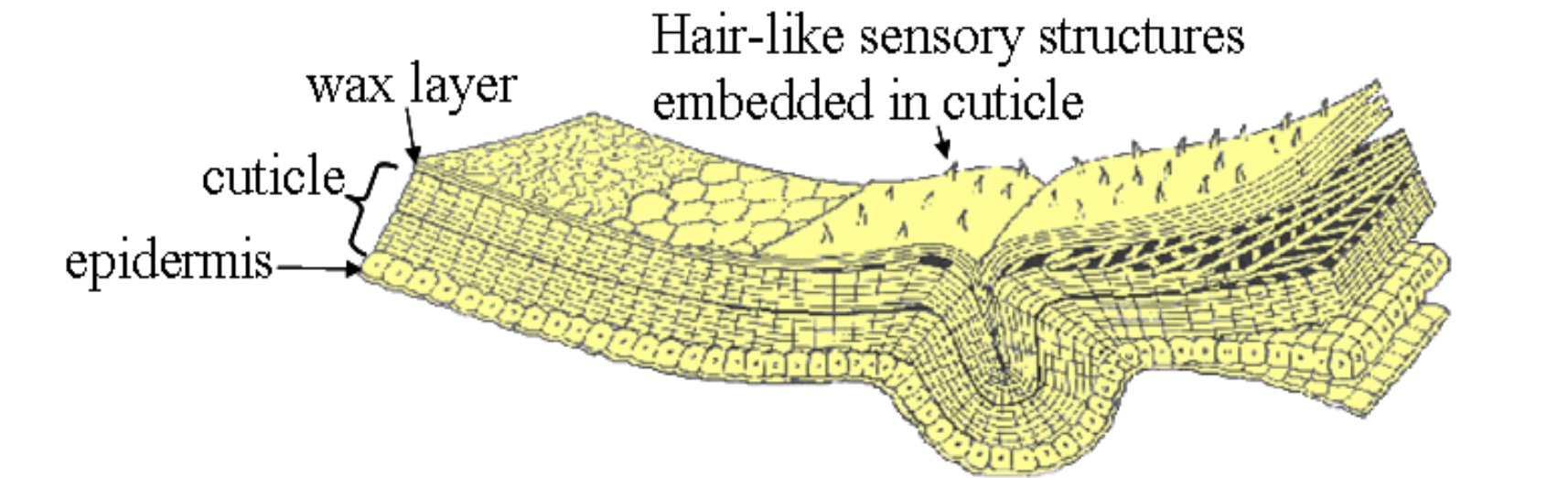
protective armor, but jointed allowing flexibility & mobility • composed of polysaccharide based chitin infused with proteins • addition of calcium salts in lobster & crab increases strength • cuticle folds inward, lining foregut, hindgut & trachea
body support analogous to vertebrate bones
muscle attachment analogous to vertebrate bones
prevents dessication, but also restricts gas exchange via diffusion • outermost layer laminated with waxy lipid • Limits size due to weight of exoskeleton vs. weight legs can support • terrestrial forms more size limited than aquatics due to buoyancy 1. hence, largest arthropods are lobsters & crabs
Exoskeleton – Molting in Crustaceans & Insects
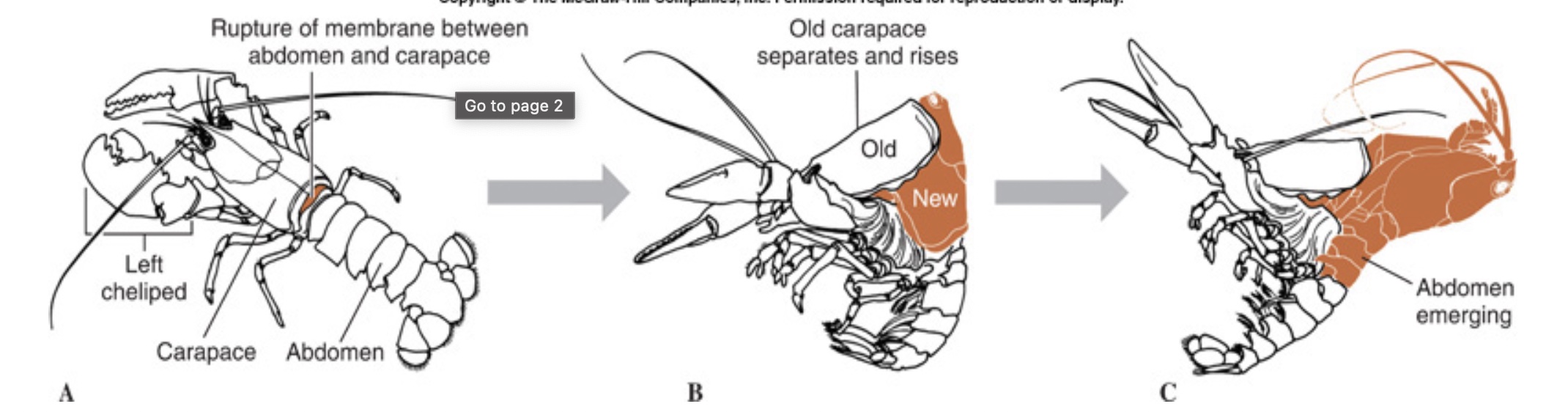
Ecdysis is process of shedding outer covering & growing a new, larger one to accommodate growth or replace damaged cuticle
typically molt 4 to 7 times during lifespan
in many, molting only occurs prior to adulthood
for some, can be seasonal; stimulated by temperature or photoperiod (daylength)
often vulnerable while new exoskeleton is forming & hardening 3. may not be able to support body until exoskeleton hardens
controlled by hormone, Ecdysone, that stimulates underlying epidermal cells to secrete chitin/protein matrix
Tagmata and Appendages for Efficient Locomotion
Often, paired jointed appendages on each segment (i.e., crayfish, centipedes,...) • some without appendages on abdominal segments (i.e., insects)
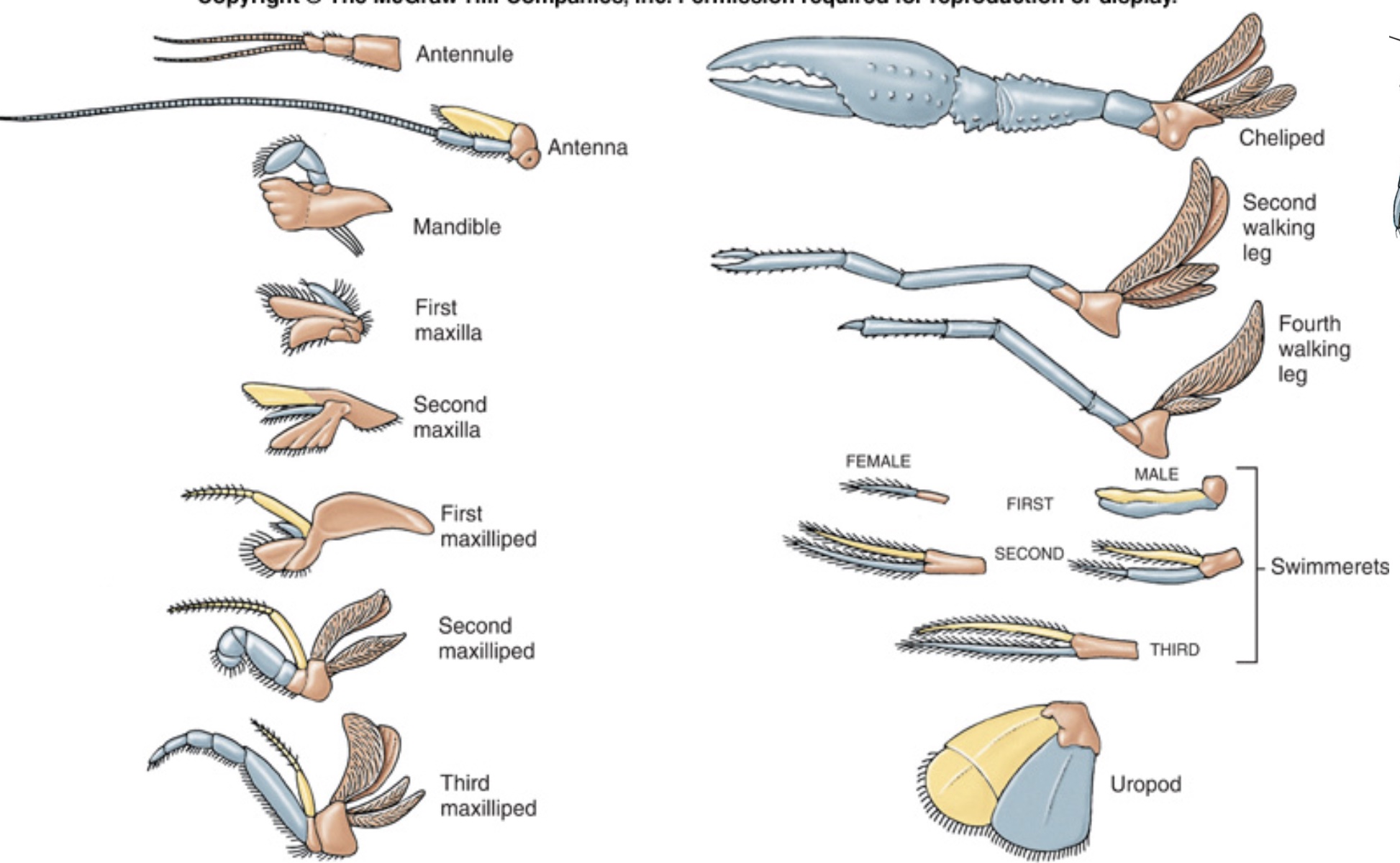
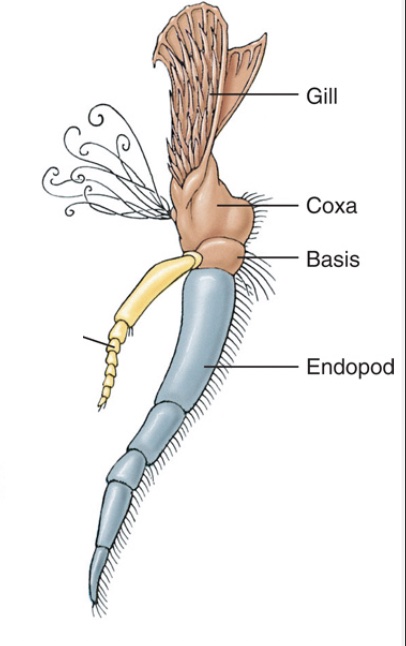
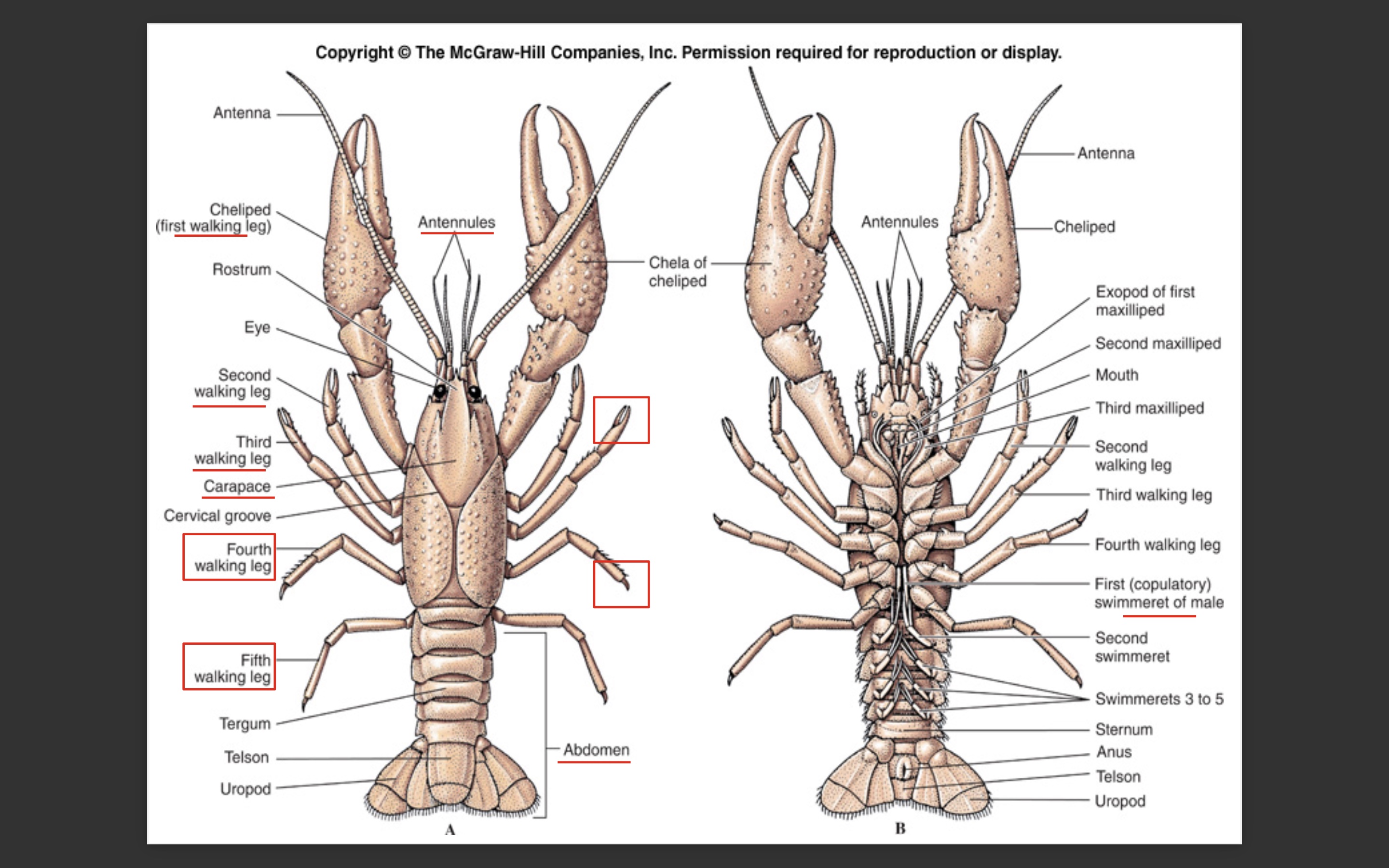
Serial Homology (recall homologous vs. analogous) • all segments & appendages ancestrally were very similar, but over time some became reduced, enlarged, lost, gained or otherwise modified variations of basic ancestral biramous plan & specialized for various functions: sensory, food handling or means of locomotion (walking, swimming, flying) • in some appendages, biramous condition secondarily lost resulting in uniramous appearance (i.e., crayfish 4th & 5th walking legs)
Crayfish posses most elaborate serial homology with 17 distinct serial homologous types of appendages
Crayfish appendages represent serial homology; they have evolved a variety of grasping, walking legs, mouthparts, swimmerets, etc. from the modified biramous appendage
Respiration
Highly efficient allowing high metabolism & levels of activity
1.terrestrial & semi-aquatic forms use a tracheal system & book lungs,
while aquatic forms use gills systems to deliver oxygen to tissues
Trilobita & Chelicerata
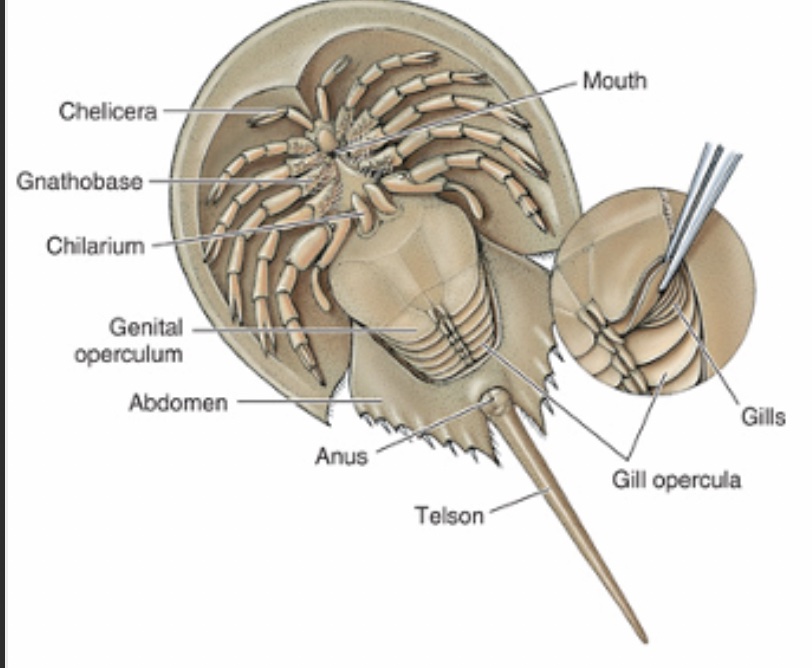
• Gills composed of broad, thin plates separated by membranes of “paper-like” material resembling a stack of hard-bound books, thus book lungs (also see spider internal anatomy figure)
Crustacea
• Smaller forms exchange gases across cuticle
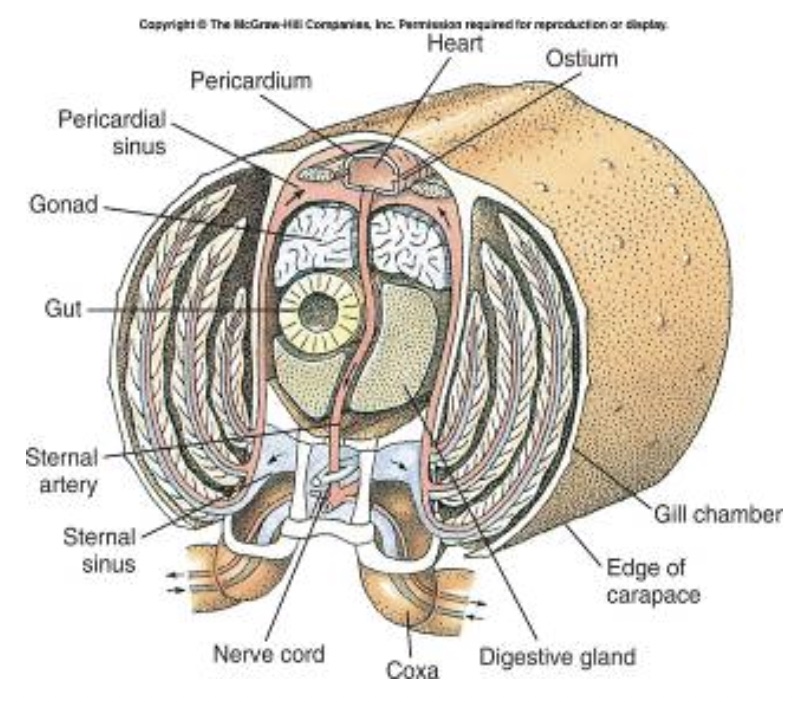
• Larger forms use featherlike internal gills
1. carapace covers gills, leaving only anterior & posterior openings
Insecta & Chelicerata
• Trachea are a network of tubes branching throughout body & open to the outside via spiracles with valves &/or filters on the body wall
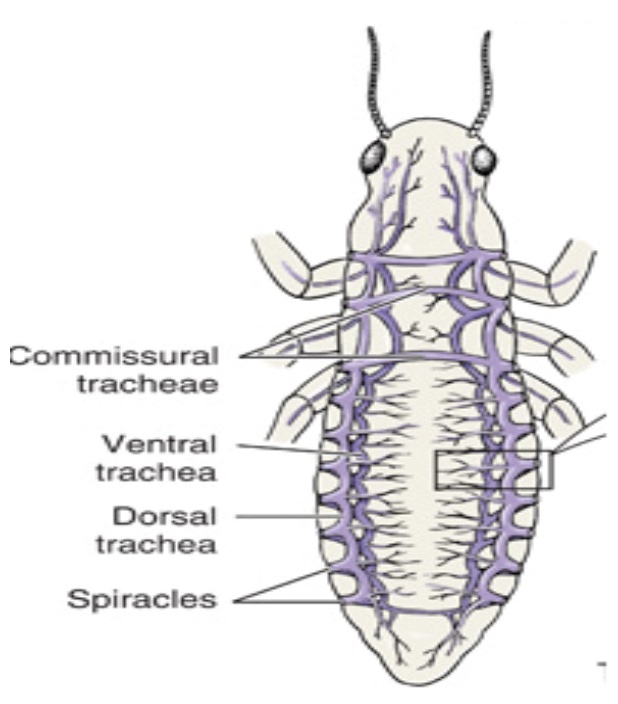
Tracheal system
Late Paleozoic: O2 levels were higher than today & fossil record shows beetles were larger then than today
• Tracheal system
• as beetle size increased, the tracheal tube diameter increase is disproportionately greater
• to a point, then bottle-neck constrictions of large diameter tracheal tubes caused pinching tubes during bending of leg joints limits insect size
• Figure:
• Y-axis: trachea tube density • X-axis: beetle body size
• black line: trachea densities in thorax among different sizes of beetles
• red line: trachea densities in legs among different sizes of beetles
• interpretation: greater trachea in body as body gets larger, but disproportionately greater increase in leg trachea as body gets larger
Data collected by powerful x-ray of insect showing tracheal tubes in body (right & top) • Right & bottom: leg x-ray enlargements with 1 as smallest beetle, 2 larger than 1, 3 larger than 2 & 4 is largest beetle • blue lines: outline of leg against body • yellow lines: outline of main trachea leg tube • as leg gets bigger, tube gets disproportionately larger • conclusion: at some point, body size limited by size of tracheal tube necessary to provide O2 to leg extremities
larger diameter tube subject to pinching at leg joints
larger tube reduces space for muscles, tissue,...
Leg data & current O2
levels used to predicted what should be size of largest extant beetle
Prediction correct as largest possibly size is same as largest known extant insect – Titan Beetle (Titaneus giganteus) from Amazon rainforest
Excretion & Water Balance
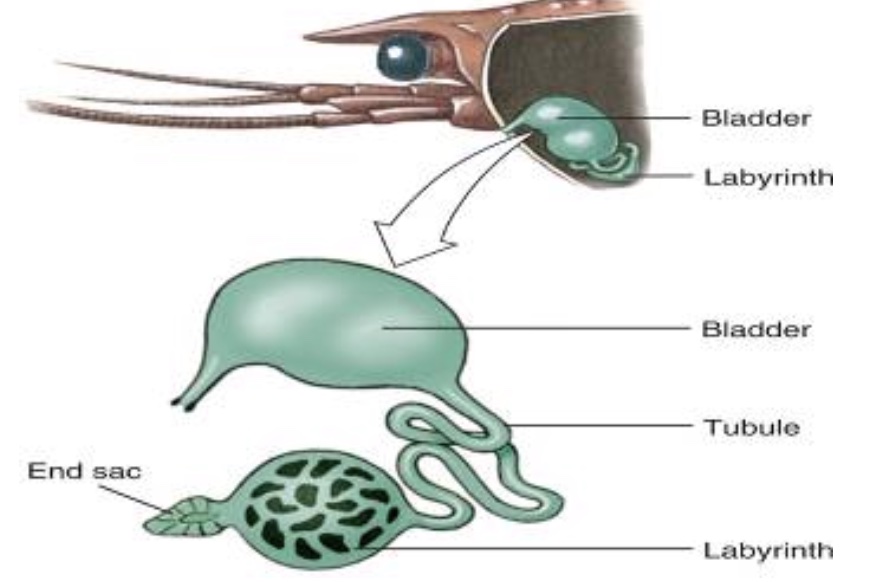
Crustacea • Removal of nitrogenous waste (mainly ammonia) by diffusion across thin areas of cuticle & gills • Water & solute (salt) balance mainly by paired excretory organs located ventral to the antennae base, thus commonly called antennal glands
hydostatic pressure in body cavity forces fluid into end sac & then to labyrinth where reabsorption can occur
fluid then travels to bladder that opens to environment
Arachnida & Insecta
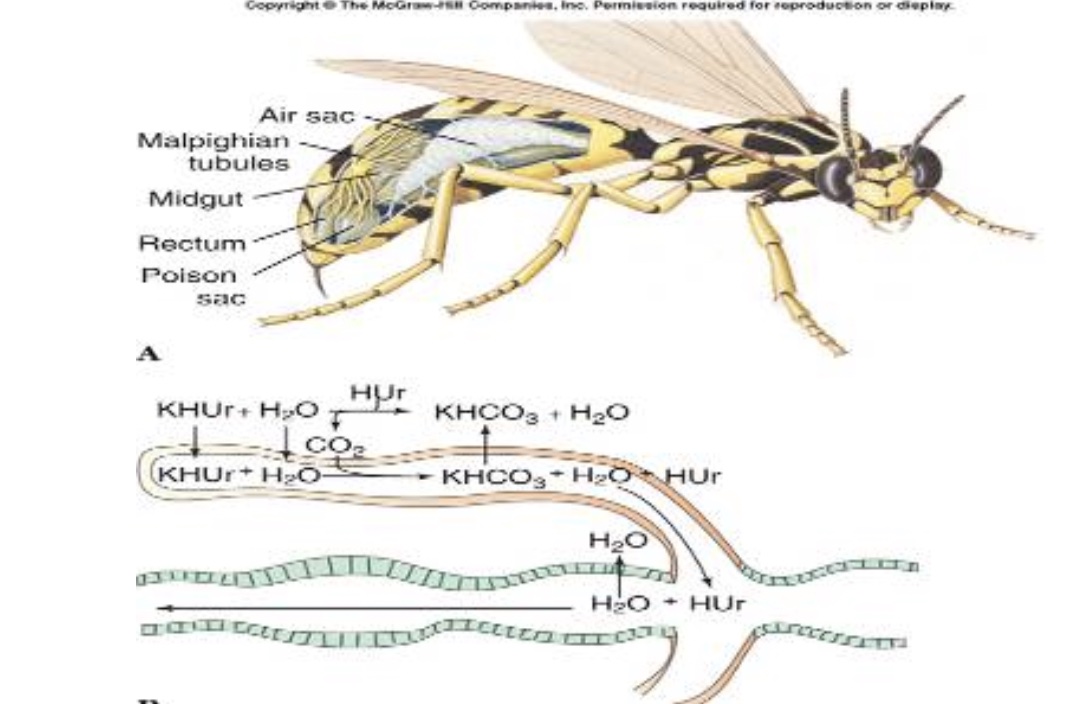
• Malphigian tubules are located at the juncture of midgut & hindgut
• One end of tubules lies in body cavity & the other end lies in the rectum
• Secretion of potassium ions into tubules pulls in nitrogenous waste (mainly uric acid) due to differences in pH & water due to differences in ion concentration
• Uric acid then binds with potassium (KHur) & is dumped into the gut
• Here, CO2 binds with potassium (KHCO3)
& is reabsorbed, leaving uric acid to be flushed to outside by remaining water
Circulatory System
Most Arthropods have an “open” circulatory system, were there is no system of veins to separate blood from interstitial fluid
• this contrasts with annelids & vertebrates, which have a “closed” system were blood is contained within veins & arteries
1.Blood leaves heart by arteries, but empties into tissue cavities & washes through the hemocoel to return to heart via cavities
• hemolymph (blood) may be bluish or reddish and hemocyanin and/or hemoglobin are the respiratory pigments on which blood cells carry oxygen
Highly Developed Sensory Organs
Sensory organs accomplish touch, smell, hearing, balance, vibration & chemical reception
• within arthropods, sensory at its highest in Class Insecta
1. Eyes vary from simple light sensitive ocelli to compound mosaic eyes that form images & consist of 1000’s of ommatidium (6300 in honeybees)
• allows 360o vision in some
• allows distinguishing 300 separate flashes of light simultaneously compared to 50 in human eye (advantageous during fast flight)
• color & ultraviolet light vision possible in pollinating species
• as communication, body posture is most common, although best known are fireflies (aka lightining bugs) that produce flashes of light to locate mates
Mechanoreception (pressure & vibration) • accomplished by setae (aka seta): external hairlike structures protruding from body wall, legs or on antennae & connected to nerve cells
Tactile Reception (touch)
also accomplished by setae
as communication, forms include tapping or rubbing with legs, bodies & antennae • Auditory Reception (hearing)
accomplished by tympanum (aka tympanic organ) & antennae
tympanum is constructed similarly to the vertebrate inner ear: membrane in body wall (like the head of a drum) enclosing an air space that vibrates when contacted by sound waves, & is connected to nerve cells
sound production as a means of communication occurs in some insects & sound is produced by rubbing wings or legs together
functions include: territory claims, courtship & warning
Chemoreception (taste, smell)
typically most keen sensory organ
nerve cells in pits on mouth parts or antennae
also detects others normally not considered to be tasted or smelled chemicals • used by mosquitoes to sense carbon dioxide exhaled by potential host & repellents (DEET) applied by human host
DEET blocks a mosquitoes ability to detect carbon dioxide and water vapor emitted in the breath of a potential host • chemical communication is accomplished by pheromones • “scout” ants can emit pheromones as a signal to others in the colony to the presence of food & then scout lays down a pheromone trail leading others to the resource • many insect pheromones have been identified & are used against pest species as bait for attraction to traps or to influence physiology & prevent reproduction or development
Subphylum Trilobita (Trilobites)
So named because: trilobed body shape due to a pair of longitudinal (anterior to posterior) grooves • Arose before Cambrian Period then became extinct 200 mya • Dorso-ventrally (top to bottom) flattened bottom dwelling aquatic scavenger • 2 to 70cm long and could roll up like pill bugs (rolly-polly) • Tagmata included: head, trunk and pygidium
head bore antennae, compound eyes and mouth
trunk bore 4 pair of jointed biramous (2 branched) legs • one branch with fringed filaments functioning as a gill system
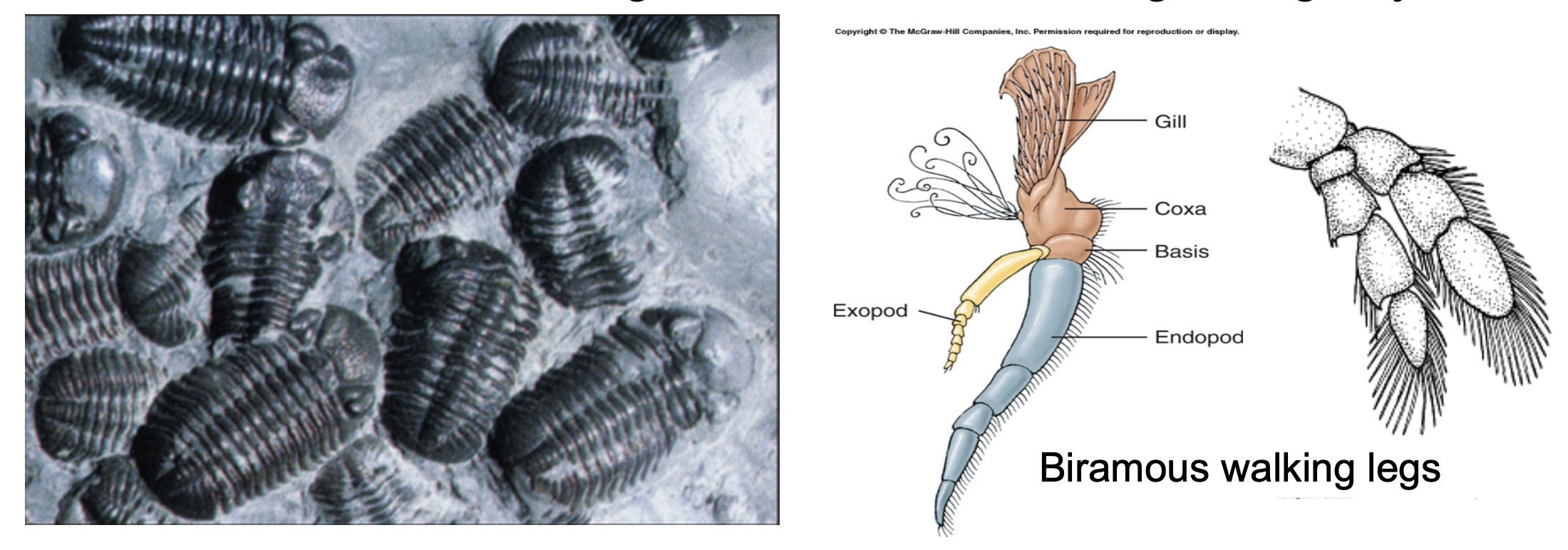
Subphylum Chelicerata (horseshoe crab, spiders, ticks, mites, scorpions)
6 pair of cephalothoracic (head & thorax combined) appendages 1. 1 pair chelicerae (mouthparts) 2. 1 pair pedipalps (tactile, grasping, sperm transfer) 3. 4 pair walking legs (compare to Insecta) • horseshoe crab lack pedipalps & posses 5 pair walking legs 1.Lack mandibles and antennae 2.Most suck liquid food from prey
Subphylum Chelicerata
Class Merostomata (horseshoe crab)
4 species that inhabit shallow water; feed on worms & molluscs 2. Common in salt-water aquarium trade
Unsegmented dorsal carapace covers body
2 pair eyes: 2 compound and 2 simple
Come to shore at a very high tide to mate • external fertilization: ♀s lay eggs in sand burrows and ♂s add sperm before ♀ covers eggs • Larvae, resemble trilobites, hatch and return to the sea
Subphylum Chelicerata Class Arachnida (spiders, ticks, mites, harvestmen, scorpions)
80,000+ species
2 tagmata: cephalothorax & abdomen
cephalothorax with pair of chelicerae (may function as fangs), pair of pedipalps & 4 pair walking legs (compare to Insecta)
Antenna & mandibles lacking
Many breathe by book lungs and/or tracheae • book lungs open to exterior of body through slits and internally are parallel air pockets extending into a blood-filled chamber
Many with malpighian tubules for an excretory system (see excretion)
Class Arachnida - Spiders
Sensory
• 4 pair simple eyes to detect movement and can form images in some species
• sensory setae (“hairs”) detect air currents and web vibrations
1. Reproduction
•♂s store sperm in pedipalps that are inserted into ♀ genitalia • ritualistic courtship required before ♀will allow mating
•♀s of some species consume ♂s after mating
• eggs may develop in a cocoon or be carried by♀
Most are predators with fangs and venom glands • fangs inject venom & digestive enzymes to liquefy prey, then sucking mouthparts ingest body fluids & liquefied inside of prey • Silk glands & spinnerets used to form webs, egg sacs & cocoon prey • Most spiders harmless to humans, few can cause pain or death • in Arkansas:
tarantulas rarely bite & bite is not dangerous, when frightened can prick with “hairs” causing itching
black widows are dangerous & posses neurotoxic venom effecting neurons & muscle control
brown recluse are dangerous & posses hemotoxic venom that destroys blood cells, vessels & clots blood reducing flow
Class Arachnida - Scorpions
• Viviparous &♀carries young on her back
• Some active predators, others ambush
predators sensing vibrations with setae
• Chelicerae small, pedipalps large and
pincer-like, 4 pair walking legs
• Most posterior segment of scorpion includes stinger
• venom varies from mildly painful to medically dangerous • in Arkansas only 1 species: Striped Bark Scorpion
• maximum of 10cm long
• found under ground debris or
on tree branches, fence posts,...
• neurotoxic venom low in toxicity to humans with no recorded deaths
• initial sharp pain & localized
swelling
• period of numbness & tingling
• period of nausea, dizziness, vomiting
• medical treatment should be sought as precaution to allergic reaction & because individual sensitivity varies
Class Arachnida - Harvestmen (aka daddy longlegs) • Cephalothorax and abdomen joined without any constriction, thus indistinguishable forming a round-bodied appearance • 1 pair eyes located on short stalks & 4 pair walking legs • can lose most of their legs without ill effect
Unlike spiders, all carnivorous scavengers
Lack venom (venom usually possessed by predators, not scavengers) and are harmless to humans, but can secrete a noxious chemical as defense
you may have heard that harvestmen are venomous, but their mouthparts are too small to bite a human – this is an old wise tale! 3. All oviparous
Class Arachnida - Ticks and Mites
• Mites are less than 1mm long and ticks less than 2 cm long • Complete fusion of cephalothorax and abdomen
with no sign of external segmentation
• Chelicerae project anteriorly from head
• 4 pair walking legs
• House dust mites are free-living and often cause allergies
• Chiggers are a larval stage ofTrombiculamites & feed on dermal tissues, causing a skin irritation
• Hair follicle mites are harmless to humans, but are the cause of mange in domestic animals
• Ticks carry Lyme disease & transmit Rocky Mountain spotted fever
Black-legged Tick
(aka deer tick)
• Pest of livestock & wildlife • Most common tick
• Vector of Lyme disease, caused by a spirochetal bacteriumBorrelia burgdorferi
Lone Star Tick
• Not a vector of Lyme Disease
• Bite can cause a red rash accompanied by fatigue, headache, fever, muscle & joint pain similar to Lyme Disease
Dog Tick
• Name Dog Tick is a misnomer as this tick feeds on a variety of mammals including humans
• Not a vector of Lyme Disease, although are vectors of other tick-borne diseases
Subphylum Crustacea Class Maxillopoda
Subclass Copepoda (copepods)
• Parasitic and free-living forms
1. free-living forms make up a large portion of zooplankton
• individuals are less than a few millimeters in length, but thebiomass in freshwater & marine habitats exceeds billions of tons • ecologically important, often dominating the lower consumer level of the food chain & provide an abundant food source for higher level consumers such as larval fish & filter-feeding whales
• Parasites of fish, aquatic invertebrates and serve as intermediate hosts for several human parasites such as tapeworms
• Posses 4 pair of swimming appendages,
large antennae used for swimming & lack
a carapace
• In many, development is indirect & includes metamorphoses
Subphylum Crustacea Class Malacostraca
Order Isopoda
(pill bug [aka sow bug, wood louse & roly-poly])
• Although in the common name, not a “bug” which is an Order under Class Insecta
• no insect should be referred to as a “bug” by a zoologically educated person unless the organism is in Order Heteroptera (True Bugs) under Class Insecta
• One of a few crustacean groups to be terrestrial, although some Isopoda species remain aquatic
• Respire via abdominal gills
• Roll into a ball as a defensive mechanism
• If terrestrial, thin cuticle restricts them to moist environments (under logs & rocks)
• Terrestrial forms herbivorous & some aquatic forms parasites of fish & other crustaceans
• Terrestrial forms with direct development, while aquatic & parasitic forms commonly undergo metamorphosis
Subphylum Crustacea Class Malacostraca
Order Euphausiacea (krill) • Only ≈90 marine species
Indirect development with metamorphosis
Ecologically very important, comprising a large % of oceanic zooplankton, which provides food for many others including baleen whales, some sharks & many fish species • can occur in enormous aggregates of millions of individuals covering 500 meters across
Subphylum Crustacea Class Malacostraca
Order Decapoda (Shrimp, crayfish, crab, lobster)
• Largest & most diverse class of Crustacea (20,000+ species)
• 5 pair walking legs
• 1st 3 pair of thoracic appendages modified into maxillipeds (mouthparts)• 1st pair walking legs forms pincers for grasping
• Crab with broad cephalothorax & reduced abdomen
• Ecologically & economically important as scavengers, cleaning aquatic environments & food for many other animals including humans
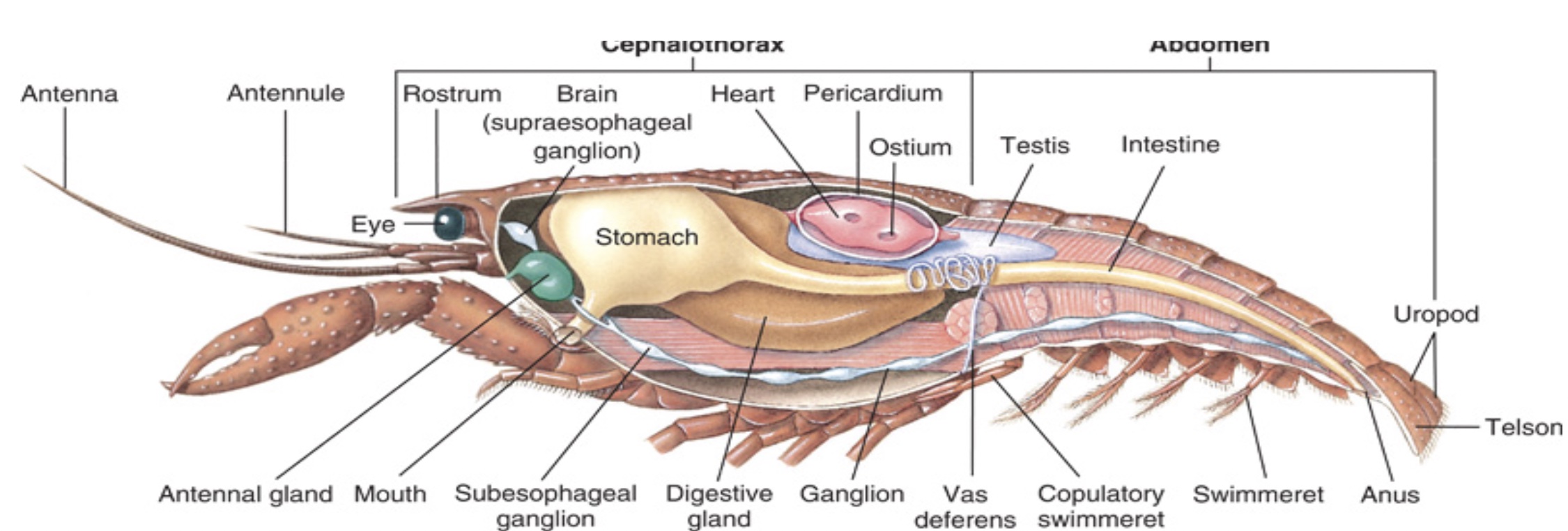
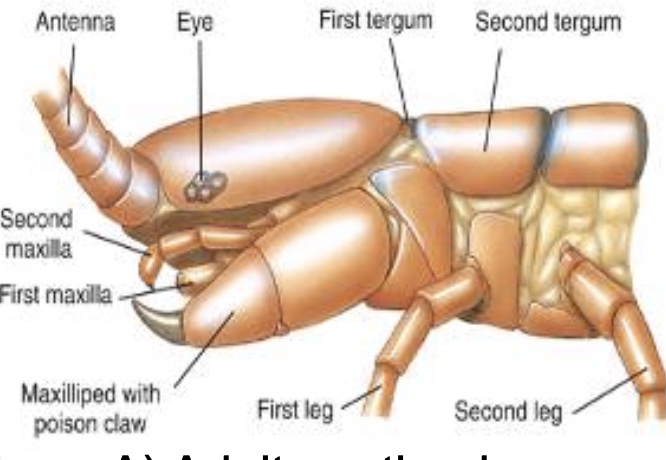
Subphylum Uniramia Class Chilopoda
(centipedes)
• Uniramia refers to adults in this group possessing uniramous appendages
• ≈3000 species
• All terrestrial & many tropical, but thin cuticle restricts to moist places (under logs & rocks) • Length from few centimeters to 30cm (12in)
• body segments from a few to 177, each with
pair of walking legs (compare to millipeds)
• Dorso-ventrally flattened (compare to millipeds) • Agile & fast carnivores of many invertebrates
• anterior most pair of appendages modified
into maxilliped with venom injector
• warning coloration (aka aposematic coloration) of bright reds & yellows common in venomous species
• Respire by tracheal system with a pair of spiracles in each segment (compare to millipeds)
• Dioceous; either oviparous or viviparous with direct development
Subphylum Uniramia Class Diplopoda (millipedes) • ≈10,000 species • All terrestrial & many tropical, although thin cuticle restricts to moist places (under logs & rocks) • Length from a few centimeters to 24cm (10in) • Body segments of 25 to 100+, each with 2 pair of walking legs (compare to centipeds) 1. Cylindrical shaped body (compare to centipeds) 2. Slow herbivores & detritovores
Non-venomous
As defense, will coil & secrete noxious repellent from repugnatorial glands
Respire by tracheal system with 2 pair of spiracles in each segment (compare to centipeds)
Dioceous & oviparous with direct development
Diplopodous Condition (doubling of walking legs & spiracles per segment compared to Class Chilopoda) may be a result of fusion of each adjacent segment pair
Subphylum Uniramia Class Insecta
(insects)
• Most diverse & abundant Class in Animalia (see figure)
1. cosmopolitan except pelagic areas of oceans & seas
• flight & small size allows wide distribution
• wide variety of structural & behavioral adaptations gains them access to all possible niches
• specialization for eating only one part of a host plant
allows multiple insect species to coexist on a single plant • Estimated 1.1 million species, but may be millions yet unclassified • Of major medical, economic & ecological roles
• many are endo or ectoparasites
• 3 pair legs (compare to Arachnida) & often two pair of thoracic wings • Range in size from <1mm to 20cm (8 in.) in length
• largest species occur in tropical regions
• Hard, protective exoskeleton & eggs adapted to harsh environments
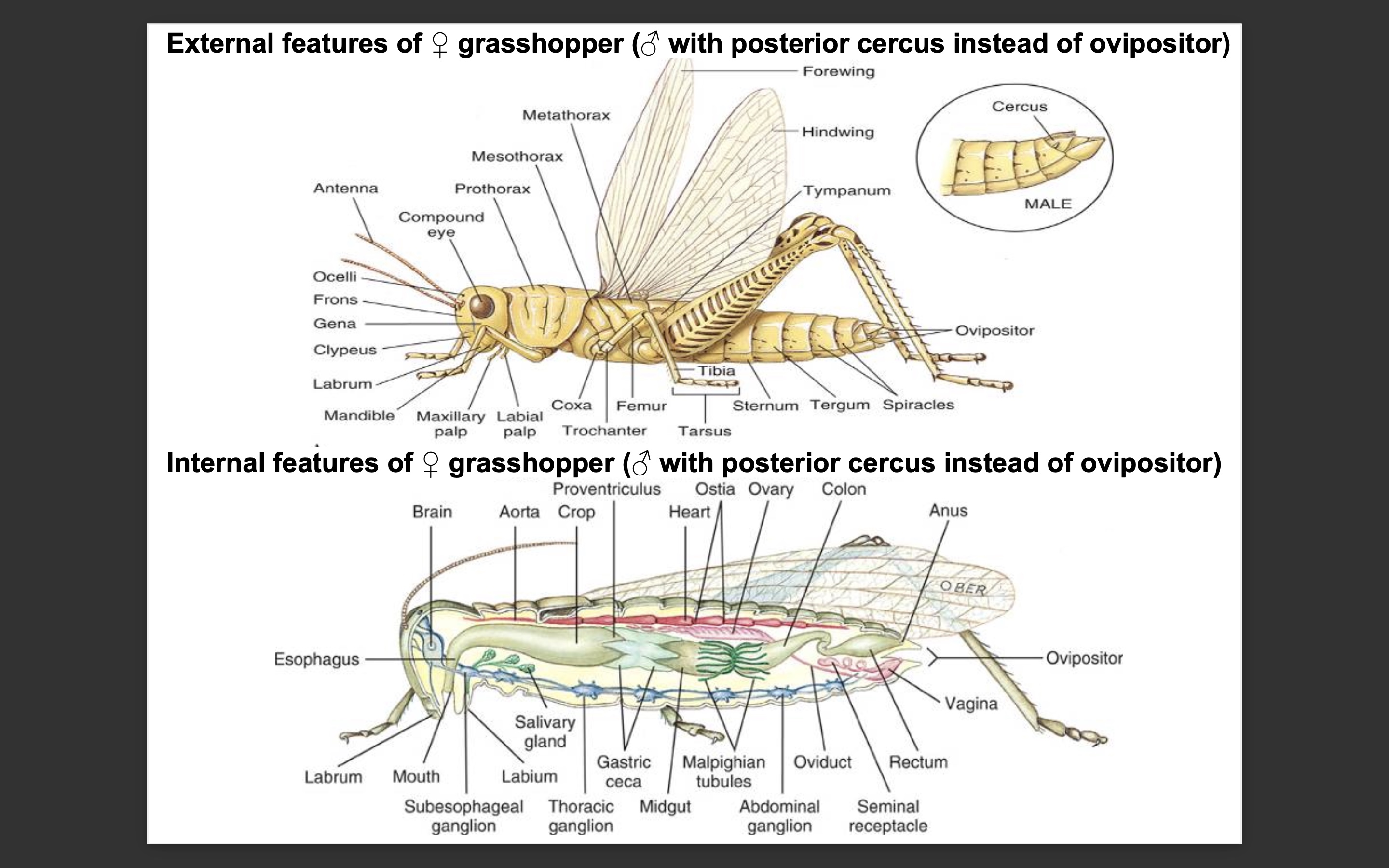
Mouth parts
“Form follows Function”
• for each type of feeding, mouthparts are adapted in a specialized way
• A) chewing mouthparts are adapted to grasp and crush solid food items
• B-D) sucking mouth parts contain a proboscis rigid enough to pierce animal and plant tissue
• E) sponging mouth parts contain elongate tubes with soft distal lobes that act as sponges; some also with tissue piercing mouth parts
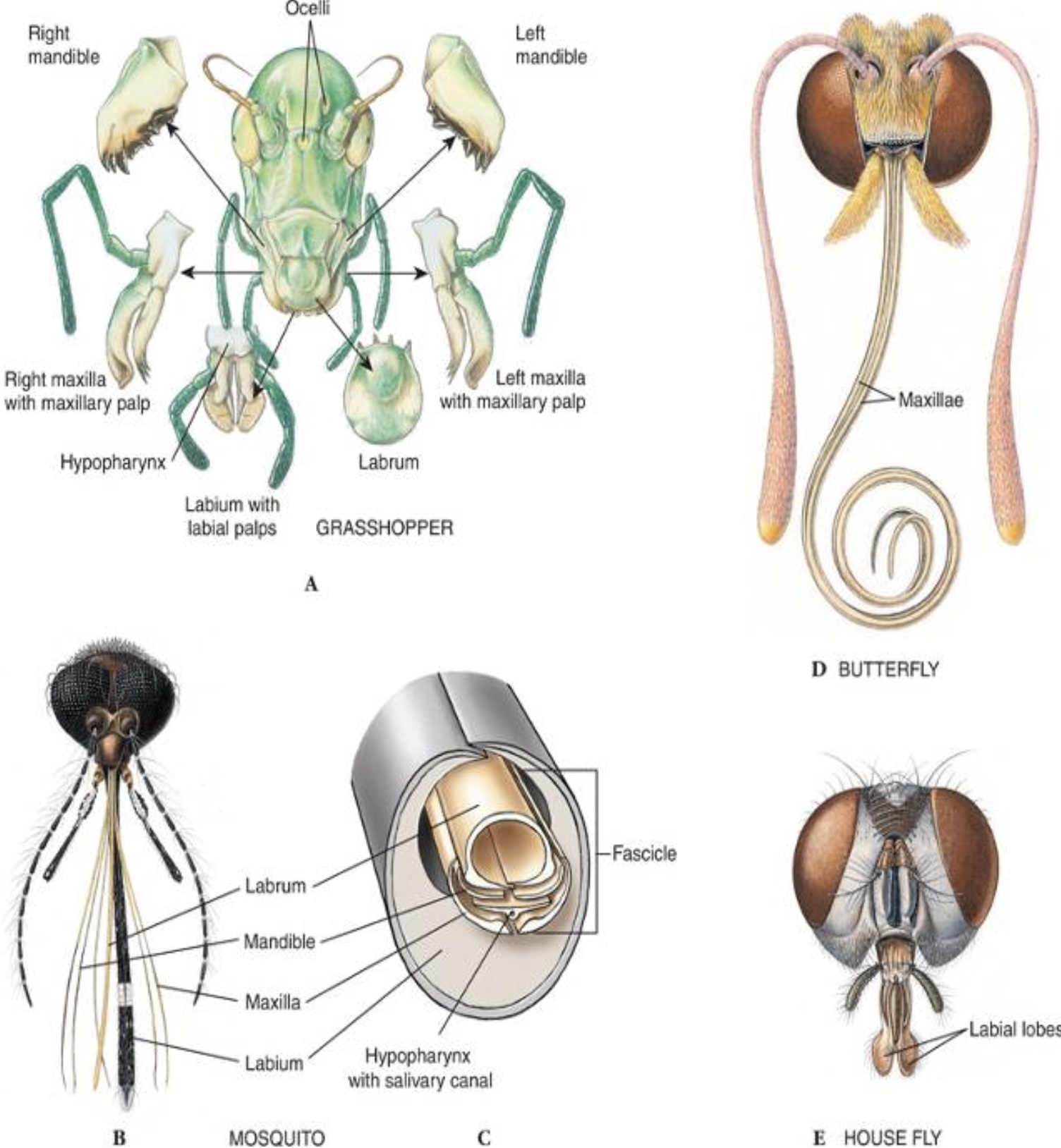
Reproduction • Insects are dioeious & fertilization usually internal • “advanced” forms often insert sperm directly into ♀ vagina during copulation, while “primitive” forms often encase sperm in spermatophores that are deposited onto substrate & picked up by ♀
Most oviparous, although viviparity seen also & species may lay <20 to 1 million eggs during a lifetime
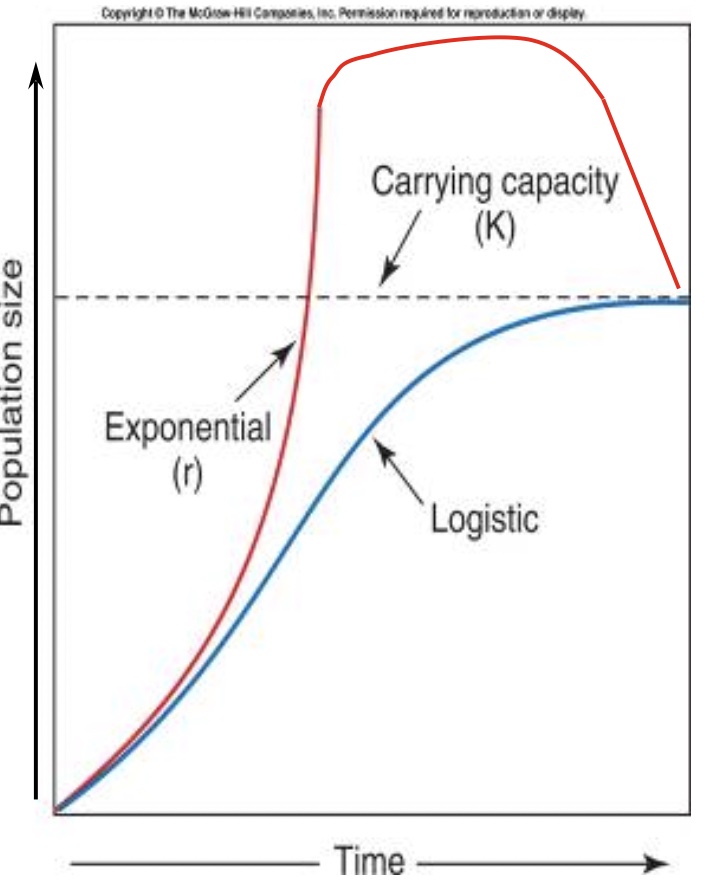
most insects exhibit an r-selected life history strategy 2. viviparous species exhibit a K-selected life history strategy, birthing as few as 1 young per reproductive event
Placement of eggs is often instinctive & specific • eggs laid on a particular plant upon which immature forms feed
• adults may paralyze a still alive prey, thenCaterpillar & newly emerged parasitic wasp larvae
deposit eggs within the prey upon which newly Wasp
emerged immature forms feed
• adults may lay eggs within the larval stage of another insect species upon which the inject larva will feed as parasites
Behavior and Communication • Arthropods surpass most invertebrates in complexity & organization of activity • Insect behavior mostly innate (genetically preprogrammed and instinctive), a complex sequence of responses & regulated by environmental stimuli without previous trial-and-error learning or teaching from parent/experienced individual • allows survival in individuals that receive no parental care and never know their parents
Some are learned via trial-and-error, prior experience and observing experienced individuals
in lab situations, insects have been trained to complete mazes & distinguish colors
Responses to stimuli often simple: cockroaches avoiding light, flies attracted to odor of dead flesh or a mimic of dead flesh (flies are pollinators of pear trees whose flowers are fowl smelling)
Responses to stimuli can be complex: dung beetles searching for feces, breaking off a manageable piece, forming it into a ball, rolling it to their below ground tunnel & laying eggs in it to keep the eggs warm & provide young with nutrients
Eusocialty in Insects (recall “Eu” means true) • Ethology – scientific study of animal behavior and considered a subdiscipline of zoology with ties to evolution, neurobiology, ecology, psychology and sociology • often research investigates a particular “type” of behavior (i.e., aggression) in a broad range of animal groups with the goal of obtaining comparative knowledge • began with Nikolaas Tinbergen (ornithologist) who published The Study of Instinct (1951), Konrad Lorenz (psychologist) and Karl von Frisch (entomologist) who all shared a 1973 Nobel Prize in Physiology and Medicine for ground-breaking work in animal sociality
Some insect social communities are temporary and uncoordinated, while other species (bees, wasp, ants, termites) exhibit eusociality that is highly organized with a caste system, division of labor & cooperation
Sociality & cooperation is common in the insect families Hymenoptera (bees, wasp, ants,...) & Ispotera (termites) • a caste system with division of labor & cooperation is necessary for perpetuation of the species
Karl von Frisch and the Honeybee “Waggle Dance”
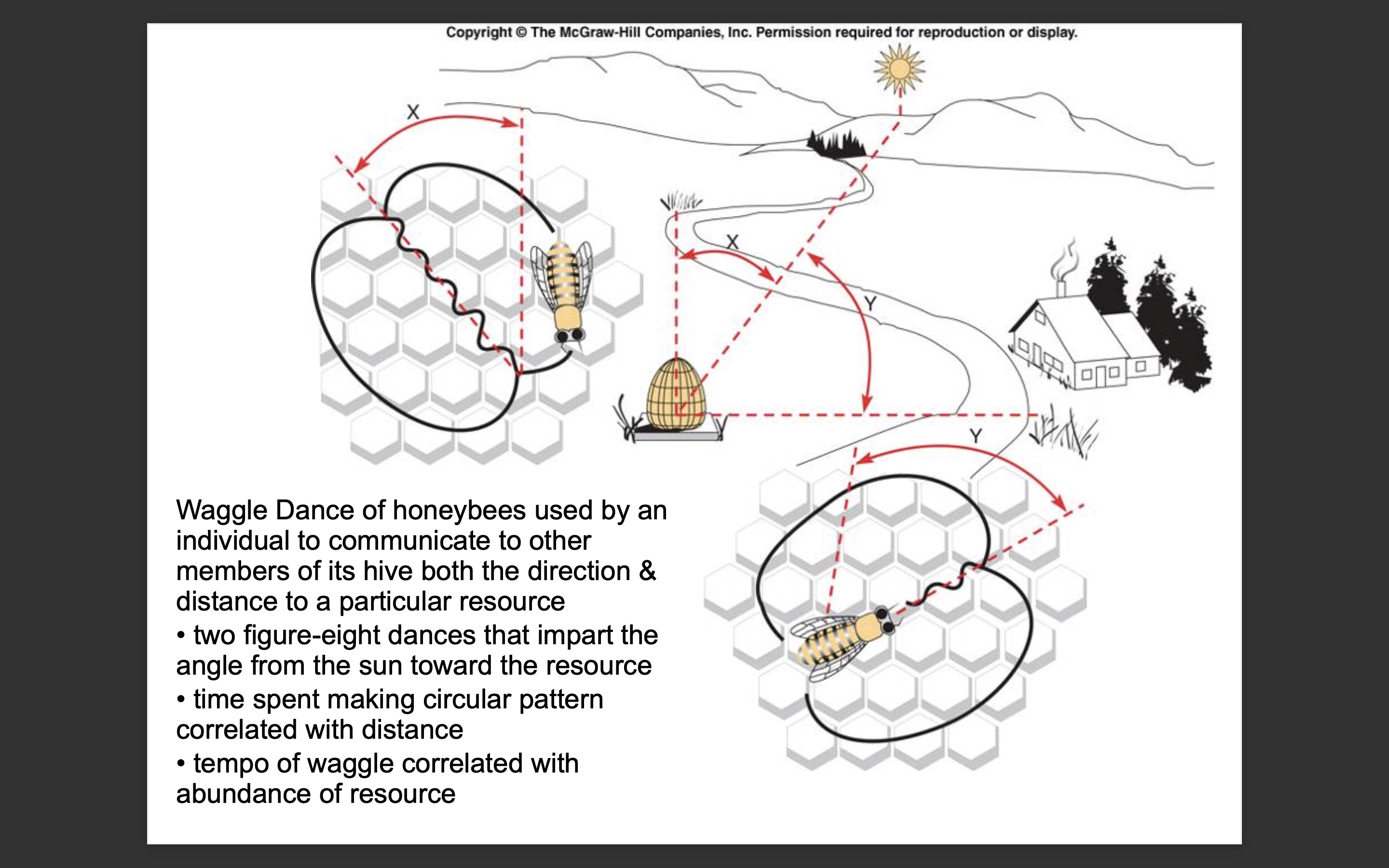
• “Scout” honeybee locates food & returns to hive to communicate location to other colony members via a complex “Waggle Dance”
1. “dance” is series of figure-eights preformed on vertical surface inside hive • 3 components conducted repeatedly:
• 1st: a circular movement in one direction
• 2nd: a linear movement while waggling abdomen from side-to-side which conveys direction from hive to resource & tempo of waggle indicates resource abundance (more rapid waggle=greater abundance)
• ex: from the hive, resource is at a 60o angle from the sun, so linear movement of bee during “dance” is 60o from vertical
• 3rd: a second circular movement in opposite direction from first & distance to source is correlated w/ time spent to make a full figure-eight
• ex: resource 1000m from hive, then time spent to complete one circuit thru “dance” is ≈3 seconds; 2000m from hive & time spent to complete a circuit is ≈5 seconds,...
• Although initially some researchers skeptical, recently a robotic bee programmed to do several variations of “waggle dance” has successfully led members of bee hives to locations determined by robot bee’s controllers
Waggle Dance of honeybees used by an individual to communicate to other members of its hive both the direction & distance to a particular resource
• two figure-eight dances that impart the angle from the sun toward the resource
• time spent making circular pattern correlated with distance
• tempo of waggle correlated with abundance of resource
Eusociality in Insects – Order Hymenoptera (wasp, bees, ants)
• A honeybee hive can contain >60,000 individuals of which there are
few hundred ♂ drones, a fertile ♀ queen & 1000s of sterile ♀ workers • ♂ drones are produced from parthenogenesis & unfertilized eggs,
thus haploid; fertilized eggs produce diploid ♀ workers & a queen 1. “Jelly” is produced by salivary glands of adults & fed to larvae
“Jelly” is produced by salivary glands of adults & fed to larvae
“Royal jelly” fed to single ♀ worker causes development into queen
2. Queen substance” is a pheromone secreted by queen causing ♀ workers to remain sterile & preventing them from producing “royal jelly”
3. When a queen leaves the hive to start a new hive, becomes too old or dies, level of “queen substance” decreases & ovaries begin to develop in ♀ workers that then produce a larva they feed “royal jelly” producing a new queen
Eusociality in Insects – Order Isoptera (termites) • A termite colony contains both fertile & infertile ♂s & ♀s
Colony is led by both a fertile ♂ king & ♀ queen
Other fertile individuals also live in the colony, but do not reproduce unless they replace the king & queen that have died or left the colony to start a new one
Sterile individuals are wingless workers & soldiers • adults of each caste produce a unique pheromone that they then pass on to nymphs through trophalaxis • the pheromone at the highest level prevents nymphs from becoming that caste type, thus new nymphs always become members of the caste lowest in number
Mimicry
• Many insects are colorful, especially moths & butterflies • Some coloration is an adaptation to predation defense
the Monarch Butterfly (A) produces a distasteful chemical, derived from a diet of Milkweed as a caterpillar, as defense against bird predation (aposematic coloration)
the Viceroy Butterfly (B) caterpillar does not consume Milkweed & does not posses any distasteful chemicals, but instead is colored & patterned like the Monarch & therefore is also avoided by birds
Beneficial Insects • Humans rely on & desire many insect-made materials • examples include honey, beeswax & silk
Of economic importance, bees pollinate $10 billion worth of food crops in the U.S. annually
Coevolution has resulted in a mutualistic relationship whereby plants exploit insect to facilitate pollination (plant reproduction) & insects exploit plants for food in the form of nectar & pollen • floral development of sepal & petal arrangements vary by plants & are specific to an insect group’s sensory array & body shape • to this end, amazing plant structures of allurement & nectar guiding along with insect feeding structures can be readily observed • Fly maggots remove dead animals • Critical lower-level component of most food chains & a central food for many fish, birds & mammals
Control of Insects
• Non-specific insecticides damage beneficial insect populations along with targeted pest species
• Some chemical pesticides persist in the environment for years & accumulate in animal tissues in increasing concentrations as you move up the food chain
• Biological control is the use of natural agents, including diseases, to suppress an insect population
1. Bacillus thuringiensis is a bacterium that controls lepidopteran (moth & butterfly) pests and the gene coding for toxin has been introduced into other bacteria & then transferred to crop plants 2. Synthetic pheromones are used to disrupt a species’ life cycle by preventing molting or making either sex sterile
Insect Flight
• Recall that insect wings are not homologous with bird & bat wings
• Recent fossil evidence suggests insects formed fully functional wings over 400mya
• Insects are the on invertebrates that can fly
• Wings are appendages of the body wall and are composed of cuticle
• Most flying insects have 2 pair of wings
• Order Diptera (true flies) have 1 pair of functional wings & a pair of rudimentary wings that provide balance during flight
• non-reproductive ants & termites, lice & fleas are wingless
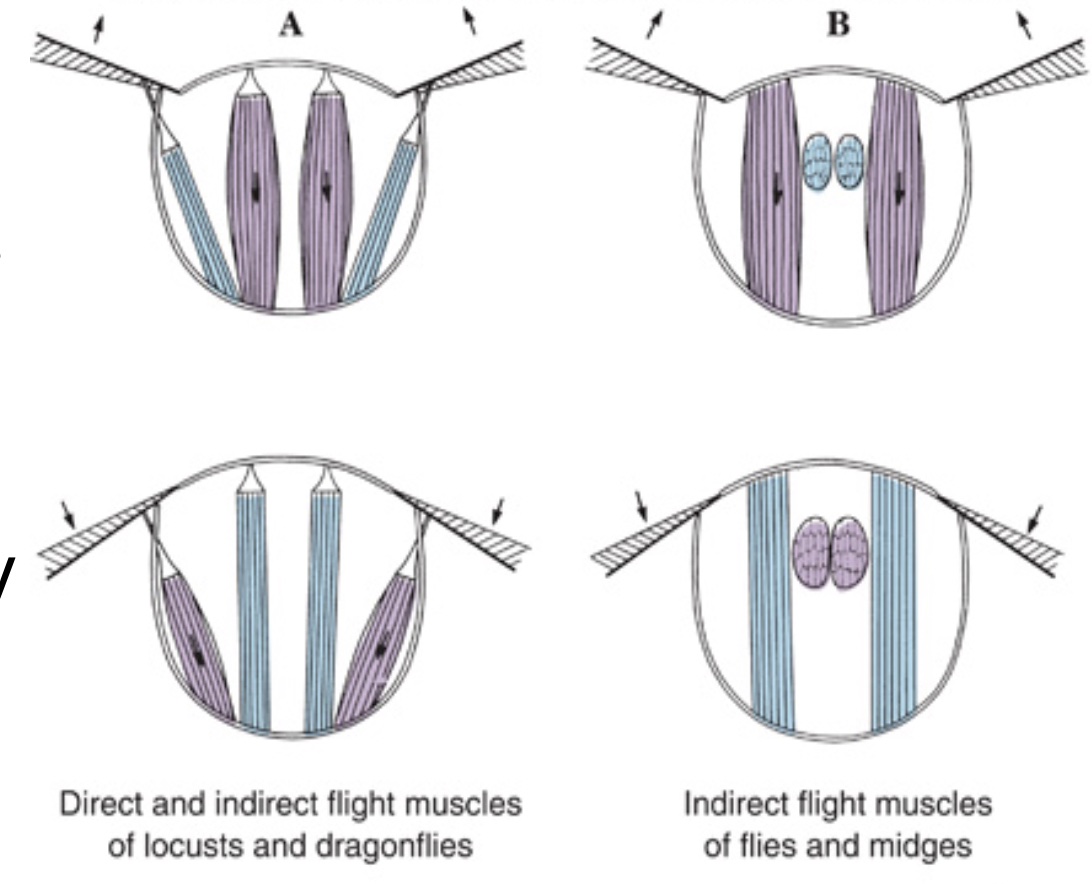
Insect Flight Cont. - Flight Muscles • Direct flight muscles attach to a wing directly • Dragonflies and cockroaches contract direct muscles to pull the wing downward (“A” lower diagram on previous slide), then indirect flight muscles pull the tergum down causing wing upstroke (“A” upper diagram on previous slide)
Indirect flight muscles alter shape of thorax to cause wing movement
Bees, wasps and flies arch the tergum by contracting indirect muscles to cause the upstroke (“B” upper diagram on previous slide), then relax the same muscles to cause downstroke (“B” lower diagram on previous slide)
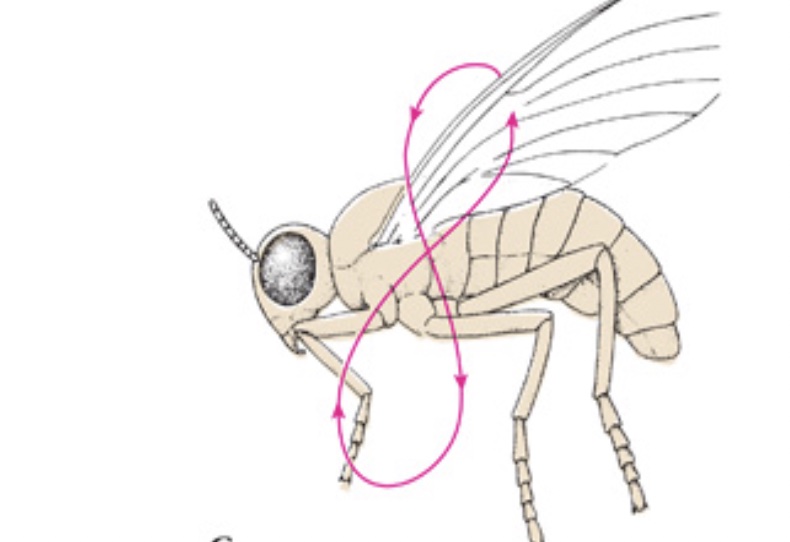
Wings are hinged on a pleural process that forms a fulcrum; all insects cause the upstroke with indirect muscles that pull the tergum downward Wing Thrust • Direct flight muscles also alter the angle of wings to twist the leading edge to provide thrust • This figure-8 movement moves the insect forward. • Fast flight requires long, narrow wings and a strong tilt, as in dragonflies and horse flies
Population Growth & Regulation [return to previous]
• Population growth is result of natality & immigration (additions) minus mortality &
emigration (subtractions)
• Intrinsic rate of growth (r) is population’s inherent ability to grow in # individuals
• continuous growth of this type eventually depletes local density-dependent resources (food, space,...) & is followed by reduction in population # due to increased mortality (starvation & disease), emigration, reduced natality,...
• the single density-dependent resource that becomes limited 1st is termed the limiting resource & determines carrying capacity (K): maximum # of like individuals (with regard to niche) that can be optimally supported by a given environment
• Ideally, a population would slow & then maintain its growth rate to just below K such that population additions equal population subtractions
K-selected species – exhibit logistic rate of population growth, maintained below K; species typically large, produce few eggs or young, have long gestation/lactation periods, parent(s) provide large amounts of parental care, live in stable habitats, are long-lived; ex: large carnivores, ungulates & few invertebrates
r-selected species – exhibit exponential rate of population growth, often temporarily exceeding K; repeated boom & bust periods; species typically small, produce large numbers of eggs or young, have short gestation/lactation periods, parent(s) provide no or little parental care, live in unpredictable habitats, are short-lived; ex: many invertebrates, fish, rodents, rabbits,...