ideal gasses
An ideal gas is a hypothetical gas that perfectly follows the ideal gas law, represented by the equation PV = nRT. In this law, P stands for pressure, V for volume, n for the number of moles, R for the ideal gas constant, and T for temperature in Kelvin. Understanding ideal gases helps in various applications, including calculating the behavior of real gases under certain conditions. In practice, this means that ideal gases are considered to have no intermolecular forces and that their molecules occupy no volume, which simplifies many calculations and theoretical models in thermodynamics. it is a hypothetical gas that obeys the assumptions of kinetic theory
Assumptions of K.T. of ideal gas
Ideal gases obey assumptions of kinetic theory, while real gases deviate from the assumptions of kinetic theory, especially under high pressure.
The particles of gases are in continuous random motion
The volume of ideal gas particles is negligible compared to the volume of the container.
Additionally, there are no intermolecular forces acting between the particles, allowing them to travel freely without significant interaction. There is no repulsion or attraction there.
The collision of gases is perfectly elastic (there is no loss of kinetic energy)
The average kinetic energy of an ideal gas is directly proportional to the temperature of the gas measured in Kelvin, which means that as the temperature increases, the average kinetic energy of the particles also increases proportionally.
Gas laws
BOYLE’S LAW
Boyle’s law states that at constant temperature, the pressure of a gas is inversely proportional to its volume. This relationship can be expressed mathematically as PV = k, where P is pressure, V is volume, and k is a constant. If we have two gases with the same temperature, it will be P1 and V1, and P2 and V2 for gas two; then, according to Boyle's Law, we can establish that P1V1 = P2V2, illustrating how changes in the volume of one gas can impact the pressure of the other when held at a constant temperature.
CHARLES LAW
Charles’s law states that at constant pressure, the volume of a gas is directly proportional to its absolute temperature. This can be represented mathematically as V/T = k, where V is volume, T is temperature in Kelvin, and k is a constant. Therefore, if we have two gases under the same pressure, we can denote their volumes and temperatures as V1 and T1 for the first gas and V2 and T2 for the second gas. According to Charles's Law, we find that V1/T1 = V2/T2, emphasizing how temperature changes affect the volume of a gas.
Kelvin is related to degrees Celsius by the equation K = °C + 273.15, which allows us to convert between the Kelvin and Celsius scales, enhancing our understanding of gas behavior at various temperatures.
gylocence law
Gay-Lussac’s law states that the pressure of a given mass of gas is directly proportional to its absolute temperature, provided the volume remains constant. This can be expressed mathematically as P/T = k, where P is the pressure and T is the temperature in Kelvin. Thus, if two different gases are compared at constant volume, we can denote their pressures and temperatures as P1 and T1 for the first gas and P2 and T2 for the second gas, leading to the equation P1/T1 = P2/T2.
The combined gas law describes the relationship between pressure, volume, and temperature for a mixture of gases. It can be formulated as P1V1/T1 = P2V2/T2,
The ideal gas equation
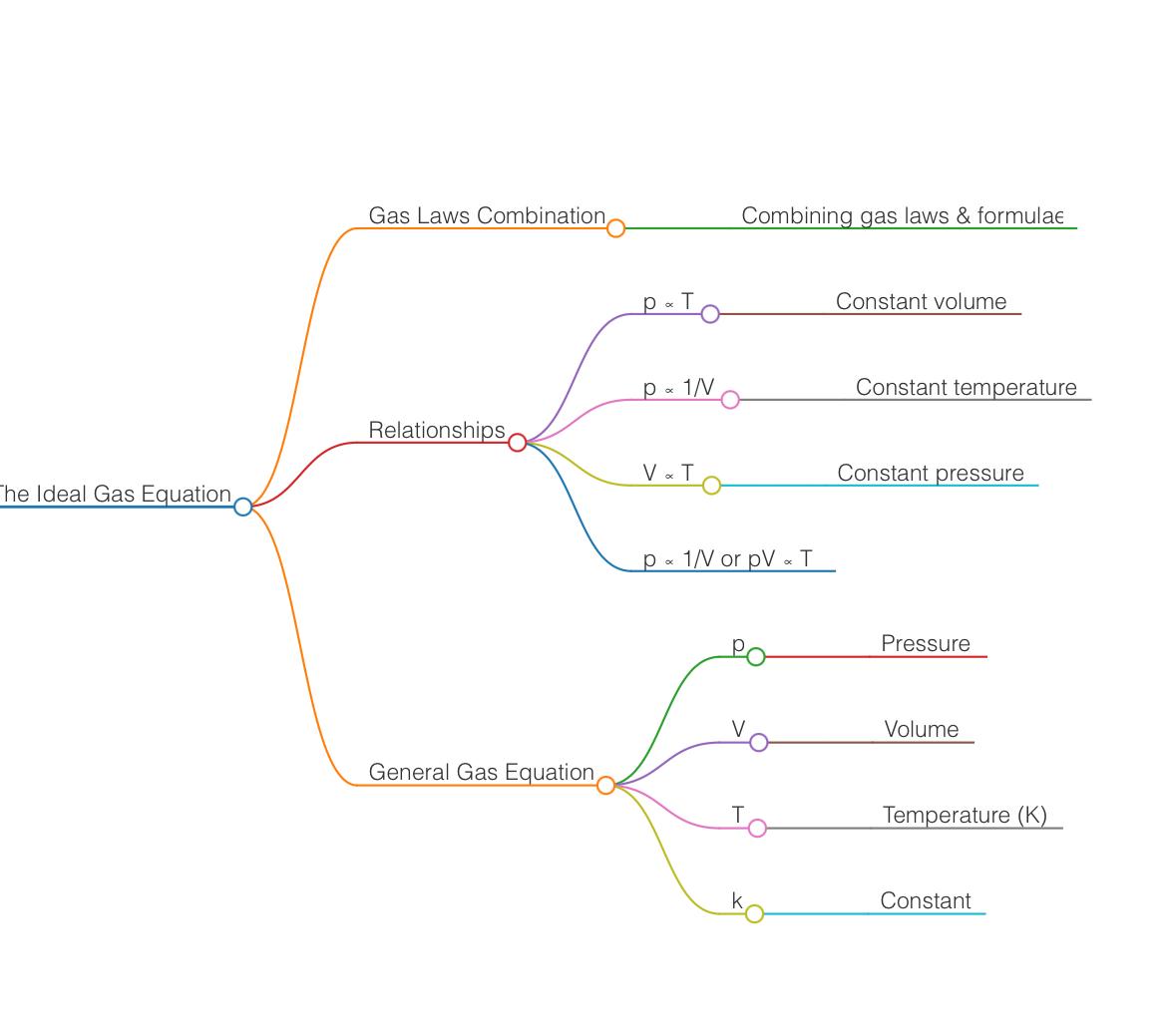
Ideal Gas Law: Study Notes
Key Concepts
Ideal Gas Law: PV = nRT
Relates pressure (P), volume (V), amount of gas (n), and temperature (T) for ideal gases.
R (Ideal Gas Constant): 8.31 J⋅K⁻¹⋅mol⁻¹
A fundamental constant in the ideal gas law.
Variables and Units
P (Pressure): Pascals (Pa)
V (Volume): Cubic meters (m³)
n (Amount of Gas): Moles (mol)
T (Temperature): Kelvin (K)
Relationships and Conversions
Moles, Mass, and Molar Mass: n = m/M
n = amount in moles (mol)
m = mass (g)
M = molar mass (g/mol)
Volume Conversions:
cm³ → dm³: ÷ 1000
dm³ → m³: ÷ 1000
cm³ → m³: ÷ 1,000,000 (10⁶)
Pressure Conversion
Pa → kPa: ÷ 1000
Example Problem
Problem: Calculate the pressure exerted by 0.5 mol of helium in a 2.5 dm³ container at 27°C.
Solution:
Given Values:
n = 0.5 mol
V = 2.5 dm³ = 2.5 x 10⁻³ m³
T = 27°C = 27 + 273 = 300 K
Ideal Gas Law: PV = nRT
Solve for P: P = nRT / V
Substitute Values: P = (0.5 mol)(8.31 J⋅K⁻¹⋅mol⁻¹)(300 K) / (2.5 x 10⁻³ m³)
Calculate: P = 498600 Pa