Unit 6: Consequences of Industrialization
Topic 1: Causes and Rationales for 19th Century Imperialism
Modern Imperialism and Colonialism
Imperialism: domination of European powers (and later US and Japan) over subject lands in the larger world. Often arose from trade, investment, and business partnership
Colonialism: Turning foreign lands into colonies and having control over political, economic, social, and cultural structures to dominate subject lands
Motives and Rationales of Imperialism
Economic Motives
Demand for raw materials increased due to industrialization. Reliable sources of these materials were not available in Europe and therefore looked for this in other parts of the world.
Colonies would consume manufactured products and therefore create more profit through larger markets
Colonies provided places where migrants could move that supported a rapidly growing European population.
Political and Military Motives
Strategic locations: Locations occupied world’s strategic sea lanes. Harbors or supply stations for commercial and naval ships
A desire for power and prestige (pride and validation driven from nationalism) → defuse social tension in some countries by inspiring patriotism and nationalism
Deny nations as rivals by colonizing them and adding them to their empire
Religious Motives
Missionaries went to foreign lands to spread their religion as justification for imperialism
Missionaries acted as facilitators between colonists and native peoples by teaching the language and communication
Cultural Motives
Europeans sought to bring “civilization” to indigenous peoples in the form of political and social stability
Kipling’s “White Man’s Burden” expressed it was the duty of Europeans to bring order and enlightenment to foreign lands
Technological Factors that Contributed to Imperialism
Medical Technologies
A treatment for malaria permitted small European populations to survive and thrive in tropical lands that previously was hard to colonize due to disease.
Transportation Technologies
Steamships: large, ironclad ships equipped with powerful guns. Allowed for faster travel because it did not rely on wind and therefore could travel and change direction at will
New canals, such as the Suez Canal and Panama Canal allowed for rapid travel and lowered cost of trade between imperial and subject lands
Railroads allowed for quick travel and facilitated trade in raw materials. It also distributed European manufactured goods to different areas.
Military Technologies
Weapons/firearms → new technologies were more accurate and reliable. Powerful arsenal allowed for imposing colonial rule on subject lands.
Communications Technologies
Steamships reduced time required to deliver messages from imperial to colonial lands over seas. Canals also reduced the time required.
The telegraph allowed for fast communication. Reliable submarine cables transmitted messages through oceans. It linked imperial and colonial lands with quick communication, and imperial officials could mobilize forces to deal with trouble in a fast manner. Merchants could also respond to economic and commercial developments quickly.
Racial Ideologies as Justifications for Imperialism
Scientific Racism and Social Darwinism
Scientific Racism: Individuals attempted to provide scientific evidence to support the superiority of Europeans in order to establish their dominance over other races
Social Darwism: Theory by Charles Darwin that humans are constantly evolving → “Survival of the fittest” slogan. Europeans were claimed to be biologically superior to other races.
Popular Racism
Racial, social, and economic dominance over an oppressed racial group in which they are taken advantage of → sense of moral superiority (basically racism)
Topic 2: Building Global Empires
Direct colonial control: Foreign powers directly controlled and governed colonial territories and societies. Colonizers held the highest positions of political and economic power (i.e., British Raj in India, the Belgian Congo)
Indirect colonial control: Foreign powers exerted power over native governments and economies by forcing weaker governments to sign unequal treaties giving foreign powers special political and economic privileges. While technically in control, foreign powers limited natives’ ability to make independent decisions.
India
With the decline of the Mughal empire, the East India Company expanded its trading posts and took control of much of India. They were attracted for trade goods such as Indian pepper and cotton, Chinese silk and porcelain, and Southeast Asian fine spices. Tea and coffee were also prominent.
European States Strengthened Control Over Existing Colonies: Before the 19th century, some European governments had authorized private individuals and trading companies to manage certain colonies. In the 19th century, these forms of indirect colonization ended in favor of establishing direct rule.
India was first controlled by the British East India Company → Control then passed to the British government following the First Indian War for Independence and the collapse of the British East India Company. This was known as the British Raj.
Native peoples were unhappy with the unfair treatment. India’s textile industry was completely suppressed as they could not compete with European manufactured goods. Indians rebelled against the East India Company, but were unsuccessful.
Belgian Congo
The Belgian Congo was controlled by King Leopold II of Belgium. Leopold exploited and used abusive methods to rule. After the brutality of Leopold’s rule, the colony was then taken from King Leopold and ruled by the Belgian government.
Rubber was a major resource in the region. Not only was it abundant in the region, it was in high demand due to industrialization and its use in tires. The extraction of rubber led to brutal working conditions, high taxes, and the death of 4-5 million Africans for the native peoples.
South Africa
European Colonization of Africa / “The Scramble for Africa” was not a single event but a series of events in the second half of the 19th century. European powers invaded, occupied, and colonized the majority of the African continent. By 1914 only Liberia and Ethiopia (Abyssinia) remained independent. European desire for raw materials and markets to sell industrial goods was a chief cause of Africa’s conquest by European colonial powers. Power, prestige, and national glory were also essential components.
The Berlin Conference: The Berlin Conference took place between 1884-1885 and represents the main event of the multi-decade Scramble for Africa. Major European powers met in Berlin, Germany, to peacefully negotiate and stake claim to portions of the African continent at the conference. African representatives and peoples were not consulted or invited to the meeting as Europeans drew new African borders and claimed African territory for European nations.
Before: European relationships in Africa largely revolved around trade through European coastal trading posts. Europe signed agreements with African rulers and tribes for the right to engage in trade and commerce.
After: Nearly all of Africa was claimed by European powers and forced into mercantile economic relationships. Europe took control of African political and economic systems.
Superior firearms made it possible for Europeans to take control of and encroach on lands. European imperialists sent armies to consolidate their rule.
Cape Town was established as a supply station for ships to Asia by the Dutch. Settlers later moved in for farming and ranching.
South African War (Boers War): conflict between Afrikaners (ethnic group descended from Dutch settlers) and the British government that led to Dutch defeat. British later takes control of the land and establish four colonies as provinces.
British exercise indirect rule through control of indigenous powers. Colonial officials were usually stereotyped as tribal and they hindered their rule in Africa.
Australia and New Zealand
The Maori signed much of their land to British through unfair treaties. Australia was a penal colony where convicts were sent for forced labor as punishment.
British colonists taught the Maori peoples carpentry, farming, and technologies to develop commercial exporting business. British also found oil.
Maori Wars/New Zealand Wars: Conflicts between English soldiers and Maori people over land ownership. Populations were lowered due to murder in retaliation to crime and spread of diseases.
Hawaii
During the Spanish-American War, Hawaii was a crucial strategic and military base. Therefore, US proclaimed Hawaii as a US territory under their power. Control over Hawaii also meant control of the sugar trade with tariffs.
The Missionary party stripped native peoples of their rights, diminished the monarchy’s power, and gave control to white businessman and planters. Hawaii was later annexed after Queen Lili’uokahou was stripped of her power and forced to turn her position over to Americans.
Puerto Rico
The United States took control over Puerto Rico as a protectorate after the Spanish American War where Americans were free to conduct military operations and interfere with elections and government. The US hoped to free Puerto Rico from Spanish rule and add it to their empire. Later, it was made into a US territory with civilian governmental rule.
Protectorate: A country or colony with its own government but it is subservient to a foreign power claiming its influence is necessary to protect the weaker power
Puerto Rico was a source of sugar and coffee, and was a possible market for US goods that attracted American businessman and plantation owners.
The Monroe Doctrine opposed European colonialism in the Western Hemisphere and gave US dominance over the Western Hemisphere and its colonies. It served as justification for US control over areas like Puerto Rico in the Western Hemisphere.
At first, native peoples did not have my rights. Over time, Puerto Ricans gained more rights and representation. For example, the Foraker Act gave civilian government, specified territorial status, and granted nonvoting representation in Congress. However, it did not grant citizenship to Puerto Ricans.
Philippines
After the Spanish American War, Americans hoped to free Philippines from Spanish Rule. The Philippines was a strategic military site and allowed for the US to enter commercial activity in Asia. The US annexed the Philippines and exercised military power to maintain control.
There was much resistance against the US to achieve independence. The Philippine-American Revolt led to much death from military violence, famine, and disease. The Philippines was not successful in gaining their independence.
Korea
Sino-Japanese War: China’s defeat in the Opium Wars brought out their weakness. In response, Japan fought with China and their victory allowed them to annex Korea, Taiwan, and the Liaodong peninsula. The Treaty of Shimoneski ended the first Sino-Japanese War and China was forced to relinquish control over Korea.
Japan was attracted to business opportunities, economic gain, and to increase national prestige.
Japan waged war on Korean culture and traditions. They destroyed the Korean language, literature, historical documents, landscape, and buildings such as Gyeonbukgung Palace. They forced Japanese traditions and worship of Japanese deities. “Comfort women” were also used as sexual slaves.
In response to Japanese rule, protestant movements were formed that pushed for Korea’s independence.
Russia
Russia was driven by territorial ambitions to have influence over places such as Liadong peninsula, Korea, and Manchuria. The Russo-Japanese war was fought over control of these areas with Japan.
Treaty of Portsmouth ended the war and gave Japan rights to Korea and Southern Manchuria.
Russia’s prestige declined when they lost the war with Japan. This transformed Japan into a major imperial power that gained unequal treaty rights and strengthened their control over Asian waters.
Topic 3:
The Sepoy Uprisings
“First War of Indian Independence” or “Uprising of 1897”
The British East India Company had control over India. They used the Indian military to help with their affairs. The native Indian populations were undergoing discrimination, excessive taxation, and their religious beliefs were challenged.
Tipping point → Indians were forced to grease their rifles with pig and cow fat, which went against Muslim and Hindu beliefs
Many sepoys became frustrated living under EIC conditions and therefore rebelled against Britain. Indians launched a full-scale mutiny rebellion and even got the support of Indian princes.
The rebellion was not effective because the British ended up with the upper hand. They officially abolished the Mughal empire along with exiling the emperor Muhammad in order to prevent later rebellions.
East India Company no longer had control and Britain continues to rule through the Government. India formally became a colony of the British Empire. The government creates policies which ensured inequality and racism.
Despite promising to no longer interfere with religion or traditions, racial abuse and economic hardships continued. English traditions and customs are established with English as the official language, English schools established, etc.
India under the British Raj
Non-violent movements through European-educated elites that set up reformation movements and nationalism.
Imperial expansion and colonial dominance by the English prompted the formation of national identities and organization of anti-colonial movements.
Educated elites helped form a sense of Indian identity. Reformers increasingly called for self-government and drew inspiration from Enlightenment ideas such as freedom, equality, and popular sovereignty.
The Indian National Congress was founded and openly sought Indian self-rule. They were successful in communicating their views on public affairs and problems they experienced with the British.
Ultimately, the Indian nationalism movement brought independence from colonial rule in 1947. It also served as a model for other anti-colonial movements.
Zulu Nation
The Zulu kingdom (South Africa) had maintained its independence. Shaka Zulu creates an organized, centralized state with a strong military. For some time, they are successful in resisting the British from colonizing their lands.
Anglo-Zulu War: War between the Zulu and the British
At the beginning, Zulu won the battle of Islawanda in which they were first successful in resisting British colonization
British ends up defeating the Zulu kingdom and divides the kingdom into several states and incorporates into the British empires
Maji Maji Rebellion
Indigenous peoples are treated terribly, overworked, and heavily taxed from German colonizers.
A prophet arose that proclaimed that a magical Maji Maji Water would protect them from Germans and their advanced military.
Inspires other ethnic groups to join their rebellion creating a legacy of inter-ethnic unity and resilience against colonial rule.
Not successful because of primitive weapons against superior European weaponry which led to many deaths of the indigenous populations. Its immediate impact was devastating with widespread scarcity of food, population loss, and entrenched colonial oppression.
Inspires other movements in the region and in Africa.
Topic 4: Economic Imperialism
Political Imperialism: colonizing power exerts political control over the region and officially claims it as a colony and thereby a part of their empire. It used either direct or indirect rule to maintain authority. These regions were also exploited for economic benefit of the colonizing power
Economic Imperialism: colonizing power only exerts economic control over a region through unequal treaties, creating spheres of influence, or by gaining exclusive access to land and resources.
Export-Oriented Economy: When a country’s primary economic activity is focused solely on the production of goods for export. In the 19th and early 20th century, much of Latin America, Africa and Asia had economies focused on the export of primary goods (i.e. natural resources and agricultural goods) to the industrialized nations of Europe, North America and Japan.
China (Opium Wars)
The British EIC had spent over 19 million pounds on Chinese goods but China had no interest in good from the British other than silver. As British reserves of silver started to get depleted, British consumer’s demands for Chinese goods such as tea, silk, and porcelain increased. The Qing empire also restricted foreign activity which made it even harder for the British to access customer goods. This was until they introduced opium which caught the Chinese markets by storm and had 10% of their population addicted.
The British would trade opium for silver, tea, and other Chinese goods. The Opium Wars starred once the Qing government made a move to try and stop the Opium trade. China lost both opium wars to Great Britain and France which forced them to open more trading ports. As a result, there was an unbalanced trade between China and European countries because of increased addiction of opium by the Chinese.
Spheres of Influence dominated China as the Qing government’s power decreased. Foreign nations gained rights to trade, resource extraction, and infrastructure development. The Qing dynasty also granted different areas of their land to foreign nations such as Germany, great Britain, Russia, France, and Japan. While China still had political control over their citizens, the foreign powers were able to exploit resources without paying the full cost of the product used.
China’s economy was disrupted by creating dependency on foreign trade and investment. Chinese industries were harmed and struggled to compete with foreign goods, leading to economic stagnation and job loss. This led to resentment of foreign powers in China.
China underwent the Boxer Rebellion, composed of numerous individuals who opposed external influences, Christianity, and imperialism. This was originally effective as they were fueled by the belief of supernatural power and hatred for Westerners. However, the increasing prevalence of the Chinese Boxer Rebellion induced external nations to respond with force against it and ultimately decimated the organization.
India (British Raj)
Indian nationalists organized a campaign against British rule, lead by “Swadeshi,” or their hope for political and economic independence. Citizens protested, burned British-made clothing, and Gandhi encouraged Indians to wear homespun cloth instead of trying to imitate Western culture.
British colonial rule and imperialism reoriented cotton production to fit the needs of the British textile industry. This encouraged the export of cotton rather than local consumption of cotton, As a result, colonial policies caused economic competition between Indian and British commerce, and a decline in demand for Indian-made goods that could not keep up with the factory-manufactured textiles. Many people loss their jobs, faced declining wages, and experienced widespread famines. Often times, people returned to agriculture to support their families and lives, which led to progressive ruralization of India.
Argentina (Foreign Invest in Latin America)
While the British were unsuccessful in colonizing Argentina, they were very successful in taking over their economy. Argentina didn’t have a good market for British goods; however, the British realized that the resources that Argentina had such as meat would be valuable to have. Also, they saw the many opportunities that could bring them profits and control over their economy and so the British decided to over loan and invest in Argentina in order to control what went in and out. For example, British was involved in the development of Argentine railroads, ports, and infrastructure. Even more, they were attracted to getting these resources to their own country for much cheaper than they normally would be able to. In return, Argentina became an important exported of meat and grain to Britain.
Latin American countries like Argentina became dependent on and indebted to foreign powers like Great Britain. Other countries like Mexico brought money in but most this went to Mexican Oligarchs and foreign investors so the people remained impoverished.
After Argentina renegotiated their loan terms with British banks, they thought they had fixed their problems. However, this was short term. People went to banks to withdraw their money, but found that there was nothing there as the banks didn’t even have enough reserves to to cover their deposits. As a result, many banks went bankrupt and were forced to shut down. This economic disaster took Argentina years to recover.
Topic 5: Global Migrations
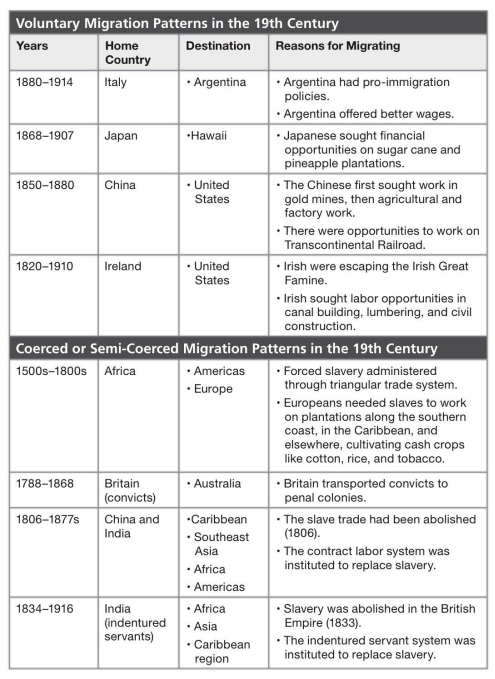
Forced migration through enslavement continued from Africa to the Americas until 1807 for Britain and 1865 for the United States when the trade was finally banned. These people were brought to the Americas to serve as enslaved laborers on plantations.
Convict labor involved the transportation of convicts from Britain and other European countries to penal colonies, most notably to Australia, as a solution to overcrowded prisons. These convicts were often employed in public works projects, such as road construction and building development, under severe and punitive conditions.
Indentured servitude was a labor system where individuals entered into a contract to work for a specific employer for a period in exchange for passage to a new country, usually in the Americas or the Caribbean. This system, prevalent in the 18th and 19th centuries, was marked by exploitative conditions akin to slavery, despite being formally voluntary.
Contract labor emerged as a form of migration where workers, often from Asia, agreed to work for an employer in a foreign country under a fixed-term contract. This system was especially common in the construction of railroads and in plantation agriculture in places like Hawaii and the American West, providing essential labor for developing economies but often under conditions that limited workers' freedoms and rights.
Return to home migrants migrate to another place—whether for work, education, or other reasons—but later returns to their place of origin or homeland. During the late 1800s, millions of Italians migrated to the United States, Argentina, and Brazil due to poverty and lack of economic opportunities in Italy. Many of these migrants, especially seasonal workers planned to work abroad temporarily and return home after saving money. A significant number of Italians did return to Italy, using their earnings to buy land, start businesses, or improve their social status.