Chemical Bonding - Chemistry
(If pictures aren’t loading, reload page)
Chemical Bonding
3 types:
Ionic Bonding
Metallic Bonding
Covalent Bonding
cation (+)
pronounced cat-ion
anion (-)
pronounced an-ion
Ionic Bonding
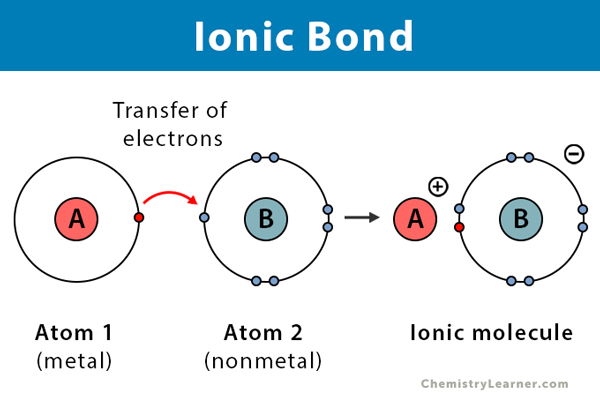
attraction that forms between a (+) ion and a (-) ion
results from a transfer of e-
Ionic Compounds
held together by an ionic bond
exists in a 3D “crystal lattice” (repeating pattern)
ratio of ions is the chemical formula
common properties:
very brittle
aligning (+) and (+) or (-) and (-) causes a split/ break
very high melting point
melting requires break ionic bonds to liquify the lattice
form electrolyte solutions when dissolved
separated ions can conduct electricity
Metallic Bonding
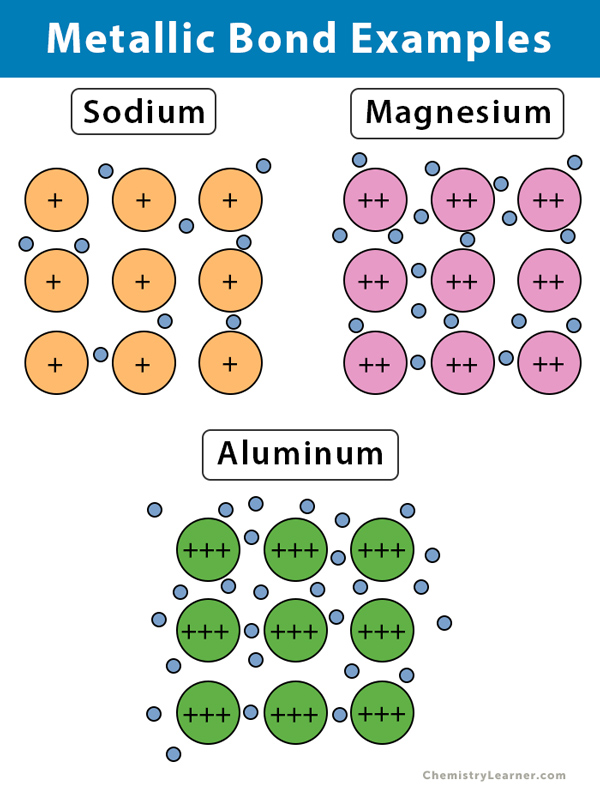
attraction between a metal atoms nucleus (+) and another atoms delocalized valence e-
the e- orbit all the atoms
“sea of electrons” hold all the atoms together
Metal Properties
malleable (change shape without it breaking)
excellent conductor of electricity
valence e- are mobile and can easily move
excellent conductor of heat
easy for atomic vibrations to travel from atom to atom
Covalent Bond
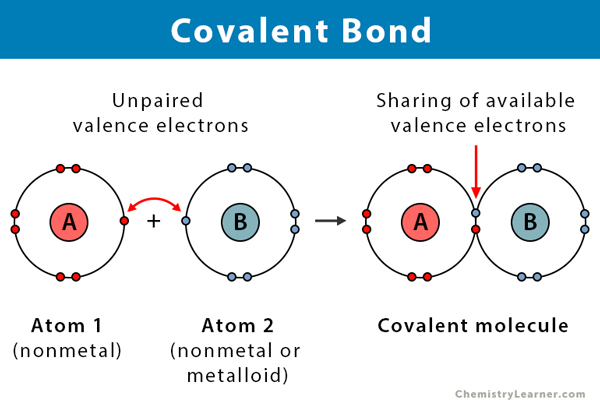
attraction between the nucleus of one atom and a valence e- from another atom
results in a sharing of e0 between non metals
valence e- orbits 2 atoms
Drawing a Molecular Structure
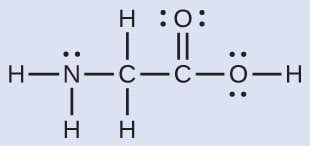
add up the total valence e- on the molecule
put the least electronegative atom in the center and connect the other atoms by a single bond
add remaining e- as “lone pairs”
rearrange long pairs and bonds to make sure each atom has the octet (only if necessary)
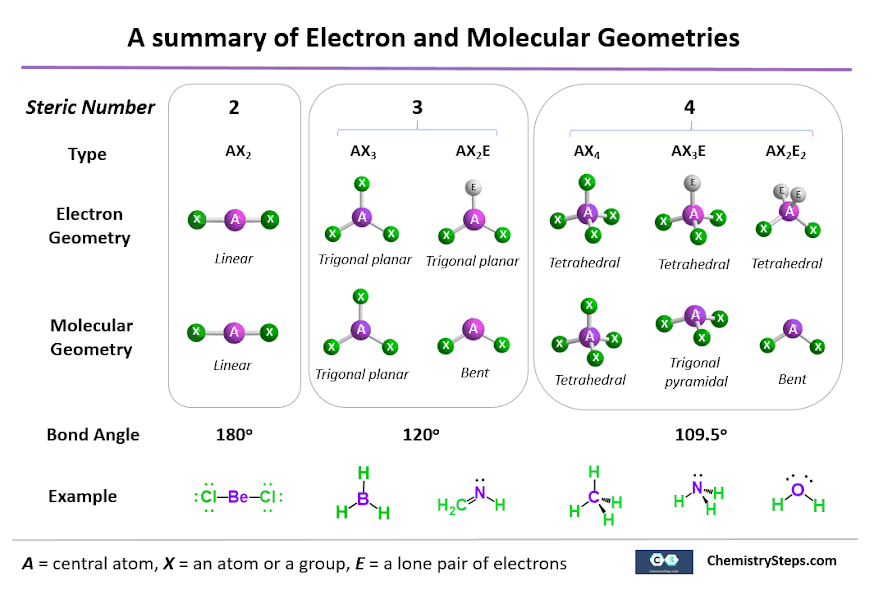
Valence Shell Electron Pair Repulsion (VSEPR) theory
Electron Domain Geometry
2 bonds = linear
3 bonds = trigonal planer
4 bonds = tetrahedral
Molecular Geometry
linear:
0 lone pairs = linear
trigonal planer:
0 lone pairs = trigonal planer
1 lone pair = bent
tetrahedral:
0 lone pairs = tetrahedral
1 lone pair = trigonal pyramidal
2 lone pairs = bent
Octet exceptions
Electron Domain Geometry
5 bonds = trigonal bipyramidal
6 bonds = octahedral
Molecular Geometry
trigonal bipyramidal:
0 lone pairs = trigonal bipyramidal
1 lone pair = seesaw
2 lone pairs = T-shaped
3 lone pairs = linear
octahedral:
0 lone pairs = octahedral
1 lone pair = square pyramidal
2 lone pairs = square planer
3 lone pairs = T-shaped
4 lone pairs = linear
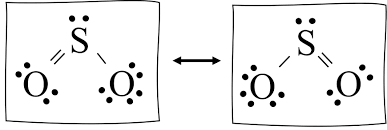
Resonance
when e- spend time between more than 2 atoms
Polar Covalent Bond
bond in which electrons pairs are shared unequally
due to atoms in the bond having different electronegativity
the bond has partially (-) and (+) ends
partial = δ (lowercase delta)
Electronegativity difference
difference ≤ .4 → nonpolar covalent bond
.4 < difference ≤ 1.8 → polar covalent bond
difference > 1.8 → ionic bond
ONLY IF THE ATOMS ARE POLAR
δ - = more electronegative atom
δ + = less electronegative atom
Determining if a Molecule is a Dipole
Dipole = polar molecule
Must have at least 1 polar bond
Molecule must be asymmetrical (if there are lone pairs on the central atom, it’s probably asymmetrical)