Lecture 5 - Metamorphism and Metamorphic Rocks
Metamorphism
The process of transforming minerals and structures of rocks involving heat and distortion, together or separately
Reactions happen mainly in the solid state: new crystals form in fissures or as replacements of other minerals
May be closed-system environment (chemical reworking of original constituents) or open-system environment (rock is “cooked” with additions from magmatic source)
Two types:
Regional Metamorphism - rocks are buried deep (10-20 km typically) and spans thousands of square kilometers
Contact Metamorphism - a body of magma in the upper part of crust can be the source of heat and metamorphose rock around it. The zone of contact metamorphism is a few meters up to tens of meter
Main factors:
Parent rock mineral fabric
Temperature
Pressure
Fluid availability (usually water)
Time
Parent rock is considered to be the igneous or sedimentary rock origin of the metamorphic rock
Ex: mudstone (sedimentary) metamorphoses to slate (metamorphic) which metamorphoses to schist (metamorphic)
Mudstone is the parent rock of slate and schist
The feature that caused metamorphosis is the minerals’ stability (of parent rock), and at different conditions, they become unstable and recrystallize into different minerals
Temperature controls what kind of metamorphism may take place
Further, from igneous rocks, minerals crystallize at certain temp, therefore, mineral stability is a function of temperature
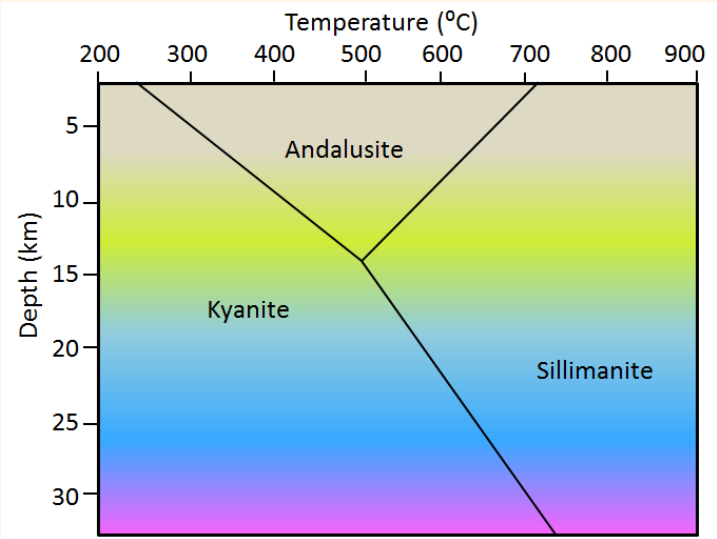
Minerals have certain temperature ranges where they are stable. If the pressure is changed and/or water is available, then the temperature range where they are stable will also change
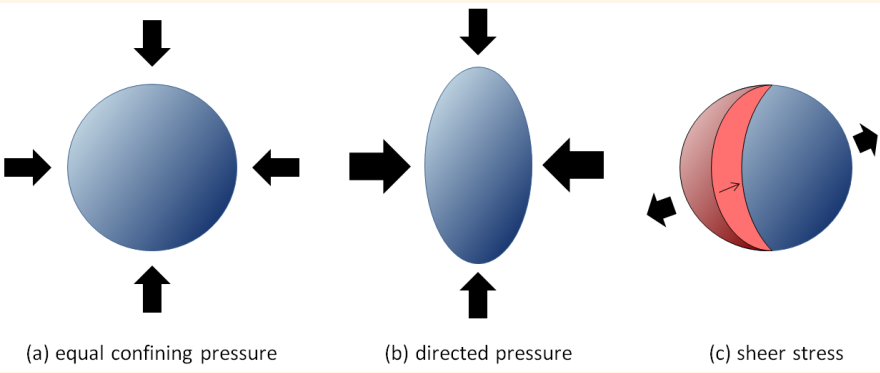
Pressure affects the texture of the resulting metamorphic rock. It may also cause metamorphic rocks to have foliation
Equal confining pressure - same pressure from all directions
Directed pressure - pressure from sides is higher than pressure at top and bottom
Shear stress - pressure pushes one side in one direction and the other side in the opposite direction
Some minerals will crystallize into one of its polymorphs based on the temperature and pressure it is in. Polymorphs have the same composition but different crystal structure.
Water facilitates ion transfer and may make metamorphic process go faster. It may have high ion (dissolved elements) concentration and may transport ions from one place to another
Time is needed for metamorphic process to happen — estimates of new mineral growths are around 1mm every million years. However, since tectonic process that cause metamorphic processes are also slow, allowing metamorphic rocks to form over a long period
Metamorphic Rocks
formed from metamorphism
These rocks have altered fabric form of the parent rock by different mineral sizes, arrangements, and textures
Two types:
Foliated - directed pressure or shear stress is needed in the environment to form this kind of rock
Non-foliated - no directed pressure environment or envi with little pressure (such as near surface)
* Some rocks do not show foliation even if they are formed in an environment with directed pressure (such as quartzite and marble)
Foliation
“layering” or “banding” in metamorphic rocks causing “sheet-like” metamorphic rocks causing “sheet-like” structure
not necessarily always seen as physical layers or bands by the naked eye but show up as weakness planes of the rocks
If a rock is squeezed (directed pressure), it may deform and texture will change such that the minerals seem elongated along an axis perpendicular to the bigger stress/squeeze
Foliated Metamorphic Rocks
can be classified on type of foliated texture it has and grade of metamorphism. These textures are listed below (and in increasing grade of metamorphism)
Slaty
Phyllitic
Schistose
Gneissic
Slate
From low-grade metamorphism of shale
Microscopic clay and mica crystals have grown and aligned perpendicular to the largest stress
Breaks into very thin flat sheets along cleavage using a chisel. This property is called slaty cleavage.
Phyllite
Similar to slate but heated to a higher temperature
Has larger mica crystals but still barely visible to the eye as sheen on the surface
Can form in wave/silky/crenulated layers
Schist
High enough temperatures forming mica big enough to be seen by the naked eye, possibly with quartz, feldspar, etc. visible
Strongly foliated and often bonded with course crystals
Gneiss
Minerals have been separated into distinct bands
Dark bands are usually biotite and hornblende and light bands are quartz and feldspar
Foliation is not as intense as schist
Non-Foliated Rocks
Form in areas where pressure is just confining pressure (same pressure from all sides) or lower-pressure conditions
Mostly, these rocks are not buried deep enough and the heat is coming from a nearby body of magma
Quartzite - metamorphosed sandstone
Marble - metamorphosed limestone
Engineering Considerations
Metamorphic Rocks and Weathering
Fresh metamorphic rocks are usually sufficiently sound for almost any engineering purpose
Weathering may lower the quality of the rock material. It may expose the foliation which are the weakest parts of a metamorphic rock
Foliation
Foliated metamorphic rocks usually presents anisotropy
Anisotropy is the difference of a material’s property at different directions
The planes of foliation provide direction along which the tensile and shear strengths are considerably less than in all other directions
The direction of rock foliation should be included in the geologic investigation
The anisotropy should be considered in applications
Creep and slides may be persistent along the foliation direction for rock slopes and excavations. Interventions perpendicular to the weak planes may be necessary.
Construction material
Non foliated metamorphic rocks are usually used as building materials
Quartzite may often be used a railroad ballast
Marbles are used a building stone