Check point 1: Basic Set Theory and Probability Definition
Definitions
Random Experiment: a phenomenon with an unknown outcome
Exp: rolling a dice not knowing what side would land on
Element: a possible outcome of an experiment
Exp: rolling a 2
Sample Space (S): S of an experiment is the set of all possible outcomes of that experiment
Exp: S = {1, 2, 3, 4, 5, 6}
Event (E): a set containing possible outcomes of an experiment. aka E is a subset of S, denoted E S
Exp: Event of rolling prime number = {2,3,5}
E Complement: Ec (or E’, ~E, ) the complement of E
Math: Sample Space (S) - Event (E)
Exp: Event of rolling non even number = {1, 3, 5}
Union (AND): Union of events is a set consisting of all outcome found in any of the events. In simple words, everything the two or more events cover
Exp: A B
Intersection (OR): Intersection of events is a set consisting of only the common outcome found in any of the events. In simple words, only the common area that the two or more events cover
Exp: A B
Math: : A B C = A x B x C
Mutually Exclusive (Disjoint): if there are no common outcomes, denoted E F = 0
For 3 or more, every events must be disjoint, not just two

Bayes’ Formula =
Independence
Check for independent =
Complement
if P(A) and P(B) are independent
P(A) and P(Bc) are also independent
P(Ac) and P(B) are also independent
P(Ac) and P(Bc) are also independent
Conditional Probability
P(A | B) =
Formula
P(∅) = 0 (P for mutually exclusive event)
Laws
Demorgon’s Law
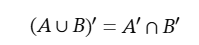

Law of Total Probability
probability of an event can be calculated by considering all the different ways it could happen
Exp: P(B) = P(B A) +P(B Ac)
Probability Axiom

Counting and Combination
Counting how many ways can smth happened
# of Stage times all the possibility of each stage
*the possibility for each stage might not be the same
Permutation
Definition
An ordered arragement is called a Permutation
Simple scenario: pick a ball from the pool and pick another way wo putting the previous one back to the pool
Formula
No repetition allowed Version:
:
n = # of all the possibility for the first stage
r = how many stage we looking for
Repetition
we dont minus one of the possibility every time we multiply since we are allowed to repeat the options in each stage.
Combination
Definition
An non-ordered arragement is called a Combination
We say N Choose K
To find how many combinations of 5 poker cards from a deck we can say 52 Choose 5
Formula
= :
n = # of all the possibility for the first stage
r = how many stage we looking for
Relationship

Example
How many combination of friends i can invite to a party if i have 8 but can only invite 2, and 2 of them are not coming if they have to come tgh