Module 13: Movement Analysis and Motor Learning Principles
Objectives
1. Evaluate movement patterns of older adults so that the most
appropriate instructional or practice techniques are employed
to facilitate learning
2. Adapt movement patterns to optimize motor performance
3. Apply motor learning concepts when teaching older adults
Chapter 15-1 - Movement Analysis
Nervous and Musculoskeletal System Changes and Motor Skill Learning
Declines in cognitive function
Greatest impact on motor learning
Older adults perform complex skills slower and with less accuracy compared to younger adults
Older adults are less able to acquire new concepts or apply existing concepts to complex movements patterns
Also, they’re less able to adapt their movement patterns in response to environmental conditions
Slower reaction times
Reaction time measures how quickly a person it able to to react to changes in task demands or changes in environment
For example: In the choice stepping response timed test, the participant needs to step to the appropriate target based upon the visual stimulus that is presented
If the left hand light on the box in front of the participant turns on, they are to step to the target on the left with their left foot
Not only do older adults perform this task slower than young adults do, but older adults who take longer to perform this task are at an increased risk of falling
Physically active older adults do not exhibit as much of a change in reaction time with advancing age as inactive older adults do
Deficits in memory
Relevant for motor learning or any time of learning
Deficits in short-term memory can lead to difficulty in remembering instructions or feedback provided by the instructor, which can lead to difficulty in learning new movement patterns
Declines in Attention
A limited capacity to process information shows several changes with aging
For example: Aging is associated with the impaired ability to maintain intentional focus for an extended period of time
Such as, reading a book or driving a long distance
Aging is also associated with an impaired ability to selectively focus on certain events in the environment while walking out other events
For example: Focusing on the instructor while taking a group exercise class rather than focusing on what the other participants in the class are doing
Impaired ability of older adults to divide attention between two or more different tasks, such as the figure eight with cognitive task item in the Expanded Fullerton Balance Scale
For most tasks, there’s not really true any true multi-tasking that happens, rather what happens is attention switching (instead of focusing on both simultaneously)
Changes in Muscle and Bone
Changes in Muscle the causes reduced power, strength, and endurance
Changes in Bone that causes decreased bone density
These influence how well an older adult performs and learn motor skills
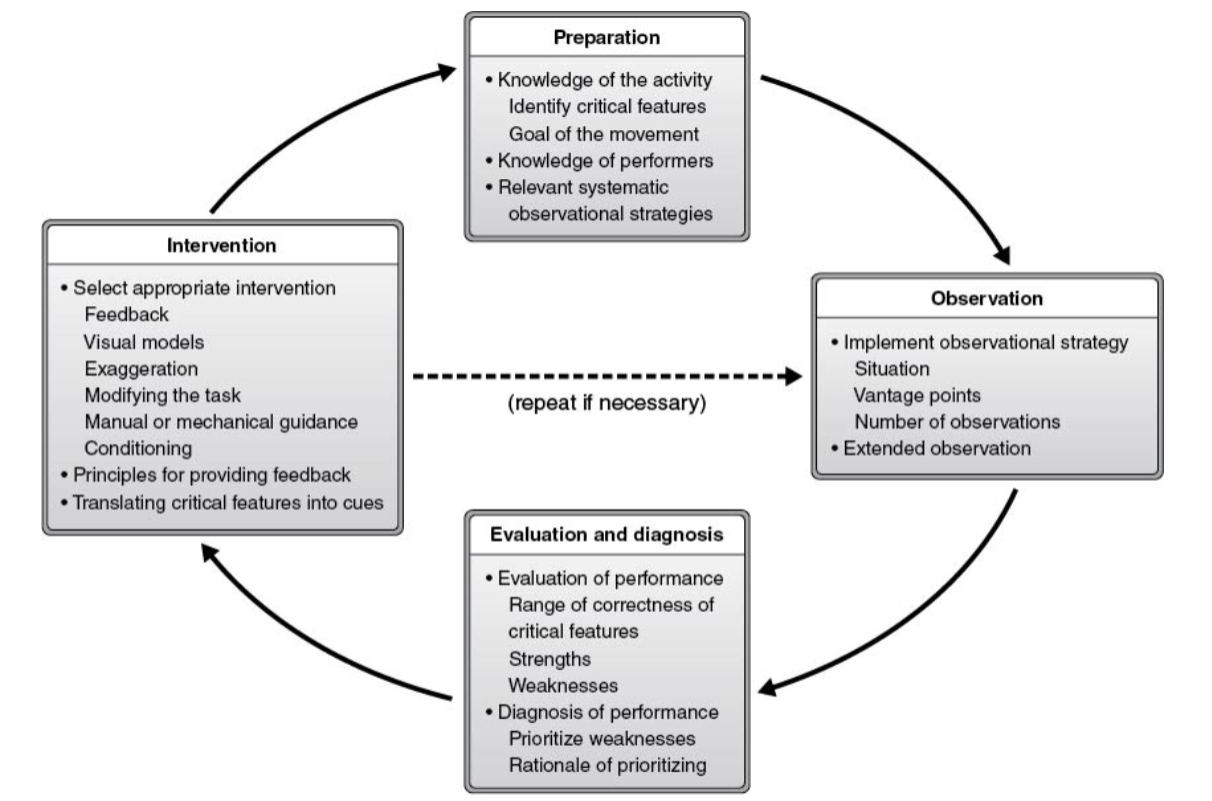
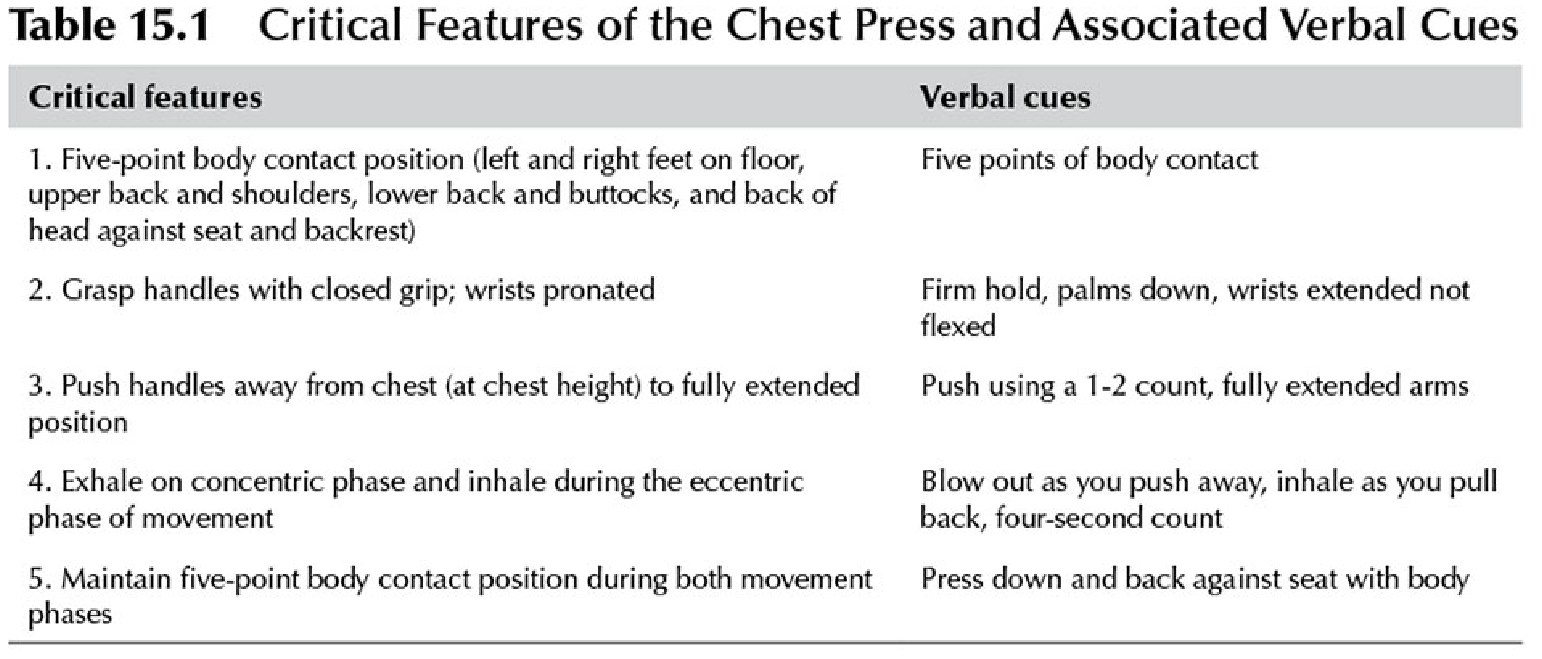
This is the analysis of a machine chest-press exercise
Once you have the critical features for one exercise understood, you can transfer that knowledge to other similar exercises and modify the critical features as necessary
For example: When having a client perform a standing chest press with a resistance band, critical features 2-4 listed in this table would all still be relevant, but 1 and 5 need to be replaced by other critical features, such as keeping the chest up and eyes pointed forward and keeping the body tall during the concentric phase rather than leading into the movement
Acceptable Range of Correctness
A certain amount of permeance error is acceptable for any given critical feature
Necessary to accommodate for medical conditions a client may have, such as back pain, joint surgery, osteoporosis, and structural deviations (e.g., kyphosis: an excessive forward curvature of the spine)
However, performance errors outside of that acceptable range of performance need to be corrected
For example: The knees collapsing inward in a squat
Varies on performance context
For example: The acceptable range of correctness can be a little bit wider for seated activities as compared to those that involve standing, especially if a loss of balance is a concern
Safety should always be the highest priority, acceptable range of correctness should be determined according to risk of injuries that can result of performing the exercise incorrectly
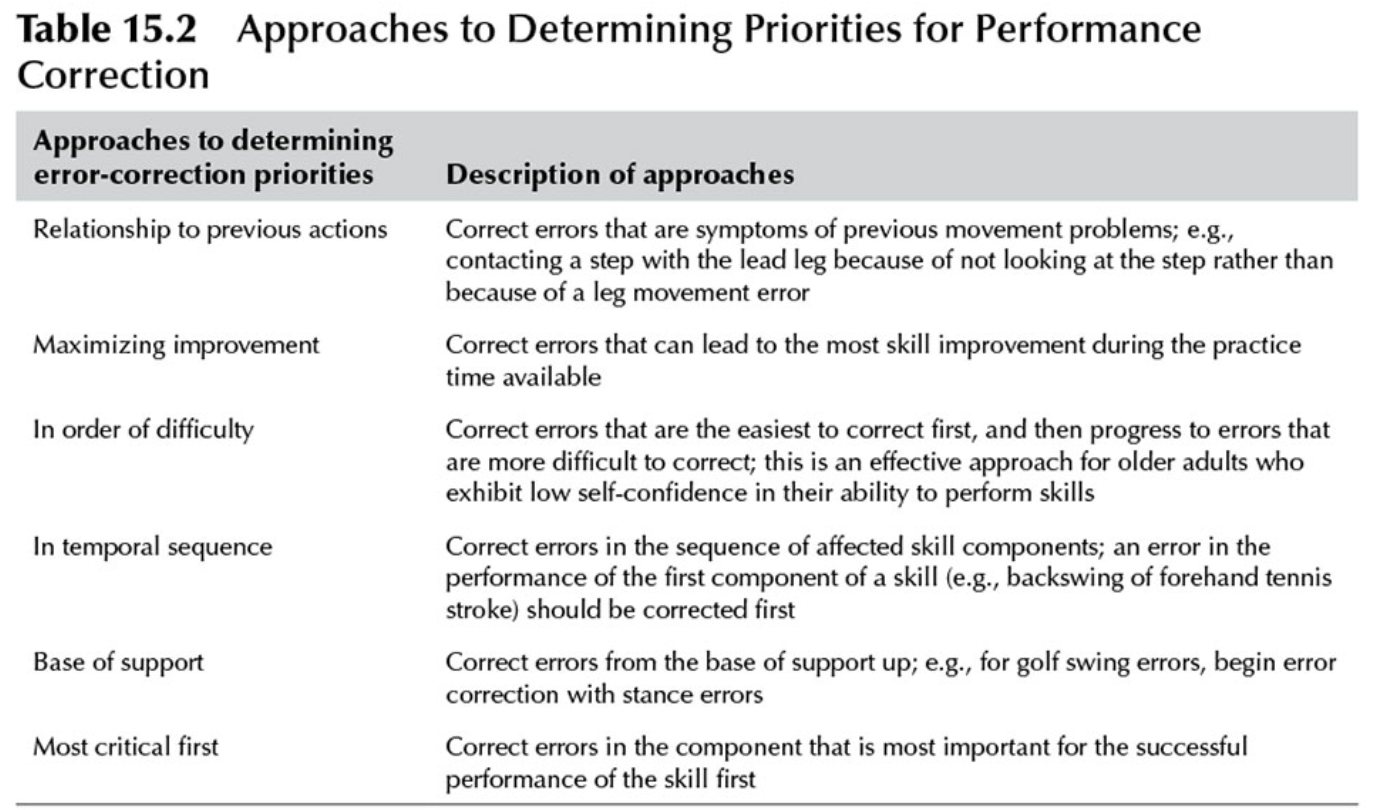
As the instructor, be mindful of the amount of feedback provided to the older adults rather than providing them feedback in every single aspect of the movement that they have performed
How do you determine which of the weaknesses that you have identified during diagnosis should be the ones that you should prioritize?
There are no single one size fits all for all situations
The approach that you select depends on the goal and the type of skill being taught and also the characteristics of the client
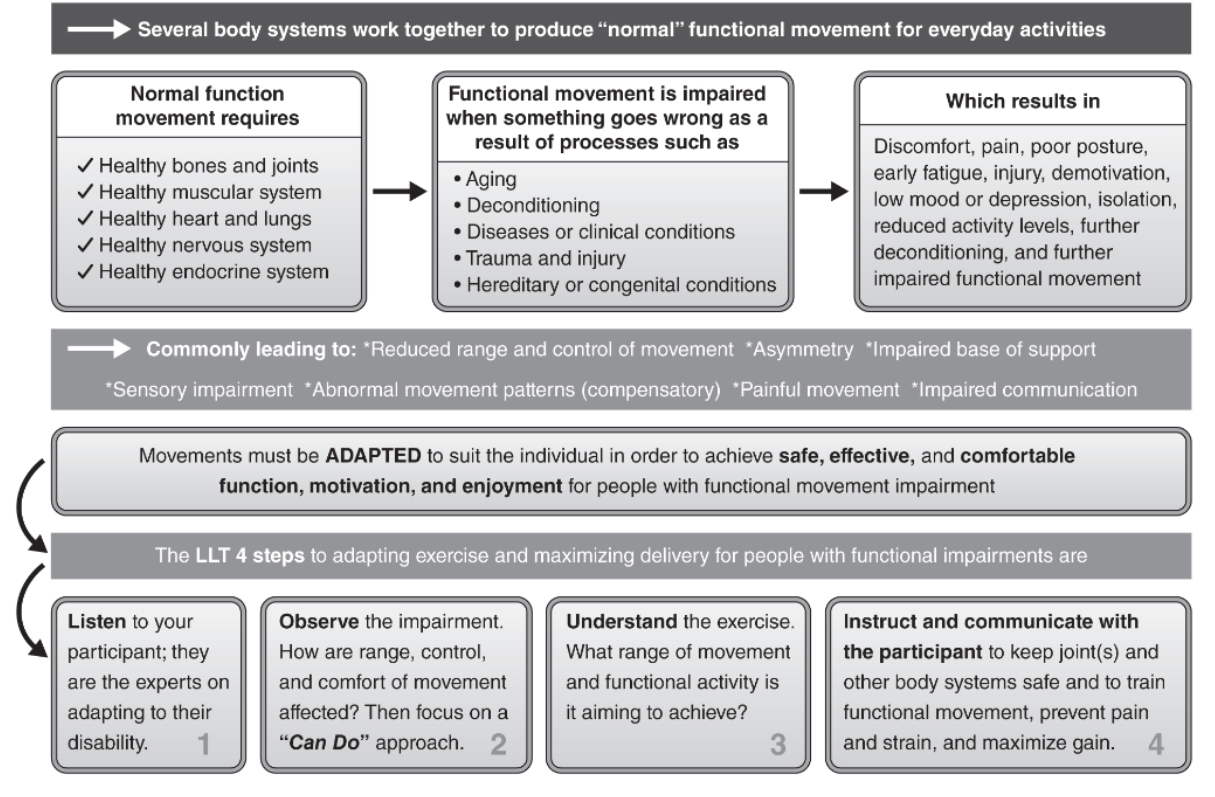
The functional movement solutions guide (based on the guide) helps to identify the functional movement problems, such as physical, sensory, of cognitive problems that might be observed in older adults and provides guidance on what to observe and communicate with your clients and how to best adapt movement patterns to optimize performance
Changes in the systems of the body due to aging, disease, or inactive can result in discomfort, fatigue, injury, etc. often resulting in a cycle of further decondition and further impairments in movement including impaired controlled movement, movement asymmetries, impaired base of support and postural control, sensory impairments, etc.
Movement needs to be adapted to the individual to achieve safe, effective, and comfortable function as well as motivation and enjoyment in people with functional movement impairment
The functional analysis and solutions model involves 4 different steps for adapting exercise (bottom of the image provided above)
Chapter 15-2 - Motor Learning
What is Motor Learning?
Motor Learning: A set of processes associated with practice, or experience, leading to relatively permanent changes in the capability for skilled performance
Learning results from practice or experience that takes place over a period of time
Motor development refers to the changes that occur in our ability to move as we proceed through the lifespan
Motor learning is specifically the result of practice or experience, not other issues, such as the maturation of the nervous system
During this time, there is an observable improvement in the performance of the skill
As performance improves, it becomes increasingly consistent from one attempt to the next
Changes in performance are relatively permanent
Learner is able to perform the skill in a variety of contexts, in which the skill needs to be performed
Transfer of Motor Skill Learning
Transfer of learning refers to the application of skills from one performance context to another
The degree to which the performance of a skill in one context influences (transfers over to) the performance of that same skill in a different context or to the performance of a different skill
Transfer can either be positive or negative
Experience in one skill can either aid in the performance of that skill
Or transfer can be negative
Transfer is generally positive, and when it is negative, the affects are typically temporary
Specificity: The greater the similarity between the practice skill/environment, the greater amount of positive transfer that there will be
What you practice, how, and where you practice it affects motor learning and the amount of transfer that occurs
Applying the four steps of the movement analysis is important to ensure the maximum positive transfer of skills
Assessment of Motor Skill Learning
Produces an acquired capability for skilled performance
Any single performance is not indicative of how well a person has learned a skill
Just because Wet Bananas had a bad game, doesn’t mean he hasn’t learned the game of basketball at all
We depend upon repeated observations of a person’s motor performance over time to evaluate learning
Learning is not directly observable
Essential to assess adaptability
Retention or Transfer test
To assess motor learning
If you are interested in how well a client has learned and able to perform a specific skill, perform a retention test
Ask the client to perform that exact same skill after a period of time without any practice
Transfer tests assess how well a person is able to adapt to contexts and situations that are different from those in which the skill was practiced
Example: Ask your clients to reflect upon or write down short anecdotes about changes that they have experienced throughout their daily lives since beginning the exercise program
The reason why we should assess the learning of clients is to provide evidence to clients, who have paid for your program, that their money was well spent
Stages of Motor Skill Learning (Developed by Anne Gentile)
Initial stage of learning
Movement pattern is not well developed
Performance is inconsistent
Obvious errors
Learner may be aware of making errors but does not know what those errors are or how to correct them
Movement at this stage is attentionally demanding
Therefore, presents difficulty multitasking
Performance of the skill involves excessive movement
Closed skill: performed in an environment that is stable and predictable
Open skill: performed in an environment that is variable and unpredictable
Second stage of learning
Goal depends on the type of skill performed
Fixating the skill (closed skills)
Refining the movement pattern so that it can be consistently performed successfully
Diversifying the skill (open skills)
Being able to modify that movement pattern acquired in the first stage so that is meets the changing demands of the situation
Fewer and smaller errors (and more difficult for instructors to detect)
Stages of Motor Skill Learning
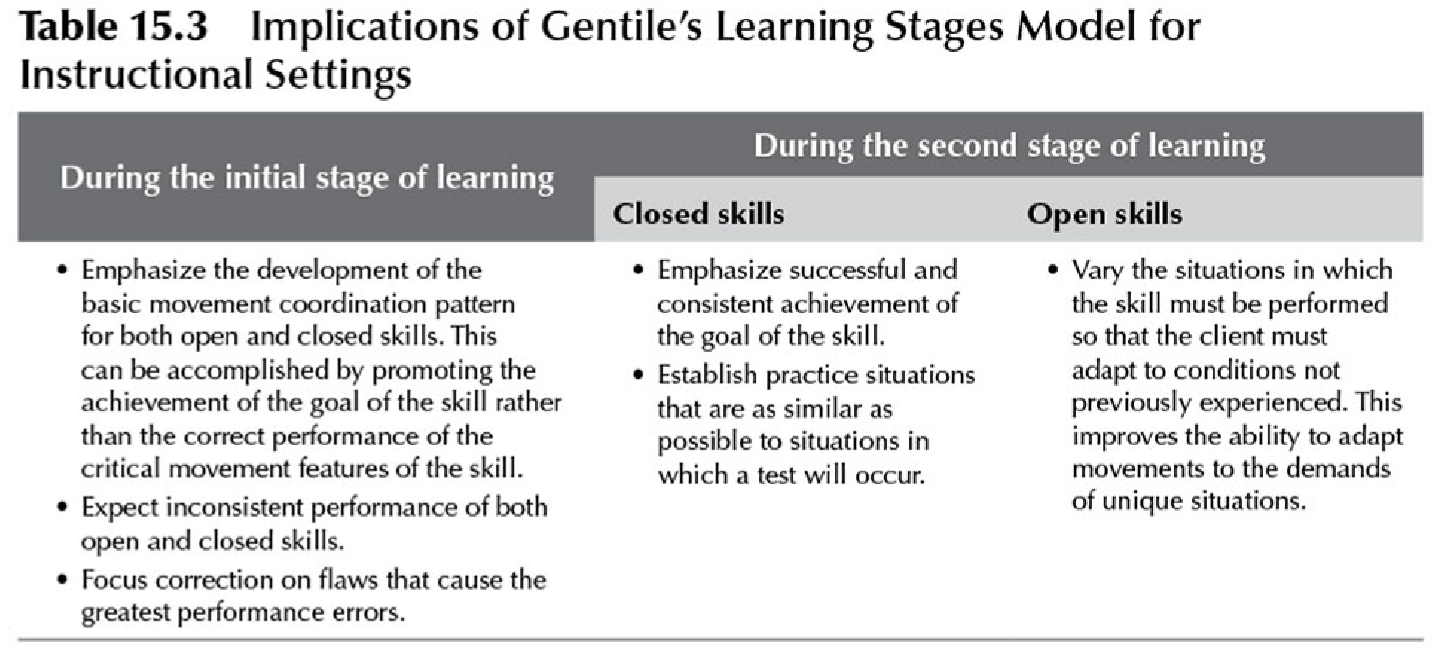
Be cognizant of the attentional demands of movement and structure your feedback/interactions with the client without overwhelming them as they perform the skill
Skill presentation: Demonstrations
Be sure the that client can see the most critical parts of the skill performed
Demonstrate the skill multiple times and at the speed it should be performed
Do not provide a lot of verbal instruction during the demonstration
Instead, use cues before the demonstration to direct the learner’s attention
Allow beginners to observe other beginner but make sure that observers can hear the feedback you are providing
Skill presentation: Verbal Instructions
Focus the learners’ attention on the critical features of the movement or on the environmental context that will enhance their performance of the skill
Do not overwhelm the clients with information
Factors that influence the effectiveness of instructions:
Older adults typically can pay attention to less information at one time and remember that information for a shorter period of time
People to whom instructions are directed must be able to interpret the meaning of the instructions (use comprehensible terminology)
Instructions influence how and where learners focus their attention, influencing how the learner learns that skill
Instructions can help simplify what may appear to the learner to be a complex sequence of movements
Skill Presentation: Verbal Cues
Single words or short, concise phrases that:
Direct the learner’s attention to specific features of their own movements, objects they must do something with, or the environment
Remind learners about the critical feature or parts of the skill
Verbal cues and demonstrations (combination of them) (in certain situations)
Skills that require performing a series of movements in a specific sequence
Skill Presentation: Verbal Instructions
Guidelines for the effective use of the verbal instructions
Include no more than one or two points about how to perform a skill or activity
Use terminology that all learners will understand
Give instructions that conjure up well-known visual images
Use verbal cues to direct the learner’s attention to the aspects that are critical to performing the skill successfully
Augmented Feedback
Additional feedback that is provided by an external source (such as an instructor) that supplements the learner’s internal sensory feedback (feedback that they get from their vision, etc.)
Role of Augmented Feedback
Identify and correct errors
Motivation
Example: Providing feedback on how much progress a client has made will motivate them
Reinforce correct movement
By providing positive reinforcing feedback, such as “keep up the good work” or “your form is improving”
Can be broken down into two categories:
Knowledge of results
Provides augmented feedback about the outcome/result of a performance
Example: Telling a client how long it took for them to complete an activity, such as the figure eight test
Knowledge of performance
Focused on quality of the movement pattern produced
Most augmented feedback is knowledge of performance
Feedback that helps the learner develop the proper technique
Timing of Feedback
There should be a delay between the completion of a movement and when you give feedback on that movement (delay of a few seconds)
Gives the clients a chance to process their own internal feedback
There should be a delay between which you finish giving feedback and having the client perform their next attempt of that skill
Allows them to process the feedback that you provided
Frequency of Feedback
Misconception: More feedback is always better
Evidence shows that not providing feedback after every single attempt is actually more beneficial than providing more feedback after every single attempt
Too much feedback causes a dependency on that feedback
Less frequent feedback as the learning progresses
After good performances, you should highlight what the learner did correctly, not just providing feedback after poor performances
Structuring the Practice Environment
Skill practice
Whole vs. part practice
The decision of which of these is best is based upon two aspects of the skill being practiced
Skill complexity - the number of different component parts of a skill
Skill organization - refers to the temporal and spatial relationship among the parts (a highly organized skill is one in which the performance of any one part depends upon the performance of previous parts)
Progressive-part practice - learner practices the first part, second part, and then combines the first two parts together, learns the third part, and then put everything together (if there’s only three parts)
Works well when teaching older adults longer, more complex sequences of movement, such as an aerobic dance sequence
Part practice is most effective when the complexity is high and the organization is low
Whole practice is more effective when the complexity is low and the organization is high
Practice Schedule
Based upon contextual interference
Refers to the memory related interference that results from practicing different variations of a skill within the same practice session
Example: If, after performing task A, you perform task B, and then go back to task A again, having performed task B in between the trials of performing task A will cause contextual interference and forgetting some of the information needed to perform task A (meaning that you have to relearn it)
Blocked practice - in which each skill is practiced separately in their own “block’ of practice trials causes the least of contextual interference
Serial practice - skills are practiced in a non-repeating but predictable order
Random practice - sequences practiced in a random order and causes the most contextual interference
Generally result in better long-term learning due to the greater cognitive effort required (However, the characteristics of the skill and learner need to be taken into account as well)
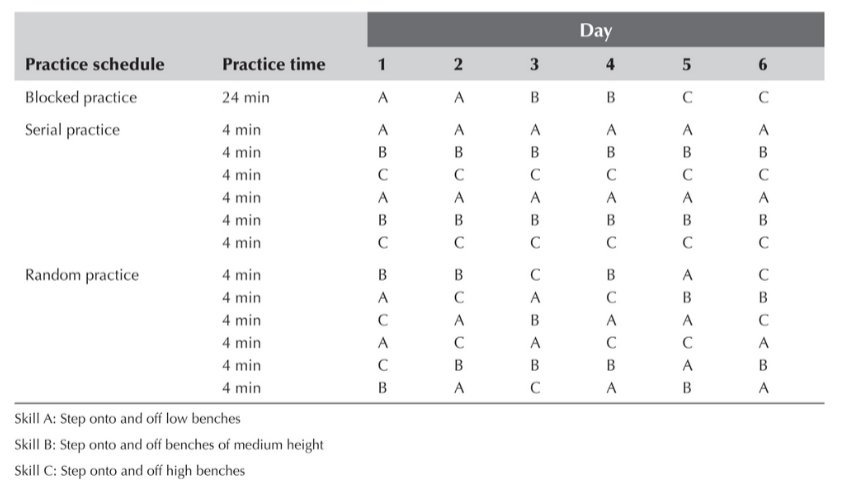
Structuring the Practice Environment
Practice time
Shorter and more frequent practice periods are better for learning
Guidelines
Determine where learners should initially practice the skill in its entirety or in parts
Organize practice sessions in a way that creates more as opposed to less contextual interference
Utilize shorter and more frequent practice periods