Stress, Health, and Human Flourishing
Stress: Some Basic Concepts
Stress - the process by which we perceive and respond to certain events, called stressors, that we appraise as threatening or challenging.
Some people might regard a difficult new class as a welcome challenge, whereas others appraise it as risking failure
Lots of people thrive and excel when stressed
Stress Reactions - From alarm to exhaustion: Physical and emotional Responses
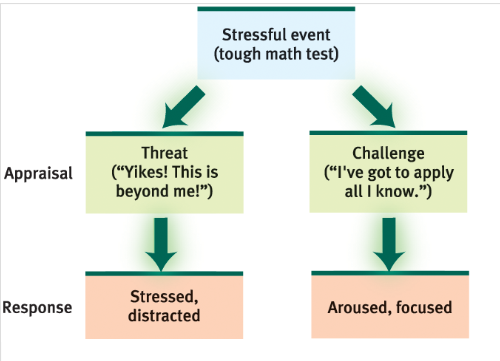
Stress can help and harm us
Mentally exhausting jobs can have physical harm
Can push us to do better
Stressors - things that push our buttons
2 in 3 adults deal with stress during their day
Stressors fall into three main types: catastrophes, significant life changes, and daily stressors.
Catastrophe
Large scale disasters
9/11, tornadoes, Tsunami
We have little control over
Significant Life Changes
Can be positive or negative changes
leaving home, having a loved one die, taking on student debt, losing a job, getting divorced
graduating from college or getting married
Long-term studies indicate that recently widowed, fired, or divorced people are more disease-prone
Daily Stressors and Chronic Stress
Minor hassles
The National Study of Daily Experiences, after following nearly 3000 adults for 20 years, found that as people mature to midlife and then later life, daily stresses subside
Approach and Avoidance Motives - the drive to move toward (approach) or away from (avoid) a stimulus.
approach-approach conflicts, in which two attractive but incompatible options pull us — to choose tacos or pizza, a funny movie or a drama, the green or the gray hoodie.
avoidance-avoidance conflict between two undesirable alternatives. Do you avoid studying a disliked subject — or avoid failure by doing your reading?
Approach-Avoidance conflicts feel simultaneously attracted and repelled
You like your job but dislike working online
Chronic Stress - stress that is ongoing, often for a long period of time, such as consistent daily work or school pressures, financial instability, or long-term illness.
Such chronic daily stressors can harm physical health years later — and even shorten life
Black Americans who have experienced police brutality are at greater risk of depression, anxiety, and heart disease'
Same-sex sexual orientation who face frequent prejudice in their communities have died, on average, 12 years sooner than have those who live in more accepting communities
Stress Reactions — From Alarm to Exhaustion
Walter Cannon’s Findings (1929)
Fight-Or-Flight Reaction - an emergency response, including activation of the sympathetic nervous system, that mobilizes energy and activity for attacking or escaping a threat.
When your brain sounds an alarm, your sympathetic nervous system responds
Increases heart rate and breathing
Diverts blood from digestive organs to skeletal muscles
Dulls the feeling of pain
Releases sugar and fat from the body as energy stores
Better at dealing with immediate emergencies than long term ones
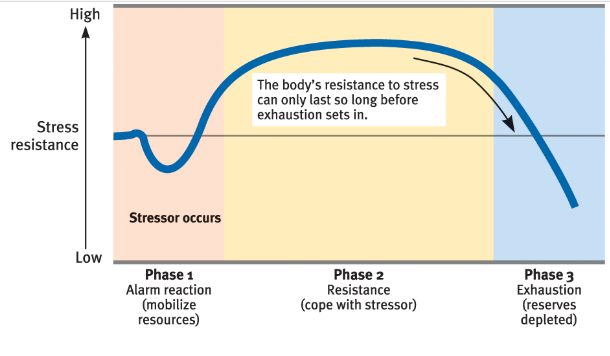
General Adaptation Syndrome (GAS) - Hans Selye’s concept of the body’s adaptive response to stress in three stages — alarm, resistance, exhaustion.
Alarm Reaction : your sympathetic nervous system suddenly activates.
Resistance : You are fully engaged, summoning all your resources to meet the challenge.
Exhaustion : As time passes, with no relief from stress, your reserves begin to run out.
Other stress responses: withdraw, isolate, and conserve energy
Tend-and-Befriend Response - under stress, people (especially women) often provide support to others (tend) and bond with and seek support from others (befriend).
Stress Effects and Health
Stress management is one way to stay healthy
Psychoneuroimmunology - the study of how psychological, neural, and endocrine processes combine to affect our immune system and health.
Your emotions (psycho) affect your brain (neuro), which controls the endocrine hormones that influence your disease-fighting immune system. And this field is the study (ology) of those interactions
Functioning Immune System:
Keeps you healthy by capturing and destroying bacteria, viruses, and other invaders (cancer)
Affected by age, nutrition, genetics, and stress level
There are two ways in which the Immune system does not function properly:
Overreacting: Immune system may attack the body’s own tissues, causing some form of arthritis or allergic reactions
Puts women at higher risk of autoimmune disease
Underreacting: The immune system may allow a bacterial infection to flare, a dormant herpes virus to erupt, or cancer cells to multiply
Stress hormones affect our immune system
In laboratories, immune system suppression appears when animals are stressed by physical restraints, unavoidable electric shocks, noise, crowding, cold water, social defeat, or separation from their mothers
Surgical wounds heal slowly in stressed people
Stressed people develop colds more readily.
Stress can speed the course of disease
Since it takes energy to use your immune system, and stress uses up a lot of energy, it makes sense that being stressed harms your immune system
During an aroused fight-or-flight reaction, your stress responses draw energy away from your disease-fighting immune system and send it to your muscles and brain
Stress and Heart Disease
Coronary Heart Disease - the clogging of the vessels that nourish the heart muscle; a leading cause of death in many countries.
Stress and personality also play a big role in heart disease.
The more ongoing stress people experience, the more their bodies generate inflammation, which is associated with heart and other health problems, including depression
Smoking, obesity, unhealthy diet, physical inactivity, and high cholesterol are other factors
The Effects of Personality
Type A - Friedman and Rosenman’s term for competitive, hard-driving, impatient, verbally aggressive, and anger-prone people.
Toxic Core: Negative emotions, especially anger
More likely to experience Heart Attacks
Type B - Friedman and Rosenman’s term for easygoing, relaxed people.
Why was Type A more likely to get a heart attack? Type A’s toxic core is negative emotions — especially anger is the reason
Their often-active sympathetic nervous system redistributes blood flow to their muscles, pulling blood away from their internal organs.
suppressing negative emotions increases gloomy moods, relationship problems, and health risks
The Effects of Pessimism and Depression
Pessimism increasing the risk of a heart attack
Depression poses a serious risk for heart disease
Depressed people tend to age faster and die sooner
Coping with Stress
Problem Focused Coping - attempting to reduce stress by changing the stressor or the way we interact with that stressor.
Involves changing the stressor or the way one interacts with that stressor
Emotion-Focused Coping - attempting to reduce stress by attending to emotional needs related to our stress reaction.
Attempts to reduce stress by attending to emotional needs related to the stress reaction
People who endure distressing events can cope with stress successfully by demonstrating resilience
Make your outlook more optimistic, emotional regulation, Social Support
Personal Control - our sense of controlling our environment rather than feeling helpless.
Learned Helplessness - the hopelessness and passive resignation humans and other animals learn when unable to avoid repeated aversive events.
External Locus of Control - the perception that outside forces beyond our personal control determine our fate.
Internal Locus of Control - the perception that we control our own fate.
Self Control - the ability to control impulses and delay short-term gratification for greater long-term rewards.
Emotional Regulation - how we manage our emotions, including which emotions we allow ourselves to feel, when we feel them, and how we express those emotions.
James Gross came up with emotional regulation strategies
Tips on managing emotions
Accept rather than criticize your feelings
Develop an emotion road map
Create a supportive environment
Remember that emotions are temporary
Social Support - Feeling liked, encouraged, and helped when needed prompts happiness and health
Helps cope with stress
Happy marriages lead to less weight gain and a longer life
Laughter among friends is good for health
Calms the cardioviral system
Fosters stronger immune functioning
Having a pet increases the odds of survival after a heart attack, relieve depression, lower blood pressure
Aerobic Exercise - involves sustained activity that increases heart and lung function
Relaxation - improves well being
provides relief from headaches, high blood pressure, enxiety, insomnia
Helps type a heart attack survivors reduce risk of future attacks
Meditation - used to reduce suffering and improve awareness, insight, and compassion
Mindfulness Meditation - reflective practice in which people attend to current experiences in a nonjudgmental and accepting manner
boosts happiness and lessens anxiety and depression
Linked with improved sleep, helpfulness, and better immune systems
Faith Factor- belonging to a religious collective is associated with a strong proactive effect
Healthy behaviors
social support
positive emotions
Happiness - positive emotions
Feel good, do good phenomenon - tendency to be helpful to other people when in a good mood
Subjective well being - self-perceived satisfaction with life
When are we happiuest?
use of positive and negative emotion words
Friday and Saturday / Friday to Sunday
Positive emotions tend to rise in the early to middle part of most day
People tend to bounce back from a bad day to do a better than usual good mood the following day
Adaptive level phenomenon
tendency to form judgements of sounds, of lights, and of income relative to a neutral level defined by past experiences
Who is happy?
Interplay with nature and nurture
* Genes: 31 percent of the difference among people’s happiness ratings are heritable, attributable to genes
Personal history and culture
values vary; one groups happiness might differ from another groups
Individualism vs communal cultures
Each person’s happiness varies around a set-point
Does money buy you happiness?
personal income predicts happiness
having money to eat, feel in control of your life, and experience special treats predict greater happiness
Piling up more money matters less after achieving comfort and security
Extreme poverty often means misery, which can be reduced by more fairly distributed economic growth
Is our happiness relative to toehrs?
In individualist cultures, we believe our happiness is independent of others
not really true because we depend on social support