1.2.7 Price mechanism summary
The basic economic problem means that we have infinite wants and scarce resources. Economics is the study of how we solve this fundamental problem. In a market economy scarce resources are allocated through the interaction of supply and demand and the price mechanism.
The role of prices in an economy / functions of prices
Have you ever wondered why goods and services have the price they do? For example, why are diamonds and gold so much more expensive than water or sugar? After all, water is essential for our day-to-day survival whereas diamonds and gold are, arguably, nothing more than bling. Likewise, I am sure you can imagine a world without diamonds and gold, but can you imagine a world without sugar? No cakes, fizzy drinks, chocolate, crunchy nut corn flakes….!!
Therefore, prices do not necessarily reflect the usefulness of a good but rather the scarcity of a good. Gold and diamonds are both finite in supply (i.e. there is a fixed amount of them in the world) whereas water and sugar are, depending on location in the world, non-scarce resources. For example, if supplies of sugar run low – more can be planted. Whereas supplies of new gold are difficult to find, need a lot of resources to extract, and will fully run out one day.
The three functions of prices
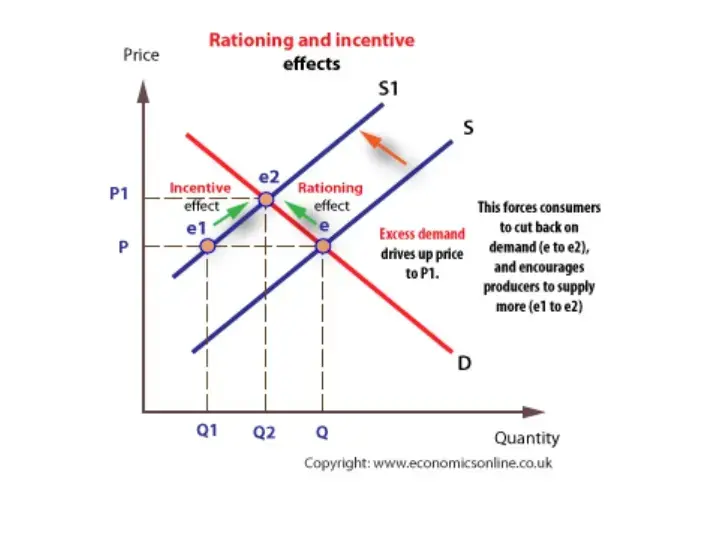
Rationing function – because resources are scarce and finite, not everyone is able to buy everything they want; when demand is greater than supply, then prices are bid up so that the good/service is rationed out to those who can afford to pay. If gold was the same price as sugar too much would be demanded and it would run out. Prices help to make sure that finite resources are rationed.
Signalling function – prices help to determine where and how resources should be allocated. For instance, if prices of a particular good increase it sends a message to producers that demand is probably high and that they should increase production. For example, high oil prices have encouraged the large oil companies to search for new supplies by exploring potential new oil fields.
Incentive function – prices help to change the behaviour of consumers and producers. For example, the government imposes high taxes on cigarettes which push up the price thus reducing the incentive of consumers to smoke. Alternatively, the government may use subsidies to reduce the price of goods it feels we should consume more of.
The price mechanism
The price mechanism, which is the use of prices to manipulate supply and demand and move markets to equilibrium (where demand equals supply and markets clear).
To illustrate the price mechanism further we will use the following example. Suppose some scientific research suggests owning a floral teddy massively reduces stress-related illnesses. The result of this, all other things being equal (ceteris paribus), would be an increase in demand for floral teddies; shown in the graph below.
The market is initially in equilibrium at Pe/Qe.
The increase in demand would initially cause excess demand for teddies at the equilibrium price of Pe – shown by arrow (1). There would now be Qd demanded at price Pe but only Qe supplied.
The shortage of teddies will signal to producers that they are able to raise their prices to try to clear the market. This should cause demand to fall due to the rationing effect of higher prices – shown by a movement along the demand curve following arrow (2).
At the same time, supply would increase due to the incentive effect of higher prices as new suppliers are attracted into the market – this is shown by a movement along the supply curve following arrow (3).
The market would eventually clear at a new equilibrium of P1/Q1. This new price will now send a signal to the rest of the economy that more resources need to be allocated to this particular market. If prices were to fall, this would send a signal to the rest of the economy that fewer resources need to be allocated to this particular market.
This is how the price mechanism allocates resources in a market economy.