Kinematics
Kinematics Concepts
Distance: total length moved irrespective of direction
Displacement: shortest distance in a certain direction
Speed: distance traveled per unit of time, no direction
Velocity: the rate of change of displacement
Acceleration: the rate of change of velocity
Equations of Motions
s=ut+12at2s=ut+21at2
v=u+atv=u+at
v2=u2+2asv2=u2+2as
s=(v1+v2)2×ts=2(v1+v2)×t
Linear Motion
Distance: total length moved irrespective of direction
Displacement: distance in a certain direction
Speed: distance traveled per unit of time, no direction
Velocity: the rate of change of displacement
Acceleration: the rate of change of velocity
Displacement-time graph:
Gradient = velocity
Non-Linear Motion
Velocity-time graph:
Gradient = acceleration
The area under graph = change in displacement
Uniform acceleration and straight-line motion equations:
v=u+atv=u+at
s=ut+12at2s=ut+21at2 =vt−12at2=vt−21at2
s=12(u+v)ts=21(u+v)t
v2=u2+2asv2=u2+2as
Acceleration of free fall = 9.81ms-2
Motion of Freefalling Bodies
Displacement | Continues to curve as it accelerates | 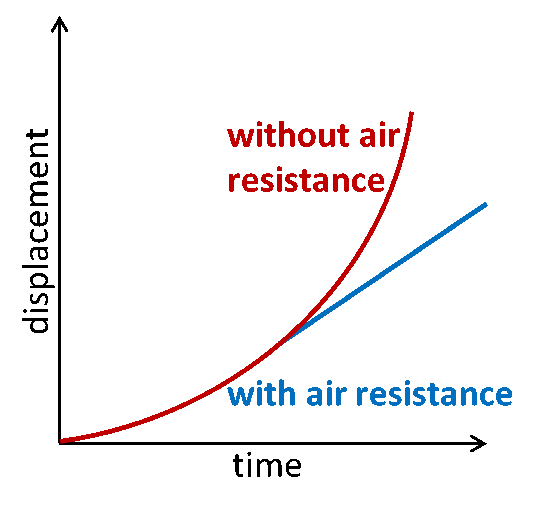 |
|---|---|---|
Graph levels off as it reaches terminal velocity | ||
Velocity | Continues to accelerate constantly | 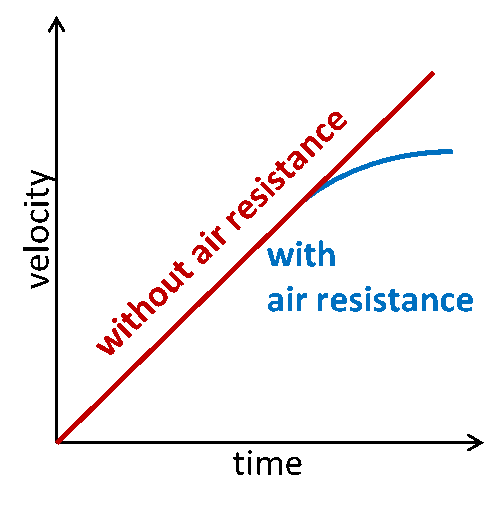 |
Graph curves as it decelerates and levels off to terminal velocity | ||
Acceleration | Straight line | |
Graph curves down to zero because the resultant force equals zero | 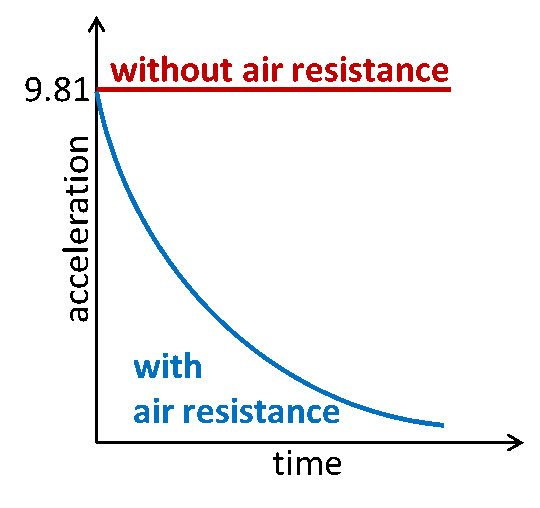 |
Determining Acceleration of Free Fall
A steel ball is held on an electromagnet.
When the electromagnet is switched off, the ball interrupts a light beam, and a timer starts.
As the ball falls, it interrupts a second beam of light & timer stopped
Vertical distance hh is plotted against t2t2
s=ut+12at2s=ut+21at2 and u=0u=0 ; s=12at2s=21at2 i.e h=12gt2h=21gt2
Projectile motion
Projectile motion: uniform velocity in one direction and constant acceleration in perpendicular direction
Horizontal motion = constant velocity (speed at which projectile is thrown)
Vertical motion = constant acceleration (caused by the weight of the object, constant free fall acceleration)
Curved path – parabolic (y∝x2)(y∝x2)
Component of Velocity | ||
|---|---|---|
Horizontal | Vertical | |
Without air Resistance | Constant | Increases at a constant rate |
With Air resistance | Decreases to zero | Increases to a constant value |
Motion of a Skydiver
Physical