chapter 6: learning
overview
- learning is defined as a long-lasting change in behavior resulting from experience
- most psychologists agree that learning is best measured through changes in behavior
classical conditioning
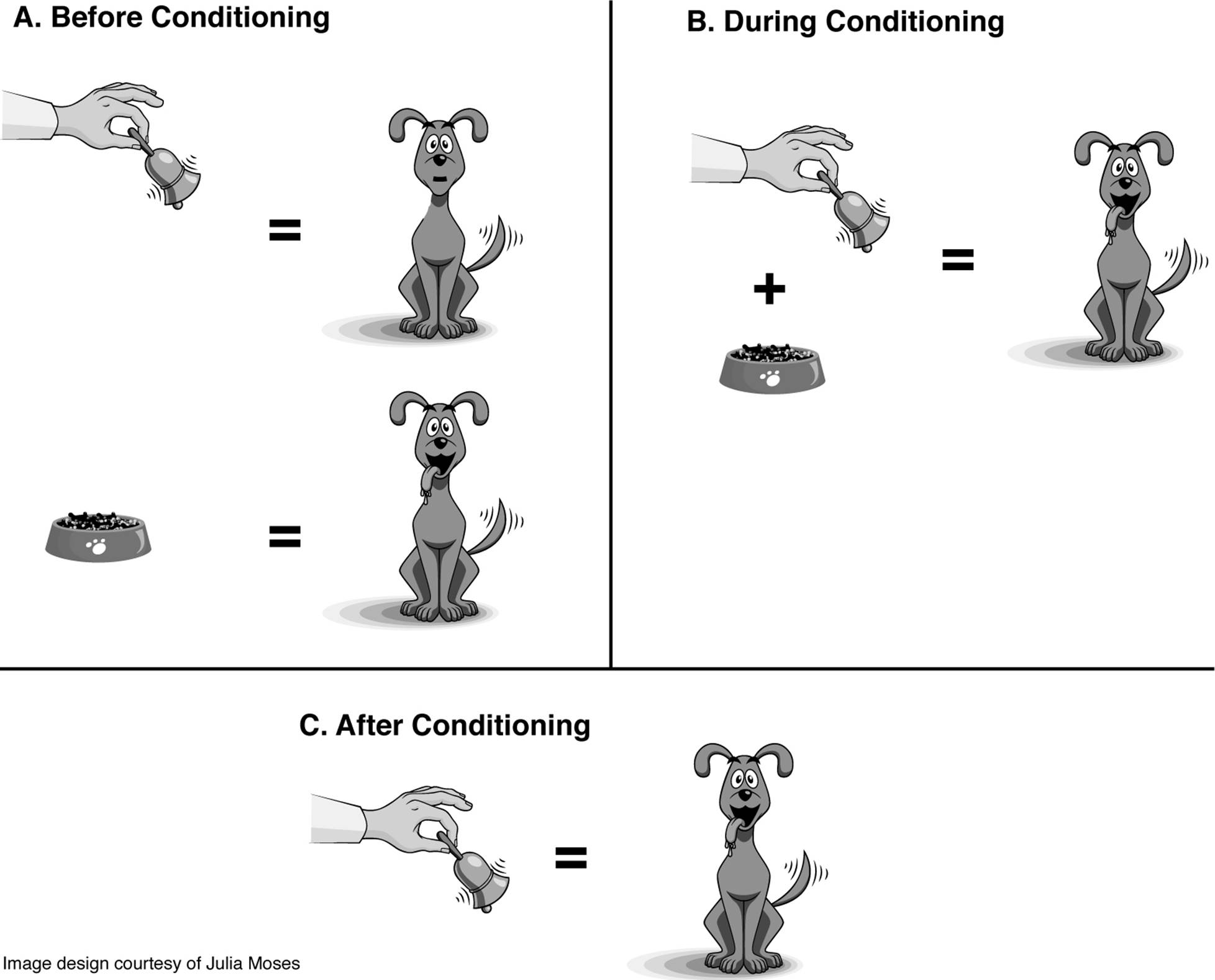
- Ivan Pavlov found that dogs learned to pair sounds in the environment where they were fed with the food that was given to them and would salivate by hearing those sounds
- from this discovery, Pavlov created the basic principle of classical conditioning
- classical conditioning - people and animals can learn to associate neutral stimuli with stimuli that produce involuntary responses and will learn to respond similarly to the stimulus as they did to the old one
- example: with the dog experiment, the sound was the neutral stimuli, involuntary responses were the food, and the similar response was salivation
- unconditioned stimulus (US or UCS) - the original stimulus that elicits a response
- example: with the dog experiment, the US is food
- unconditioned response (UR or UCR) - the involuntary response produced from the unconditioned stimulus
- example: with the dog experiment, the UR is salivation
- conditioned response (CR) - the response made by a person or animal after learning to associate an experience with a neutral or arbitrary stimulus
- conditioned stimulus (CS) - this is what occurs when a neutral stimulus and a conditioned response are paired
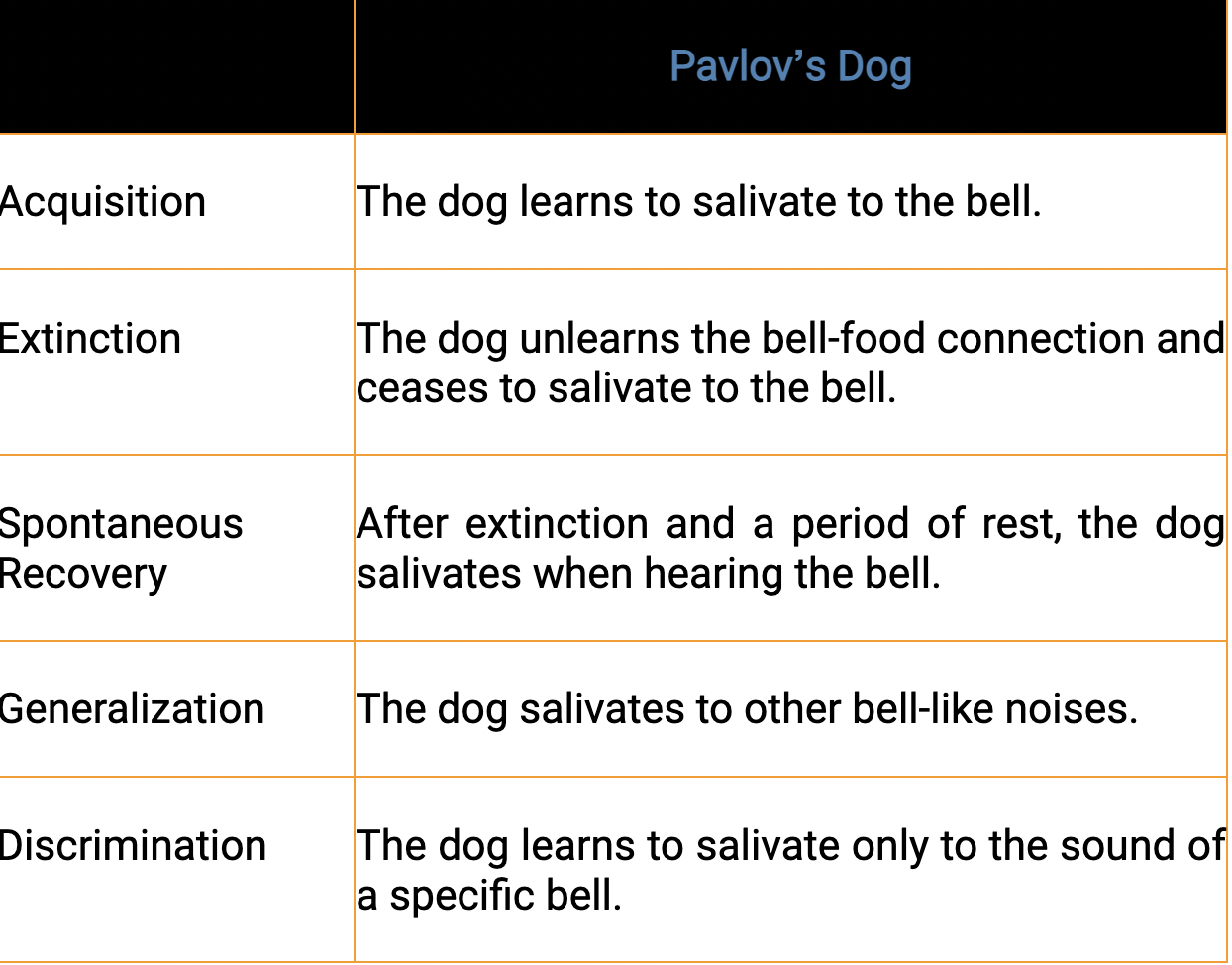
- acquisition - when animals respond to a conditioned stimulus without the unconditioned stimulus being present to them
- factors that affect acquisition include:
- repeated pairings of conditional stimuli and unconditioned stimuli create stronger conditional responses
- the order and timing of the conditioned stimulus and the unconditioned stimulus
- the most effective method of conditioning is presenting the conditional stimulus first and then introducing the unconditional stimulus while the conditional stimulus is still present
- delayed conditioning - a procedure in which the conditioned stimulus is presented, and remains present, for a fixed period (the delay) before the unconditioned stimulus is introduced
- less effective methods of learning include:
- trace conditioning: the conditional stimulus is presented first, a delay, and the unconditional stimulus is presented
- simultaneous conditioning: the conditional stimulus and the unconditional stimulus are presented at the same time
- backward conditioning: the unconditional stimulus is presented first, then the conditional stimulus
- extinction - the process of unlearning a behavior
- extinction takes place when the conditional stimulus doesn’t elicit the conditional response and repeatedly presents the conditional stimulus without the unconditional stimulus, losing the association between the two
- spontaneous recovery - after a conditioned response is gone and no other training of the animals has taken place, the response reappears after the conditioned stimulus is presented again
- generalization - the tendency to respond to similar conditional stimuli
- discriminate - to tell the difference between various stimuli
- aversive conditioning - conditioned to have a negative response
- example: John Watson and Rosalie Rayner’s experiment by conditioning a little boy named Albert to fear a little rat
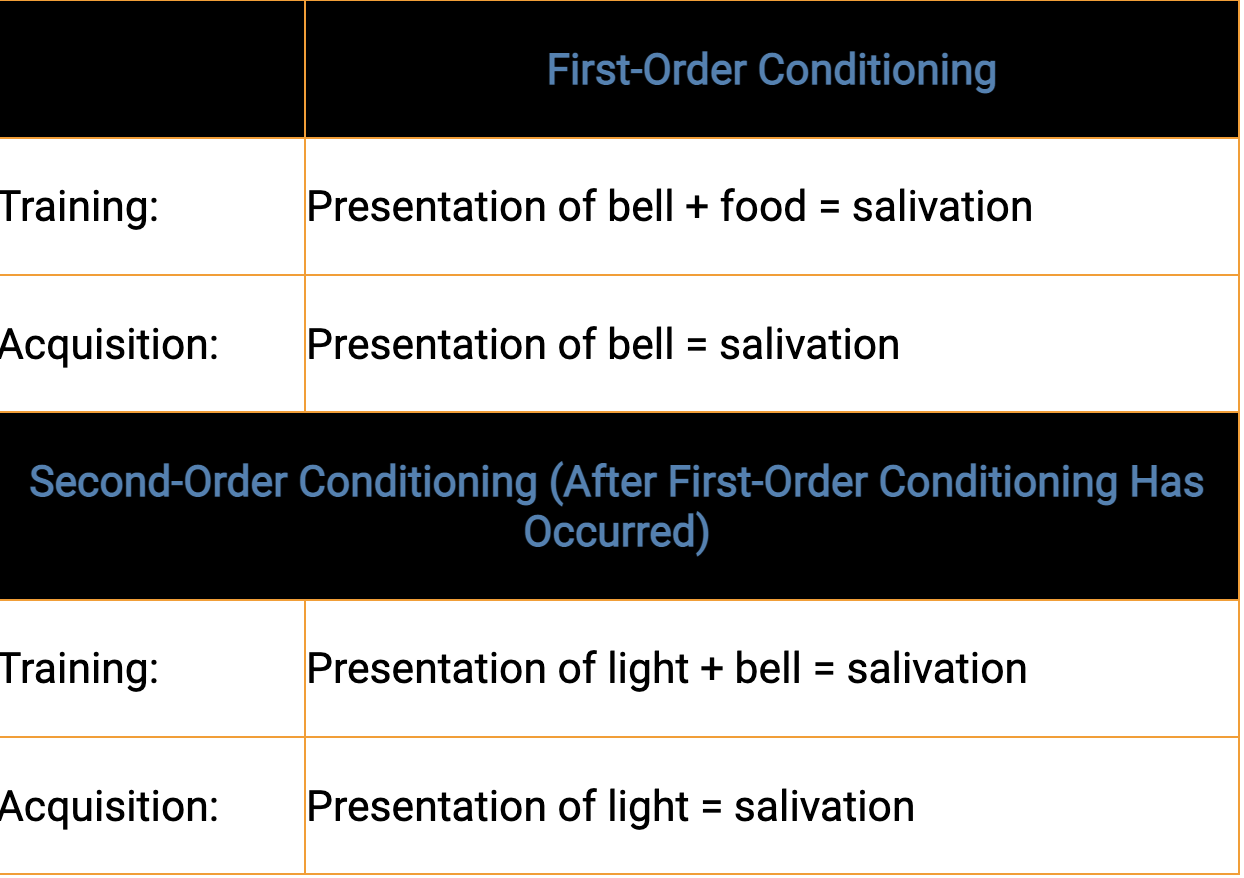
- second-order/higher-order conditioning - once a conditional stimulus elicits a conditional response, you could briefly use a conditional stimulus as an unconditional stimulus to condition a response to a new stimulus
biology and classical conditioning
- learned taste aversions - an association between the taste of a particular food and illness such that the food is considered to be the cause of the illness
- salient - this type of stimulus is easily noticeable and creates a more powerful conditioned response
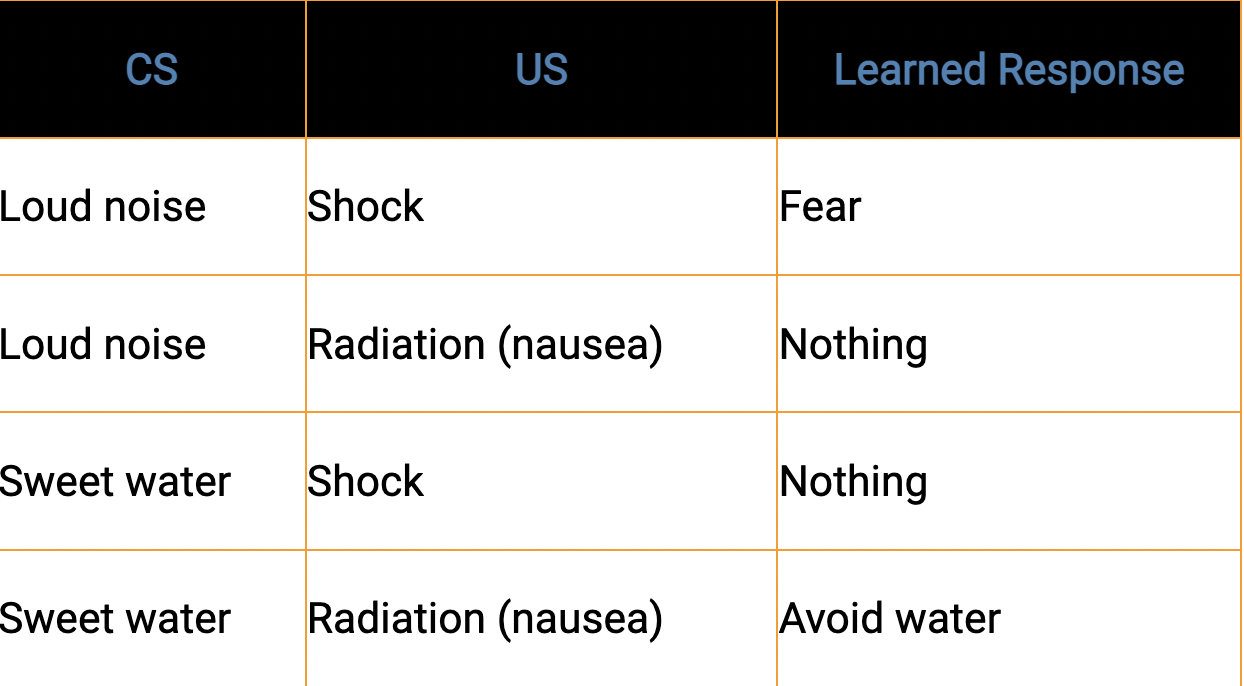
- John Garcia and Robert Koelling performed an experiment saying how rats learned to make associations faster than others did
operant conditioning
- operant conditioning - a kind of learning based on the association of consequences with one’s behaviors
- Edward Thorndike was one of the first people to research this kind of learning
- he conducted an experiment where a cat was in a cage next to a dish of food. the cat to get out in order to get the food. throughout the number of trials, the cat had done to get out of the box, the time decreased
- from this experiment, we learned that the cat learned new behavior without mental activity but simply connecting a stimulus and a response
- law of effect - states that if the consequences of a behavior are pleasant the stimulus-response connection will be strengthened and the likelihood of the behavior will increase. however, if the consequences of a behavior are unpleasant, the connection will weaken and the likelihood of the behavior will decrease
- instrumental learning - the term Thorndike used to describe his work since he believed the consequence was instrumental in shaping future behaviors
- B.F. Skinner - coined the term operant conditioning and created a Skinner box
- Skinner box - a way to deliver food to an animal and a level to press or disk to peck in order to get the food
- the food would be called a reinforcer whle the process of giving the food would be called reinforcement
- reinforcement is also defined by its consequences: anything that makes a behavior more likely to occur is a reinforcer
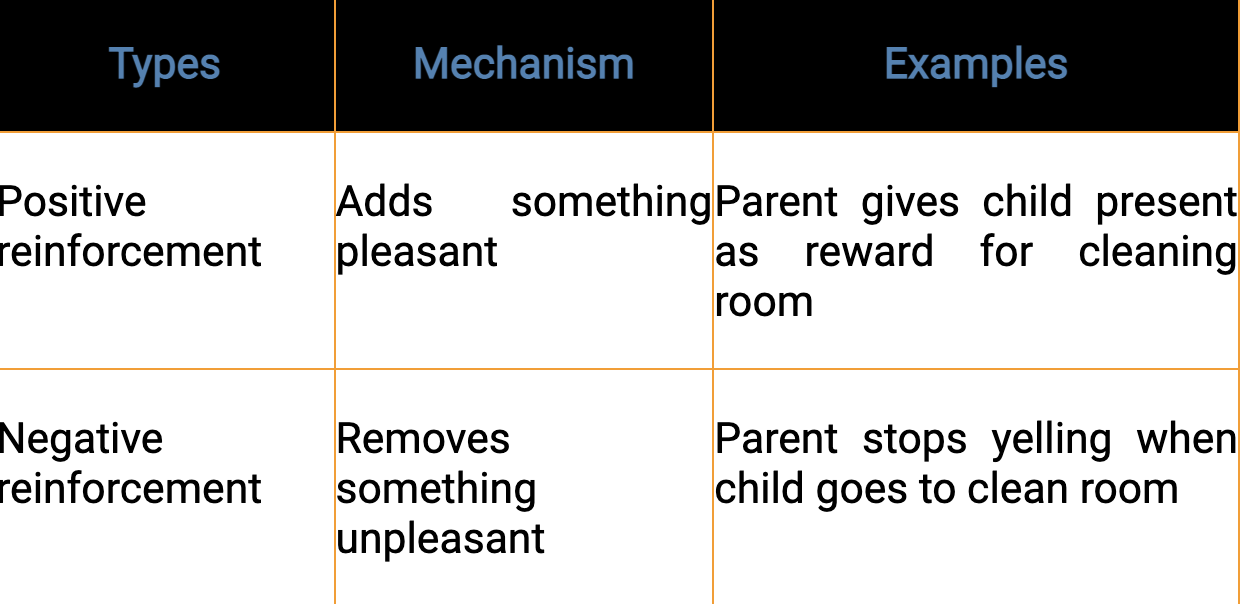
- positive reinforcement - refers to the addition of something pleasant
- example: if we give a rat in a Skinner box food when it presses a lever, we are using positive reinforcement
- negative reinforcement - the removal of something unpleasant
- example: if we terminate a loud noise or shock in response to a press of the lever, we are using negative reinforcement
- escape learning - allows one to terminate an averive stimulus
- example: if someone is causing chaos in a classroom, and they are asked to leave
- avoidance learning - enables one to avoid the unpleasant stimulus altogether
- example: if someone cut a class
- punishment - anything that makes a behavior less likely
- there are two types of punishment: positive punishment (usually just referred to as punishment) and omission training (or negative punishment
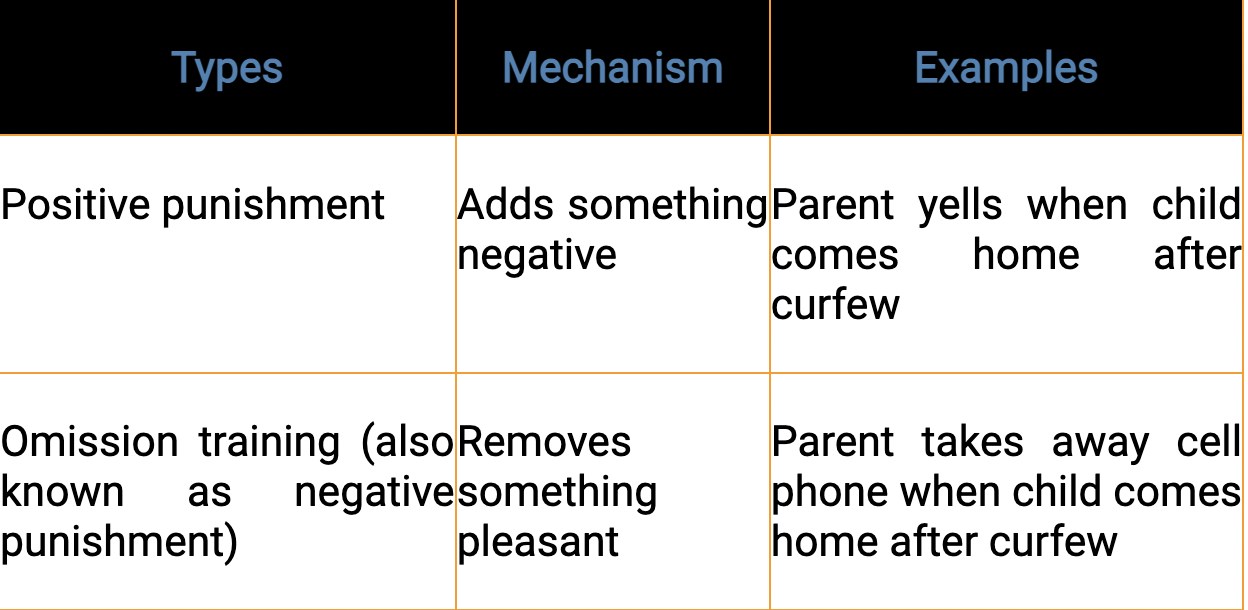
positive punishment - the addition of something unpleasant
- example: if we give a rat an electric shock every time it touches the lever
- negative punishment - the removal of something unpleasant
- example: if we remove the rat’s food when it touches the lever
punishment versus reinforcement
- punishment is operant conditioning’s version of aversive conditioning and is more effective if it occurs immediately after the unwanted behavior and is harsh
- however, harsh punishment can also ;read tp unwanted consequences such as fear or anger
- shaping - reinforced the steps used to reach the desired nejavopr
- example: the rat might be reinforced for going to the side of the box with the lever. then we might reinforce the rat for touching the lever with any part of its body. by rewarding the rat step by step, the rat may understand what type of behavior we’re looking for
- chaining - to be taught to perform a number of responses successively in order to get a reward
- example: a rat named Barnabus had to run through an obstacle course to obtain food
- the goal of shaping was to mold a single behavior while the goal in chaining was to link together separate behaviors into something more difficult
- acquisition, extinction, spontaneous recovery, discrimination, and generalization occur in operant conditioning as well
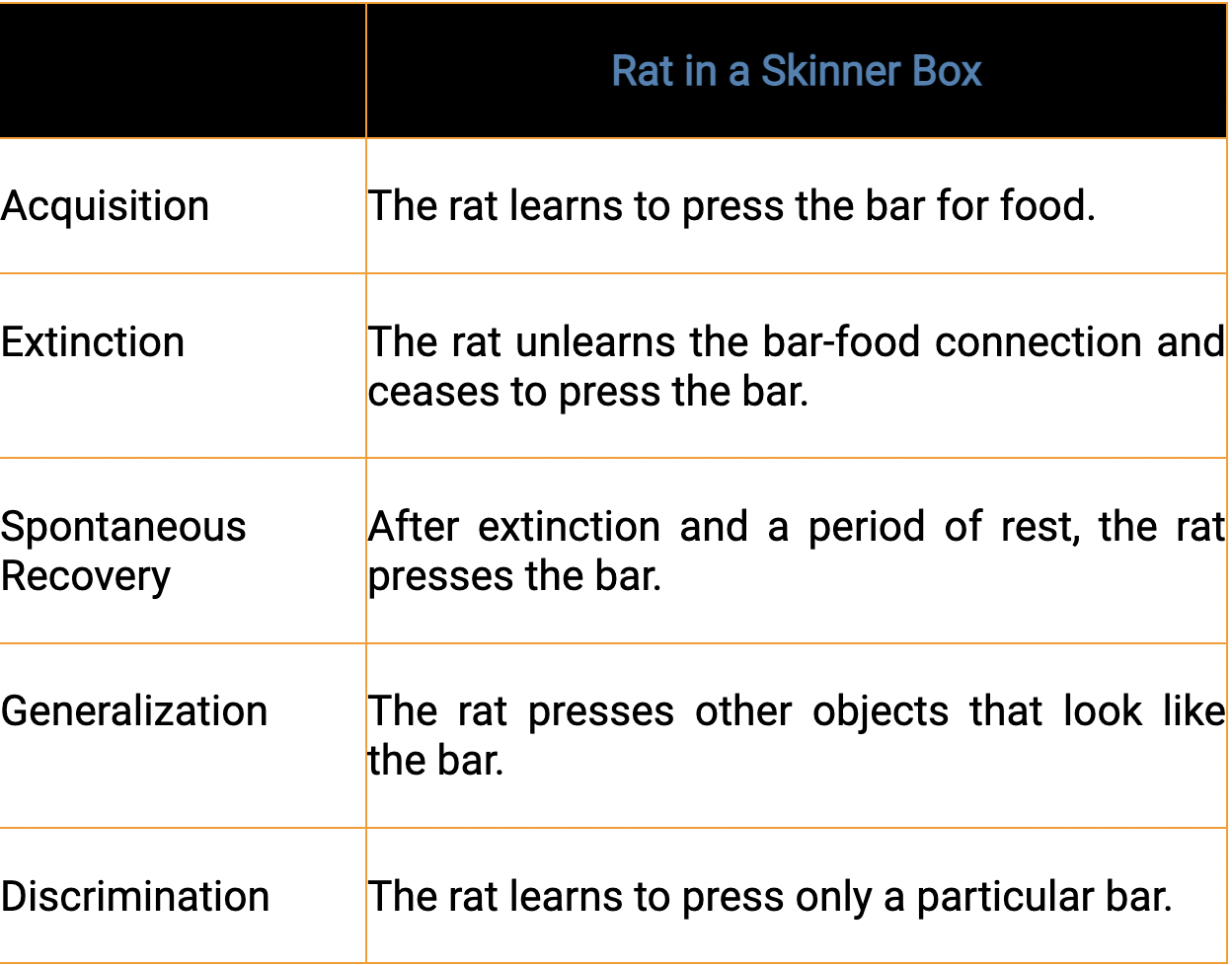
- acquisition would be when the rat learned to press the lever to get the reward
- extinction would be when the rat doesn’t want to press the lever since there isn’t a reward
- spontaneous recovery would be when after unlearning to press the lever, and without providing any further training, it starts to do it again
- generalization would be if the rat started pressing other things in the Skinner box
- discrimination would be teaching the rat to only press one lever or press a lever on conditions
- discriminative stimulus - when you teach an animal to do something only on certain conditions
- there are two types of reinforcers: primary and secondary
- primary reinforcers are rewarding, while secondary reinforcers are things we learn to value
- examples of primary reinforcers: food, water, or rest
- examples of secondary reinforcers: money, praise, or the chance to play a video game
- money is a special kind of secondary reinforcer, so it’s called a generalized reinforcer, since it can be traded for anything
- token economy - every time people perform a desired behavior, they are given a token and are allowed to trade their tokens for any one of a variety of reinforcers
- Premack principle - explains that whichever of two activities is preferred can be used to reinforce the activity that isn’t preferred
reinforcement schedules
- continuous reinforcement - rewarding a behavior everytime if you are teaching a new behavior
- reinforcement schedules different in two ways:
- what determines when reinforcement is delivered-the number of responses made or the passage of time
- the pattern of reinforcment-either constant or changing
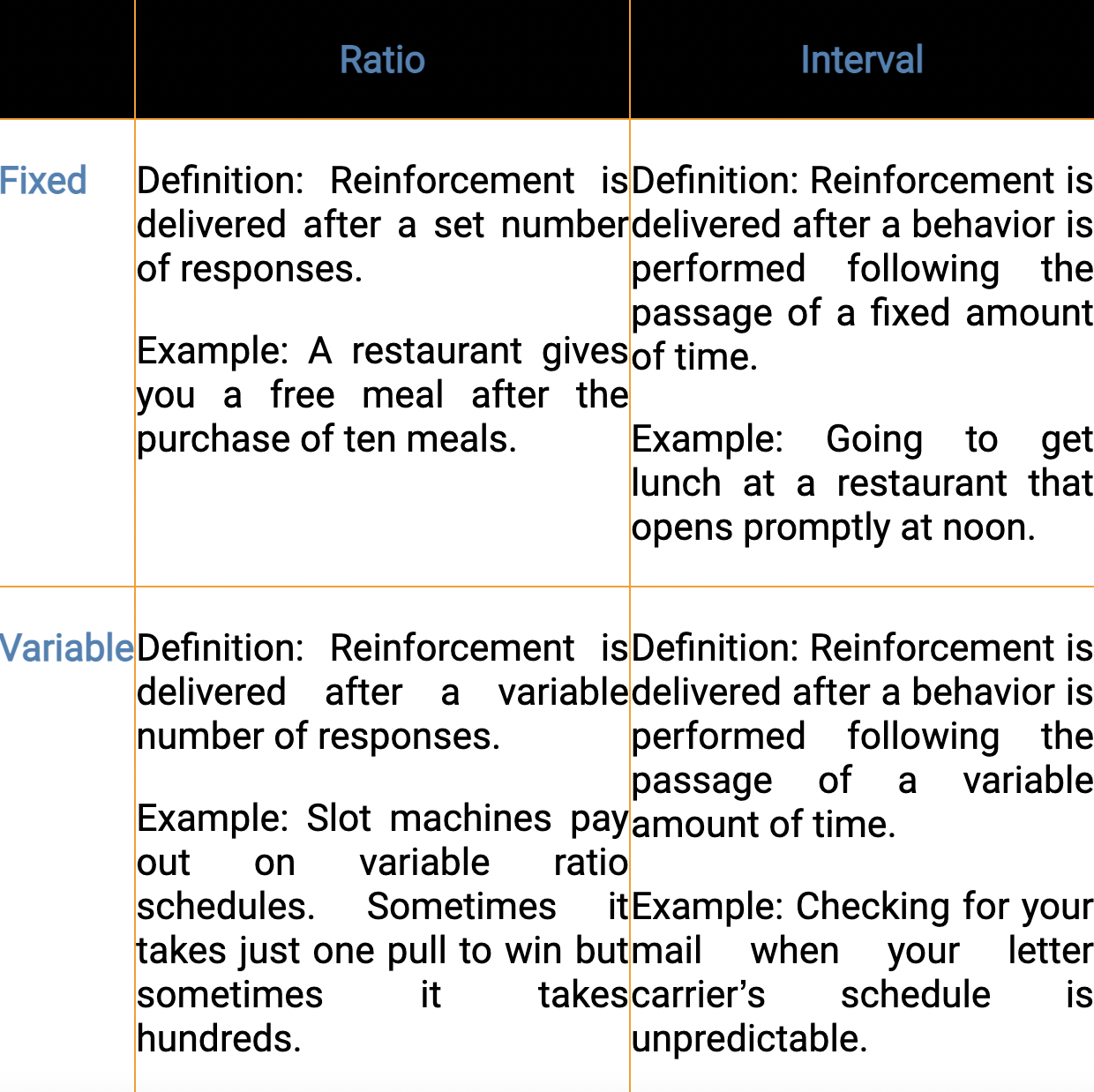
a fixed-ratio schedule provides reinforcement after a set number of responses
- example: if a rat is on an FR-5 schedule, it will be rewarded after the fifth bar press
- a variable-ratio schedule provides reinforcement based on the number of bar presses as well, but the number can vary
- example: a rat on a VR-5 schedule might be rewarded after the second press, the ninth press, the third press, etc; the average number of presses required would be 5
- a fixed-interval schedule requires that a certain amount of time should occur before a bar press in order to obtain a reward
- example: in an FI-3 minute schedule, the rat will be reinforced for the first bar press that occurs after three minutes have passed
- a variable-interval schedule varies the amount of time required to occur before reinforcement
- example: in a VI-3 minute schedule, the rat would be reinforced for the first response made after an average time of three minutes
biology and operant conditioning
- limits exist concerning what animals can learn to do through operant conditioning
- researchers found that animals won’t perform behaviors that go against their natural instincts or way of life
- instinctive drift - the tendency for animals to forgo rewards to pursue their typical patterns of behavior
the contingency model of classical conditioning
- the Pavlovian model of classical conditioning is the contiguity model since it states how the more times two things are paired, the greater the learning will take place
- Robert Rescorla revised the Pavlovian model to make it so that two dogs in separate situations experience a bell paired with food for 10 times. these two trials mixed together has five trials where the food is presented without the bell and the bell was rung but no food is presented. after this training period, which dog would have a stronger salivation response?
- this revised model is called the contingency model of classical conditioning
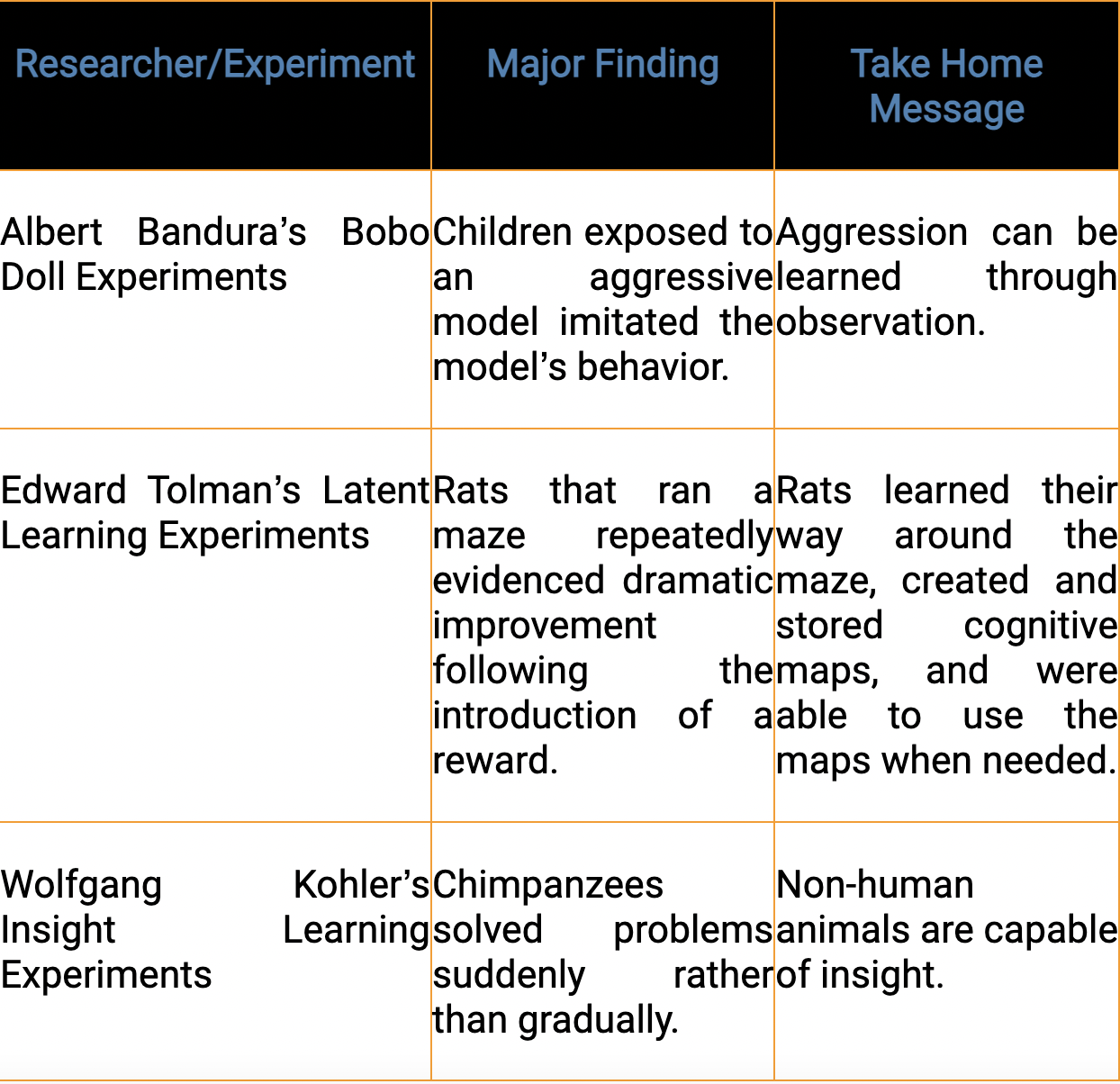
- there are also additional types of learning: obersarvational learning, blatant learning, abract learning, and insight learning
observation learning
- an example of observational learning is when children play house; they’ve observed their families and the families of others to do so
- observational learning is when you look at certain situations to develop an understanding for behaviors
- this is also called modeling and is said to occur only with members of the same species, found by Albert Bandura
latent learning
- latent learning is learning that becomes obvious only once reinforcement is given for demonstrating it
- by crediting improvement, the species will understand what the behavior is
abstract learning
- this type of learning uses pictures to teach behaviors
- example: a pigeon was given a reward when in one series of trials, they were presented with a variety of pictures and it pecked at the same picture two times in a row
insight learning
- Wolfgang Köhler is well known for his studies of insight learning
- insight learning occurs when one suddenly realized how to solve a problem
- this occurs because of the gradual strengthening connection of the stimulus and the response