Week 2/2-2/9
Lecture 2/3
Exam 1 - Feb 19
Exam 2 - Mar 19
Exam 3 - Apr 23
Final Exam - May 19
NO DROPPING OF ANY EXAMS
Cell Structure
How do they form?
What are they used for?
What are they made from
How are they positioned in the cell?
Answers & ideas:
Expanded and shrinked
Change in shape when engulfing things
Tearing away, latching on
Looking like it was seeking something, reeled it in (called questing)
What kind of structure provides these forces such as bending?
What are cells made of?
DNA/RNA*
Nucleic acids*
Protein/amino acids*
H2O
Carbs*
Lipids*
Glucose
Oxygen
DO NOT USE PROKARYOTE IN THIS CLASS
Cellular Components
Membranes
Cell wall
Cytosplasm
Vacuoles
Membrane-bound compartments
Cytoskeleton
What are the differences between eukaryotes and bacteria/archaea?
Bacteria/archaea have organelles!
Main things present in eukaryotes:
Nucleus
Golgi
ER
Peroxisomes
Actin, myosin, tubulin
Mitochondria
The Bacterial Cell: An Overview
Cytoplasm - consists of a gel-like network
Cell membrane - encloses the cytoplasm
Cell wall - covers the outside of the cell membrane
Nucleoid - non-membrane bound area of the cytoplasm that vonysind the chromosome in the form of looped coils
Flagellum - external helical filament whose rotary motor propels the cell
Not evolutionary related to each other
The Bacterial Cell
Cytoplasm surrounded by envelope
Cytoplasm contains DNA in nucleoid
Envelope has lipid membrane boundary plus a structural cell wall
GM+ → 1 membrane
GM- →2 membranes (outer + inner)
What are the major functions of the Cytoplasmic Membrane?
Structure & shape - what properties provide this?
Channels
Membrane made from - lipids
Water has trouble getting in the membrane
Ions as well
Anything large, charged, or polar
To create a semipermeable layer
Permeability barrier - prevents leakage and functions as a gateway for transport of nutrients into and out of the cell
Protein anchor - site of many proteins involved in transport, bioenergetics, and chemotaxis
Energy conservation - site of generation and use of the proton motive force
Cell membranes
Made of lipid bilayer
Separate the cytoplasm from the outside world
Some proteins are embedded in membrane
Anchor membranes to envelope
Sense the outside world
Transport materials into and out of cell
Membrane Lipids
Membranes have equal volumes of phospholipids and proteins
Phospholipid - consists of glycerol wit ester links to two fatty acids and a phosphoryl head group
The two layers are called leaflets
Diverse Membrane Lipids
Unsaturated chains
Bacteria/Eukaryotes have different membrane lipids than Archaea
Bacteria/Eukaryotes
Ester-linked lipids
Lipids are fatty acids
Archaea
Ether-linked lipids
Lipids are branched terpenoids
Called the Great Lipid Switch due to this difference in lipids
Archaeal lipids
The # of rings in the lipid increases with the growth temperature
Using lipids with higher rigidity prevents the membrane from “melting” at higher temperatures
Think of butter, when it’s solid in cold temperatures but becomes a liquid in hot temperatures
Membrane Structure of Bacteria & Archaea
Bacteria
Phospholipid - bilayer
Archaea
Phospholipid - monolayer
Different means of adding membrane rigidity
Bacteria & eukaryotes
Cholesterol - eukaryotes
Hopane - bacteria
Archaea
Branched lipid ether - rings?
Membrane Proteins
Membrane proteins serve numerous functions, including:
Structural support
Detection of environmental signals
Secretion of virulence factors and communication signals
Ion transport and energy storage
Membrane proteins often contain both hydrophilic and hydrophobic regions, allowing them to be inserted into the cell membrane.
Transport across the cell membrane
The cell membrane acts as a semi-permeable barrier
Selective transport is essential for survival
Small unchanged molecules, easily permeate the membrane by passive diffusion
Some molecules will diffuse passively through the membrane following concentration gradients
Others require energy to be transported against the concentration gradient
Transport of most solutes occurs faster than diffusion
Transport is an active process
Requires energy
Often occurs against a concentration gradient
Highly specific
Shows saturation effect (finite concentration of the carrier)
Biosynthesis of transporters is often regulated by the cell
Limit is the # of transporters
Transport systems
There are 3 modes of transport:
Uniporter - one way in
Antiporter - opposite directions
Symporter - same directions
Coupling the simultaneous transport of different molecules allows the cell to use chemical gradients as a source of energy
3.1 - The Bacterial Cell: An Overview
Bacteria share these traits:
Thick, complex outer envelope
Compact genome
Tightly coordinated functions
Cytoplasm
Contained by a cell membrane or plasma membrane
Plasma membrane is also known as the inner membrane which is composed of phospholipids
Periplasm - water-filled space containing nutrient-binding proteins and secretion machines
Outside the cell wall is the lipopolysaccharides (LPS)
Class of lipids attached to long polysaccharides (sugar chains)
Form a slippery layer that inhibits phagocytosis
Envelope - cell-surface proteins that enable the bacterium to interact with specific host organisms
Bacterial Cell Membrane
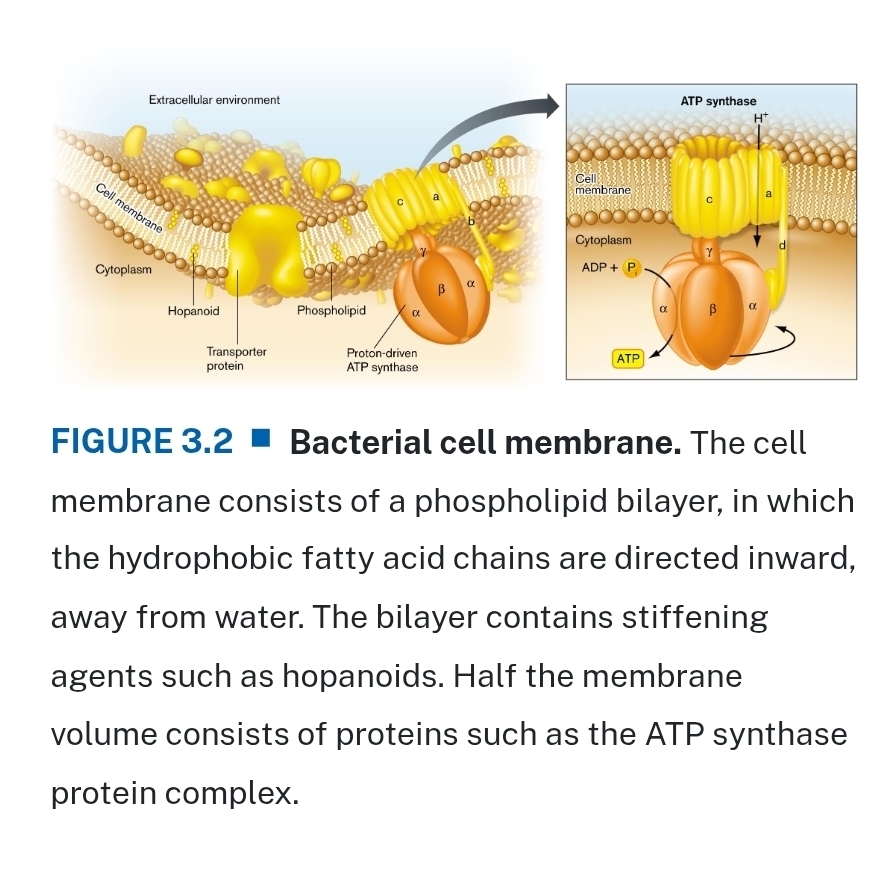
Steps:
ATP synthase causes the flow of H+ ions
Flow of H+ ions is driven by the charge difference and concentration difference
This is considered a “molecular machine”
Nucleoid - chromosome organized within the cytoplasm as a system of looped coils
Small Molecules and Ions
Inorganic ions - ions that store energy in the form of transmembrane gradients + serve essential roles in enzymes
Small charged organic molecules
Polyamines - molecules with multiple amine groups that are positively charged when the pH is near neutral
Macromolecules
Electrophoresis - negatively charged molecules migrate in an electrical field
DNA and RNA can be isolated using this method
Proteome - proteins express by a cell under given conditions
Peptidoglycan - an organic polymer of peptide-linked sugars that constitutes nearly 1% of the cell mass
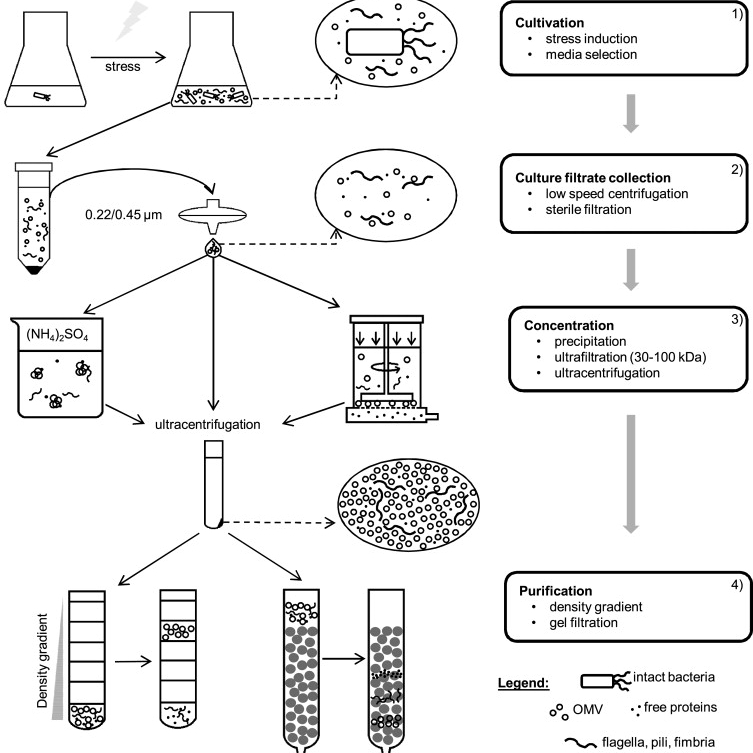
Cell Tractionation - how we separate cell components such as membranes, ribosomes, and flagella
Also provides purified proteins that act as antigens for candidates vaccines
Steps to fractionation of Gram-negative cells:
EDTA weakens outer membrane, and sucrose enters periplasm
Lysozyme breaks down cell wall, causing spheroplast formation
Water dilution shocks outer membrane; periplasm leaks out
Ultracentrifuge
French press
Ultracentrifuge
Density gradient ultracentrifugation
Spheroplast - lacking the turgid cell wall, the cell swells into a sphere
Ultracentrifuge - a device in which tubes containing solutions of cell components are spun at very high speed
To summarize:
Bacterial cells are protected by a thick cell envelope
A Gram-negative cell includes an outer membrane
Bacteria are composed of nucleic acids, proteins, phospholipids, and other organic and inorganic chemicals
The bacterial cytoplasm is highly structured
Cell fractionation isolates cell parts for structural and biochemical analysis
Cell compartments contain different types of proteins
Microscopy reveals cell structure