Developmental; week 5; Language Development 1 - Prelinguistic communication and word learning
Reading:
A communication system
human language is a communication system- a means for speakers of language to communicate with one another, but communication systems are found in many species, like bees and dolphins; they just don’t possess all the characteristics found in human communication.
A symbolic system
Language is a symbolic system because words and parts of words represent meaning. The meaningful units of a language are symbols because they refer to things other than themselves. These symbols are conventional because speakers of a language use the same words to express the same meanings. For example, speakers of English use the word ‘bird’ to refer to the wide variety of creatures that comprise avians.
Language symbols are arbitrary because there is no necessary relation between sounds and meanings. Consider the word ‘bird’ again. It is not necessary for this sound pattern to refer to the particular class of animals that it does. Speakers of English could just as easily refer to what we now call ‘birds’ as ‘girts’ or ‘mantels’. The arbitrary nature of language symbols is readily apparent when we consider different human languages. Different languages use different sound combinations to refer to the same meaning. The English ‘bird’ is ‘vogel’ in German, ‘ptaszek’ in Polish and ‘oiseau’ in French
A rule-governed system
Language is a rule-governed system, meaning that each human language is constrained by a set of rules that reflects the regularities of the language. For example, in English, words such as ‘the’ and ‘a’ must precede the noun to which they refer: ‘the dolphin ate a fish’ is a correct English sentence, but ‘dolphin the ate fish a’ is not. The rule system of a language is abstract because it goes beyond the simple association of individual words and instead involves the manipulation of abstract classes of words. Thus, rather than saying that ‘the’ must precede ‘dolphin’, we may state that articles (the abstract class of words containing words such as ‘the’ and ‘a’) precede nouns (the abstract class of words containing words such as ‘dolphin’ and ‘fish’). The abstract classes and the rules that manipulate them make possible the most important characteristic of human language, its productivity.
Language is productive
Human language is productive in the sense that a finite number of linguistic units (sounds, words and the abstract classes that contain these units) and a finite number of rules are capable of yielding an infinite number of grammatical utterances. Even though no speaker of any human language will produce all of the sentences that their language makes possible, the capacity to do so means that speakers of human language are not limited to reproducing sentences that they have heard, but may instead produce and comprehend novel utterances. As a result, humans can communicate a wide variety of information. We are capable of communicating facts, opinions and emotions, regardless of whether they occurred in the past, are occurring in the present, or will occur in the future. Language also makes it possible to discuss fantasies and hypothetical situations and events. Language facilitates learning, acquiring new knowledge, or clarifying previous information. The potential productivity of language and the richness of the human mind combine to make possible the communication of a very broad array of topics. This makes human language unique among all known communicative systems.
The development of the pragmatic system
These are the abilities that enable us to communicate effectively and appropriately. For example, the abilities involved in turn-taking, initiating new topics and conversations, sustaining a dialogue and repairing a faulty communication are all important aspects of the pragmatic system.
Turn-taking:
Turn-taking required individuals to alternate between the roles of listener and speaker during the course of a conversation. Effective turn-taking requires that the listener recognise that a response is necessary, and realise when it is appropriate to make a response. Therefore, minimising the number of unnecessary interruptions is an important aspect of turn-taking because interruptions disrupt the flow and cohesiveness of a conversation
Mother-Infant interaction:
Turn-taking behaviour begins between mothers and infants. For example, nursing sometimes involves an early non-verbal type of turn-taking. During nursing, infants pause between bursts of sucking. During these pauses, mothers sometimes jiggle the nipple or nudge the infant to stimulate the sucking response. Young infants obviously don’t realise that they are taking turns when they rest after a sucking burst, but this interaction may still set the stage for the development of other forms of turn-taking.
TT is also involved in other forms of M-I interactions; touching and vocalisations are two modalities in which exchanges between mothers and their infants occur. Mothers and infants use touch to initiate exchanges, soothe each other or to communicate emotional states. Vocalisations may also be used to initiate and maintain games like peek-a-boo. For example, mothers tend to vocalise when their infants are not vocalising or after their infants have finished vocalising, which stimulates a TT event.
These patterns of interactions are called proto-conversation (P-C). In early P-C, adults bear the burden of TT as they must maintain the interaction by interpreting their infants’ sounds and responding appropriately. However, sometime between 8 and 12 months, infants begin to take a more active role in T-T; these are called dyadic interactions because they only involve the child and adult. The dyadic interactions evolve into triadic interactions which involve the infant, an adult and an object.
Triadic interactions often involve proto-imperatives and proto-declaratives. A proto-imperative occurs when an infants points to an object and then alternates their gaze between the object and the adults until they obtain the desired object. A proto-declarative occurs when an infant uses pointing or looking to direct the adult’s attention to an object. These actions allow infants to communicate their intentions more clearly while also facilitating their conversations with others.
Imitations
TT is also involved in infants’ imitation of others. Some think young infants are capable of imitation. One study indicated that a greater frequency of vocal imitation at 12 months was related to early facial imitation at 3 months like tongue protrusions. Whilst other studies have also indicated that infants are capable of imitation at very early ages.
One explanation for this early imitation is the discovery of a mirror neuron system in non-human primates. Mirror neurons are a class of cells within the brain that respond to the execution of an action as well as to an observation of that action. EEG recordings have provided some initial support for this purported mechanism of imitation. It is clear that imitation in various play activities is an important precursor to the development of language. Children frequently use imitation in their conversations with other children or adults. Imitation allows children to take a turn by repeating what the speaker just said. The average 2 year old take sonly one or two turns per conversation, where as, 3-5 year olds are able to engage in conversations that contain as much as 12 turns.
Initiating interactions
Infants must learn II and their first attempts with an adults often focud on directing the adult’s attention to the infant or to an object, such as with proto-imperatives and proto-declaratives. The first attempts are often non-verbal, 8 month olds will usually point or reach toward an object of interest. As children learn to repond to the points of others, they also learn to better direct their attention of others. Thus, sometimes between 12 and 18 months, infants learn to coordinate gestures, looks and vocalisations in order to communicate their intents and wants to others. As children acquire languagem their attempts to II become more verbal and less gestural.
Research has indicated that incorporating gestures at earlier ages predicts future language development. Children younger than 2 tend to talk about things that exist in the here and now. They are more likely to refer to familiar and visible objects or people. As their language skills increase, children come to discuss a much broader range of topics, including imaginary, possible and hypothetical events. For example, in a study performed with Japanese children (Komatsu, 2003), 5-year-old children were more likely to discuss their experiences with other children, games they played and emotions they felt during their day at kindergarten with their mothers. Three-year-olds also discussed many of these same topics but were more likely to repeat topics or simply imitate their teacher’s or classmate’s actions. However, both ages were very active in their participation in the conversations.
Maintaining conversations
Appropriate turn-taking is an important aspect of conversation maintenance. Young children are likely to interrupt others, and so disrupt the conversational flow. Older children are more likely to wait until the other speaker has finished before attempting to gain their intended listener’s attention. Children must also learn to add relevant information to the dialogue as well as learn when it is their turn to speak. Young children are likely to use their turns to refer to something completely different from the topic at hand, making sustained conversation difficult. This is true even if children are asked questions. Children under the age of 2 years typically answer only a third of the questions posed to them. By 3 years of age, children answer more than 50 per cent of the questions they are asked. Although parents may sometimes find this difficult to believe, children are more likely to respond to questions than they are to ask questions. As a result, most of their conversations with adults involve children being asked lots of questions. By now, it should be clear that adults contribute a great deal to the structure and maintenance of conversations with young children. As one might expect, young children’s conversations with their peers tends to be problematic. When children ‘converse’ with one another, topics are rarely consistently maintained. Instead, young children’s conversations with peers contain high proportions of imitations, repetitions and sound play. However, if the conversation concerns a topic that is familiar to both children, even young children are able to sustain meaningful conversations
Repairing faulty conversations
In order to communicate effectively, children must learn when and how to repair conversations as miscommunications occur. In order to repair a miscommunication, one must both realise that a miscommunication has occurred and understand how to correct the problem. Sometimes all that is necessary is to repeat the original statement. Other times one must revise the original message in order for it to be understood. Children as young as 1 year sometimes appear to recognise the failure of their nonverbal communicative attempts. For example, if infants do not receive the object they wanted, they may continue to point to the object until they are given it. In such a case, the infant seems to be trying to repair the communicative failure by repeating the pointing. Of course, it is possible that the infant neither perceives the miscommunication nor is trying to repair it, but is instead simply producing a behaviour that has resulted in desired objects being provided in the infant’s past experience. Regardless of the communicative intent of these early ‘repairs’, young children do learn to use repetition to correct faulty communications. As they get older children add revisions and substitutions to their increasing repertoire of strategies for repairing and maintaining conversations.
Adults play an important role in the development of this aspect of the pragmatic system. Adults often request children to repeat utterances or to clarify the portion of the conversations that they did not understand. These forms of interactions help children learn that utterances can be misunderstood, why particular utterances are not understood, and how to correct a miscommunication.
By the age of 3, children have learned to request clarification of messages that they do not understand, these early requests could be single word questions like ‘huh?’ or repetitions of portions of the adults’ utterances. Children learn mnay aspects of the pragmatic system before their 5th birthday.
The development of the phonological system
Speech perception
speech segmentation
speech stream: when infants are deciphering the sounds of language that they hear they are exposed to an undifferentiated series of speech sounds (this is speech stream)
infant-directed speech/ motherese: when compared to speech directed to adults, speech directed to infants are often higher pitch, more exaggerated pitch contours, a larger pitch range and is more rhythmic
7 months old:
able to recognise familiar words in an uninterrupted speech stream
thus the capacity to segment the speech stream into words is present in infants at this age
also able to remember the words that they have segmented
seem to use a variety of cues to determine when words begin and end in the speech stream, including strongly stressed syllables to indicate the onset of new words
The ability to segment speech
critical component of language acquisition
usual onset at 7 months
despite the difficulty of the task, infants do learn to divide or segment the speech stream into meaningful units
infants prefer to listen to human speech than to other sounds in their environment
may facilitate the task of segmenting speech
recent study indicated that infants who were better at speech segmentation tasks before 12 months had a larger expressive vocab at 2years and scored higher on language measures as preschoolers
Categorical perception of speech sounds
Phonemes:
a set of sounds that are not physically identical to one another, but which speakers of a language treat as equivalent sounds
phonemes are specific to a language
thus speakers of English and speakers of Chinese differ in terms of their ability to discriminate the two sounds
For example, the /k/ sound in ‘key; and the /k/ in ‘ski’ are members of the same phoneme in English, which means the two /k/ sounds are perceived as the same sound by English speakers despite the fact that the /k/ sound in ‘key’ is aspirated (concludes with a short puff of breath) and in ‘ski’ is unaspirated (does not conclude with a short puff of breath), but in Chinese the two /k/ sounds are members of different phonemes
Infants discriminate between phonemes:
Habituation:
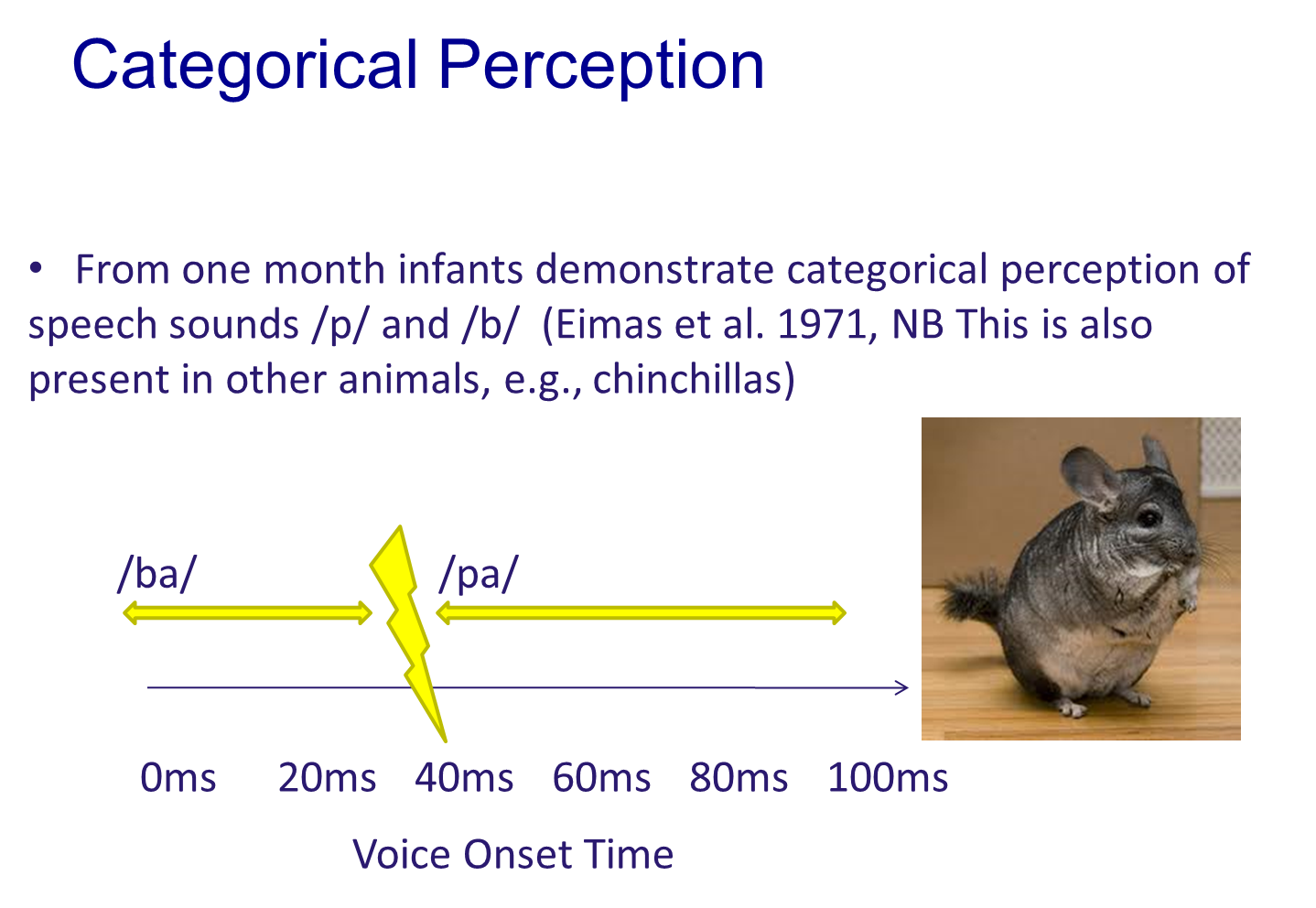
Eimas et al (1971)used habituation to test 1m olds ability to discriminate the syllables /ba/ and /pa/
using the technique discussed in the lecture Eimas et al found that the infant could discriminate between the /ba. and /pa/ sounds
thus there is a set of physically distinct sounds that comprise the phoneme /ba/
the infants could not discriminate one /ba/ noise from the other, like that of an adult, but could discriminate it from a /pa/ noise
there, however, were considerable implication:
the fact that infants can discriminate sounds from different phonemes but cannot distinguish sounds from the same phoneme class suggests that even young infants engage in the categorical perception of speech sounds
second, the young age at which infants are able to discriminate phonemes suggests that categorical perception may be an innate mechanism for interpreting sounds. This mechanism may rest on general auditory processing skills rather than on skills specific to human speech. (aka, infants may be predisposed to categorise sounds which then may influence their perception of speech sounds)
support from cross species research of chinchillas and macaque monkeys that demonstrates categorical perception of human speech sounds
categorical perception
the process that allows us to distinguish sounds between categories (different phonemes) yet at the same time makes it difficult to distinguish sounds within a category (a particular phoneme like /ba/)
Becoming a native listener:
the discriminative capabilities of the 6m old infant is influenced by experience; especially the language they hear
8m olds will use info that they are already familiar with to help discriminate new sounds
suggesting an interaction between previous experience, top-down processing and basic perceptual abilities, bottom-up processing
the effects of experience become more pronounced with increasing age
by 12m of age, infants remain able to discriminate the phonemes of the language they are learning, but are unlikely to discriminate the phonemes of other languages
thus, it seems that children’s acquisition of the phonemes of their native language depends on both the innate predisposition for categorical perception of sounds and experience with sounds and experience with sounds used as phonemes in their native language
in Werker’s terms, the infant becomes a ‘native listener’
Speech production:
the ability to produce speech sounds lag behind the ability to perceive the same sounds
this lag reflects the difficulty of learning to control the vocal cords, mouth, tongue and lips
perhaps because of the maturation that’s required for sounds production, all children pass through the same phases of vocal production
reflexive vocalisations (birth-2 months)
first sounds produced by infants; including cries, coughs, burps
during the first month, infants produce more than one type of cry, raising the possibility that different infant cries might mean different things
these cries have different fundamental frequencies, durations and compositions of sounds
however, if parents are asked to discriminate these cry types, they are unable to do so if the cries are tape recorded and played back to them in the absence of external context
even if infants are attempting to communicate with these cries, parents are more likely to respond to external context (like a wet nappy)
but infants and adults do still respond physiologically to these changes in characteristics of cries
Cooing and laughing (2-4m)
infant begin to laugh and combine sounds with one another
the coo sound emerges toward the end of the second month of life, often produced while the infant is in a happy state
the parent-infant interactions following infant cooing are usually pleasant in nature; parents may coo back at their child, who may also coo back and so on
this reciprocation may help the infant to learn that communication involves taking turns
Babbling and vocal plays (4-6m)
as they gain control over their vocal cords, lips, tongue and mouth, infants begin to produce a wide range of sounds and sound combinations
play with sounds (babbling) is the main characteristic during this period
Canonical babbling (6-10m)
infants begin to produce sound combinations that sound like words
however, there is no evidence that infants actually attach meaning to these sound combinations
during this period infants continue their experimentation and play with sounds
the most common of which is reduplicated babble, in which syllables are repeated
Even many deaf children babble, demonstrating that there is no need for others to respond to infant vocalisations for earl babbling to occur
but vocal babbling is rare in deaf infants older than 7m, suggesting that hearing speech sounds plays an important role in the continuation of babbling past its early stages
more recently, gestural babbling (manual babbling) has been documented in deaf children and hearing children learning to sign (this is the manual equivalent of vocal babbling)
manual babbling
the presence of vocal and gestural babbling in hearing and non-hearing children has led to the proposition that a manual communication system may have evolved before our vocal-based system
recent research has indicated that gestures are critical to language development, which may also be related to the development of motor abilities
it is clear that some form of interaction is important for maintaining the infant’s efforts to produce language sounds or gestures
for example, infants in institutions that provide little infant-adult interaction do not produce many vocalisations and may not even cry
modulated babbling (10months on)
final period or babbling and language play
characterised by a variety of sound combinations, stress and intonation patterns and overlaps with the beginning of meaningful speech
may play an important role in the acquisition of the intonation patterns that are important for the infant’s native language
may help infants learn to produce different intonations
regardless it is clear that infants enjoy playing with speech sounds and intonation patterns and that this play is a cornerstone for subsequent language development
The development of articulation
children must learn to pronounce words correctly as they learn the phonological system of language
children are more likely to use words they can produce, which suggests they are aware of the differences between their incorrect and correct pronunciations
for example, one 3yr old consistently deleted the /s/ sound from the beginnings of words when it was followed by a consonant sound. Thus ‘I smell a skunk’ was changed to ‘I mell a kunk’, but the child recognised that his form was the immature form and acknowledged it to the researcher
as children learn to produce correct pronunciations, they may produce phonological distinctions that adults cannot perceive
‘gwass’ produced by a two year old for glass and grass had two slightly different sounds, even though adults equated the two ‘gwasses’, suggesting that the children were beginning to produce the two diff sounds that would eventually yield ‘grass’ and ‘glass’
both suggests that children are aware that their incorrect pronunciations differ from those of adults, and that at least some children’s pronunciations that are viewed as equivalent b adults may be functionally distinct for children.
however, we do not know if children are aware of how their pronunciations differ from adults
The development of the syntactic system
syntax: deals with the manner in which words and parts of words are related to one another to produce grammatical sentences
Chomsky (1957, 1982): syntactic structure of every human language is the result of an interrelated set of elements
one level is the s-structure (surface structure), which roughly corresponds to the spoken sentence
the meaning of the s-structure is determined by the d-structure
s-structures involve the format, for example, of the sentence (noun-verb-adjective-infinitive verb)
the s-structure can have more than one meaning
at another level is the d-structure (deep structure), which is a more abstract representation of a sentence
the intended meaning is determined by the d-structure
The one-word period
children’s acquisition of syntax follows a relatively predictable pattern during the first two years of life
between 10-18 months, children begin to produce single word utterances
by examining the first 1-10 words produces by 8-16m old English and Chinese speaking children, research indicated that first words generally include people-based terms (mommy or auntie etc) followed by object nouns, which represent familiar, concrete objects found around the home and action verbs.
however, they also found that cultural differences affect the frequency in which certain types of words appear during the one-word period
Delaguna (1927) suggests that children in the one-word period are limited to producing single-word utterances, they are capable of conceiving of and comprehending more complete sentences.
for example, the children who say ‘doggie’ while pointing to his pet might actually mean ‘there’s my doggie’, whereas the child who points to a toy dog that is on top of a shelf and says ‘doggie’ might mean ‘I want the toy doggie’. In such scenario, the s-structure ‘doggie’ has different d-structures
What’s in a word?
Brown and Bloom pointed out the dangers of ‘rich interpretation
the problem is deciding exactly how much more a child means to produce than the singly word contained in the s-structure.
while few of us would be willing to grant the young child knowledge required to produce the second or third d-structure, the available info does not provide sufficient cues to determine exactly what a child means when a single word utterance is produced
thus assumptions about what children mean in the one-word period must be made with great caution
as a result, the implication of the one-word period for syntactic development is unclear
it is clear that children do comprehend more than they can produce
Golinkoff (1995) presented 17m old infants with two videos, each of which portrayed two different scenes
for example, one video might show a dog licking a cat and the other video might show a cat licking a dog. While the vids were playing, the infant heard one of two sentences. The infant looks langer at the video that corresponded to the sentence that they heard, suggesting that infants who can produce only a single word at a time nonetheless understand at least some aspects of word order
The two-word period
between 18-24 months old most children begin to produce two words at a time to convey the most meaning and omit other sorts of words such as ‘in’, ‘and’ and ‘of’ and words ending such as the past tense ‘ed’ and the plural ‘s’. Thus children are likely to produce utterances such as ‘mummy go’ and ‘kick ball’
children are more likely to use the words most salient in their environment, which turns out to be nouns, verbs and adjectives
children are also more likely to verbally produce words that they have initially produced as gestures and are faster in producing two-word combinations if they had previously combined a gesture with a word, such as pointing at a dog and saying water
Word order
children’s knowledge of language and their use of this knowledge are limited during the two-word period
children’s use of consistent word order seems to reflect limited knowledge rather than general rules
For English, the most general way to relate an agent and an action is to place the agent before the action, as in ‘doggie lick’ when the dog is the one doing the licking. Young children are most likely to use the correct ‘agent + action’ word order in a limited sense. For example, children may use the ‘agent + action’ word order only when the agent is animate. Thus, they would be more likely to say ‘doggie bark’ than ‘balloon pop’ or ‘hat fall’ because ‘doggie’ is an animate noun and ‘balloon’ and ‘hat’ are not.
the manner in which speech in the two-word period is related to later syntactic development is a matter of considerable debate
some have argued that children learn syntax by linking semantic categories such as agency (the thing producing an action) and action (what something does) with syntactic categories such as subject and verb.
Others believe that children in this period lack certain aspects of d-structure, although there is little agreement about exactly what aspects of d-structure are missing
Relatively recent evidence suggests that 2-yearolds can successfully identify general rules regarding word order when novel verbs are used
Thus, children may be primed to learn patterns or ‘rules’ and novel words early on, suggesting that some syntactic knowledge may be present inherently – a generativist view. However, other researchers contend that syntactic knowledge is constructed through experience – a constructivist view
So although it is clear that children in the two-word period are progressing toward a more mature understanding of syntax, it is not clear exactly how much they know nor how they know.
Later syntactic development
Children’s syntactic knowledge increases dramatically following the two-word period, resulting in rapidly improving language skills.
For example, one of the children studied by the second author was producing two-word utterances such as ‘me happy’ at 24 months of age. This same child produced the following sentence about a year later: ‘I don’t want to go to sleep and dream the dream I dreamed last night.’
The difference between this child’s language competence at 24 months and at 36 months of age is striking. This type of grammatical development is typical, as evidenced by the following two speech samples (obtained from one child at two different ages).
there are a number of difference sin the speech produced by 24 months and at 36months
the child’s utterances are longer
more complex speech at 36 months
children use a variety of linguistic forms and structures relatively quickly in the months following the two-word period
The significance of overregularisation errors and creative generalisations
overregularisation errors:
occur when children apply a rule to an exception to the rule
for example, a child learning English might say ‘thinked’ rather than ‘thought’ because the child is using the regular past tense rule
children producing this mistake are making reasonable and understandable errors, they’re just acting like the rule does not have exceptions
children who produce overregularisations errors are using forms they have not heard, which suggests they are using the rules of the language they are learning to produce novel words
plurals
regular nouns: plural = ‘s’
irregular forms: plural ‘anything other than s’
children tend to overregularise the plural to irregular count nouns (which refer to objects that can be counted) like ‘foot’ but not to mass nouns like ‘water’ and ‘air’ (which cannot be counted).
this suggests that young children can distinguish nouns that refer to countable objects from nouns that refer to entities that cannot be counted
Past tense
regular = ‘-ed’
irregular past tense forms like ran and hit
as kids learn the past tense, children often overregularise their use of ‘-ed’ like ‘runned’ and ‘hitted’
these errors continue for many years, given that English has many irregular past tense forms and children must learn every exception to this regular rule
Creative overgeneralisations
the progressive ‘ing’ form is the first suffix to be acquired by young children learning English
there are no irregular progressive forms in English and so no opportunities for overregularisation errors
children’s use of the progressive does go beyond simply repeating what they have heard
children occasionally create ne verbs by treating a noun as such
children also use the progressive with some of these novel forms
as in ‘why is it weathering?’
both creative overgeneralisations and overregularisations demonstrate that children do not simply reproduce forms that they have heard others use.
instead, they create new forms based on the regularities in the language that they hear
How can syntactic development be explained?
innate knowledge? (Chomsky)
Chomsky’s argument for innate knowledge rested on the points:
language requires the ability to relate d-structures to s-structures
the environment only provides children with information about s-structures. As knowledge of d-structures is not available in the environment, such knowledge must be innate
the sentences that children hear are complex and often ungrammatical
children receive little feedback about the grammatical correctedness of their utterances
children acquire their first language relatively quickly and easily
do parents correct their child’s language?
parents are unlikely to correct their children’s ungrammatical utterances- in fact, parents may actually reinforce ungrammatical utterances, like if a mother responds to her child’s ‘no dinosaur no go here’ with: ‘that’s right. We don’t put dinosaurs there’
parents sometimes correct grammatical sentences because the meaning of the sentence is incorrect even though the syntax is perfect
for example, a child’s grammatical statement that ‘and Walt Disney comes on Tuesday’ was corrected by the mother who said ‘no. he does not’
Chomsky claims that parents do not play a significant roles in their children’s syntactic development is supported by the data
however, they do in fact learn the language they have heard their parents speak
but overregularisation and creative overgeneralisations demonstrate that imitation cannot be the primary method
The language input to the child
Chomsky claims
innate knowledge of language is necessary for language acquisition
the reason is that no matter how simple the language input is, there is also s-structures
Chomsky believes that d-structures must be innate because spoken language can provide no direct information about this aspect of language
this view is controversial: maybe children have a very strong DISPOSITION to learn a language, they are not necessarily born with innate knowledge of language
research conducted on errors children make when producing questions emphasises the importance of constructing knowledge rules or frames from a basic set of experiences, which children then apply to familiar and novel situations, however, the speed and accuracy with which children acquire and produce various utterances also suggests that some innate component must be present.
Rather than specifying specific categories of knowledge, perhaps the innate predisposition consists of a set of mechanisms that help children to sort out the info they hear. For example, we are born with the ability to perceive phonemes, but we are not born with knowledge of particular phonemes or a general understanding of what phonemes are
the role of experience is to provide information about s-structures
this will combine with the child’s innate knowledge of language to yield the particular grammatical rules for the language the child is learning
The acquisition of word meaning
word meaning acquisition is a comprehension-based process
in order to learn a word, children must hear it being used
as children acquire their first words, they learn that words are meaningful sounds that can be used to represent something else
the process of word meaning acquisition
may begin in early infancy
Tincoff and Jusczyk (1999) presented 6m old infants with side-by-side videos of their parents. The infants looked longer at the video of the mother if the word ‘mommy’ was heard but looked longer at the video containing the father if the word ‘daddy’ was heard. This pattern did not occur if a strange woman and man were substituted for the mother and father
these results suggest that young infants are learning the meanings of at least some of the words of their environment
before their fourth birthday, children will learn to use words to represent and refer to real, possible and imaginary aspects of their world
thus the toddler who uses the word ‘ball’ only while holding a baseball becomes a 3-yr old who can use words to express complex thoughts
Guessing a word’s meaning
the manner in which a child interprets a recently discovered word depends on the child’s existing semantic system, their knowledge of the world, the level of their cognitive skills and their ability to selectively attend to others’ cues, such as eye gaze.
If a word the the child has just heard refers to an object
the child’s attention might be drawn to the object while the word is being spoken, as when a parent points to a cow while saying ‘there’s a nice cow’
in such a case, the child must first understand that the parent intends to communicate something about the object to which the parent is pointing
if the child does comprehend the parent’s intention, they are likely to guess that the word has something to do with the cow
initially, children build their vocab by focusing on one-to-one correspondences does not make the child’s task much easier
given the number of possible interpretations that children might make about a word’s meaning
it is not surprising that their first guess about the meanings of object words are incorrect
children sometimes believe that a word refers to many more objects than it actually does
for example, the child might use the word ‘bird’ to refer to birds, aeroplanes, kites etc
a child who extends the meaning of a word too broadly is making an overextension error
the opposite extreme occurs when children extend the meaning of a word to too few instances, as when a child restricts their use of a word such as ‘duck’ to situations in which the child is playing with a toy duck while in the bath, using a word too narrowly is called an underextension error
the complexity of the task
words occur in situations that may be interpreted in numerous ways, many things may be referred to with a variety of words and linguistic forms
for example, the same person might be called ‘mum’, ‘sister’, ‘Sue’, ‘honey’ etc depending on the speaker and the context
some categories are part of larger categories to make matters more confusing
for example, a person might be a Caucasian (a race included in the larger category ‘people’). A person is also a mammal (a category which includes people), an animal (a category that includes mammals) etc
Additionally, many words have more than one meaning
hence, there is ample opportunity for children to be confused
despite these complexities, children somehow construct a vocab of approx 14,000 words by the time they are 6 years old
as children gain additional experience with a word and its uses…
they must compare recently acquired info with what they have already stored in their semantic system
this process will allow children to eventually determine the correct meaning of the word
regardless of the type of word being acquired, the basic processes of word meaning acquisition are the same
the child encounters the word in a situation
this information is interpreted in terms of the existing semantic system..
the result being an initial guess about the meaning of the novel word
as a result of subsequent experiences and interpretations, this initial guess will be modified until the child has determined the correct meaning of the word
building a semantic system requires the child to process vast amounts on information within a context in which words can mean virtually anything and are related to one another in myriad ways
is children’s acquisition of word meaning constrained?
some researchers suggest that children acquire words and meanings as quickly as they do because their choices are constrained
the notion of constrains on semantic development assumes that children neither consider all of the information available to them nor are overwhelmed by possible interpretations
instead, both the types of information to be considered and the possible interpretations of this information are constrained by innate factors
A number of constraints have been suggested to influence word meaning development- the following are examples:
whole object constraint:
assumes that children believe that words refer to whole objects rather than to parts of objects.
thus the child who heard an adult say elephant while pointing to an elephant assumes that the adult is referring to the entire elephant rather than to some part of the elephant
mutual exclusivity constraint:
assumes that children believe that there is a one-to-one correspondence between words and meanings
thus if a child knows that certain creatures are called dogs, they will not use ‘dog’ to refer to other types of objects or creatures. they will also assume that things they calls ‘dog’ can have no other name
none of the hypothesised constraints has shown to be an absolute predisposition.
the results of a recent study with 10m olds indicated that the infants preferred to attend a novel object when paired with a novel label rather than a familiar label or neutral phrase, suggesting that the constraint may not be language-specific but more generally related to attention and learning mechanisms
many of the proposed constraints would actually make word meaning acquisition more difficult
for example if the whole object constraint actually constrained children’s acquisition of word meaning, why and how do they acquire so many words that refer to parts of objects?
similarly, if children are constrained to believe that word meanings are mutually exclusive, how do they ever learn that an ‘elephant’ is also a ‘pachyderm’, a ‘mammal’ and an ‘animal’
the importance of semantic relations
children construct a semantic system rather than a list of independent words because words are related to one another rather than existing in isolation. The development of the semantic system is facilitated by children’s acquisition of semantic relations
the child must know how words relate to another
come words are opposites (hot-cold), others form semantic dimensions (‘hot’, ‘warm’, ‘cool’ and ‘cold’) and still others are structures in terms of subordinate-superordinate relations
for example, the word ‘dog’ is subordinate to the word ‘mammal’, which in turn is subordinate to the word ‘animal’
semantic dimensions
usually children learn the two far ends of extremes in semantic sets far before others in the spectrum of dimension
the end points of semantic dimensions seem to be more salient to young children than are points between the two extremes
the salience of end points may be one reason that polar opposites are important aspects of the semantic system
as kids discover the semantic relations are necessary to structure their semantic system, they are better able to organise their growing vocabulary
learning semantic relations helps children become aware of gaps in their vocabulary
for example, the child who knows that people have hair and that dogs have fur may wonder what one calls the stuff that covers a bird’s body
The interaction of language and cognitive development
Kuczaj (1982b) suggested that children use two strategies when faced with gaps in their semantic and/or conceptual system; these strategies reflect the interrelationship of language and cognitive development
strategy 1- acquiring a new word
when acquiring a new word, search known concepts in case the word denotes a previously acquired concept. If no existing concept seems appropriate, attempt to construct a new one
strategy- acquiring a new concept
when acquiring a new concept, attempt to attach a known word to it. If no word seems appropriate, look for one
In the process of building a semantic system, children acquire a world view that is shaped at least in part by the language they hear. The development of the semantic system influences conceptual development by virtue of the manner in which language dissects and organises the world
Lecture:
Hockett’s Design Features of Language
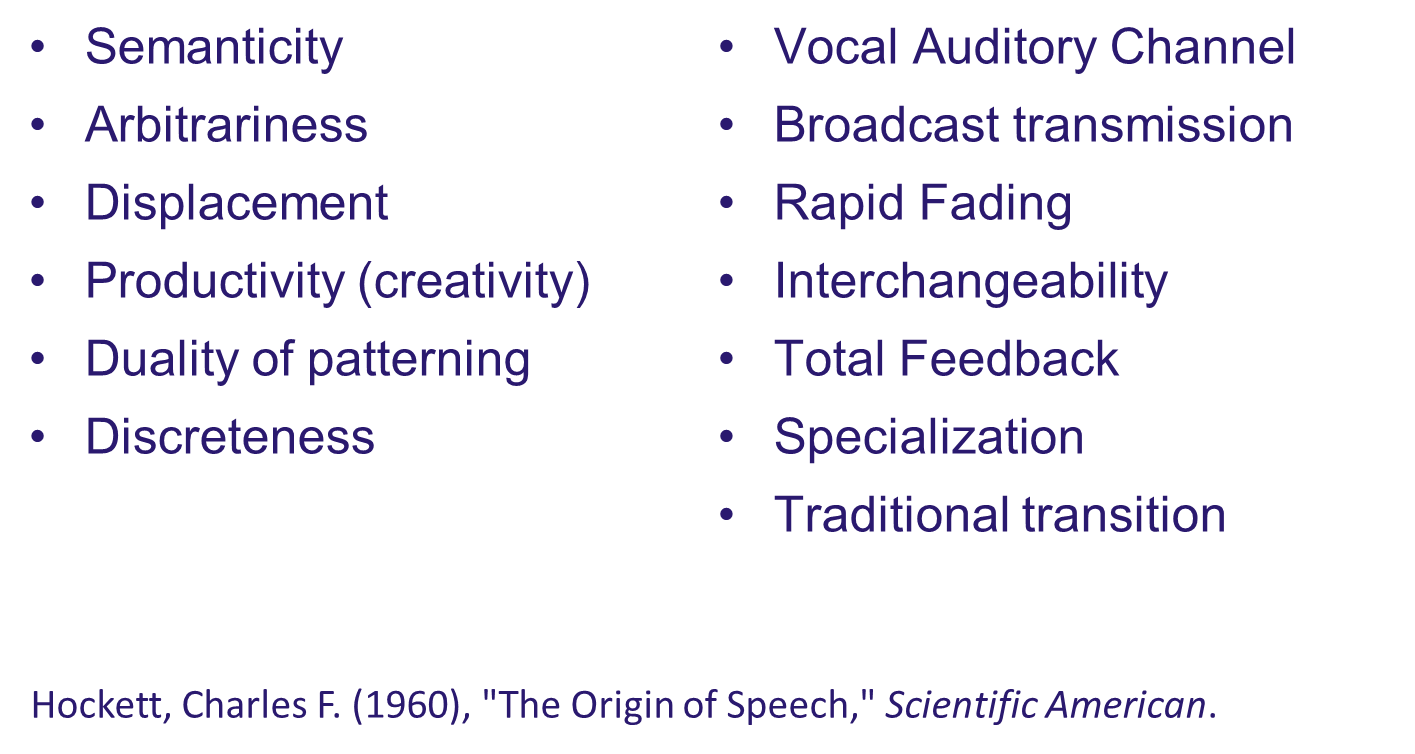
when looking at across species communication, no one other animal has all the properties that human language has
most of these aspects of communication occur in other animal languages (typically only one of these at a time)
a bunch of these features added up together make a really strong communication system
Looking at these strong four of the bunch together
arbitrariness:
no necessary connection between the sounds used and the message being sent
the understanding of the word goes beyond how it just sounds
displacement:
the ability to communicate about things that are currently not present
productivity:
the ability to create new utterances from previously existing utterances and sounds
even if a sentence has never been said before in the order or words used have been said, we still understand the meaning and gets the message across
think of when we’re first explained something in school that we’ve never heard of before
duality of patterning
meaningless phonic segments (phonemes) are combined to make meaningful words, which in turn are combined again to make sentences
Language as form-function relations
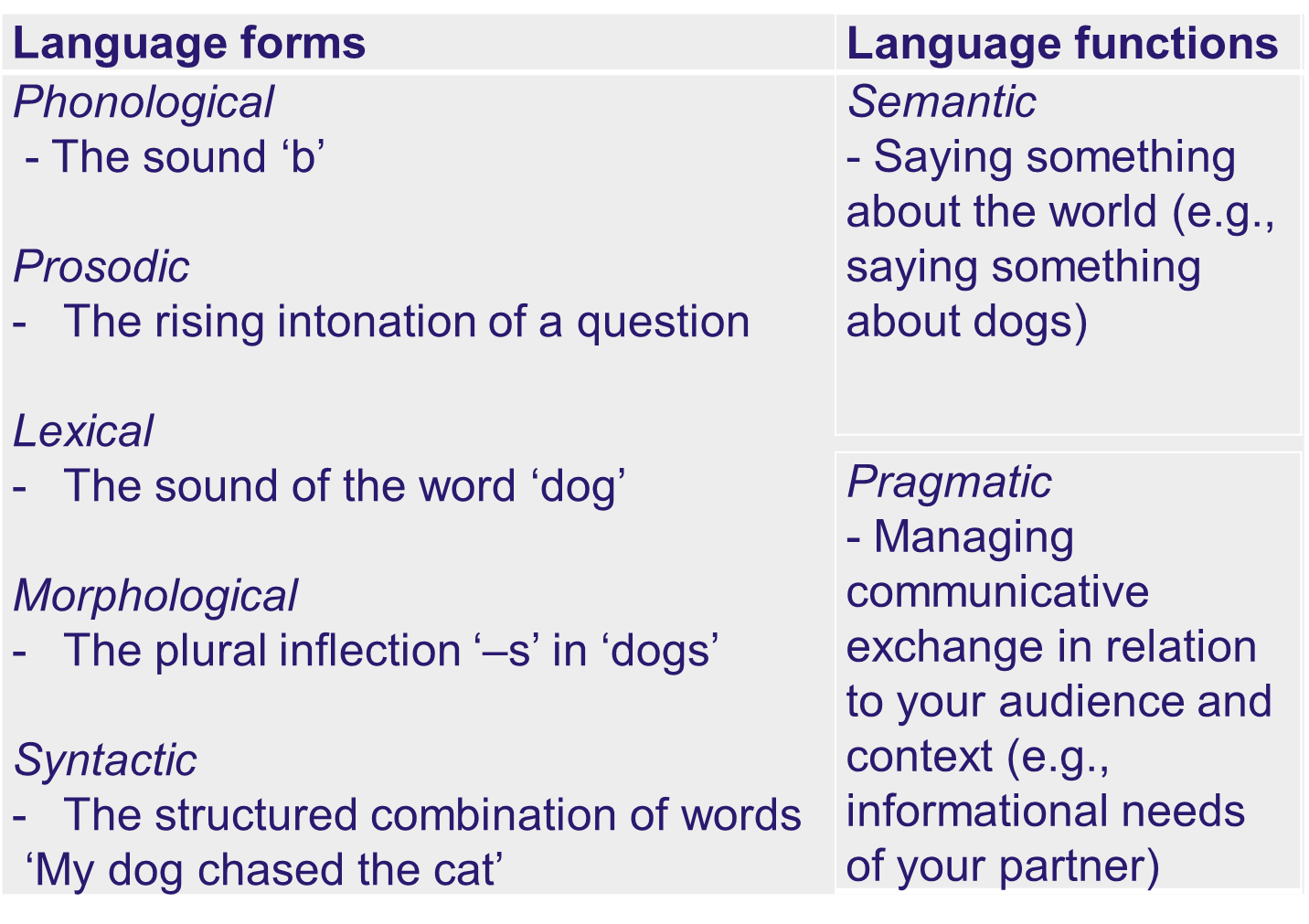
language functions:
semantic: saying something about the world
pragmatic: for example, if I hid an object from someone I was talking to, my way of describing it would eventually get you to know what object I’m talking about, however, poor pragmatics would be if I referred to the hidden object at ‘it’ because you wouldn’t actually know WHAT the object is
Phonological Development: Early comprehension
infants have auditory perceptual abilities that are shaped by experience (even in the womb during the 3rd trimester of pregnancy)
from birth (or days thereafter), infants:
prefer to listen to speech rather than music (suck faster when listening to own mother’s voice rather than another woman’s)
process speech predominantly with the left side of the brain
able to distinguish some foreign languages from their own native language based on prosody
Prosody
the rhythm or melody of language
Categorical perception
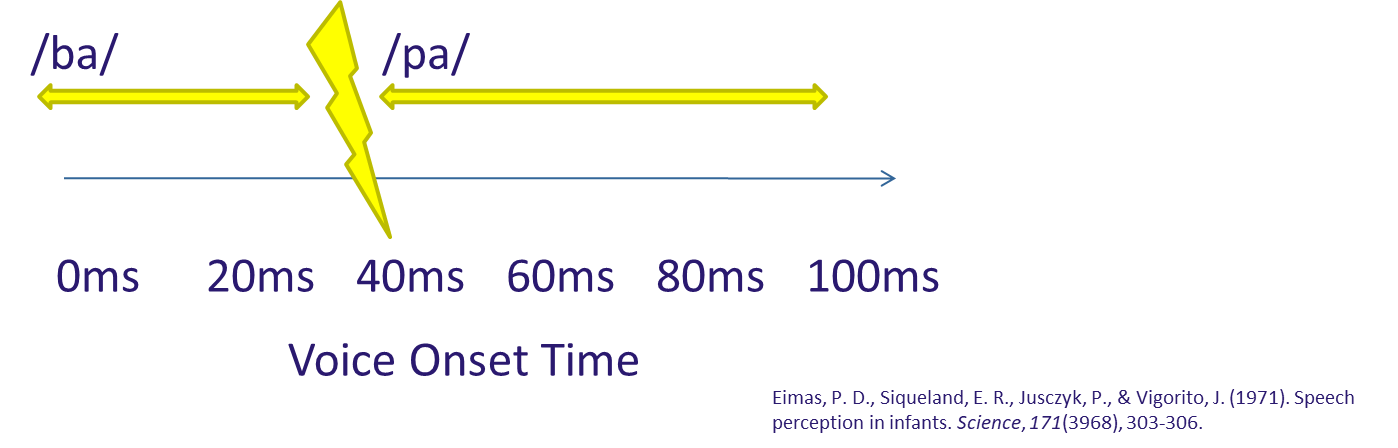
from one month, infants demonstrate categorical perception of speech sounds /p/ and /b/
the vocal chords vibrate earlier in /ba/ than /pa/ and you can vary the vibration on a continuum by literally a millisecond but what we hear is always /pa/ or /ba/ never something in between,
it’s a categorical perception so it’s either/ or never something in between the two noises
The high amplitude sucking procedure
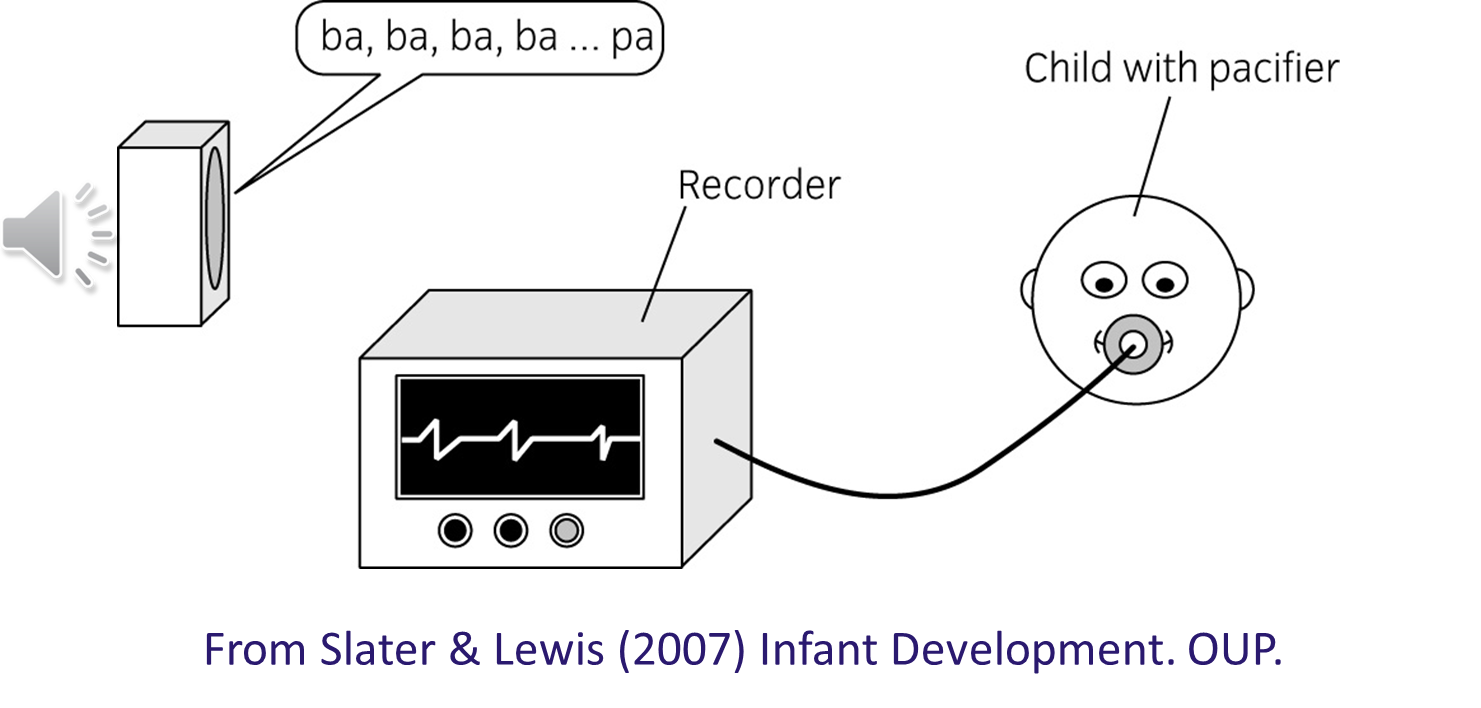
babies also have categorical perception of these noises, and this study shows it
they are demonstrated a /ba/ noise on a speaker and the child sucks on their pacifier more (indicated they’re interested in the noise) they continue to play this noise and slowly change the vibration bit by bit (the baby loses more interest and starts to suck on their pacifier less/ less intently) then the moment the vibration has changed enough for the baby to process the noise as a /pa/ rather than a /ba/ they get interested again (because it’s a new noise) and they start sucking on their pacifier more (showing they hear a specific moment when the vibrations on the continuum has changed enough to switch noises
categorical perception is different within different languages
TERMINOLOGY
Phones:
languages differ in the sounds they use and how they combine them- this is how we can tell the difference between Italian and Japanese even if we speak neither
the different sounds in the language are called phones:
the ‘p’ in ‘pin’ and ‘spin’ are different phones (aspirated /p^h/ and unaspirated /p/)
phonemes
if different phones change the meanings of words they’re called phonemes: /p/ and /b/ are phonemes in English because if were change the /p/ in ‘pin’ to a /b/ we get a word that means something different: ‘bin’
not all languages have the same phonemes:
/pʰ/ and /p/ are different phonemes in Thai but not in English
/r/ and /l/ are different phonemes in English but not in Japanese
dental /ʈ/ and retroflex /t̪/ are different phonemes in Hindi and Urdu but not in English
phonemes are thus the smallest segmental units of sound employed in a language to form meaningful contrasts between words
Cantonese Tonal Phonemes
many languages have tonal phonemes
different meanings of [fan] with different cantonese tones
Tone 1 fan55 分 “to separate”
Tone 2 fan35 粉 “powder”
Tone 3 fan33 糞 “faeces”
Tone 4 fan21 焚 “to burn”
Tone 5 fan13 奮 “diligent”
Tone 6 fan22 份 “(own) part”
Phonological development
infants are born being able to perceive all the sounds used in the world’s languages’ (approx 600 consonants and 200 vowels, plus tones)
experience with a language over the first year of life allows them to tune into the phonemic contrasts that are used in their language and tune out those that are not
japanese 8-month olds distinguish [ra] and [la], whereas Japanese 1-yr-olds and adults finds this difficult because there is only one /r/ phoneme in japanese
This was tested using conditioned head turning
infants learns to turn head when hearing a sound, rewarded with moving toy
use to test auditory thresholds and phoneme detection
if the child doesn’t hear a difference or change in two separate noises, there head doesn’t turn
if there head turns for a change in two noises that are often not heard in speakers of their language, it can be understood that the child is still young enough to be a universal speaker that can differentiate between practically every phoneme
phonological development: recent research
suggests that a relatively small amount of exposure to a foreign language maintains perception of foreign phonemic contrasts
it has been argued that infants must experience this foreign language in the context of social interaction rather than, e.g., by passively observing a video
suggests complexity of might be going on when we tune in or out to phonemes
Phonological development: early production
Timetable of infant vocal communication:
from birth
crying and involuntary sounds of bodily functions
2-4 months:
cooing and, around 16 weeks, laughter
4-7 months:
squeals, yells, raspberries, vowels and marginal babbling
gradually increased control of larynx and oral articulatory mechanisms
around 7 months:
sudden onset of reduplicated or canonical babbling e.g. dadada, guhguhguh
this switch seems quite sudden
around 10 months:
babbling comes to reflect frequent sounds in the ambient language
babble tunes into the speach they hear around them
around 1st birthday:
increase rare of variegated babbling e.g., bagoo and production of longer strings of sounds with varied intonation and stress patterns
the babbling has two different syllables rather than repeating
this is the starting point of being able to produce words
vocal tract development
range of infant vocalisations is limited due to:
the size and placement of tongue in relation to vocal cavity
neuromuscular limits on the movements of the tongue
which is adapted at birth for sucking and swallowing but not so able to produce fine articulatory movements
babies are not very good at doing this in the beginning because they’re set up for feeding
Prelinguistic communication: A foundation for the transition to word use
How do babies learn to communicate?
interaction
babies love to look at people and when they do, they learn what people around them do
responding to babies noises begins the developmental turn taking
when we communicate with babies, it’s usually on their level, like facial expression or hand gestures, once they get a bit older we start to coo with them, this is how we support their communication
at first babies learn from face to face interaction, as their eye sight develops they begin to learn from things around them
at around 9 months, they beginning learning from joint attention
Turning towards the outside world:
early infancy
learn about people (dyadic communication (exchanging motions between the two), sharing emotion)
learn about the world
from 6 months
start to weave the two together
joint attention from around 9 months (opens way to triadic communication)
joint attention
when two or more people are attending to something and they are mutually aware that they are attending to it together
time spent in joint attention predicts later word learning
Types of prelinguistic communication
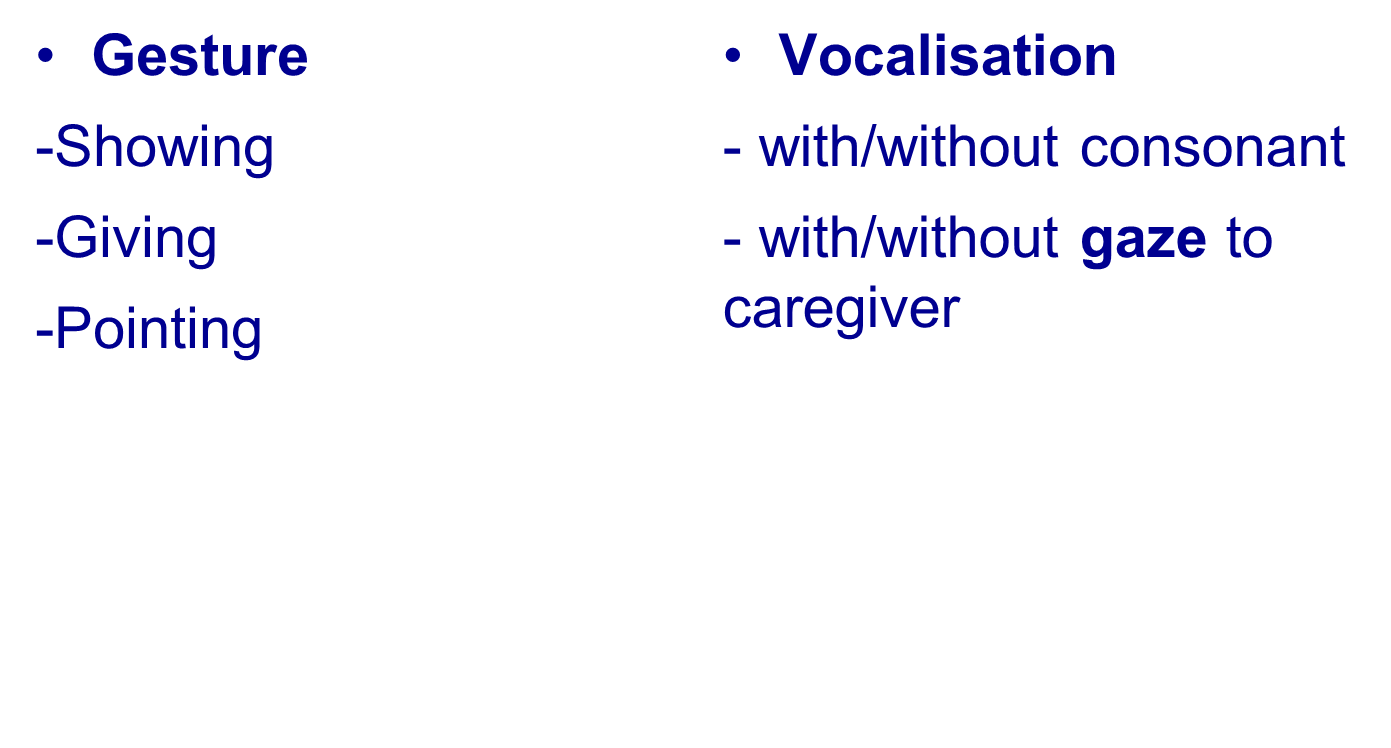
we can use diff types of prelinguistic communication to direct other peoples attention into what you want to talk about,
for example, the pointing and babble directs the parents attention to what the baby wants and then urges communication and attention about the topic the baby wanted to communicate about
Gestures: pointing
between 10-14 months, infants begin to point imperatively (to tell someone to do something), declaratively (to inform someone else about something) or interrogatively (to request information about something)
index finger pointing is a predictor of later vocabulary learning along with other gestures including showing
vocalisation with gaze co-ordination
vocalisation and looking to the caregiver within one second
the frequency with which this happens and is responded to by a caregiver is a good predictor of later language skills
Gaze co-ordination
Bates Camaioni Volterra (1975)
a perlocutionary stage
the child has a systematic effect on his listener without having intentional control over that effect
an illocutionary stage
the child intentionally uses non-verbal signals to convey requests and to direct adult attention to objects and events
a locutionary stage
the child constructs propositions and utters speech sounds within the same performative sequences that they previously expressed nonverbally (i.e. they are using words and sentences- the conventions of their language)
When do babies tend to first start producing words?
12 months for some and by 18 months most children should be able to say at least a few words, by 24 months if they aren’t speaking, they’re classified as a late talker
Word learning
most children start producing their first words within a few months of their first birthday (10-15m)
word learning is typically quite slow until children have learnt about 50-100 words
by the age of 6 children have something in the region of 10-14,000 words in their lexicon although there are huge individual differences
Word recognition
during the 2nd year of life children become faster at recognising spoken words
Fernal, Swingley & Pinto (2001) told children ‘look at the baby!’ while presenting them with two pictures, one of a baby and one of a dog
they measured how long it took infants to look at the right picutre
they found that:
children look at the right picture even when they had only heard the first part of the word
older children and children with larger productive vocabularies were faster to look at the right picture
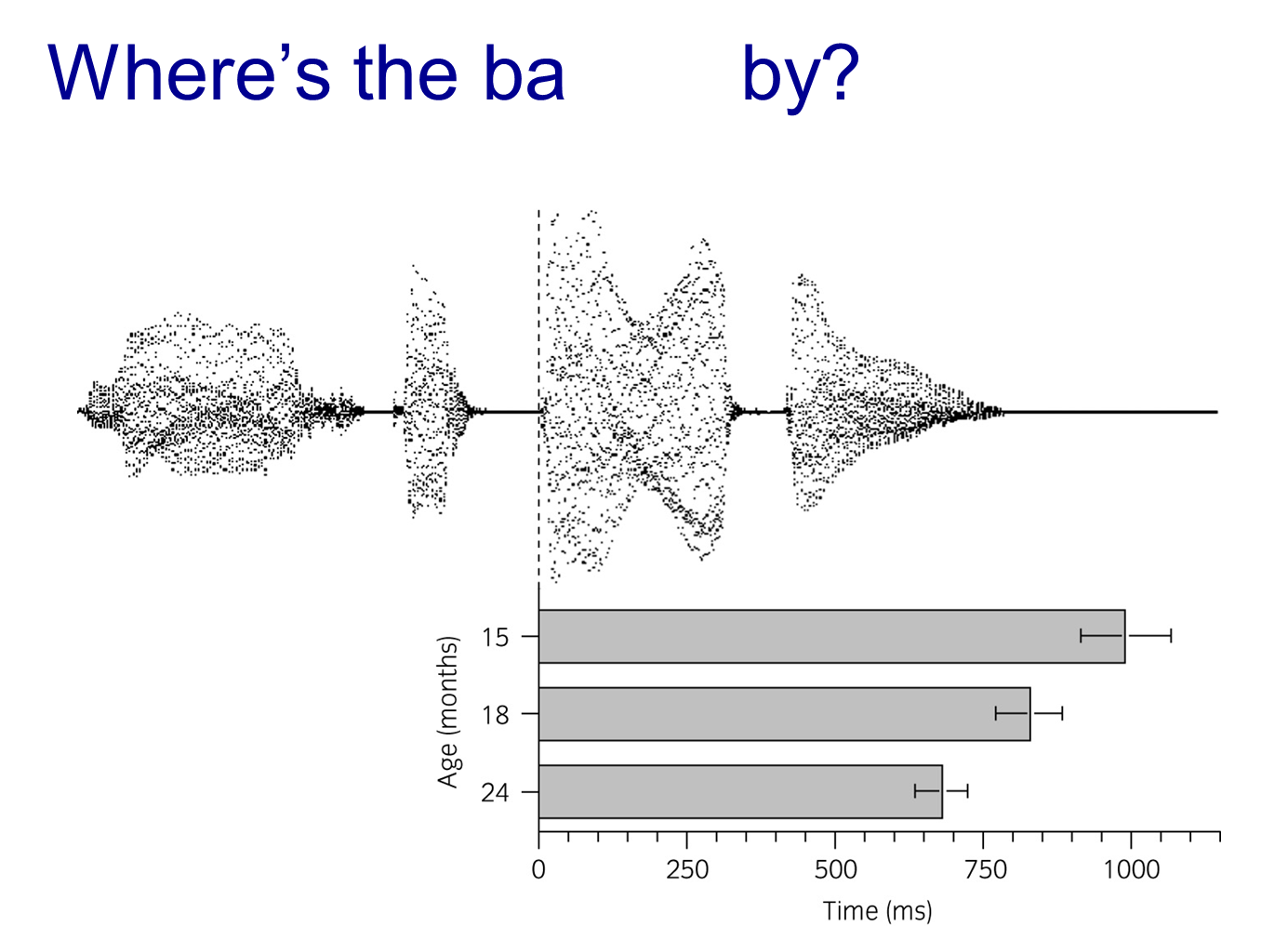
it no longer becomes ‘do you know the meaning of the word baby’ but rather ‘how fast can you process the word that I’m says (which happens ot be baby)
Word learning: phonology
errors in production of target word form common for many years (like adult spoonerisms and malapropisms)
children may be able to perceive but not produce certain speech sounds
example:
Therapist: Johnny, I’m going to produce a word times, and you tell me which time I said it right and which time I said it wrong. Rabbit, Wabbit
Child: Wabbit is wight and wabbit is wong
the kid knows that ‘wabbit’ is wrong but also cannot say it correctly themself
Word learning semantics
it is hard to tell when children have learnt a word’s meaning (its semantics)
following Wittgenstein (1953), we can assume that word learning is about converging on the conventional (adult) use of a word
children don’t get this right first time
In particular they tend to make ‘errors' of scope’ that can shed light on the obstacles and the process of learning
underextensions: e.g. ‘daddy’ to mean any adult male, dog to mean any four legged animal. May be due to lack of alternative
Learning mechanisms
children draw on many sources of info and learning mechanisms to learn words
some theorists argue for the importance of one mechanisms over others, but likely they are all working in concert
different learning mechanisms may be more or less important at different points in development
Word learning: Simple Association
children are exposed to many situation in which a word might map to a referent
they learn labels through statistical learning- adjusting the probability of the word- referent (or word-function) mapping as they get more information
needs some tweaking to explain how abstract words are acquired (verbs: thinking, Preposition: inside, during). Not all words are labels for objects
Word learning: Social-Pragmatic cues
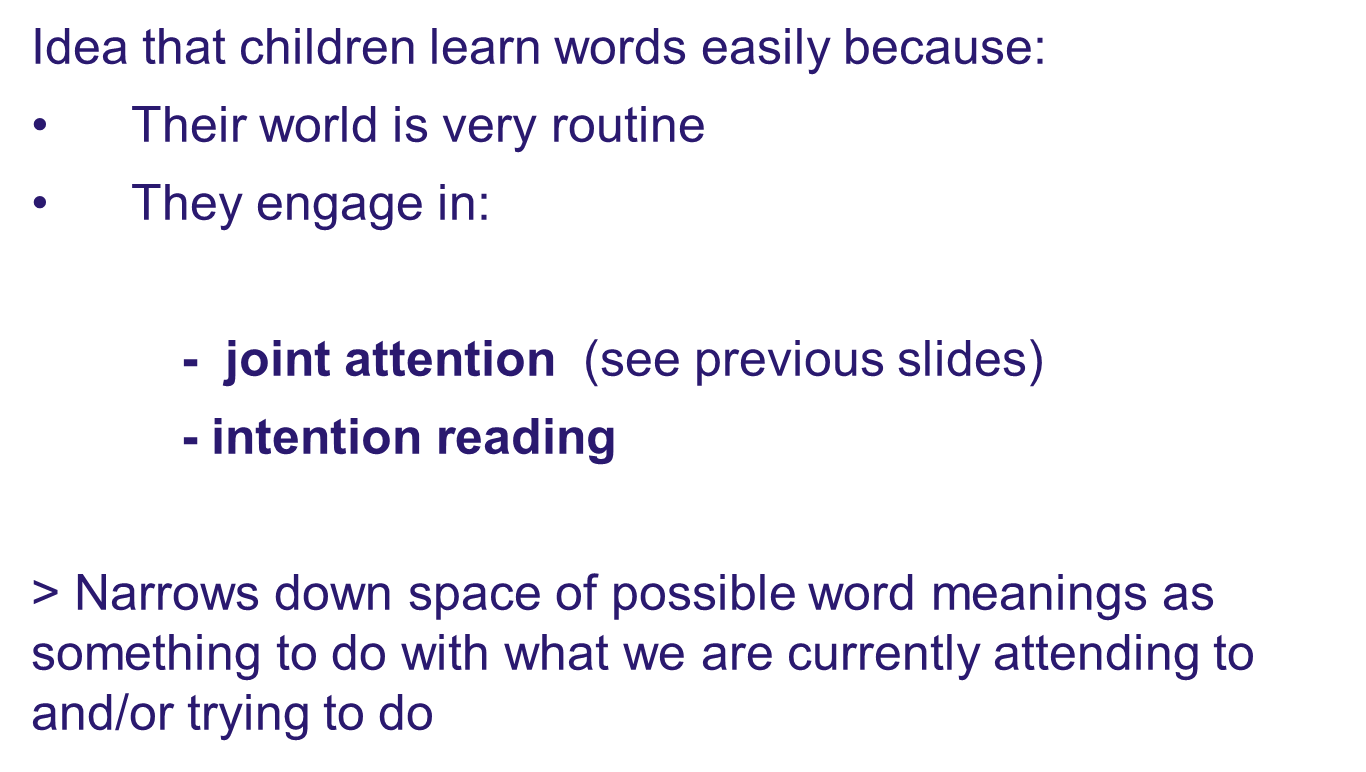
intention reading
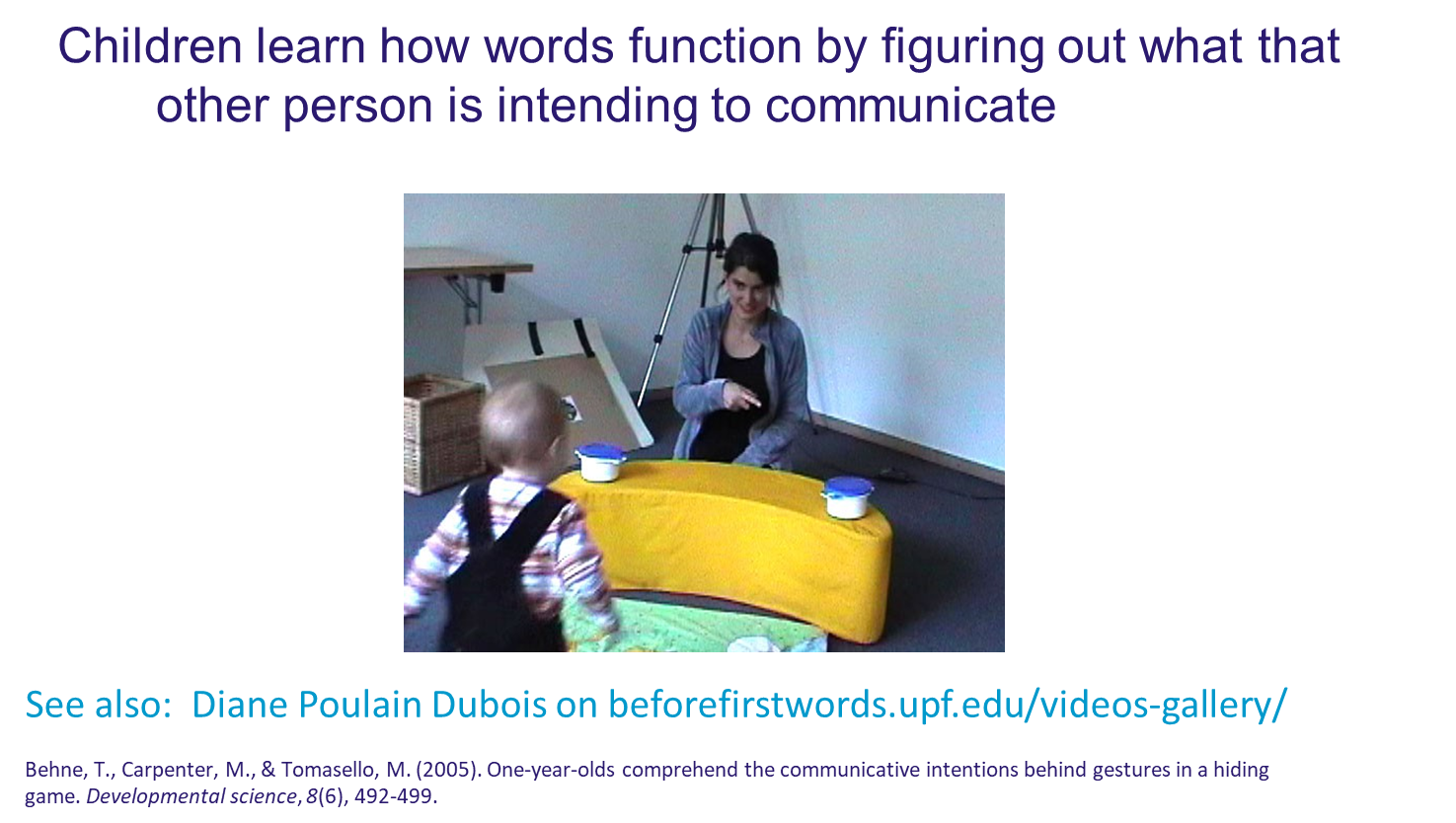
researcher points to one of the boxes and the child knows to go to that one to get something out of that box
seems simple but chimpanzees would have no clue that this is a gesture
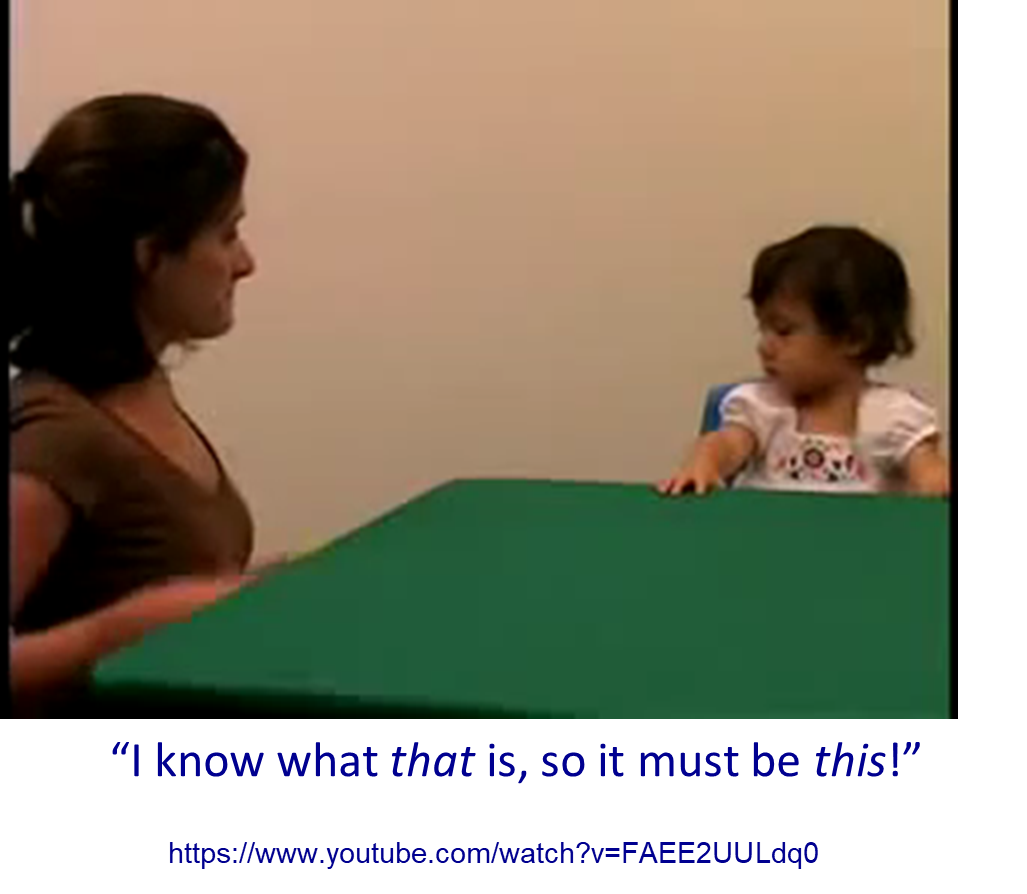
Word learning: mutual exclusivity
knowing the meaning of one word may help understand the meaning of another word
for example, knowing the meaning of pen and not cloth but someone asks you to pass the cloth and there are only the option of passing a cloth and a pen so you know that she doesn’t want to pass a pen and thus the other object must be cloths
Word learning: Syntactic bootstrapping
linguistic context can help us guess the meanings of words
‘Twas brillig and the slythy toves did gyre and gimble in the wabe’ Lewis Carroll
syntactic bootstrapping:
using language structure to identify what a word means