Science Exam
CHEMISTRY
Classify matter:
Pure substances -
Elements: can't be broken down (P.T)
Compounds: made from 2 or more elements
Mixtures -
Heterogeneous;
Mechanical: can visually see the different matters ex. salad
Suspension: Cloudy mixture where tiny particle of one substance is held in another Ex. Hot chocolate
Homogeneous;
Solutions: cannot see the different substances ex. apple juice
Colloid: tiny particless are scattered through another Ex. Marshmallow, Air in solid
Chemical changes:
Rusting, combustion (anything where the original substance is changed into other substances that have different properties)
Clues- New colour, new odour, bubbles of gas, heat/light, precipitate (solid->liquid)
Qualitative and quantitative physical properties:
Qualitative - Gather from senses (words) Quantitative- measured with numbers
Ex. Colour, optical clarity, odour, texture, state, malleability, ductility, melting/boiling point, solubility, viscosity, lustre, (conductivity), hardness, density
Chemical properties:
Combustibility, Flammability, Light sensitivity, Reaction with an acid
Density problems (ex):
Calculate the density of a metal sample that is 18 cm long, 9.21 cm wide, and 4.45 cm high, that has a mass of 14.25 kg. What is the density of the metal?
D = m/v = 0.01425g/(18×9.21×4.45) = 19.316 SIG FIGS = 19.3g/cm3
Sig digs:
Multiply = sig figs
Add = decimals
Define and give examples of elements, compounds and isotopes:
Elements - Mercury, Iron, Sodium
Compounds - H2O, NaCl, CO2
Isotopes - Same element but different neutrons, so average mass is used
Name the elements in a formula (ex):
NaOH = Sodium, Oxygen, Hydrogen
NH4Cl = Nitrogen, 4 Hydrogens, Chlorine
Count the atoms in a chemical formula (ex):
Cl2 = 2 atoms of Chlorine bonded together (HOFBrINCl)
Discuss the atomic models of Dalton, Thomson, Rutherford, and Bohr:
Dalton - Billiard ball (tiny particles, identical, different elements = different atoms, atoms cannot be created/destroyed)
Thomson - Plum pudding (Positive atom with negative particles)
Rutherford - Nuclear (Proton in center called nucleus, around is negatively charged electrons)
Bohr - Planetary (Proton center orbited by electrons)
Determine: # of protons, neutrons and electrons:
Isotopes - Protons & Electrons = atomic number Neutrons = Atomic mass - Atomic number (protons)
Ions - Protons = same as isotope Electrons = filled valence shell so net charge can be positive or negative Neutrons = Atomic mass - Atomic number (protons)
Determine atomic number, atomic mass, standard atomic notation:
AN - Number of protons (& electrons)
AM - mass of an atom consisting of the nucleus, ADD # OF PROTONS AND # OF NEUTRONS = amu or u,
SAN - Mass number (bigger) on top left (round mass), atomic number on bottom left, Symbol in center
Draw Bohr-Rutherford diagrams (atom, ion, ionic compounds, molecular compounds) (ex):?
DONE
Show the formation of ionic compounds using Lewis diagrams (electron-dot diagrams) (ex):
[F]1- [MG]2+ [F]1-
Magnesium fluoride
MgF2
Draw Lewis structures (covalent compounds) (ex):
H — O — H
Dihydrogen Oxide
H2O
Distinguish between metals and non-metals:
Metals- solid, lustre, conductive, malleable, ductile
Non-metals- gases, powdery solids, opposite of metals
Determine the group and period of an element & what they tell us about an atom’s structure:
Group - vertical ↓ (Increase in valence electrons)
Period - horizontal → (Increase in electron shells)
Identify alkali metals, alkaline earth metals, halogens, and noble gases:
Alkali metals - group 1, 1 electron in valence, most reactive metals, shiny, soluble
Alkaline earth metals- group 2, 2 electrons in valence, shiny, silver, insoluble
Transition metals- middle
Halogens- group 17, 7 electrons in valence, most reactive non-metal, poisonous, react with Alkali
Noble gases- group 18, 8 electrons in valence, non-reactive, do not form compound
Explain how negative ions (anions) and positive ions (cations) form:
Cations (+) - When the Ion loses electrons, it becomes positive
Anions (-) - When the Ion gains electrons, it becomes negative
Name ionic compounds (binary, multivalent and polyatomic) and write formula:
Binary - Names of compounds
Multivalent - Differing roman numerals (transitions)
Polyatomic - Has Polyatomic ions
Write word equations and balance chemical equations (ex):
Fe2O3 + H2 → Fe + H2O = Fe2O3 + 3H2 → 2Fe + 3H2O
Iron (III) Oxide + Hydrogen (g) → Iron + Air
BIOLOGY
Biotic & Abiotic factors:
B - Living components: organisms, remains, products, wastes. Ex: fish, dead fish, offspring, poo
A - Non-living components: physical & chemical. Ex: wind, water, temp, minerals, air
Differentiate between limiting factor, tolerance range and carrying capacity:
Limiting factor: Restricts the size of the population (B- availability of food or A- access to water)
Tolerance range: The survival range of each species
Carrying capacity: Species size limit of ecosystem
Population increases, need for resources increase
More susceptible to predators and diseases
Discuss species interactions:
Mutualism - Both benefit
Commensalism - 1 benefits, 1 neutral
Ammensalism - 1 harmed, 1 neutral
Predation - 1 benefits, 1 harmed (Predatory, whatevers not parasites)
Parasitism - 1 benefits, 1 harmed (Insects, parasites)
Explain why biodiversity is important in ecosystems:
So that the food web can flourish even when one species dies out
Explain predator/prey relationships:
Predator hunts prey. Normally to get energy (10% fanum tax for each predator)
Analyze a food chain and/or food web and the flow of energy (ex):
Arrow pointed to predator. 10% fanum tax for each predator. Measured in Joules.
Draw food chains, food webs and ecological pyramids (ex):
______ → ______ → ______ → ______ = Food Chain
______ → ______ → ______ ^ = Food Web
Pyramids - Energy = 🔼 Numbers = 🔽 Biomass = 🔼
Explain the carbon cycle (ex):
Carbon is cycled through the atmospheres
Plants need CO2
When fossil fuels are burnt, it sends more CO2
Explain the nitrogen cycle (ex):
Nitrogen fixation = N2 → NH3
Explain why photosynthesis and cellular respiration are complementary processes - write the word and chemical equations for photosynthesis and cellular respiration
Photosynthesis happens in the morning with sunlight to create sugars, using those sugars, Cellular respiration happens.
Photosynthesis - (Light energy)
Carbon Dioxide + Water → Glucose Sugar + Oxygen
CO2 + H2O → C6H12O6 + O2
Cellular Respiration -
Glucose Sugar + Oxygen → Carbon Dioxide + Water + (Useable) Energy
C6H12O6 + O2. → CO2 + H2O + E
Explain the importance of decomposers in an ecosystem:
Without decomposers, other organisms int he food chain wouldnt be able to recycle the nutrients of the dead back into the soil.
Distinguish between the terms: herbivore, carnivore, omnivore, producer, and niche:
Herbivore - Only eats plants
Carnivore - Only eats animals
Omnivore - Eats both plants and animals
Producer - Organisms that photosynthesize
Niche - Function if a species in ecosystem (species feeds on, what eats it, how it behaves)
Discuss the impact of invasive species on native species:
Eat things they aren’t supposed to and
Explain the impact of pesticides and bioamplification:
Pesticides can either kill a specific pest or kill a multitude
Bioamplification - when one organism is affected by toxins, the deeper into the food chain, the more the pesticide accumulates
Explain why DDT is banned in North America:
Operation cat drop
DDT = Broad-spectrum
Killed mosquitoes
Killed wasps that ate thatch-eating caterpillars (Thatch houses destroyed)
Killed cockroaches → damaged lizards systems → cats poisoned and died ← rat population increased → plague increased
Discuss the benefits of modern pesticides:
Making of expensive narrow-spectrum insecticides
Distinguish between oligotrophic and eutrophic lakes:
Oligotrophic - Lake low in nutrients (slow growth, low population density)
Eutrophic - Lake high in nutrients (dense plant population, low oxygen)
PHYSICS
Explain the Law of Electric Charges:
Like charges repel each other; unlike charges attract
Explain charging by friction, conduction, & induction:
Friction - Electrons transfer from 1 to another when rubbed (electrostatic) then stick together cuz of the law ^
Conduction - In contact, electrons move. [charged → neutral or charged → charged (Always goes from most to least charged)]
Induction -
Temporary loss of electrons = when charged is brought near neutral, electrons shift, uneven distribution)
Permanent loss of electrons = when charged is brought near neutral, electrons shift, you can use grounding to transfer/take electrons
Ue the Electrostatic Series – to determine which materials tend to gain or lose electrons (ex):
SEE IMAGE
Explain how “grounding” works and why it is necessary:
Connecting a conducting object to the Earths surface; transferring electrons
Protection form electric shocks
Distinguish between conductors and insulators:
Conductors - can transfer electrons (Good, fair) Ex. Mostly metals
Insulators - cannot transfer electrons
Explain why metals are good conductors:
Because the electrons are free to move in a network of the metal atom.
Explain what insulators do with charges:
Charge cannot flow, non-metals
Differentiate between static and current electricity:
Static - Stationary, stays in one place
Current - Flows
Explain the effects of humidity on static electricity:
If its too humid, it makes the air more conductive so it absorbs and evely distributes excess charges so friction is harder to acheive
Draw and label circuit diagrams (ex):
?
Use circuit symbols (ex):
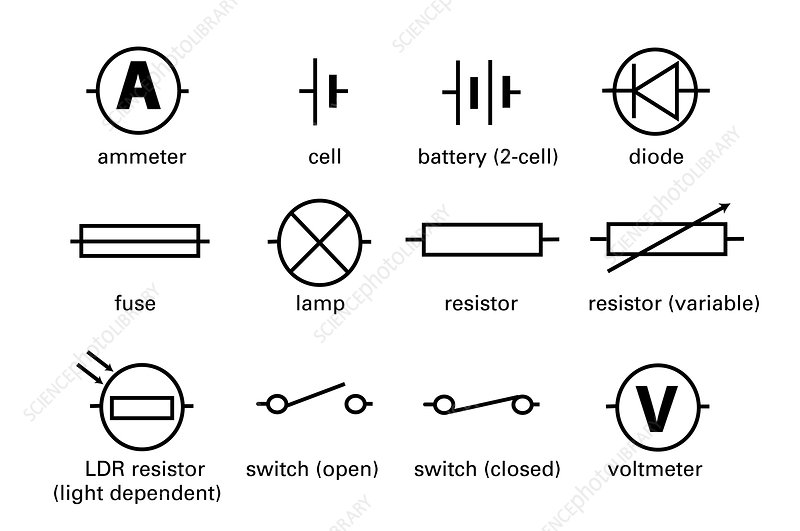 Cells, Resistor, Fuse, Wire, Ground, Lamp, Switch, Ohmmeter, Ammeter, Voltmeter, Motor
Explain relationships and calculate – USING GRASS – current, potential difference (voltage), resistance, power, percent efficiency, cost of electricity and equivalent resistance
Power - P = IV OR P = E/T
Current - I = P/V OR I = V/R
Voltage - V = P/I OR V = IR
Resistance - R = V/I
% Eff = (Energy Out / Energy In) * 100% Eout is always smaller, Ein is bigger
Cost = P (kW) x t (H) x cost of electricity [¢] (rate) (kWH)
APPLY SIGDIGS
- use the symbols and units for current, potential difference, resistance, power and efficiency properly
I, V, R, P, %Eff
Discuss factors that affect resistance
Type of material - Better conductor (least resistant) = Fewer collisions
Cross-sectional Area - Larger diameter = less collisions and opposition, more room
Length - Shorter = less resistance
Temperature - Colder = less collisions and resistance
Describe how to measure current and potential difference in a circuit
Ammeter - Current (Series)
Voltmeter - Voltage (Parallel)
Ohmmeter - Resistance (Parallel)
Analyze series and parallel circuits to determine voltage, current and/or resistance
Kirchoffs Laws
Series → (I t = I1 = I2 ….) (V t = V1 + V2 ….) (R t = R1 + R2 ….)
Parallel → (I t = I1 + I2 ….) (V t = V1 = V2 ….) (1/R parallel = 1/R1 + 1/R2 ….)
Name conventional and alternate ways to generate electrical energy
Nuclear, wind, solar, hydro, biomass, geothermal power plants
Distinguish between renewable and non-renewable energy resources
Renewable - Naturally replenished without human interference (Ex. Solar, Hydro, Wind energy)
Non-renewable - Finite; Will eventually deplete without human interference (Ex. Fossil fuels, nuclear energy)
ASTRONOMY
Describe inner/outer planets; gas vs. terrestrial planets:
MeVEMa | JSUN
Terrestrial - Mostly solid, Made of rocks and/or metals
Gas Giants - Larger, made of gases
Differentiate between solar and lunar eclipses:
Solar - Moon is between Sun and Earth
Lunar - Earth is between Sun and Moon
Explain why Pluto is no longer classified as a planet
3 qualifications:
Orbits around the Sun ✅
Has a nearly round shape ✅
Has its own orbital path ❌
Define units of AU and ly and calculate distances (Apply sig digs & Scientific Notation):
AU - Astronomical Units
Measuring distances within the Solar System
1 AU = distance from the Sun to Earth
1.5 × 10^8 km = 1 AU MEMORIZE THIS
ly - Light Years
Measuring distances outside the Solar System
9.46 × 10^12 km - 1 ly
Discuss properties of stars – colour and temperature:
Blue → White → Yellow → Orange → Red
Hottest —> Coldest
Composition of stars (ex):
Core, Radiative Zone, Convective Zone
Photosphere, Chromosphere, Corona
Outline life cycle of stars (small/medium, large, and massive) (ex):
Small/medium - Nebula, main-sequence star, red giant, planetary nebula, white dwarf, white dwarf cooling, black dwarf
Large - Nebula, main-sequence star, Supergiant, SuperNova, Neutron Star
Massive - Nebula, main-sequence star, Supergiant, SuperNova, Black Hole