Muscles
- The study of muscles is called myology
- Total muscles in the human body: 639
- Smallest muscle: stapes (in the ear)
- Broadest muscle: gluteus maximus (in the hip)
- Longest muscle: Sartorius
- Well, we see different types of movements in both humans and other living beings.
TYPES OF MOVEMENT IN HUMANS:
- Protoplasmic movement
- pseudopodia in amoeba, and macrophage, WBC in humans
- cilia in the paramecium, respiratory tract, ependymal cell, fallopian tube, and collecting duct in humans.
- flagella in euglena, sperm tail in humans.
- Muscular Movement
- muscles: excitability, contractibility, extensibility, elasticity
- coordinated work by muscle, bone, and nerve
CLASSIFICATION OF MUSCLES:
- SKELETAL MUSCLES:
- Voluntary
- connected with skeleton
- found in bundles
- striated
- unbranched (muscle cell)
- multinucleated
- SMOOTH MUSCLES
- involuntary
- connected to visceral organs
- not found in bundles
- unbranched
- unstriated
- uninucleated
- CARDIAC MUSCLES
- in heart
- involuntary
- branched
- striated
- uninucleated
- muscles connected to each other in the intercalated disc
MUSCLE
- Muscle cells are surrounded by a plasma membrane called sarcolemma.
- The cytoplasm which acts as the main arena of activities is called sarcoplasm.
- cell organelles include the nucleus, mitochondria, er
- cytoplasmic inclusions: glycogen, lipid, myoglobin, creatine phosphate, enzymes, ATPase, creatine phosphate kinase.
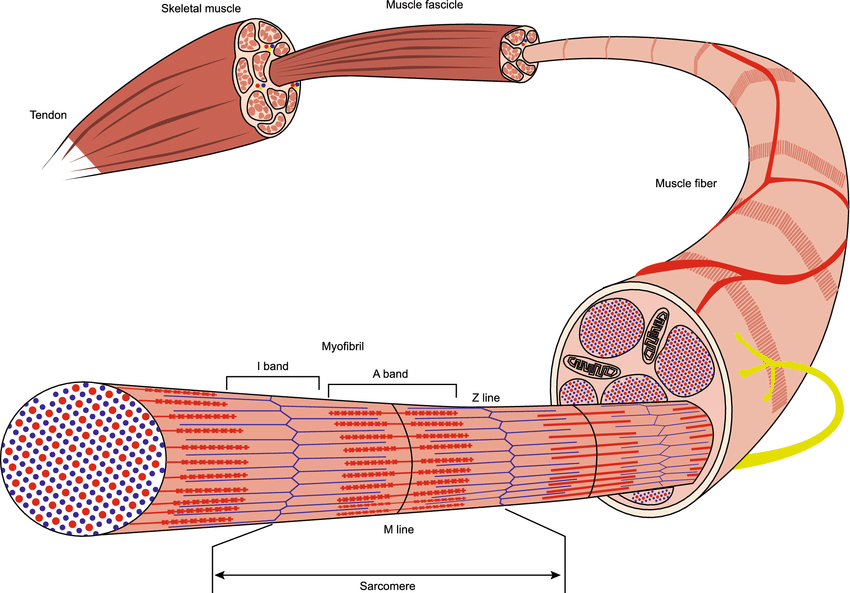
- Skeletal muscle layer (epimysium)
- Muscle fascicle layer (perimysium)
- Muscle fiber layer (endomysium)
COMPOSITION OF MUSCLE FIBER:
- Water (75%)
- Other (25%)
- protein (20%)
- force-generating: actin, myosin
- regulating: troponin, tropomyosin
- structural: actinine
- other (5%) ions like Na+, K+, HCO3-
MYOFIBRIL:
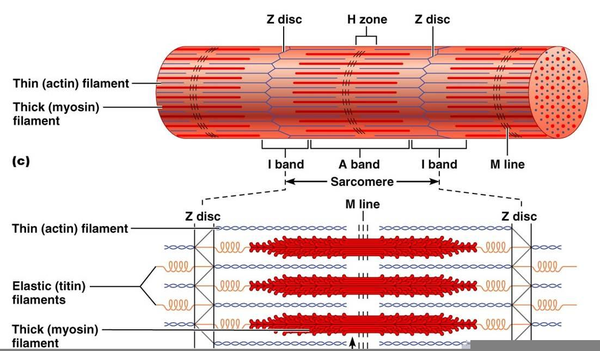
- Z line is attached to sarcolemma by costomere.
- M line consists of myosin rod.
- Actin is attached to sarcolemma by dystrophin.