Thermal Relations
Thermal relations of animals require definition of two key concepts:
Endothermy
When an animal’s tissues are heated by its metabolic heat production
Thermoregulation
Maintenance of constant tissue temperature despite changes in environmental temperature
Some animals are endotherms, thermoregulators, both, or neither.
Animals who aren’t endotherms are called ectotherms or poikilotherms
Animals who both perform endothermy and thermoregulation are termed homeotherms
Heterotherms exhibit endothermy and thermoregulation in one part of the body, while lacking in other parts (e.g. bumblebees)
Temperature vs. Heat
Temperature
Measure of average speed of random atomic motions in a material
Determines the direction of heat transfer
Heat
Energy associated with the motion of each atom
Moves by conduction or convection
Animals exchange heat with its surroundings via
Conduction
Heat transfers via static object(s)
E.g. from warm end to cold end of metal bar
Convection
Heat transfers via moving substance(s)
E.g. via wind/flowing water
Much faster than convection
Evaporation
Water escapes in gas form due to absorption of heat
Thermal radiation
Emission of infrared wavelengths (=thermal radiation)
The warmer the object, the shorter the wavelength
Fire is visible thermal radiation (kind of)
Poikilothermy
May have behavioural control over their body temperatures, as they can move to warmer microclimates
Thus maintain a roughly constant body temperature
Must however tolerate greater spans due to e.g. bad weather (eurythermal and stenothermal)
When body temperature is raised in a series of steps, the metabolic rate increases exponentially
When the poikilotherm is kept at one body temperature for a long time, its exponential relation adapts to the constant body temperature due to acclimatisation
Acute responses
Occur promptly to changes in body temperature
Chronic responses
Changes that occur over a longer period
= Acclimation / Acclimatisation
When poikilotherms adapt to colder temperatures, the metabolic rate increases in a direction that puts the metabolic rate closer to the original metabolic rate prior to the drop in temperature
This is called compensation
Animals may acclimate to colder temperatures by
Increases synthesis of key rate-limiting enzymes
Thus increasing metabolism
Red muscles increase mitochondria density
The performance of a poikilotherm over body temperatures can be illustrated by the performance curve
Low performance at low body temperatures
Increases to a peak
Also maximal O2 delivery to blood
Afterwards declines rapidly
Pejus phase
Also less O2 delivery
Eventually dies (not sure why, temperature is lower than would cause protein denaturation)
Poikilotherms threatened with freezing may:
Produce antifreeze compounds
Lower freezing points of body fluids
Colligative antifreezes
Increases total concentration of solutes in body fluids
Includes glycerol, sorbitol, mannitol
Non-colligative antifreezes
Have particular chemical properties, e.g. bind to ice crystals to suppress ice growth, preventing them from joining up with other crystals
Lower freezing points but not melting points (=thermal hysteresis)
Perform supercooling
Cool down below freezing point, remaining unfrozen
If the temperature of the supercooled solution keeps falling, it may spontaneously freeze within a short time
Property of most liquids
Animals may lower supercooling point by cleansing their body fluids of ice-nucleating agents
Evolve tolerance of freezing
Can tolerate having their body fluids being completely frozen during winter
Does not include the intracellular body fluids
Note that the freeze-tolerance is only for extracellular body fluids. Freezing of intracellular body fluids is always fatal no matter what.
Homeothermy
Ability to physiologically maintain/regulate a constant body temperature independent of external environmental temperatures
Evolved independently in mammals and birds
Mammals ~37 degrees
Birds ~39 degrees
The body temperature is maintained by thermoreceptors in the skin, spinal cord, brain, and scrotum
Sensory signals are processed by thermal control centres in the hypothalamus.
The metabolic rate of a mammal/bird varies with ambient temperature.
However, within a certain range of ambient temperatures, called the thermoneutral zone (TNZ), the animal’s metabolic rate is independent of the ambient temperature.
In this zone, the resting BMR is constant
To the “left” (before the lower-critical temperature), the BMR increases (decreases until the TNZ)
To the “right” (above the upper-critical temperature, the BMR increases.
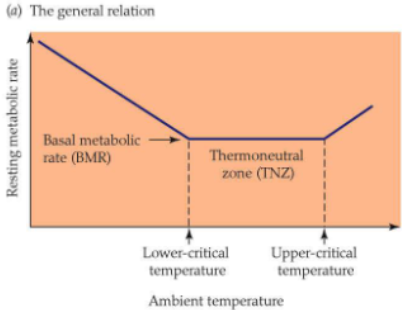
The metabolic rate is constant in the thermoneutral zone due to adjustment of the insulation.
When the ambient temperature lowers, the animal increases its insultation
The skin becomes erect, trapping a thicker layer of air between the skin and the surrounding air
Arterioles constrict, thus reducing heat loss
Also by curling up (mammals) or placing head under feathers (birds), heat loss is minimised
If the ambient temperature increases, the animal decreases its insulation
Arterioles can dilate, increasing the rate of blood flow to release heat
Note that TNZ tends to be narrower in smaller animals.
Dry heat transfer
Transfer of heat that excludes evaporation/condensation of water
Involves only conduction, convection, and thermal radiation
Thermogenic mechanisms
Increase rate of heat production when TA falls below the lower critical temperature
Shivering:
Unsynchronised high-frequency contractions and relaxations of the skeletal muscles
Uses ATP and liberates heat
Nonshivering thermogenesis (NST)
Most common in placental mammals
Occurs after long period of acclimation to low temperature (long after shivering has ceased)
Most important site of NST is brown fat
To restrict heat loss, many mammals reduce local temperature of the appendages
Counter-current heat exchange also helps the blood heat up on the way back to the core body.
For temperatures above thermoneutrality, there are two main strategies how to cope:
Active evaporative cooling
E.g. panting, sweating, gular fluttering
Extra loss of water
Hyperthermia
Birds/mammals allow their body temperatures to rise to unusually high levels
More heat leaves the body
Common in animals adapted to hot dry environments (to avoid water loss)
Both these strategies paradoxically increase the metabolic rate