10 - Glycolysis
Glycolysis: The Breakdown of Sugar
Definition: Glycolysis literally means "breaking down sugar."
It's a series of steps that breaks down glucose into pyruvate.
Glucose —> 2 pyruvate
Role in Cellular Respiration: Cellular respiration is how cells get energy from glucose.
Glycolysis is the first step in this bigger process.
Overall Net Reaction (Glycolysis only): Takes glucose, , and ATP to make pyruvate, NADH, and a small amount of ATP.
Glucose, NAD+, ATP ——> Pyruvate, NADH, ATP
Connection to Other Processes: The pyruvate and NADH made in glycolysis usually go on to other parts of cellular respiration
(like the TCA cycle and oxidative phosphorylation) to make a lot more ATP.
No Oxygen Needed: Glycolysis itself doesn't need oxygen.
Aerobic Glycolysis: Glycolysis is followed by steps that do need oxygen (pyruvate oxidation, TCA cycle, oxidative phosphorylation).
Anaerobic Glycolysis: Glycolysis is followed by fermentation (e.g., making lactate)
which does not need oxygen.
Self Note: Glycolysis is the process of breaking down sugar. In glycolysis, glucose is turned into pyruvate. It starts with ATP, NAD+, and glucose and ends with 2 ATP, pyruvate, and NADH.
Redox Reactions in Metabolism
Definition: A redox reaction involves one molecule losing electrons (oxidation) and another gaining electrons (reduction).
Oxidation: Losing electrons (or sharing them less with a strong electron-puller).
Reduction: Gaining electrons (or sharing them more).
Historical Note: "Oxidation" first referred to reactions with oxygen, but it now means any electron loss, even without oxygen.
Key Terms:
Electron Acceptor: Gains electrons, gets reduced, and causes something else to be oxidized (it's the oxidizing agent).
Electron Donor: Loses electrons, gets oxidized, and causes something else to be reduced (it's the reducing agent).
Menomic: OIL RIG: Oxidation Is Loss, Reduction Is Gain (of electrons).
Self Note: Electron acceptors are the atoms that are reduced and gain an electron, considered to be the oxidizing agent since it is taking an electron from another atom. Electron donors are the atoms that are being oxidized and loose an electron, considered to be the reducing agent since it is giving an electron to another atom.
Cellular Respiration and Redox:
Cellular respiration is a redox process that releases energy.
Instead of releasing all energy at once (which would be wasteful and dangerous), it happens in many small steps
capturing energy along the way.
Electrons are passed step-by-step through electron carriers before reaching oxygen.
Electron Carriers:
Nicotinamide Adenine Dinucleotide () is a very important electron carrier.
(the "empty" form) picks up electrons and proton () from food molecules during reactions
with the help of dehydrogenase enzymes. (Enzymes that catalyze the oxidation of substrate molecules by removing hydrogen atoms and transferring the electrons to electron carriers)
This turns into NADH (the "full" form).
then carries these high-energy electrons to other stages of cellular respiration to make ATP.
Detailed Steps of Glycolysis
Glycolysis has 10 steps, split into two phases:
Phase 1: Energy Investment (Steps 1-5)
Uses ATP molecules. (comes from existing ATP pool in the cell)
Breaks glucose (a -carbon sugar) into two -carbon sugars.
Phase 2: Energy Payoff (Steps 6-10)
Produces ATP molecules (for a net gain of ATP).
Generates NADH molecules.
Self Note: Glycolysis is made up of 10 steps. Steps 1-5 is known as the energy investment phase, to where 2 ATP molecules are invested to split a 6-carbon glucose into 2 3-carbon molecules. Steps 6-10 are the energy payoff phase during which 4 ATP (net gain 2 ATP), 2 NADH, and 2 pyruvate are produced.

Phase 1: Energy Investment
Glucose Getting into Cells:
After eating, food breaks down into molecules like glucose.
Glucose goes into the bloodstream.
Pancreas releases insulin in response to high blood glucose.
Insulin tells cells to move glucose transporters (GLUTs) to their surface.
Glucose then enters the cell.
Step 1: Hexokinase
Enzyme: Hexokinase.
Action: Adds a phosphate group to glucose at carbon . (full form) This costs ATP.
Product: Glucose--phosphate.
Why it matters: This traps glucose inside the cell. The liver can remove this phosphate to release glucose back into the blood if needed.
Self Note: Hexokinase is an enzyme that acts on glucose-6 once it enters the cell. The enzyme phosphorylates the glucose molecule, causing it to become trapped inside the cell. The added phosphate group gives the glucose molecule a negative charge, which makes it too polar to diffuse through the lipid membrane.
Hexokinase + Glucose (6C) —> Glucose-6-phosphate
Step 2: Phosphoglucoisomerase
Enzyme: Phosphoglucoisomerase.
Action: Changes Glucose--phosphate into Fructose--phosphate (an isomer).
Product: Fructose--phosphate.
Self Note: The phosphoglucoisomerase enzyme rearranges the glucose-6-phosphate into fructose-6-phosphate which makes the molecule more symmetrical. The symmetry of the molecule sets it up to be split by the aldolase enzyme into two 3-carbon molecules.
Phosphoglcoisomerase + Glucose-6-phosphate ——> Fructose-6-phosphate

Step 3: Phosphofructokinase (PFK)
Enzyme: Phosphofructokinase (PFK).
Action: Adds another phosphate to Fructose--phosphate at carbon . This costs another ATP (total of ATP used so far).
Product: Fructose--bisphosphate.
Why it matters: PFK is a major control point for glycolysis.
Self Note: The phosphofructokinase is an enzyme that catalyzes the phosphorylation of fructose-6-phosphate into fructose-1,6-biphosphate, using 1 ATP molecule. The addition of the phosphate group makes the molecule more symmetrical, which enables the adolase to make a clean cut in the upcoming step. The PFK is also an important step in glycolysis because it is the committed step that makes the fructose-1,6-biphosphate locked into glycolysis in the cell.
Fructose-6-phosphate + phophofructoisomerase ——> Fructose-1,6-biphosphate

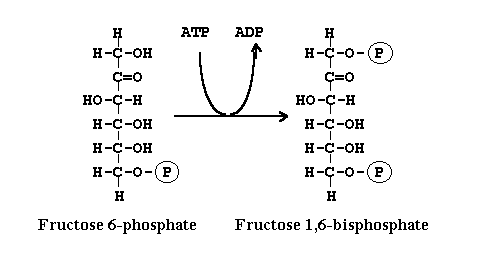
Self Note: The added phosphate makes the molecule more symmetrical
Step 4: Aldolase
Enzyme: Aldolase.
Action: Splits Fructose--bisphosphate (the -carbon sugar) into two different -carbon sugars: Glyceraldehyde--phosphate (G3P) and Dihydroxyacetone phosphate (DHAP).
Self Note: The aldolase enzyme splits the fructose-1,6-biphosphate into 2 3-carbon sugars, including 1 glyceraldehyde-3-phosphate molecule (G3P) and 1 DHAP
Fructose-1,6-biphosphate + aldolase ——> 1 Glyceraldehyde-3-phosphate + 1 DHAP
Step 5: Triose Phosphate Isomerase
Enzyme: Triose phosphate isomerase.
Action: Converts DHAP into G3P.
Why it matters: Only G3P can continue in glycolysis.
As G3P is used up, more DHAP converts to G3P (Le Chatelier's Principle).
Self Note: Since DHAP is not needed for glycolysis, the triose phosphate isomerase converts it into G3P. Now there are 2 G3P molecules
DHAP + Triose Phosphate isomerase ——> 1 glyceraldehyde-3-phosphate (G3P)
Now there are 2 G3P molecules
Phase 2: Energy Payoff (Steps 6-10) - Now working with two -carbon sugars
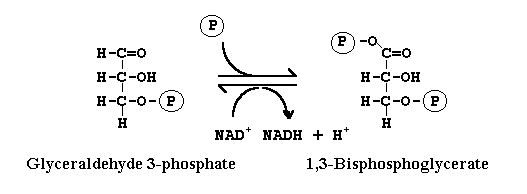
Step 6: Glyceraldehyde-3-phosphate Dehydrogenase (GAPDH)
Enzyme: GAPDH.
Action: Oxidizes G3P (meaning it removes electrons and gives them to to make NADH).
At the same time, it adds an inorganic phosphate () to G3P.
The energy from the oxidation powers this phosphorylation.
Product: Two molecules of -bisphosphoglycerate (because the original glucose split into two -carbon units).
Co-factor: Requires to accept electrons.
Self Note: The glyceraldehyde-3-phosphate dehydrogenase enzyme catalyzes the oxidation of G3P to reduce NAD+ into NADH. The high-energy from the oxidation of G3P prompts the attatchment of an inorganic phosphate group to G3P to make 1, 3-biphosphoglycerate molecule
2 1, 3-biphosphoglycerate molecules since there were 2 G3P
G3P + G3P dehydrogenase ——> 1, 3-bisphosphoglycerate + NADH + H⁺.
Steps 7 & 10: Substrate-Level Phosphorylation+
Definition: Making ATP by directly moving a phosphate from a high-energy molecule to ADP.
Step 7: Phosphoglycerokinase
Enzyme: Phosphoglycerokinase.
Action: Transfers a phosphate from -bisphosphoglycerate to ADP
making ATP.
Product: Two molecules of -phosphoglycerate and ATP.
Self Note: The phosphoglycerokinase enzyme utilizes substrate-level phosphorylation to phosphorylate ADP into ATP, using a phosphate group from 1 3-biphosphoglycerate molecule. The 1, 3-biphosphoglycerate molecule turns into 3-phosphoglycerate since it now only has 1 phosphate.
1, 3-biphosphoglyerate + phosphoglycerokinase ——> 3-phosphoglycerate
Step 8: Phosphoglyceromutase
Enzyme: Phosphoglyceromutase.
Action: Moves the phosphate group from carbon to carbon on -phosphoglycerate.
Product: Two molecules of -phosphoglycerate.
Self Note: The phosphoglyceromutase enzyme moves the phosphate group from carbon 3 to carbon 2 to make it 2-phosphoglycerate. This is done to set up the molecule for water extraction in the next step.
3-phosphoglycerate + phosphoglyceromutase——> 2-phosphoglycerate
Step 9: Enolase
Enzyme: Enolase.
Action: Removes water from -phosphoglycerate, creating a high-energy phosphate bond.
Product: Two molecules of Phosphoenolpyruvate (PEP).
Self Note: the enolase enzyme removes H2O from the 2-phosphoglycerate molecule to make phosphoenolpyruvate (PEP). The PEP molecule has a very high-energy phosphate bond that is important for step 10 of glycolysis.
2-phosphoglycerate + enolase ——> phosphoenolpyruvate (PEP)
Step 10: Pyruvate Kinase
Enzyme: Pyruvate kinase.
Action: Transfers the high-energy phosphate from PEP to ADP, making ATP.
Product: Two molecules of Pyruvate and ATP.
Self Note: The pyruvate kinase enzyme utilizes substrate-level phosphorylation to turn ADP into ATP with the phosphate group from the phosphoenolpyruvate, which turns the molecule into pyruvate
Phosphoenolglycerate + Pyruvate Kinase ——> Pyruvate and ATP
Glycolysis Summary
What goes in (Input s): Glucose molecule, , ATP (used up in phase 1), ADP
What comes out (Outputs): Pyruvate molecules, NADH, ATP (total made), net gain of ATP.
How ATP is made: All ATP in glycolysis is made through substrate-level phosphorylation.
Fates of Pyruvate
After glycolysis, what happens to pyruvate depends on whether oxygen is present:
With Oxygen (Aerobic Conditions):
Pyruvate goes into the mitochondria.
It's converted to acetyl-CoA.
Acetyl-CoA then enters the TCA cycle (Krebs cycle).
The electron carriers (NADH, ) from these steps are used in oxidative phosphorylation to make a lot of ATP.
Without Enough Oxygen (Anaerobic Conditions) - Fermentation:
Since the mitochondria-based processes need oxygen, cells use fermentation to keep glycolysis going
(by regenerating ).
Alcohol Fermentation:
Used by yeast and some bacteria.
Pyruvate is turned into acetaldehyde, then into ethanol, which converts NADH back to .
Example: Yeast uses this to make alcohol and for baking.
Self Note: In Alcohol fermentation, the pyruvate, produced from glycolysis, undergoes a catalytic reaction to convert it into acetaldehyde, which enables the molecule to act as an eelctron acceptor. NADH transfers its electrons to acetaldehyde, which oxidizes NADH back to NAD+, and turns acetaldehyde into ethanol.
Self Note: Pyruvate has a CO2 molecule removed, which converts it into acetaldehyde. Acetaldehyde acts as an electron acceptor and is reduced to ethanol, as NADH is oxidized back to NAD+.
Lactic Acid Fermentation:
Used by muscle cells during intense exercise when oxygen is low.
Enzyme: Lactate dehydrogenase.
Action: Converts pyruvate into lactate and changes NADH back to .
Reactants: Pyruvate, NADH.
Products: Lactate, .
Benefit: Regenerates so glycolysis can continue making a small amount of ATP even without oxygen.
Muscle Fatigue: Though lactic acid is produced, it's not the only cause of muscle fatigue;
other factors like ATP depletion, calcium problems, and damage play a role.
Self Note: In lactic acid fermentation, the pyruvate produced from glycolysis is reduced to lactate, because NADH transfers elctrons to the molecule and is oxidized into NAD+. The recycled NAD+ enables the continuation of glycolysis.
Catabolism vs. Anabolism and Glucose Regulation
Catabolism: Processes that break down large molecules into smaller ones
releasing energy (e.g., glycolysis, breaking down glycogen).
Anabolism: Processes that build large molecules from smaller ones
requiring energy (e.g., making new glucose, building glycogen).
Examples:
Glycolysis: Catabolic (breaks down glucose).
Gluconeogenesis: Anabolic (builds new glucose).
Glycogenolysis: Catabolic (breaks down glycogen).
Glycogenesis: Anabolic (builds up glycogen).
How Regulation Works:
High Levels of substrate often boost building (anabolic) pathways.
Example: High blood glucose triggers insulin
which leads to glucose uptake and glycogen storage (building).
Low Levels of Substrate or Energy: Often boosts breakdown (catabolic) pathways.
Example: Low blood glucose triggers glucagon
which leads to glycogen breakdown (catabolic).
Anticipating Need: Hormones like epinephrine can start breakdown processes before energy is even demanded.
Self Note: High concentration of substrate boosts anabolic pathways because it makes sense to build larger molecules since there are many building blocks present, whereas low concentration of substrate prompts catabolic pathways because larger molecules need to be broken down.
Intracellular Feedback Regulation of Glycolysis
Main Control Enzyme: Phosphofructokinase (PFK), in step of glycolysis, is a key regulator.
Its activity is controlled by the cell's energy status.
ATP (High Energy): High levels of ATP inhibit PFK.
This slows down glycolysis because the cell already has enough energy
saving glucose.
AMP (Low Energy): High levels of AMP activate PFK.
This speeds up glycolysis to make more ATP because the cell needs energy.
Self Note: the PFK enzyme acts as the control enzyme, as it is turned on and off based on the concentration of ATP and AMP. With high ATP, this inhibits the enzyme, and slows down gycolysis because there is a lot of energy present, where as with high AMP, this activates the enzyme and speeds up glycolysis because more energy needs to be made.
ATP/AMP Ratio as an Energy Sensor:
When ATP is used, it turns into ADP.
An enzyme called adenylate kinase can convert ADP ATP AMP.
So, if a lot of ATP is being used, ADP goes up, and thus AMP also goes up, signaling an energy shortage.
This increased AMP directly turns on PFK to boost glycolysis and ATP production.
AMP also triggers other important signaling pathways.
AMP-activated protein kinase (AMPK):
AMPK gets activated when the AMP/ATP ratio is high (meaning low energy).
It then signals the cell to increase catabolic processes (energy-producing) to make more ATP.
Metformin: A drug for Type II diabetes (insulin resistance) is thought to work by activating AMPK. This helps cells take in glucose and break it down even when insulin signaling is faulty, helping to control blood sugar.
Evolutionary Considerations of Glycolysis
Glycolysis is a very old and essential metabolic pathway, found in almost all living things (bacteria, plants, animals).
It makes ATP quickly, which is important for bursts of energy or when oxygen isn't available.
It happens only in the cytoplasm and does not need oxygen.
It makes less ATP compared to oxidative phosphorylation.
Because it's so common and doesn't need oxygen, glycolysis was probably one of the first ways cells made energy on early Earth, before the atmosphere had much oxygen.