Ecology
Ecology is a branch of biology
Ecology is not conservation or environmental
→ The study of how organisms interact with their environment.
→ Understand the distribution ad abundance of organisms.
→ The focus of study is at different levels.
organisms → an individual living system
population → a group of organisms of the same species living in an area
community → a group of populations in an area
ecosystem → a community plus the non-living environment in which it lives
landscape → a mosaic of connected ecosystems
biosphere → the sum of all the planet’s landscapes
Organismal Ecology
Including evolutionary ecology and behavioural ecology, focuses on how an organism’s anatomy, physiology, and behaviour meet the challenges imposed by its environment.
Population Ecology
Focuses on factors that influence population size.
Community Ecology
Focuses on how interactions between species influence community structure.
Ecosystem Ecology
Focuses on energy flow and nutrient cycling.
Landscape Ecology
Focuses on exchange of energy, materials, and organisms among ecosystems.
Global Ecology
Focuses on the distribution and functioning of ecosystems across the biosphere.
Behavioural Ecology
The study of the ecological and evolutionary basis for animal behaviour.
animal behaviour: everything an animal does, and how it does it
→ an animal’s responses to external and internal stimuli.
Kinds of behaviour:
Innate behaviour
behaviour that is developmentally fixed
fixed action pattern: a sequence of unlearned acts directly linked to a simple stimulus
more complex signals and responses: migration, communication
Learned behaviour
behaviour that is modified based on experience
imprinting: the formation at a specific stage in life of a long-lasting behavioural response
more complex learning: spatial learning, associative learning, problem solving
behaviours are part of the phenotype, may be influenced by the genotype, may evolve
if a behaviour may be inherited, then it may evolve
Population Ecology
Factors that influence the size of a population:
births, immigration, deaths, emigration
exponential growth (growth of 2-4-8-16 etc)
carrying capacity: the maximum population size that can be supported by the available resources
→ Verhulst equation as the population grows to its carrying capacity, growth will slow down
carrying capacity is not always constant
r/K selection theory
“r-selected”
many small offspring
short generation time
“K-selected”
few large offspring
long generation time
Community Ecology
Interaction between species:
Competition (-/-)
Interaction is harmful to both populations.
Members of the two species compete for a resource.
In a simple competition, one species may drive the other to local extinction.
→ Competitive Exclusion
Even when one species competitively excludes another;
Natural selection may favour avoidance of competition.
Plus minus interactions:
Interaction is beneficial to one species and detrimental to another
Predation (+/-)
Members of one species (predators) eat members of another species (prey).
Parasitism (+/-)
Members of one species (parasites) live in or on members of another species (hosts) while feeding on the hosts.
Herbivory (+/-)
Members of one species (herbivores) eat parts of plants or algae.
Disease (+/-)
Microscopic parasitism. (eg. measles)
In predation:
Interaction is beneficial to predator, harmful to prey.
Natural selection favours traits that allow prey to avoid predators.
Predation may prevent a prey population from reaching its carrying capacity.
Predation may reduce competition among prey populations.
Mutualism (+/+)
Interaction is beneficial to both species.
Commensalism (+/0)
Interaction is beneficial to one species and irrelevant to the other.
Symbiosis: A long-term intimate (closely integrated) association of organisms of two different species.
eg. lichen, fungal hyphae and algal cell
tapeworm and humans
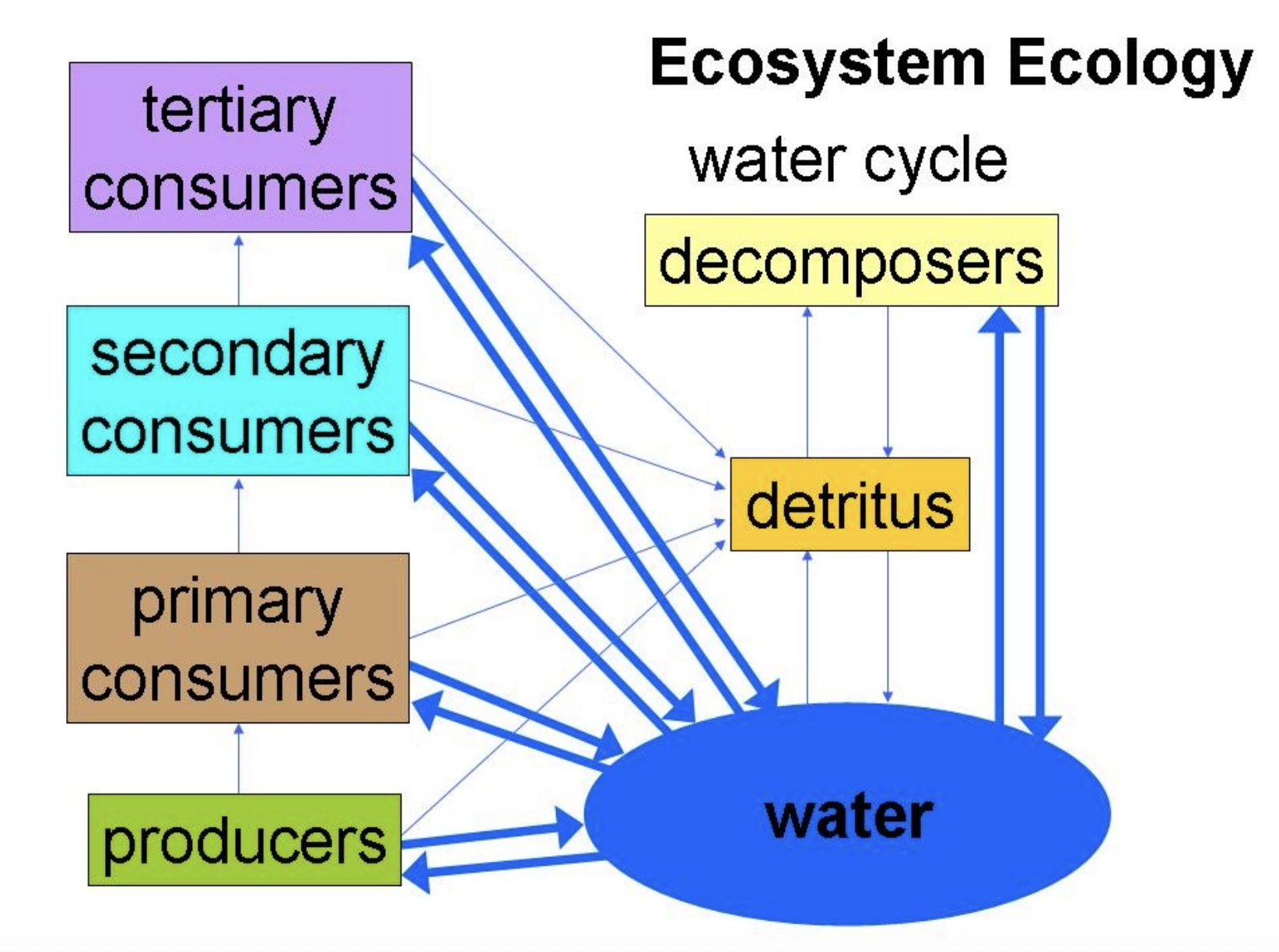
Ecosystem Ecology
primary producers (usually plants and algae)
primary consumers (usually herbivores) - eat primary producers
secondary consumers (carnivores) - eat primary consumers
tertiary consumers (carnivores) - eat secondary consumers
quaternary consumers (carnivores) - eat tertiary consumers
decomposers (detritivores) - feeds off detritus
‘trophic levels in a community’ - how many layers there are between you and the primary producers
biomass declines rapidly as you go up the trophic levels
biotic: related to living organisms.
abiotic: not related to living organisms.
niche: the sum of a species’ use of the biotic and abiotic resources in its environment.
biomass: the amount of organic matter (living things) in a group of organisms.
primary production: the rate at which new biomass is generated in an ecosystem.
detritus: an accumulation of biomass accumulating on the ground
Water Cycle
Carbon Cycle
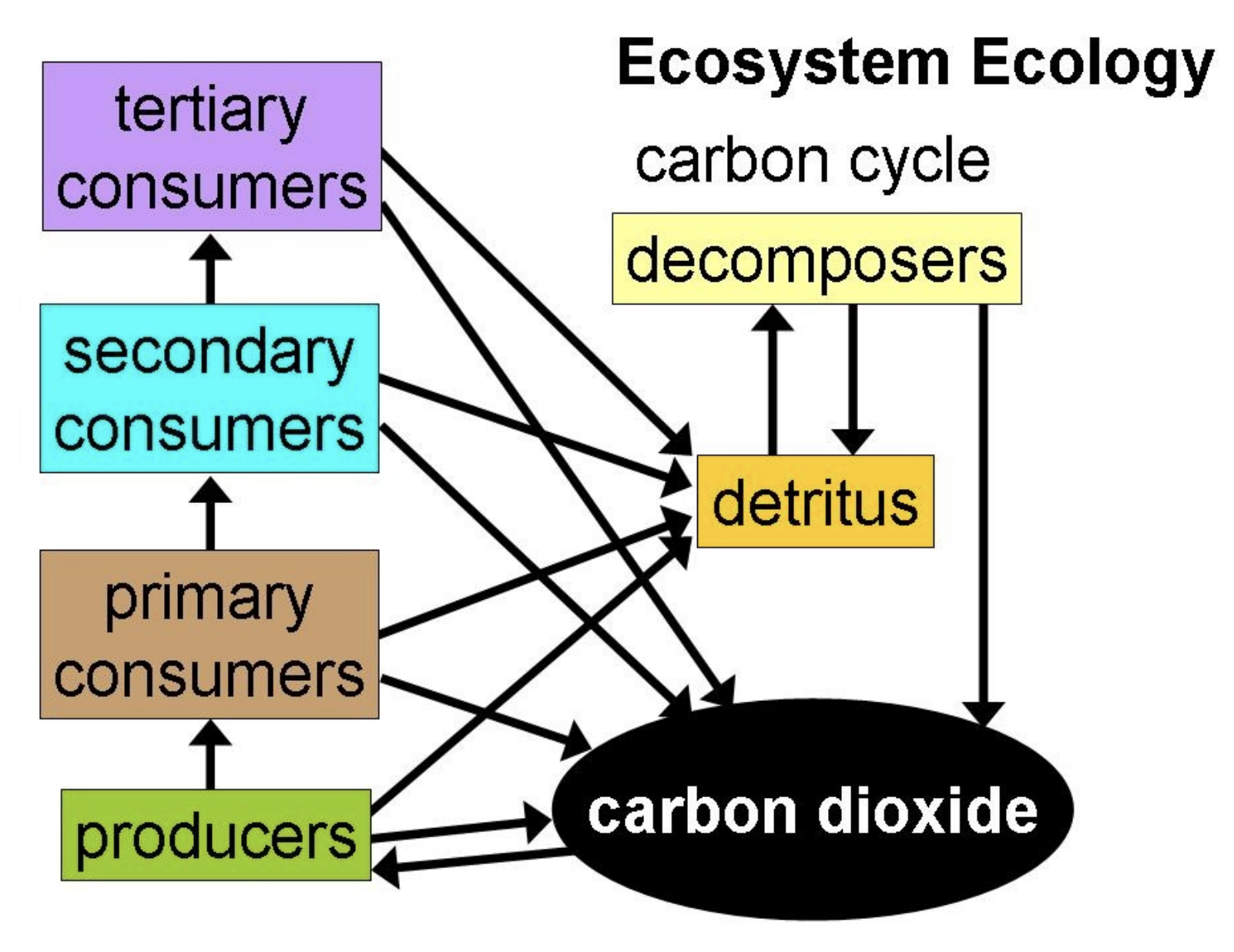
Most organisms cannot access carbon dioxide
Nitrogen Cycle
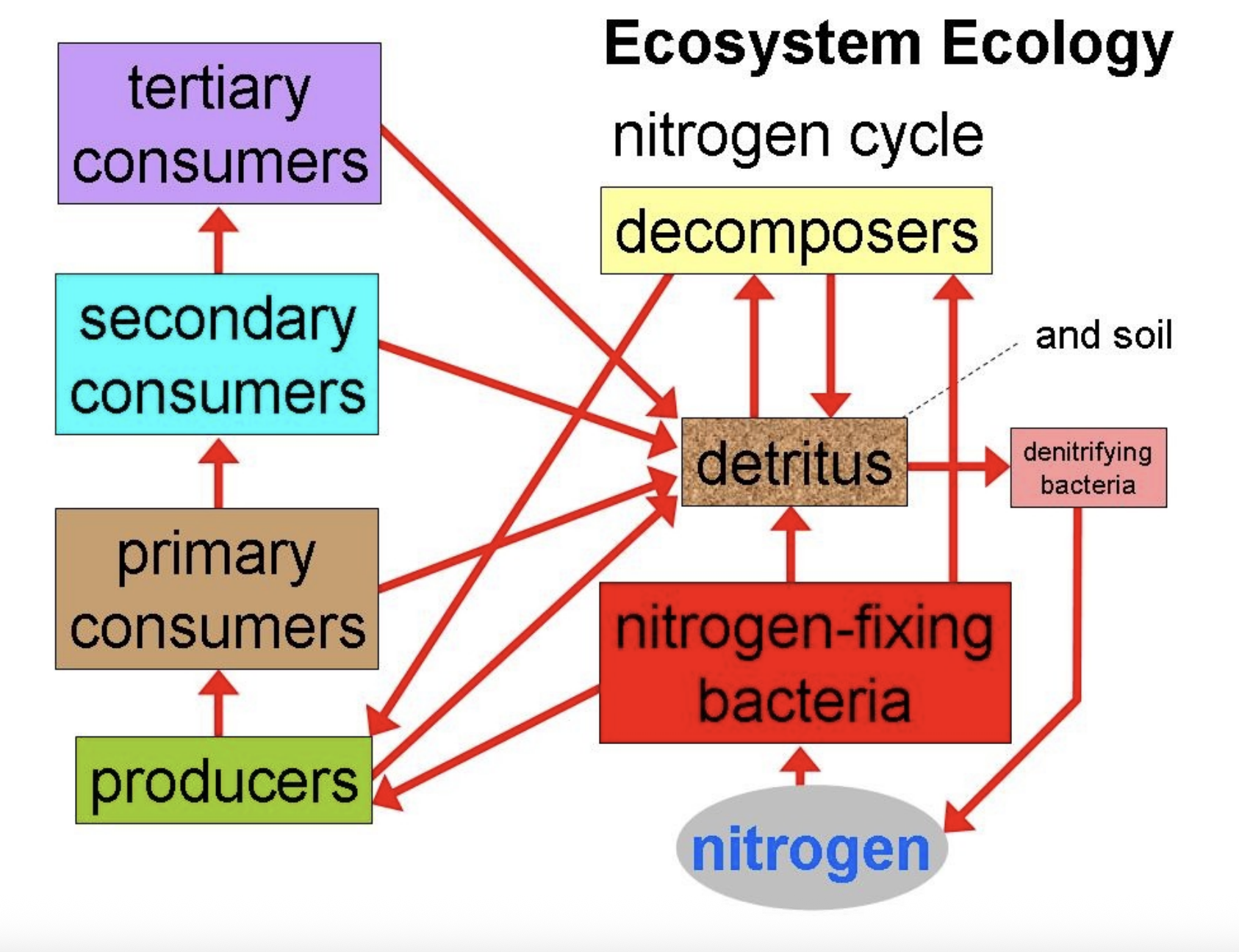
Needed to make amino acids
Phosphorus Cycle
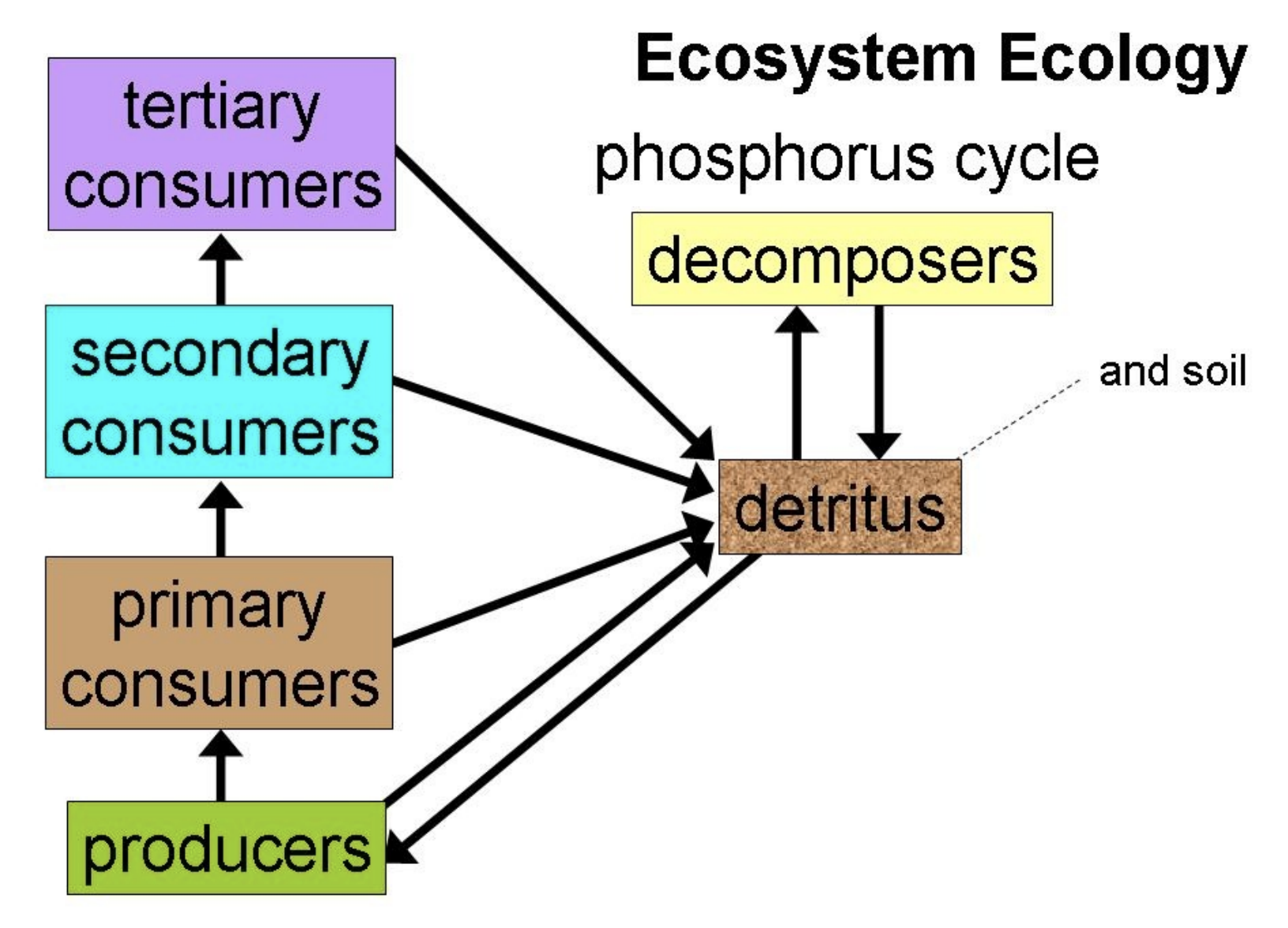
limiting nutrient: the nutrient that must be added to increase primary production in an ecosystem.
→ usually nitrogen or phosphorus
Ecology
Biodiversity
variation in living things
Species Richness
the numbers of species in a community
limitations
many other: niche diversity, Shannon diversity, etc.
important for ecosystem stability
Ecosystem Services
services provided to humans (eg given not to remember just for understanding)
regulation
cleaning air and water
climate regulation and carbon capture
pest control
pollination
flood control
provisioning
sea food, game
lumber
pharmaceuticals
support
nutrient cycling
culture
recreation
spiritual/historic
Conservation Biology
Applied Biology: Preserving and restoring biodiversity and ecosystems
Ecology is central, but this is a multidisciplinary field