Pages 48-54 ~Edited.
Aqueous Acid-Base Equilibria
Acid-base reactions involve hydroxide and dissociation in water.
The formation of water during these reactions is a driving force.
Acids
Characteristics: Acids contain an H or H+ and an oxygen element.
They dissociate at the OH bond.
Definitions:
Ionization: Dissociation into ions in a solution.
Acid: Always has a greater concentration of H+ in a solution.
Monoprotic Acid: Has one proton.
Diprotic Acid: Has two protons.
Polyprotic Acid: Has multiple protons.
Nonmetal oxides are categorized as acids.
Bases
Characteristics: Bases contain an OH bond, typically with a metal first followed by the OH bond.
Weak bases contribute to an increase in OH molecules; metal oxides are considered bases.
Acid-Base Reactions
Neutralization: Acids and bases neutralize each other, leading to the formation of salt and water, represented by the reaction:
HX + MOH → MX + H2O.
Bronsted-Lowry Theory
This theory presents a framework involving ammonia and hydroxide, highlighting reversible reactions and equilibrium.
Key Terms:
Proton Donor: Classified as an acid.
Proton Acceptor: Classified as a base.
Conjugate Acid: The base formed from a proton donation.
Conjugate Base: The acid formed from a proton acceptance.
Water acts as both an acid and a base, therefore its amicrobic
Conjugate Bases/Acids
In the reaction HA + H2O → H3O+ + A-. HA donates a proton.
A- can react with water to regenerate HA and generate OH-.
The strength of acids and their conjugate bases is interdependent.
Ionization Constants
At equilibrium, we describe acid and base dissociations using Kb and Ka.
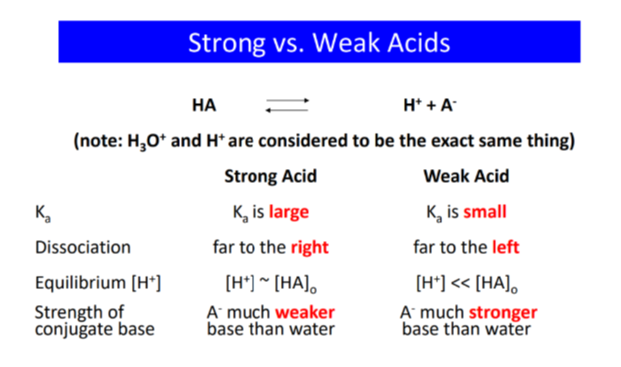
Strong Acids: Completely dissociate in solution.
Weak Acids: Such as acetic acid, remain mostly undissociated (99.6%).
Carboxylic Acid Characteristics
General Structure: Carboxylic acids have the functional group C=O-OH and are typically weak, forming organic anions.
Strong Bases: Completely dissociate, while weak bases do not ionize 100% in water.
Conjugate Pairs
A strong acid generates a weak conjugate base. Conversely, a weak acid will generate a stronger conjugate base.
The relationships involve two acids and two bases.
Self-Ionization of Water and pH Scale
Water is amphiprotic, acting as both an acid and a base.
The ion product of water (Kw) equals 1.0 x 10^14; in a neutral solution, the concentrations of H+ and OH- are equal.
Understanding pH and pOH
Definitions:
pH is calculated using -log[H+], and pOH with -log[OH-].
Kw = [H+][OH-] = 1 x 10^-14.
The equation pKw = pH + pOH = 14 holds true.
Steps for Calculating pH
Identify major species in the solution.
Select compounds that influence pH and identify pairs.
Write the equilibrium expression that dominates the system.
Construct an ICE table (Initial, Change, Equilibrium).
Plug equilibrium concentrations into the equilibrium expression.
Solve for x using assumptions where applicable.
Verify the assumptions made.
Calculate the pH based on the H+ concentration.
Example Calculation: Acetic Acid Reaction
Given: Acetic acid concentration as 1.40 M and Ka = 1.80 x 10^-5.
Setup the equilibrium expression:CH3CO2H ⇌ CH3CO2- + H+
Initial: [1.40], Change: [-X +X +X], Equilibrium: [1.40-X, X, X].
Plug into Ka expression: Ka = [H+][CH3CO2-] = (x)² / (1.40-x) = 1.80 x 10^-5.
Result
Using the assumption method gives x = 0.00502. Without it gives solutions of x = 0.00501 or -0.00503.
Acid/Base Application Problem
A solution prepared by diluting 20.0 mL of glacial acetic acid (density = 1.05 g/mL) with water up to a total volume of 250.0 mL. Calculate [H+] and pH, taking Ka = 1.8 x 10^-5 into account.
Concentration calculation: 20.0 mL x 1.05 g/mL / 60.05 g/mol = 0.350 mol of CH3CO2H.
Final concentration in 0.250 L: 0.350 mol / 0.250 L = 1.40 M acetic acid solution in water.
Polyprotic Acids
In polyprotic acids, Ka1 can be strong or weak; Kax corresponding to subsequent protons is generally weak.
We will ONLY consider examples where the reactions can be considered separately
Ions as Acids and Bases
General relationship: Ka = Kw/Kb, where Ka times Kb equals Kw.
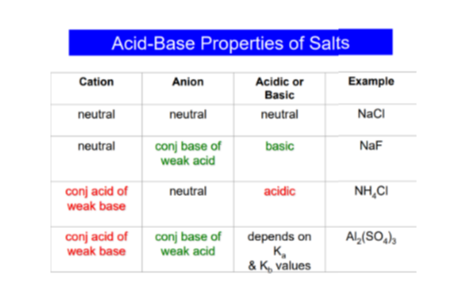
Acid-Base Properties of Salts
Cations and Anions:
Sodium chloride (NaCl): Neutral.
Sodium fluoride (NaF): Weak acid conjugate base.
Ammonium chloride (NH4Cl): Weak base conj. acid.