Psychosocial Development in the First Two Years
Early Emotional Development
Emotional Progression: Emotional development in early infancy transitions from basic reactive responses to pain and pleasure toward complex social awareness.
Smiling and Laughter:
Social Smile: Appears at approximately of age and is specifically evoked by viewing human faces.
Laughter: Emerges between of age and is frequently associated with curiosity and novel experiences.
Anger and Sadness:
Anger: First explicitly expressed around of age. It serves as a healthy, adaptive emotional response to frustration.
Sadness: Strongly correlates with maternal depression. An excessive presence of sadness in infancy is a troubling indicator of potential later emotional problems.
Fear and Social Anxiety:
Fear initially develops in response to unexpected environmental events but quickly shifts to center on human interaction.
Separation Anxiety: Emotional distress expressed through crying or clinging when a familiar caregiver leaves. This anxiety typically peaks in toddlerhood and should naturally reduce by age
Lasts a few minutes or a little longer
Stranger Wariness: An infant's fearful response, marked by crying or looking frightened, when an unfamiliar person approaches too closely.
Toddlers' Emotions and Temper Tantrums:
Temper Tantrums: Defined as explosive behavioral reactions to anger, characterized by yelling, screaming, crying, and physical hitting.
Tantrums operate beyond logical reasoning and are typical before age
They are heavily affected by internal physiological states (e.g., hunger, fatigue) and triggered by specific social contexts.
Self-Awareness and Self-Recognition
Self-Awareness Definition: A person's realization that they are a distinct individual whose body, mind, and actions are separate from those of other people.
Developmental Timeline:
First 12 Months: Infants possess no explicit sense of self-awareness and fail mirror self-recognition tests.
15 to 24 Months: Self-awareness becomes increasingly common and measurable.
The Rouge Test:
An experimental procedure where a mark of red makeup (rouge) is surreptitiously placed on an infant's nose or forehead before placing them in front of a mirror.
Infants under react to the mirror reflection as if it were another child.
Infants between demonstrate self-recognition by touching the mark on their own face rather than touching the glass.

Temperament and Its Dimensions
Temperament: Inborn differences between individuals in emotions, activity level, and self-regulation.
Biological Foundations: Temperament is biologically based and establishes environmental interaction styles that make later developmental adaptations easier or more difficult. It is foundational and distinct from adult personality.
Three Core Dimensions of Temperament:
Effortful Control: The capacity to regulate attention and emotion, including the ability to self-soothe.
Negative Mood: The tendency to express fearful, angry, or unhappy emotional states.
Exuberance: High activity levels, social approach behaviors, and surgence.
Classic Temperament Typologies:
Easy: High Effortful Control, Low Negative Mood, Moderate to High Exuberance.
Difficult: Low Effortful Control, High Negative Mood, Often High/Reactive Exuberance.
Slow-to-Warm-Up: Moderate Effortful Control, Moderate Negative Mood, Low Exuberance.

Development of Social Bonds: Synchrony
Definition of Synchrony: A coordinated, rapid, and smooth exchange of responses between a caregiver and an infant.
Functions in Early Development:
Directly supports early cognitive development.
Establishes an interactive "mutual dance" between parent and child.
Involves parent-child "social games" that serve as cultural routines passed from adult to infant.
Interactive Dynamics:
Both caregiver and infant are active participants in synchrony.
The adult-infant symbiosis serves as a primary context for emotional and social learning.
Synchrony begins with adults imitating infant facial expressions and body movements, helping infants learn the link between their internal feelings and physical expressions.
The Still-Face Technique:
An experimental procedure designed to evaluate the psychological necessity of synchrony by having an adult maintain an unmoving, completely expressionless face during face-to-face infant interactions.
Experimental Sequence:
Engage: Normal, expressive interaction.
Still Face: Caregiver becomes silent and expressionless.
Reunion: Caregiver resumes normal expressive engagement.
Findings: Infants are deeply distressed by the loss of synchrony during the still-face phase, displaying visible signs of physiological stress and vocal frustration.

Attachment and the Strange Situation
Attachment Definition: An affectional bond that an infant forms with a caregiver—a tie that binds them together in space and endures over time. It is a universal component of human nature, though its specific behaviors vary by culture and age.
Key Behavioral Indicators of Attachment:
Proximity-Seeking: Behaviors aimed at maintaining physical closeness, such as crawling toward, following, or reaching for caregivers.
Contact-Maintaining: Behaviors designed to keep physical contact once achieved, such as holding, snuggling, or clinging.
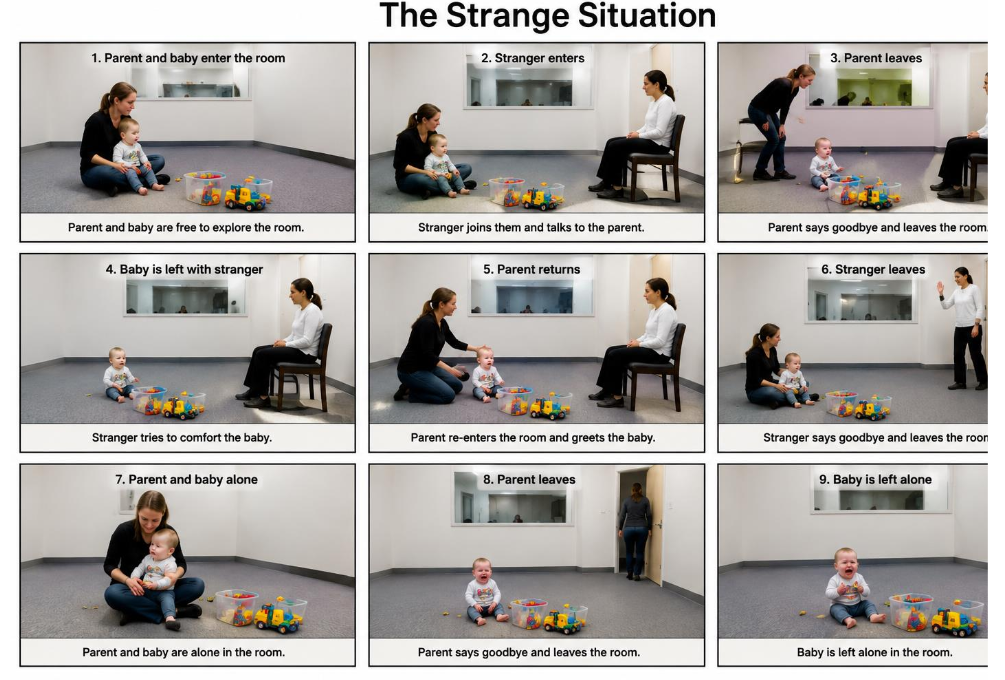
Measuring Attachment: The Strange Situation:
A standardized laboratory procedure created to assess infant attachment styles by subjecting infants to structured stress in an unfamiliar playroom through planned comings and goings of the parent and a stranger.
Core Behaviors Observed:
Exploration of available toys in the playroom.
Emotional reaction to caregiver departure.
Behavior and emotional response during caregiver return (reunion).
Patterns of Attachment in Infancy:
Secure Attachment (Type B):
Infant obtains comfort and confidence from the presence of the caregiver.
Caregiver Present: Plays happily; explores the playroom using the caregiver as a secure base.
Caregiver Leaves: Unhappy and visibly upset; may cry.
Caregiver Returns: Seeks immediate physical contact, is easily comforted, and resumes play.
Insecure-Avoidant Attachment (Type A):
Infant avoids connection with the caregiver and appears unconcerned by their presence or absence.
Caregiver Present: Indifferent; plays independently without interacting with or looking at caregiver.
Caregiver Leaves: Displays little or no distress.
Caregiver Returns: Ignores or avoids the caregiver upon reunion; continues playing.
Insecure-Resistant / Ambivalent Attachment (Type C):
Infant exhibits excessive anxiety and anger, clinging to caregiver while simultaneously resisting comfort.
Caregiver Present: Clingy and anxious; unwilling to explore toys even when caregiver is close.
Caregiver Leaves: Extremely distressed, showing intense crying or full temper tantrums.
Caregiver Returns: Demonstrates ambivalent responses—seeking proximity while pushing the caregiver away or crying hysterically.
Disorganized Attachment (Type D):
Infant lacks a consistent or organized coping strategy, displaying contradictory or bizarre reactions. Associated with significant risk for later psychopathology.
Caregiver Present: Exhibits dazed, confused, or fearful behavior.
Caregiver Leaves: May freeze in place, show sudden fear, or display unusual movements.
Caregiver Returns: Shows inconsistent, contradictory behaviors (e.g., approaching while looking away, falling to the floor).

Cultural Variations in Attachment and Caregiving:
Secure Attachment (Type B) is the predominant pattern across all functional communities worldwide.
Caregiving techniques vary across societies while successfully building secure bonds:
Babywearing in Rural Africa: Continuous physical proximity provides security while caregivers perform work.
Multigenerational Care: Grandparent and extended family care builds multiple secure attachments.
Father as Primary Caregiver: Fathers participate fully in feeding, soothing, and direct care.
Encouraging Independent Exploration: Caregivers serve as a secure base while urging physical discovery.
Co-sleeping Practices: Family sleeping arrangements reinforce emotional regulation through physical contact.
Group Care Settings: Group care arrangements allow safe peer interaction alongside caregiver checking.

Severe Early Social Deprivation (Romanian Orphanage Studies):
In the early 1990s, thousands of institutionalized children were adopted from Romanian orphanages.
Research demonstrated that if extreme social deprivation extended beyond , cognitive and emotional impairments were largely irreversible.
Children exposed to prolonged institutionalization exhibited high rates of disorganized and insecure attachment patterns.

Social Referencing
Definition: The process by which infants observe another person's emotional expressions and reactions to gain information about how to interpret and respond to an unfamiliar or ambiguous object, person, or event.
Characteristics:
Infants engage in social referencing continuously and selectively.
Caregivers serve as crucial social benchmarks guiding infant exploration and danger avoidance.
Behavioral Examples:
Positive Referencing: An infant approaching a dog cheerfully after observing a caregiver smile and react warmly toward the animal.
* *Negative Referencing:* An infant retreating or displaying caution toward an object after observing a caregiver show fear or disgust toward it (e.g., a spider).
Role of Caregivers and Gender Dynamics
Caregiver Flexibility: Synchrony, secure attachment, and social referencing develop successfully with caregivers of all gender identities.
Traditional Trends: Historically and cross-culturally, a general trend positioned mothers as primary physical nurturers and fathers as interactive playmates.
Modern Shifts: Gender roles in child rearing have become far less restrictive in the twenty-first century, with fathers increasingly sharing or assuming primary caregiving duties.
Theoretical Perspectives on Psychosocial Development
Psychoanalytic Theory (Sigmund Freud):
Main Question: What internal conflict drives development?
Shaping Factors: Biological drives and instincts.
Examples: Conflicts during the oral stage (feeding) and anal stage (toilet training) set lifelong emotional patterns.
Psychosocial Theory (Erik Erikson):
Main Question: What psychosocial challenge must be resolved?
Shaping Factors: Caregiver responsiveness and environmental feedback.
Examples: The first stage, Trust vs. Mistrust, determines whether infants view the world as safe based on consistent parental care.
Behaviorism:
Main Question: How are behaviors learned?
Shaping Factors: Reinforcement, punishment, and observational learning.
Examples: Social learning occurs when caregivers praise desired emotional responses or when infants model adult emotions.
Cognitive Theory:
Main Question: How do children interpret experiences?
Shaping Factors: Mental representations and cognitive schemas.
Examples: Developing a working model—a set of assumptions and mental representations that an individual uses to organize perceptions and evaluate caregiver availability and reliability.
Evolutionary Theory:
Main Question: Why did these behaviors evolve?
Shaping Factors: Biological survival and species adaptation.
Examples: Attachment systems evolved because keeping infants in proximity to protective adults ensured survival against environmental hazards.
Infant Childcare and Quality Indicators
Research Findings on Non-Familial Childcare:
Cultural Influence: Beliefs regarding who "should" provide care for infants are heavily shaped by cultural norms and personal experiences.
Attachment Security: Early entry into center-based day care does not inherently weaken or diminish parent-child attachment security.
Behavioral Development: Empirical research confirms that high-quality day care does not cause or increase long-term behavioral problems in children.

International Variations in Childcare Types:
Childcare models (parental care, relative care, center care) vary substantially across nations at and of age (e.g., comparing the United States, United Kingdom, Québec, The Netherlands, and Norway).

Five Essential Characteristics of High-Quality Day Care:
Adequate Individual Attention: Maintaining low adult-to-child ratios.
Language and Sensorimotor Encouragement: Providing structured stimulation for brain and motor development.
Health and Safety Focus: Ensuring cleanliness, proper nutrition, and childproof environments.
Professional Caregivers: Employing staff trained in child development and early childhood education.
Parental Involvement: Encouraging active communication and mutual respect between facility staff and parents.
Scientific Consensus on Early Caregiving:
Mutual attachment to one or several familiar caregivers is essential for healthy psychological development.
The overall quality of care (whether delivered at home or in an external facility) is the critical determinant of developmental outcomes.
Infants require actively engaged and emotionally responsive caregivers.
Instability, frequent caregiver turnover, and inconsistent care settings must be avoided.