1.1 C Energy and Changes of State
GOALS
Interpret observable changes in physical properties and temperature during changes of state ✅
Convert between Celsius and Kelvin scales✅
The kelvin (K) is the SI unit of temperature and has the same
incremental value as the Celsius degree (°C) ✅
NOTE
energy added during a change of state does NOT increase temperature
goes into breaking inter-particle forces
TEMPERATURE CHANGE VS INPUT WHEN HEATING OBJECT AT CONSTANT PRESSURE
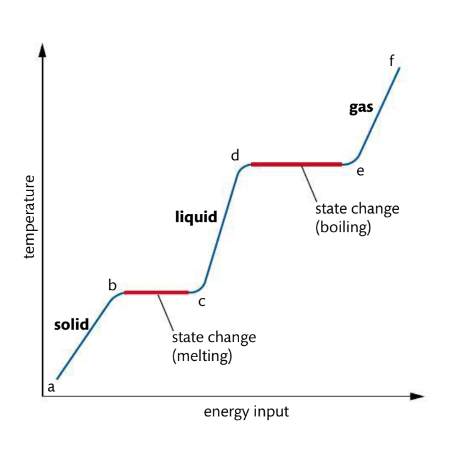 a-b: solid is heated, vibrational energy of particles increases so the temperature increases
b-c: melting point, vibrations are energetic enough for particles to move away from fixed positions and form a liquid. Energy added breaks interparticle forces, but does not raise kinetic energy so temperature remains constant
c-d: liquid is heated, particles gain kinetic energy and temperature increases
d-e: boiling point, sufficient energy to break all interparticle forces and form a gas.
• Requires more energy than melting
• Temperature remains constant
• Bubbles of gas visible throughout volume of liquid
e-f: gas is heated under pressure, kinetic energy of particles continues to rise, temperature also rises
KELVIN
oC to Kelvin
Temperature (K) = Temperature (oC) + 273.15
absolute zero (0 K) = -273.15 oC
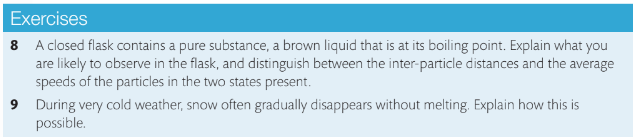
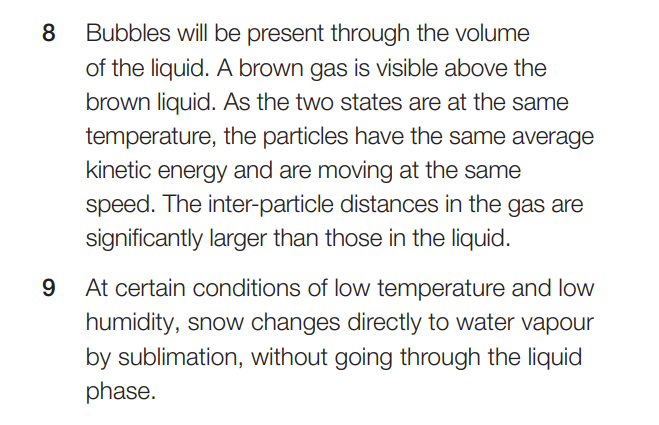
Q p 14 # 8,9