Intelligence
Psyc Week 5/6 – Intelligence
Intelligence Part 1
Brains are costly
60% of energy to brain development
Maternal costs: “The Curse of Eve”
Giant human brains required a larger baby head
Bipedalism required a narrower pelvis
This creates the “Obstetrics Dilemma”: human childbirth is longer, more painful and historically more dangerous than that of other primates (up to 1% maternal mortality per birth)
So why didn’t the brain continue to grow?
Evolutionary trade-offs between:
Infant brain size
Infant dependency period
Female pelvic width
Maternal mortality (historically 1% per birth)
Two theories (what do these two theories answer?)
Runaway sexual selection theory
Males’ and females’ insatiable need for more and more intelligent mates (sexual selection) led to a runaway process resulting in our giant brains
The social brain hypothesis
Our big brains (along with language) evolved as a way to keep track of our increasingly complicated social lives
So what is intelligence?
Ability to use one’s mind to solve novel problems and learn from experience
So what is IQ?
A measure of individual differences in general cognitive ability (i.e. intelligence)
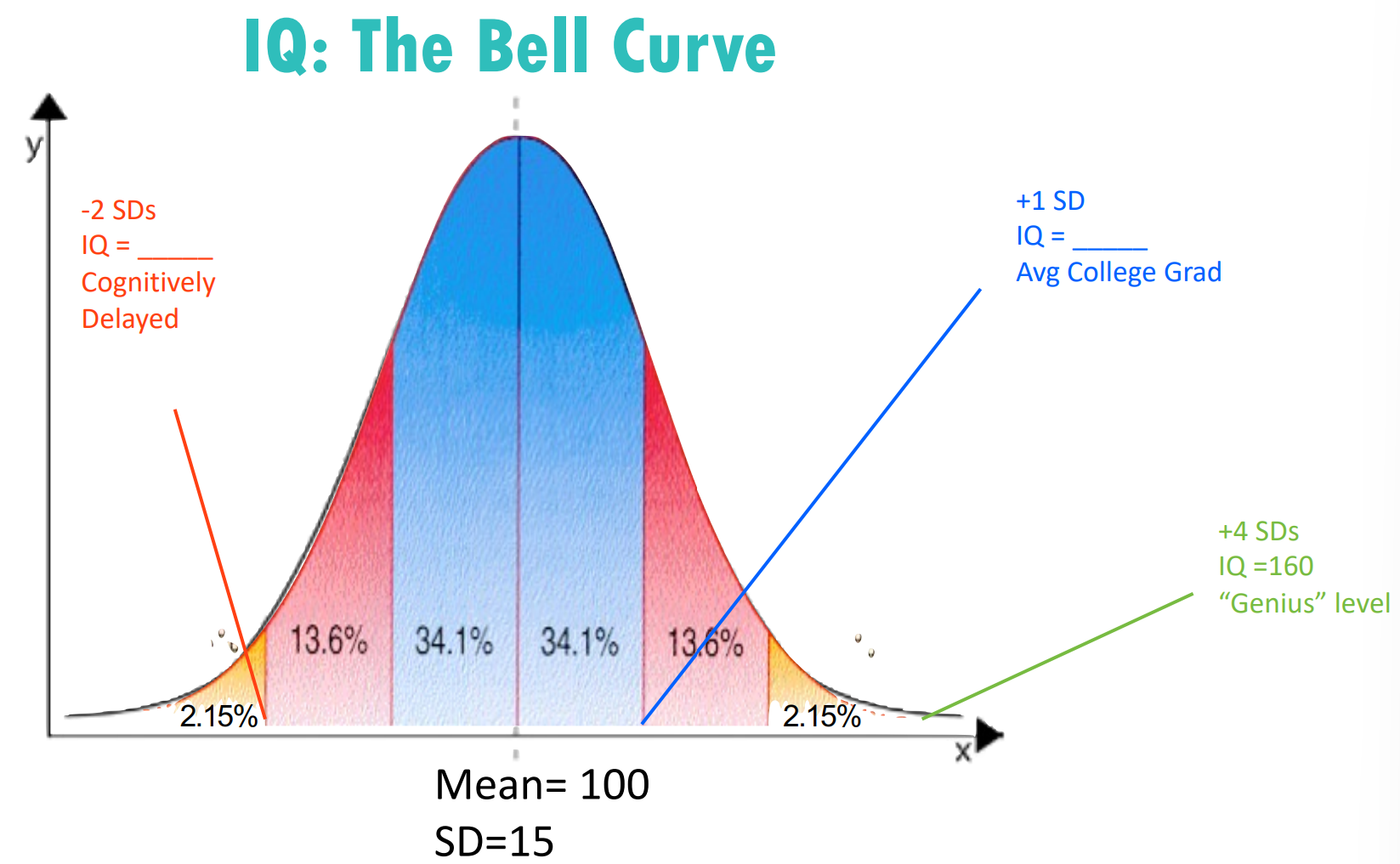
Intelligence quotient: originally developed to identify cognitive delays among children in school and became artificially constructed around a mean of 100 and a SD of 15
IQ history
Goddard – one of first to measure intelligence; used discriminatorily towards US immigrants
Binet & Simon – developed the first intelligence test to identify children who needed remedial education
Measured aptitude apart from achievement
Terman – developed modern IQ test
Ratio IQ: a child’s “mental age” (as measured by IQ test) divided by their chronological age x 100
IQ then was used to measure differences in intelligence between adults; had to abandon the age-based calculation
Deviation IQ: a person’s test score divided by the average test score of same age group x 100
Commonly used today
IQ: The Bell Curve


Intelligence Part 2
Intelligence Tests
Intelligence tests are typically used to __________
Do not measure “intelligence” per se, but tasks that correlate with such
Most widely used intelligence tests today:
Wechsler Adult Intelligence Scale (WAIS)
Wechsler Intelligence Scale for Children (WISC)
Is IQ a Valid Measure?
Yes, it’s a predictively valid measure of something meaningful (I predicts things we would expect it to predict)
Correlates positively with:
Academic grades (r= .5)
Occupational status and job performance (r = .2 to .6)
Income (r= .4 to .6)
And negatively with:
Arrests (r= .2)
Drug and alcohol use
Car accidents
The Hierarchy of Abilities
Spearman found correlations among many cognitive tasks
Two-factor theory of intelligence: Spearman’s theory suggesting that every task required a combination of:
1) an overall single general ability (g), and
2) skills that are specific to the task (s)
Thurstone argues for a few primary mental abilities that were stable and independent
Primary mental ability | Description |
Word fluency | Ability to solve anagrams and to find rhymes |
Verbal comprehension | Ability to understand words and sentences |
Numerical ability | Ability to make mental and other numerical computations |
Spatial visualization | Ability to visualize complex shape in various orientations |
Associative memory | Ability to recall verbal material, learn pairs of unrelated words etc. |
Perceptual speed | Ability to detect visual details quickly |
Reasoning | Ability to induce a general rule from a few instances |
A Three-Level Hierarchy
Both were correct; correlations between scores on different menta ability tests are best described in a three-level hierarchy
Spearman’s general factor (g) and specific factors (s), and between Thurstone’s group factors (m)








What are the Middle-level abilities?
They lie between specific & general mental abilities with regard to intelligence
The data-based approach connects intelligence test performance to clusters
Intercorrelations
Resulting factors (i.e. items that cluster together)
Confirmatory factor analysis
Middle-level abilities according to this approach:
Carroll found patterns of correlation among 8 independent middle-level abilities
Crystallized intelligence: retain & use knowledge that was acquired through experience (e.g. facts, vocab, trivia)
Increases with age
fluid intelligence: see abstract relationships and draw logical inferences (e.g. problem-solving)
Raven’s Progressive Matrices Test
Limitations??
The theory-based approach broadly surveys human abilities and then determines which one’s intelligence tests do/don’t measure
Three kinds of intelligence posited:
A_____ intelligence: finding correct answer to a defined problem
Creative intelligence: finding novel solutions & choosing which to apply
Practical intelligence: implementing solutions in everyday settings
What about cultural differences? Emotional intelligence?
Emotional intelligence: ability to identify, describe, predict and manage own emotions and those of others
Gardner observed many types of people and argued for 8 forms of intelligence
Why is emotional intelligence important?
People with higher EQs:
Are happier
Report greater life satisfaction
Are physically and mentally healthier
Have better social skills and are judged to be more socially competent
Have better relationships
More likely to be promoted
Where does intelligence come from?
Influenced by “nature” (innate) and “nurture” (learned)
Heritability: how much of observed differences between people can be attributed to genes
Variability must add up to 100%
Heritability coefficient (h^2): statistic that describes the proportion of the difference between 2+ people’s IQ scores that can be explained by differences in their genes
Adoption studies show:
Adopted siblings reared in similar environments – positively correlated IQs
Environment plays a role (30-50% of differences in IQ scores is due to environment
Identical twins reared in different environments - positively correlated IQs
The correlation b/w identical twins raised apart > fraternal twins raised together
So: genes play a role in intelligence (heritability of intelligence = .5 to .7; that is 50-70% of differences in IQ score
s between people is due to genetic differences
An analogy to (not mis-) understanding heritability??
Heritability
IQ heritability can range with SES
.10 to .72 in children from low vs high income households, respectively
Heritability changes with age
Higher: adults > adolescents (.70) > younger children > infancy (.25)
Environmental influences
Shared environment: environmental factors experienced by all relevant members of a household
Nonshared environment: environmental factors not experienced by all relevant members of a household
E.g. birth order, teachers, friends, gender roles
IQ scores are more similar in similar-aged siblings
Genes are not destinies!
Intelligence influenced by the environment
Important factors: economics and education
E.g. relative intelligence is generally stable over time, but absolute intelligence can change considerably
E.g. Flynn effect: the average intelligence test score rises about 0.3% every year
SES
One of the best predictors of intelligence is _________
+12 to +18 IQ points
Differences in high vs low SES at age 2 can be nearly tripled by age 16
Why biologically?
Nutrition
Health
Environmental toxins
Medical care
Daily stress
Why cognitively?
Intellectual stimulation
Learning opportunities
Vocabularies
What has worse outcomes for IQ: poverty in early childhood or later childhood, and why?
Education
The correlation between the amount of formal education and intelligence is large (r= .55 to .90)
School makes people smarter…
But, smart people tend to stay in school
Education may improve test-taking ability, rather than general cognitive ability
Educational effect on intelligence may be small and short-lived, but school produces long-lasting increases in other skills (e.g. reasoning, language, literacy)
The nature-nurture distinction
Nature and nurture, though separate, have a combined influence on IQ
They interact in complex ways
E.g. environmental influence on gene expression (i.e. epigenetics)
E.g. indirect genetic influences such as through behaviours
Genes and environments don’t exert an independent influence on IQ
It is unfeasible to unpick the distinction between the 2
The malleability of intelligence
E.g. research study on grade 7 students who were either taught that IQ is malleable or not
Intelligence Part 3
IQ distributions
Mensa: largest international high IQ society
Intellectual Developmental Disorder
Mild (IQ 50-69)
80-85% of cases
“educable” level (can benefit from schooling)
Can lead independent lives
Maintain unskilled or semiskilled jobs
Moderate (IQ 35-49)
10% of cases
Deficits in language development and play
Can care for themselves
Benefit from vocational training
May be ale to work under supervision
Severe (IQ 20-34)
3-4% of cases
Basic motor and communication deficits in infancy
Require careful supervision and can perform basic work tasks
Rarely able to live independently
Profound (IQ<20)
1-2% of cases; 70% male
Noticeable at birth/early infancy
Need structured environment and one-on-one help from caregiver
Severe and profound examples include:
Down syndrome (trisonomy 21)
Fragile X syndrome
Cretinism
Fetal alcohol syndrome
IDD from birth complications
IQ facts
People with high IQs are:
More physically healthy, lower illness rates
Less susceptible to MH (mental health) problems (e.g. psychosis, mood disorders, personality disorders and addictions)
Usually well adjusted as children
No more likely than those with average intelligence to contribute to their professional fields in adulthood
Usually gifted in a single area (i.e. middle-level or specific ability)
More single minded
Gifted children often spend more time engaged in their domain of excellence
But it has been said that “it takes 10000 hours of deliberate practice to become an expert”
Gender differences
Females and males have the same average IQ
Perceived that males have a higher IQ – maybe because male IQ score distribution is more spread out (SD is larger)
Why? Socialization = yes. Biology = ??
Girls at a young age can be lablled as just shy whereas males who are shy are likely to be labelled as having autism
Women and men have different types of intelligence
Culture, Race and IQ
Terman (early 1900s) involved on Binet & Simon’s work, produces Standford-Binet intelligence scale
Looked at group differences in IQ scores. His claims of intelligence were racist; however, between-group differences do exist
It’s difficult to point to the cause of group differences, but there are many theories:
E.g. nutritional, SES, educational, cultural specificity of IQ tests, stereotype threat
Between-group differences tend to be less than within-group differences
His facts:
IQ is genetic - true
Some racial groups outperform other groups – true
Thought superior genes equaled higher IQ – not a fact
The test itself as an explanation
Original intelligence tests were culturally biased – made by white, old, racist men
What does this say about the validity of these tests?
Cultural specificity of IQ tests: cultural differences in “correct” test answers historically
Now ‘unbiased’; e.g. non-verbal problems
Testing situations may vary
Stereotype threat may be exhibited
Fear of confirming negative beliefs that others may hold about their group
The more you think about not doing something, the more you’ll likely do it (ex. Skiing analogy)
Test done with Asian women who took a math test; they did better when they had to put their race at the top vs putting their gender at the top
Differences in performance doesn’t necessarily impact ability
Environmental and genetic explanations
Environmental differences influence intelligence
Higher rates of chronic illness; poorer medical care; poorer diet; lower birth weights
Poorer development & educational opportunities (worse schools)
Higher rates of single-parent families; home stress; lower incomes
Exposure to toxic chemicals through air pollution (faster age-related declines)
Exposure to more toxic messages about their innate abilities which may in turn minimize the importance of academic achievement to preserve self-esteem
Differences in SES influence intelligence
Genetic explanation is not supported
E.g. adoption studies; bi-racial children
HW instead of EA due Oct 17, access code: eye queue
Improving intelligence
Children:
Feeding children polyunsaturated fatty acids (in pregnancy supplements and breast milk) [+4]
Early educational interventions for low SES children [+6]
Interactive reading and conversing (earlier=better) [+6]
Preschool [+6]
Children, adults & elderly:
Some mental exercises (fluid intelligence)
Cognitive enhancers (beware their side effects) – likely short-term benefit
Keep in mind:
Rest is good for the brain