Operations Management Module
Lesson 6: Process selection and facilities layout
Process selection
refers to deciding on the way production of good or services will be organized. occurs when new products or services are being planned.
(capacity planning, layout facilities, equipment, and design of work system)
How an organization approaches process selection is determined by the organization’s process strategy. Key aspects include
● Capital intensity: the mix of equipment and labor that will be used by the organization.
● Process flexibility: the degree to which the system can be adjusted to changes in processing requirements due to such factors as changes in product or service design, changes in volume processed, and changes in technology
Two key questions in process selection are:
How much variety will the process need to be able to handle?
How much volume will the process need to be able to handle?
There are five basic process types: job shop, batch, repetitive, continuous, and project.
Job shop - usually operates on a relatively small scale. Used when a low volume of high-variety goods or services will be needed. skilled worker is important
Batch - used when moderate volume of goods or services is desired, and it can handle a moderate variety in products or services. not high skilled worker unlike job shop
Repetitive - when higher volumes of more standardized good or services are needed. slight flexibility of equipment is needed and skill of workers is generally low.
Continuous - when a very high volume of nondiscrete, highly standardized output is desired. almost no variety in output and, hence, no need for equipment flexibility. Workers’ skill requirements can range from low to high.
(automobiles, telivision, lines)
Project - used for work that is nonroutine, with a unique set of objectives to be accomplished in a limited time frame. (buidling a dam, bridge)
Lean process design
Waste reduction. focuses on variance reduction in workload over the entire process to achieve level production and thereby improve process flow.
Process strategy
decision makers choose flexible systems for either of two reasons: Demand variety or uncertainty exists about demand. The second reason can be overcome through improved forecasting
Basic types of layout (Product, process and fixed- position layouts)
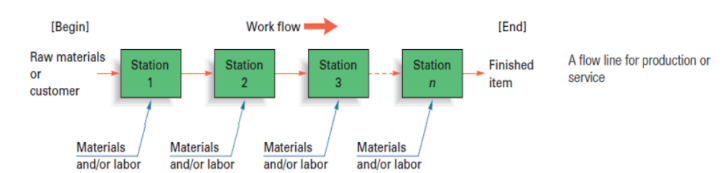
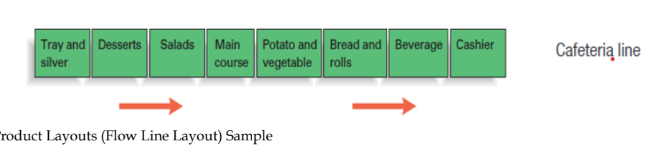
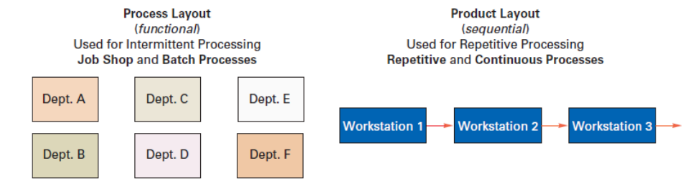
Product layout - used to achieve a smooth and rapid flow of large volumes of goods or customers through a system. This is made possible by highly standardized goods or services that allow highly standardized, repetitive processing.
Production line - production tasks.
Assembly line - assembly tasks.
The main advantages of product layouts are:
1. A high rate of output.
2. Low unit cost due to high volume. The high cost of specialized equipment is spread overmany units.
3. Labor specialization, which reduces training costs and time, and results in a wide span ofsupervision.
4. Low material-handling cost per unit. Material handling is simplified because units followthe same sequence of operations. Material handling is often automated.
5. A high utilization of labor and equipment.
6. The establishment of routing and scheduling in the initial design of the system. Theseactivities do not require much attention once the system is operating.
7. Fairly routine accounting, purchasing, and inventory control.
The primary disadvantages of product layouts include the following:
1. The intensive division of labor usually creates dull, repetitive jobs that provide little opportunity for advancement and may lead to morale problems and to repetitive stress injuries.
2. Poorly skilled workers may exhibit little interest in maintaining equipment or in the quality of output.
3. The system is fairly inflexible in response to changes in the volume of output or changes inproduct or process design.
4. The system is highly susceptible to shutdowns caused by equipment breakdowns orexcessive absenteeism because workstations are highly interdependent.
5. Preventive maintenance, the capacity for quick repairs, and spare-parts inventories are necessary expenses.
6. Incentive plans tied to individual output are impractical since they would cause variation among outputs of individual workers, which would adversely affect the smooth flow of work through the system
Process layout - designed to process items or provide services that involve a variety of processing requirements. The variety of jobs that are processed requires frequent adjustments to equipment. common in-service environments
(hospitals, colleges, univesities, banks)
The advantages of process layouts include the following:
1. The systems can handle a variety of processing requirements.
2. The systems are not particularly vulnerable to equipment failures.
3. General-purpose equipment is often less costly than the specialized equipment used inproduct layouts and is easier and less costly to maintain.
4. It is possible to use individual incentive systems.
The disadvantages of process layouts include the following:
1. In-process inventory costs can be high if batch processing is used in manufacturing systems.
2. Routing and scheduling pose continual challenges.
3. Equipment utilization rates are low.
4. Material handling is slow and inefficient, and more costly per unit than in product layouts.
5. Job complexities often reduce the span of supervision and result in higher supervisory costs than with product layouts.
6. Special attention necessary for each product or customer (e.g., routing, scheduling, machine setups) and low volumes result in higher unit costs than with product layouts.
7. Accounting, inventory control, and purchasing are much more involved than with product layouts
Fixed-position layouts - item being worked on remains stationary, and workers, materials, and equipment are moved about as needed. This is in marked contrast to productand process layouts. (farming, firefighting, road building, home building,remodeling)
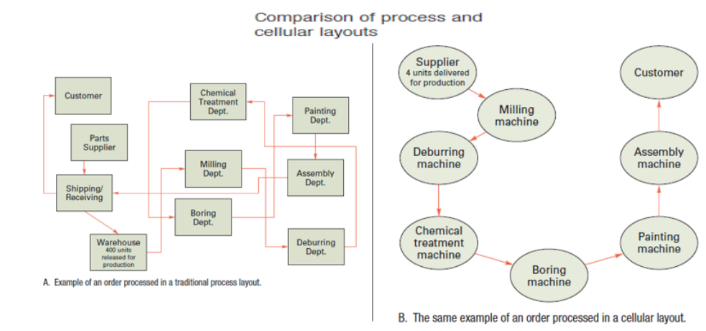
Cellular layout - workstations are grouped into what is referred to as a cell.
Cellular manufacturing - enables companies to produce a variety of products with as little waste as possible
Service layout - service layout requirements are somewhat different from manufacturing layout requirements. The degree of customer contact and the degree of customization are two key factors in service layout design.
warehouse and storage layouts - The design of storage facilities presents a different set of factors than the design of factory layouts.
retail layouts - The objectives that guide design of manufacturing layouts often pertain to cost minimization and product flow.
office layouts - undergoing transformations as the flow of paperwork is replaced with the increasing use of electronic communications. This lessens the need to place office workers in a layout that optimizes the physical transfer of information or paperwork.
restaurant layout - There are many different types of restaurants, ranging from food trucks to posh establishments.
hospital layout - General layout of the hospital is one aspect of layout, while layout of patient rooms is another.
automation in service - One way to improve productivity and reduce costs in services is to remove the customer from the process as much as possible.
Lesson 7: Inventory management
Inventory
a stock or store of goods.
Different kinds of inventory:
Raw materials and purchased parts.
Partially completed goods, called work-in-process (WIP).
Finished-goods inventories (manufacturing firms) or merchandise (retail stores).
Tools and supplies.
Maintenance and repairs (MRO) inventory.
Goods-in-transit to warehouses, distributors, or customers (pipeline inventory).
Functions of Inventory
To meet anticipated customer demand -
to smooth production requirements -
to decouple operations
to reduce the risk of stockouts
to take advantage of order cycles
to hedge against price increases
to permit operations
to take advantage of quantity discounts
Requirements For Effective Inventory Management
Management has two basic functions concerning inventory. One is to establish a system to keep track of items in inventory, and the other is to make decisions about how much and when to order.
To be effective, management must have the following:
1. A system to keep track of the inventory on hand and on order.
2. A reliable forecast of demand that includes an indication of possible forecast error.
3. Knowledge of lead times and lead time variability.
4. Reasonable estimates of inventory holding costs, ordering costs, and shortage costs.
5. A classification system for inventory items.
Issues of inventory management:
How much to order
When to order
A. Economic Order Quantity Models
identify the optimal order quantity by minimizing the sum of certain annual costs that vary with order size and order frequency.
a. Basic economic order quantity (EOQ) Model
the simplest of the three models. It is used to identify a fixed order size that will minimize the sum of the annual costs of holding inventory and ordering inventory.
The basic model involves a number of assumptions:
1. Only one product is involved.
2. Annual demand requirements are known.
3. Demand is spread evenly throughout the year so that the demand rate is reasonably constant.
4. Lead time is known and constant.
5. Each order is received in a single delivery.
6. There are no quantity discounts
b. Economic production quantity (EPQ)
The batch mode is widely used in production. Even in assembly operations, portions of the work are done in batches. The reason for this is that in certain instances, the capacity to produce a part exceeds the part's usage or demand rate.
The assumptions are:
1. Only one product is involved.
2. Annual demand is known.
3. The usage rate is constant.
4. Usage occurs continually, but production occurs periodically.
5. The production rate is constant when production is occurring.
6. Lead time is known and constant.
7. There are no quantity discounts.
c. Quantity discounts
Quantity discounts are price reductions for larger orders offered to customers to induce them to buy in large quantities.
When quantity discounts are available, there are a number of questions that must be addressed to decide whether to take advantage of a discount. These include:
1. Will storage space be available for the additional items?
2. Will obsolescence or deterioration be an issue?
3. Can we afford to tie up extra funds in inventory?
Fixed-order interval model
used when orders must be placed at fixed timeintervals (weekly, twice a month, etc.): The timing of orders is set. The
The single-period model
sometimes referred to as the newsboy problem ) is used to handle ordering of perishables (fresh fruits, vegetables, seafood, cut flowers) and items that have a limited useful life (newspapers, magazines, spare parts for specialized equipment).
Potential in improving inventory process
Record keeping
Variation reduction
Lean operation
Supply chain management
Lesson 8: Supply chain management
Supply chain (value chains) (lifeblood)
sequence of organizations—their facilities, functions, and activities— that are involved in producing and delivering a product or service.
Supply chain management'
is the strategic coordination of business functions within a business organization and throughout its supply chain for the purpose of integrating supply and demand management
Supply chain manager
are people at various levels of the organization who are responsible for managing supply and demand both within and across business organizations
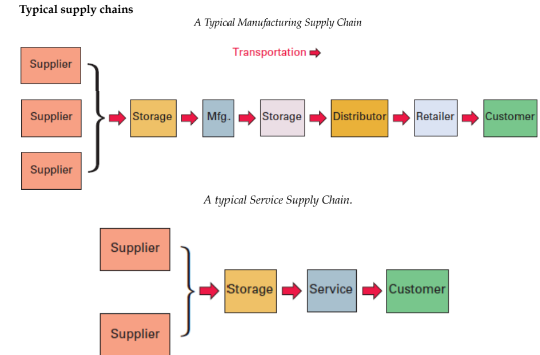
Important aspect of supply chain management is FLOW MANAGEMENT
Three types of flow:
product and service flow - movement of goods or service from supplier to customers
information flow - sharing forecast and sales data, transmitting orders, tracking shipments, and updating order status.
financial flow - credit terms, payments, and consignment and title ownership arrangements
Key elements of successful risk management include:
know your supplier -
provide supply chain visibility
develop event-response capability
Risk management
identifying risks, assessing their likelihood of occurring and their potential impact, and then developing strategies for addressing those risks.
Resiliency
the ability of a business to recover from an event that negatively impacts the supply chain
Key activities of ERP
supplier relationship management - RP integrates purchasing, receiving, information about vendor ratings and performance, lead times, quality, electronic funds disbursements, simplifying processes, and enabling analysis of those processes.
performance management - pulls together information on costs and profits, productivity, qual performance, and customer satisfaction.
sales and order fulfillment ERP - ability to provide inventory and quality management.
customer relationship management
Purchasing interfaces
operations - main source of requests for purchased materials, and close cooperation between these units and the purchasing department is vital if quality, quantity, and delivery goals are to be met.
accounting - responsible for handling payments to suppliers and must be notified promptly when goods are received in order to take advantage of possible discounts.
design and engineering - prepare materials which must be communicated to purchasing
receiving checks - to determine wether quality, quantity, and timing objectives have been met.
suppliers - purchasing to learn what material will be purchased
The purchasing cycle
begins with a request from the organization to purchase outside the organization.
Steps in Purchasing Cycle
Purchasing receives the requisition - (a) a description of the item or material desired, (b) the quantity and quality necessary, (c) desired delivery dates, and (d) who is requesting the purchase.
Purchasing selects a supplier - purch dep must identify suppliers who have the capability of supplying the desired goods.
Purchasing places the order with a vendor -
Monitoring orders - follow-up on orders, especially large orders or those with lengthy lead times, allows the purchasing department to project potential delays and relay that information to the operating units.
Receiving orders - Receiving must check incoming shipments for quality and quantity.
Centralized purchasing
purchasing handled by one special department
may be able to obtain lower price
better service and closer attention to supplier
Decentralized purchasing
individual departments or separate locations handle their own purchasing requirements.
awareness of differing local needs and being better able to respond to those needs.
save on transportation cost
Supplier management
Reliable and trustworthy suppliers are a vital link in an effective supply chain.
Aspects of Supplier Management
Choosing suppliers - (vendor analysis) involves taking account many of the same factors associated with making a major purchase.
Supplier Audits - Periodic audits of suppliers are a means of keeping current on suppliers’ production.
Supplier certification - (world class supplier) a detailed examination of the policies and capabilities of a supplier.
Suppliers relationship management -
Strategic partnering - occurs when two or more business organizations that have complementary products or services that would strategically benefit the others agree to join so that each may realize a strategic benefit.
Order Fulfillment
the process involved in responding to customer orders
Common approach for OF
Engineer to order - products are designed and built according to customer specifications (large scale construction, LENGHTY)
Make to order - standard product design is used, but production of the final product is linked to the final customer’s specifications. (aircraft, LESS THAN ETO)
Assemble to order - products are assembled to customer specifications from a stock of standard and modular components. (computer manu, FAIRLEY SHORT OFTERN A WEEK OR LESS)
Make to stock - products based on a forecast and products are sold to customer from finished good stock (department store, IMMIDIATE)
Logistics
movement of materials, service, cash, and information in supply chain.
Movement within a facility:
1. From incoming vehicles to receiving.
2. From receiving to storage.
3. From storage to the point of use (e.g., a work center).
4. From one work center to the next or to temporary storage.
5. From the last operation to final storage.
6. From storage to packaging/shipping.
7. From shipping to outgoing vehicles
Incoming and outgoing shipments
handles schedules and decisions on shipping method and times
Tracking Goods: Radio frequency identification (RFID)
a technology that uses radio waves to identify objects, such as goods in supply chains.
Third party logistic (3 PL)
use to describe the outsourcing of logistics management
Creating an effective supply chain
a thorough analysis of all aspects of the supply chain.
Strategic sourcing
use to describe the process
Effective supply chain
Plan
Source
Make
Deliver
Manage returns
Lesson 9: Management of Quality
Quality
the ability of product or service to meet or exceed customer expectations
Frederick Winslow Taylor
father of scientific management
The dimension of quality
one way to think about quality is the degree of performance of a product or service meets or exceeds CE.
Product Quality.
1. Performance —main characteristics of the product.
2. Aesthetics —appearance, feel, smell, taste.
3. Special features —extra characteristics.
4. Conformance —how well a product corresponds to design specifications.
5. Reliability —dependable performance.
6. Durability —ability to perform over time.
7. Perceived quality —indirect evaluation of quality (e.g., reputation).
8. Serviceability —handling of complaints or repairs.
9. Consistency —quality doesn’t vary.
Service Quality.
1. Convenience —the availability and accessibility of the service.
2. Reliability —the ability to perform a service dependably, consistently, and accurately.
3. Responsiveness —the willingness of service providers to help customers in unusual situations and to deal with problems.
4. Time —the speed with which service is delivered.
5. Assurance —the knowledge exhibited by personnel who come into contact with acustomer and their ability to convey trust and confidence.
6. Courtesy —the way customers are treated by employees who come into contact withthem.
7. Tangibles —the physical appearance of facilities, equipment, personnel, and communication materials.
8. Consistency —The ability to provide the same level of good quality repeatedly
9. Expectations —Meet (or exceed) customer expectations.
The Determinants of Quality
1. Design.
2. How well the product or service conforms to the design.
3. Ease of use.
4. Service after delivery
Three categories of Cost:
Appraisal cost - inspection, testing and other activity intended to uncover defective products
Prevention cost - prevent defects from occurring
Failure cost - incurred by defective products
Quality awards:
The Baldrige award - Malcolm Baldrige, to stimulate efforts of improve quality, to recognize quality achievements, and to publicize successful programs
The European Quality award - europe’s most prestigious award for organizational excellence
The Deming Prize - W. Edwards Deming, japan’s highly coveted award recognizing successful quality efforts.