Ch. 5.4 Half-Life of a Radioisotope
Half-Life
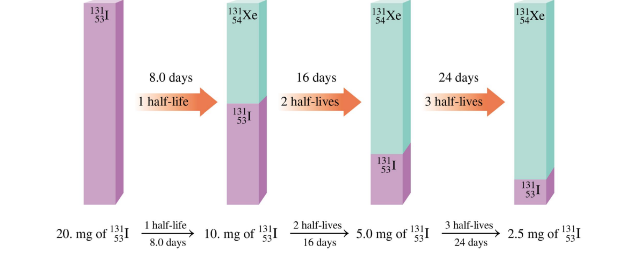
The half-life of a radioisotope is the time for the radiation level to decrease (decay) to one half of the original value. This also means that one-half of the amount of the original isotope remains
Decay Curves
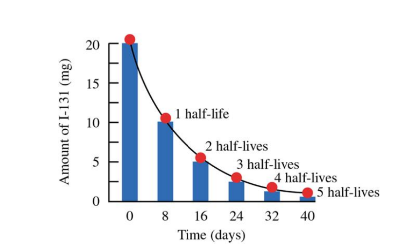
The decay curve illustrates the amount of time that is required for one half of the substance to be converted into a different element
Half-life is the time required for the radiation level (or quantity of a radioisotope) to decay to one-half of its original value.
Half-Life Calculations
STEP 1
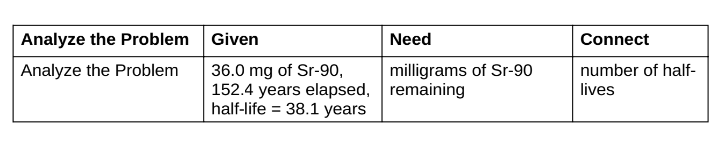
state the given and needed qualities
STEP 2
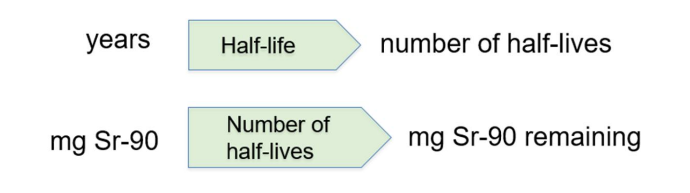
write a plan to calculate the unknown quantity
STEP 3
write the half-life equality and conversion factors
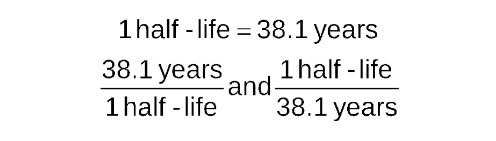
STEP 4
set up the problem to calculate the needed quantity
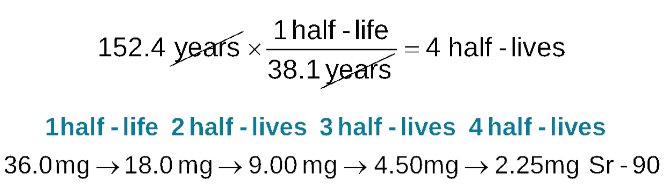
Quick Formulas to Remember
Number of half-lives elapsed:
Remaining quantity after time t:
General continuous form (alternative):
Practical interpretation: each full half-life halves the remaining amount; fractions of half-lives reduce accordingly.
Suppose you had a 10.00 grams radioactive element that had a 1/2 life of 3.00 minutes. How long would it take to get to less than 1 gram?
time (min) amount (g)
0 10.00
3 5.00
6 2.50
9 1.25
12 0.675
It would take 12 minutes. Or 4 half lives.