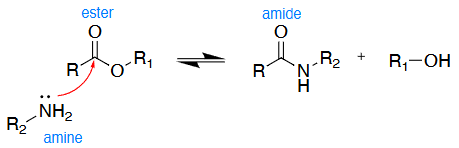
Amines
An amine is any derivative of ammonia in which one or more protons have been replaced by an organic group
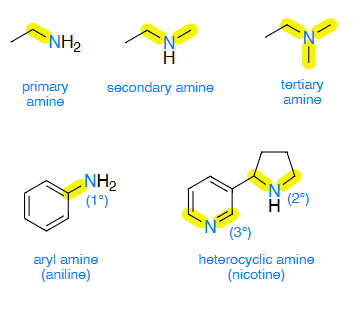
Low molecular weight amines (typically fewer than 5 carbons) are water soluble as they can form hydrogen bonds. However, amines are not as good as hydrogen bonding compared to oxygen containing groups because nitrogen is less electronegative than oxygen (therefore the N-H bond is less polarised than O-H bond). Also nitrogen only has one lone pair of electrons so can only accept one hydrogen bond, while oxygen has two and so can accept 2 hydrogen bonds
Amino acids with amino containing side chains
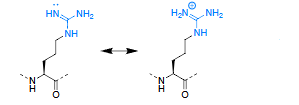
Arginine contains a guanidine group which can be protonated to form a guanidinium cation
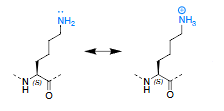
Lysine contains a primary amine which can be protonated to form a primary ammonium cation
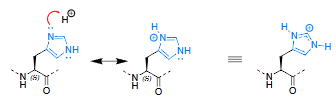
Histidine contains an imidazole group (aromatic amine) which can be protonated to form an imidazolium cation
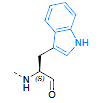
Trytophan contains an indole group (aromatic amine). This is not basic as the lone pair of electrons on nitrogen are delocalised across the aromatic structure
Amines are bases and nucleophilic
Amines are Bronsted bases. Bronstead bases react with a proton in acid-base reactions to give the conjugate acid.
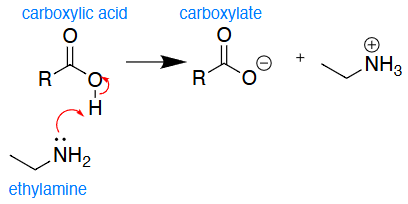
Amines are also Lewis bases. Lewis bases can donate a pair of electrons to form a Lewis adduct. Therefore this is interchangeable with nucleophile