Lecture 5. Maintenance of Biodiversity
Productivity
Definition of Primary Production
Primary production is the process by which organic compounds from atmospheric or aquatic CO2 is made by primary producers.
Ex: Photosynthesis in plants, algae
How is primary production measured?
It is the amount of biomass created in a given amount of time and area
To get this measurement the biomass if removed from the forest and put to dry the weighed. (grams of dry weight/ (area x time))
Productivity is not distributed equally across the globe.
There is higher productivity closer to the equator.
Productivity is higher in the tropics.
More productivity correlates with a higher total biomass.
More productivity correlates with more species richness.
More productivity leads to more resources available all year round.
Hypothesis
High species richness is due to high productivity.
Ant species along productivity gradient
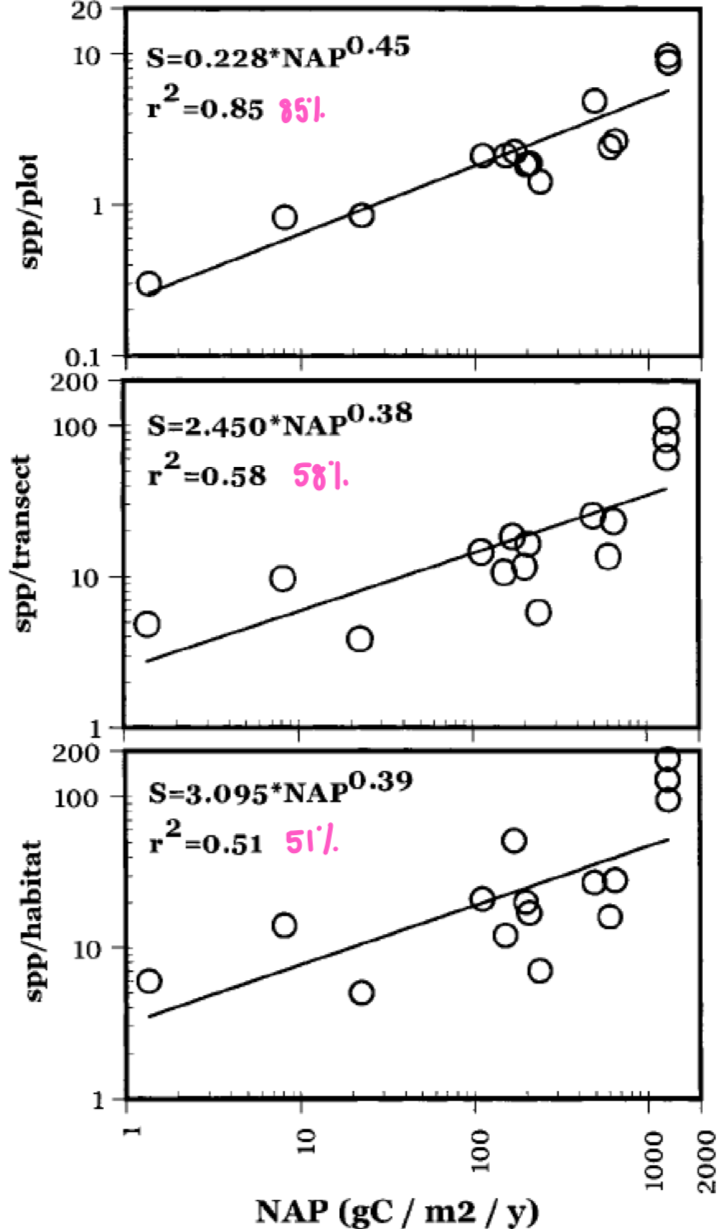
As productivity goes up, the species richness of ants go up too, but this relationship is strongest in small areas and weaker at larger scales.
Higher NAP(Net Aboveground Productivity) leads to more carbon in the environment.
Species Interactions
Density-dependent predation
Density-dependent predation promotes the maintenance of biodiversity.
Dan Janzen and Connell Hypothesis:
Study predation of insects and rodents on fallen seeds.
Lots of seeds are found at base parent tree but the farther away from that tree you go less seeds from the parent tree are present.
Predation is higher at the base of the parent tree and much less as you move away.
Dan Janzen: figure of ecology and conservation in Costa Rica.
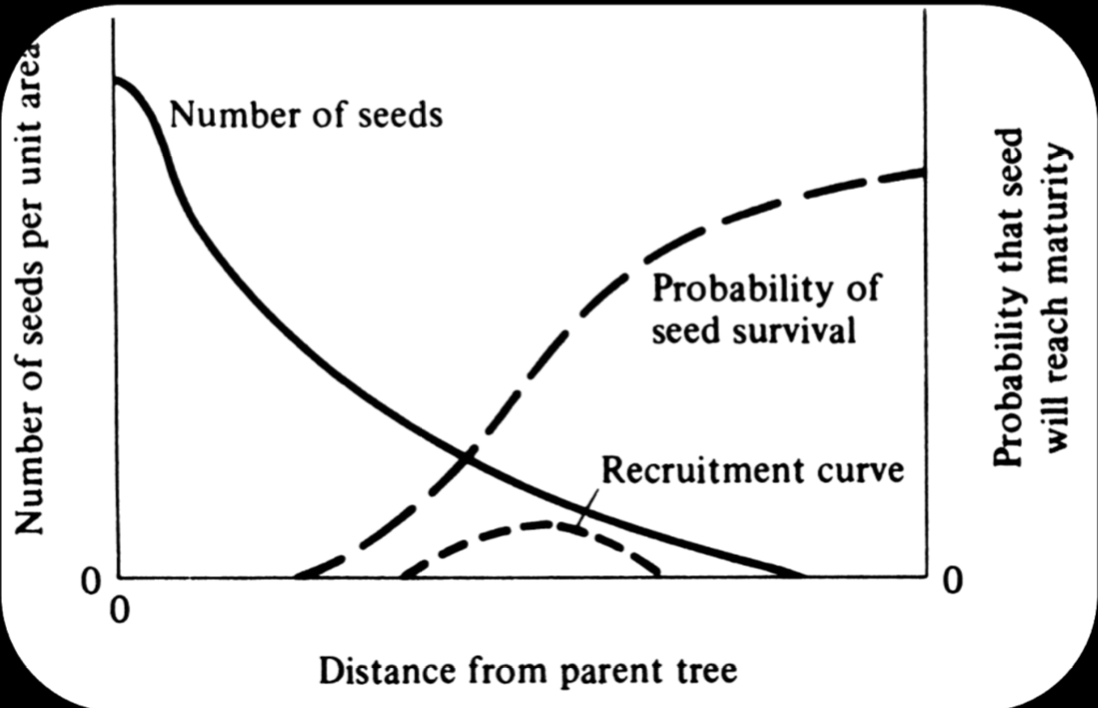
Seeds are most likely to survive and grow into mature plants at a moderate distance from the parent tree, where there’s a balance between seed availability and survival conditions.
Why is there higher predation at the base of the tree?
Higher predation at the bas of trees is due to rodent and insect behavior:
searching for seeds
handling seeds
guarding against predators
Consequences of Positive Density Dependent seed predation
The rare species of plants and trees are overlooked by predators, while the more common ones get predated the most.
The rare species of plants can become abundant but not too common.
Frequency Dependent Selection
Frequency-dependent selection is a type of natural selection where a trait's advantage depends on how common or rare it is in the population.
Natural selection favors rare species which maintains high tree-diversity.
Diversity give rise to diversity
More kind of organisms present may lead to more co-existing species.
Competition and niche partitioning
Niche
What is a niche?
A niche is the range of physical and biological conditions in an environment that caters to the existence of a species.
Ex: Space, food, water, light, shelter, mates.
Every species play a unique role in their niche.
A niche contains everything a species needs to exist.
A nice is not a habitat it is a feature of the organism.
Competition over resources leads to niche partitioning
Competition can be defined as the antagonistic interaction over a limited resource, resulting in reduced survival or reproduction by one or more parties.
Species will compete because resources are limited and they need to survive.
Types of competition:
Direct (Interference) competition: When two organisms compete directly for a resource.
Indirect (Exploitative) competition: when two species feed on the same prey and one species feed on the prey more so that the other has less food available.
Competition should drive one species to extinction and thus reduce the community richness.
For species to co-exist they must use different resources when they are together.
There are a lot of resources in the tropics.
How is co-existence possible if species are competing?
Principle of Competitive Exclusion
No two species can occupy the same niche at the same time and at the same place. If two species co-exist they do so as a result of niche differentiation/ partition.
Ex: Two species of barnacles existing in the same place and at the same time, however, one is a higher elevation than the other.
Facultative vs obligate niche partitioning
Facultative niche partitioning occurs when species can share resources and adapt their behavior or resource use depending on the availability of resources or presence of competitors. They don’t rely on partitioning to survive but do it as needed to reduce competition.
Facultative: Two bird species may feed on the same insects but choose different feeding areas only when food is limited or when they're near each other.
Obligate niche partitioning, on the other hand, is when species must use specific resources or occupy specific niches to survive. These species have evolved to fill distinct roles that reduce competition, and they rely on this separation to coexist.
Obligate: Different fish species in a coral reef may be specialized to eat different types of algae, making this niche separation essential for their survival.
John Terborgh’s study on bird feeding guilds in the tropics
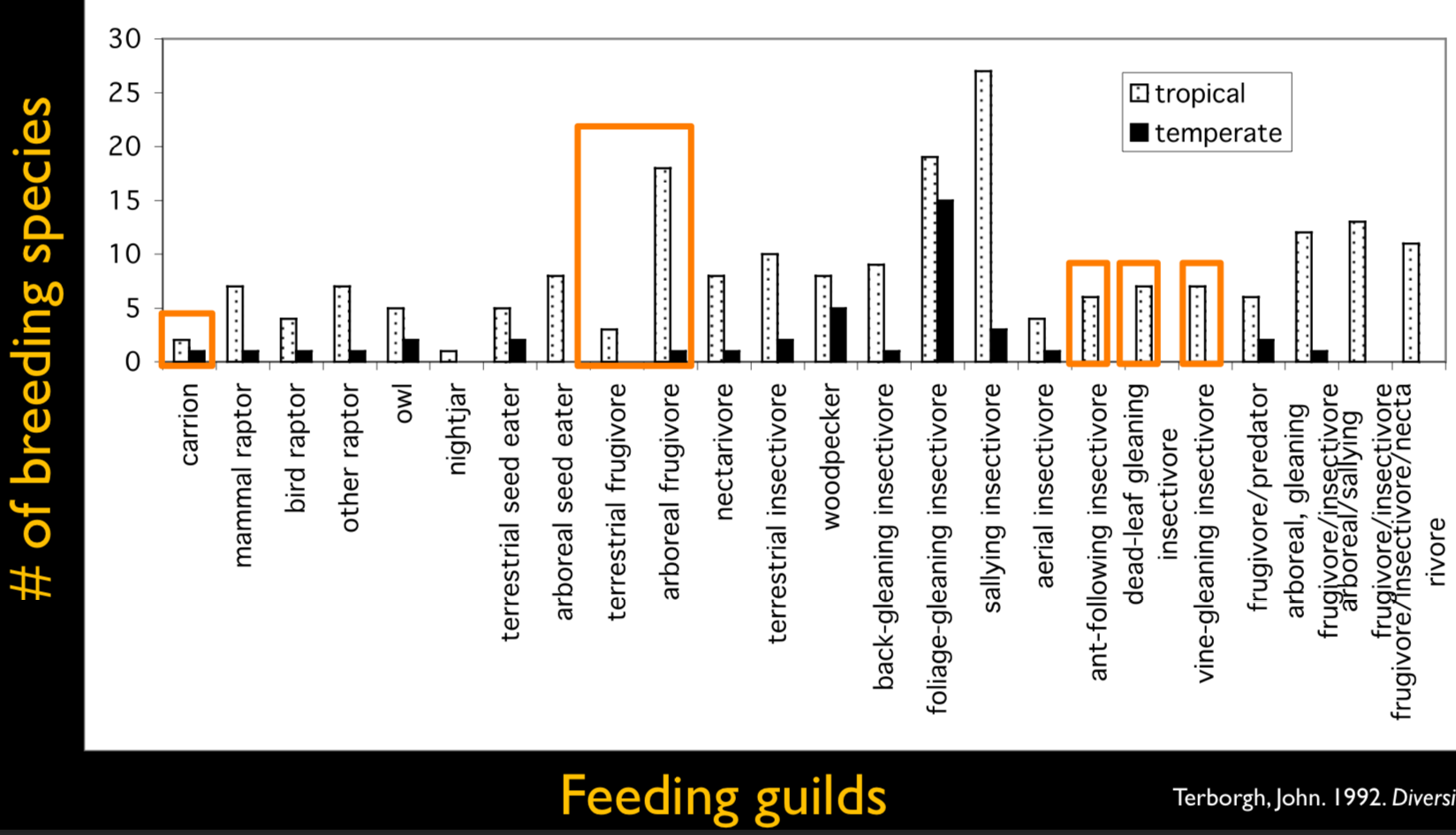
Results: The tropics have a higher number of feeding guilds than the temperate zone.
More guilds means that there are more specialized species in that area.
More guilds/species in the tropics indicates that there may be a greater number of resources in the tropics.
Comments on bird guild study
Suggests that the presence of higher specialization ensures increases species change to avoid competition via niche partitioning.
The more resources available in an area means that more species can be maintained.
Summary about productivity and species interactions
Energy likely plays a role in creating more resources.
There are more resources in the tropics; diversity begets diversity.
Resources that are finely partitioned allow co-existence.
Species interactions help with the maintenance of biodiversity.
The role of chance
Niche Theory
Niche Theory
Species can co-exist in a community only of they have different niches.
Niche theory has some difficulties in explaining the diversity often observed in species-rich communities such as tropical forests where it seems like species often share most resources.
Alternatives to the niche theory:
Island Biogeography theory
Hubbell’s Neutral Unified Theory of Biodiversity.
Chance models can predict the number of species co-existing in a community assuming that:
there are no species interactions
species are competitive equivalents
whether a species persist in a community is determined largely by chance
chance is affected by factors such as region, size, population size, and movement between regions.
Islands and the species-area effect: Initial observations by MacArthur and Wilson
Islands have fewer species than its corresponding areas on the mainland.
Islands that are farther away from the mainland have fewer species than the ones that are closer.
Smaller islands have fewer species than do larger ones.
Species-area effect
The total population size of a species is proportionate to the island’s area.
The probability of population extinction decreases population size.
Area effect:
The larger the area of an island the more species it is likely to receive during migration from the mainland.
Distance effect:
The closer an island is to the mainland the more species it will receive as the species will only have to use less energy.
Conservation recommendations of the Island Based Theory
Reserve sizes should be:
As large as possible
As close as possible to mainland populations.
Issues with Island Based Theory
Extinction and immigration rates can differ between islands.
Islands may not always be in a stable balance of species arriving and going extinct.
Different species have different rates of extinction and immigration.
Extinction and immigration affect each other (high immigration can prevent extinction).
Having multiple mainland sources means more immigration paths and rates.
The model assumes no new species evolve on the island; speciation.
Hubbell Unified Theory of Biodiversity
Concept of Connectivity
Doesn’t just approach species movement as uni-directional.
System of communities, where there is movement between all communities.
Includes speciation
The system of local communities, connected via immigration and emigration, is called a meta-community.
Hubbell Unified Theory asserts that there is community drift in local communities.
Community drift
Just like genetic drift, but species - not alleles - are involved.
Common species become more common while rare species get rarer.
Eventually mono-dominance.