Exoplanets
🔍 How We Find Exoplanets: Methods & Principles 🧪
1. Radial Velocity Method 🎯
The radial velocity method involves measuring the tiny shifts in a star's light caused by the gravitational pull of orbit1. b, ing planets. Here's a short breakdown:
Doppler Shifts: Detects motion toward and away from Earth based on blue (toward) and red (away) shifts in the star’s light.
Wobble Detection: When a planet orbits its star, it causes the star to "wobble" slightly, and this wobble is detected through tiny shifts in the star’s absorption lines.
Inclination & Doppler Signature:
We don’t always know the inclination of the planet's orbit (face-on or edge-on), which affects the Doppler shift.
Face-on gives a minimal Doppler signature (smaller wobble).
Edge-on gives the maximum Doppler signature (largest wobble).
Over 100 Planets Discovered (1995-2003):
The method helped astronomers discover over 100 extrasolar planets during this time, by detecting the “wobble” of stars caused by orbiting planets.
High-Mass Planets with Small Orbits:
The method is more sensitive to large, heavy planets close to their stars because their gravitational pull causes a stronger wobble, making them easier to detect.
Stars with Multiple Planets:
The radial velocity method has revealed that some stars host multiple planets, each contributing to the overall wobble of the star.
Impact on Theoretical Models:
The discovery of many large planets close to their stars (often in orbits not predicted by early models) forced theorists to revise their ideas about how planets form and evolve.
How It Works:
Wobble: A planet’s gravity pulls on its star, causing it to move slightly toward and away from Earth.
Spectrometer & Wavelength Splitting: Keck uses a spectrometer to split light from the star into wavelengths.
Blue-shift: When the star moves toward us, its light shifts to shorter wavelengths.
Red-shift: When it moves away, the light shifts to longer wavelengths.
Absorption Lines: Stars have absorption lines in their spectrum — unique patterns where elements absorb light. These lines shift due to the Doppler effect (similar to the change in pitch of a passing car’s horn). When the star moves, the absorption lines move too (blue or red shift).
Switching Between Toward and Away:
As the planet orbits its star, its gravity causes the star to move toward and away from us, shifting the absorption lines between blue and red.
Peak-to-Peak Velocity Difference:
By measuring the maximum blue-shift and maximum red-shift, scientists calculate the star’s radial velocity (how fast it moves toward or away from us).
The difference between blue and red shifts gives the peak-to-peak velocity, showing how much the star is wobbling due to the planet’s gravitational pull.
How It Helps Us Find Planets:
The wobbling motion reveals the presence of a planet.
Tracking the star’s velocity with red and blue shifts helps us detect extrasolar planets orbiting stars far away!
Orbits of Many Exoplanets Are Not Circular! 🌌
Non-Circular Orbits: Many of the planets detected by the radial velocity method (and other methods) do not have circular orbits. Instead, their orbits are elliptical (more like an oval).
Why It Matters: A planet's elliptical orbit means that its distance from the star changes throughout its orbit, causing the wobble of the star to vary in strength over time. This variation helps astronomers learn more about the planet's orbital characteristics and mass by analyzing the radial velocity curve (how the star's speed changes).
2. Astrometry 🛰
What is it?
Astrometry measures the side-to-side motion of a star as it is slightly “tugged” by the gravitational pull of orbiting planets.
This method tracks the star’s position in the sky and detects tiny shifts that reveal the presence of planets.
This requires precise measurements of the star's position over time.
3. Transit Method 🌑
What is it?
The transit method detects exoplanets by observing small decreases in the star’s brightness when a planet passes in front of it (a "transit").
The size of the dip in brightness gives us an estimate of the planet’s size.
A transit also allows us to measure the orbital period of the planet (how long it takes to complete one orbit).
4. Microlensing 👀
What is it?
Gravitational microlensing occurs when the gravity of a star or planet bends and magnifies the light of a more distant background star.
If a planet is orbiting the lensing star, it can cause a small blip in the light curve, revealing its presence.
This method can be used to detect planets that might otherwise be difficult to observe.
5. Imaging 📸
What is it?
Imaging directly captures the light from a planet.
It is extremely difficult due to the brightness of the parent star, but possible with advanced techniques like star nulling (reducing the light from the star) and coronagraphs (instruments that block out the star’s light).
Planets can be imaged by capturing their reflected starlight.
New Addition: Gravitational Lens Detection 🔭
What is it?
If a star or planet moves exactly in front of a background star, the brightness of the background star can be greatly magnified by the gravitational lens effect.
In principle, the gravitational lens technique can detect planets of any mass.
However, once the event is over, the planet is lost forever (since we are only seeing the background source). It is impossible to learn anything more about the system after the event.
51 Pegasi Example 🌟
51 Pegasi is a G5 main-sequence star 15 pc away from the Sun.
Its Doppler motion changes by ± 53 meters/sec over a period of 4.2 days.
Data imply the presence of a planet with:
A roughly circular orbit.
Semi-major axis of 0.052 A.U. (Mercury is 0.38 A.U.).
Mass of 0.46 Mjup (a “hot” Jupiter).
Solar System Barycenter 🌍
The barycenter of the solar system is the center of mass around which both the Sun and its planets orbit.
Jupiter’s Influence: Jupiter is so massive that its gravity causes the barycenter to lie just outside the Sun’s surface.
“Wobble” of the Sun: The Sun itself wobbles slightly in space as it orbits the barycenter. The movement traces a small loop or spiral.
Analogous to a Seesaw:
If two heavy objects (like Jupiter and Saturn) sit at opposite ends of a seesaw, the balance point (barycenter) shifts toward the heavier objects, causing the seesaw (or the Sun) to wobble.
Stars, Planets & Our Galaxy: The Numbers Game 🪐
Stars with Planets: ~50% of stars have planets.
Star Count in Our Galaxy: ~100 billion stars.
Planets per Star: Each star has ~1–10 planets. So, 50 billion to 5 trillion planets in the Milky Way!
Star Formation Rate: ~1–5 new stars form every year in our galaxy.
New Planetary Systems Formed/Year: ~1–3 new systems/year.
New Planets Formed/Year: ~1–10 new planets per year!
🔍 Gravitational Lensing: Magnifying Distant Stars Through Gravity 🪞🌠
Gravitational lensing is a method used to detect extrasolar planets by taking advantage of Einstein’s theory of general relativity:
The Principle: If a star or planet passes directly in front of a distant background star, its gravity can bend and magnify the light from that background star — acting like a lens.
Light Curve "Blip": The alignment causes the background star to momentarily appear brighter. If a planet is orbiting the foreground star, it can add an additional blip to the light curve.
Any Planet Mass Can Be Detected: In theory, gravitational lensing can detect planets of any mass — even very small ones — because the effect depends on gravity, not light.
🧭 Limitations:
The event is one-time only — we don’t get to see the planet again because the lensing alignment is temporary and rare.
Once it’s over, the planet is effectively “lost,” and we can’t learn much more about the system.
🪐 Planet Decenter & Ring Warp Effects:
This kind of gravitational interaction has also been observed in planetary rings (like Saturn’s) and in protoplanetary disks around young stars.
Forming planets can distort the surrounding gas and dust, causing the rings to become misaligned, warped, or “decentered” — influencing how light bends and is magnified during lensing.
🌟 Blocking Starlight: Old vs. New Methods
🔵 Old Method: Coronagraph
🛑 "Sunglasses" for telescopes
Physically blocks out a star's bright light
Makes it easier to see faint objects (like exoplanets) nearby
Simple but limited — struggles with high precision
🔴 New Method: Interferometry + Optical Vortex
💡 High-tech light control
Uses interference patterns to cancel out the star's light
An optical vortex twists incoming light like a corkscrew
Cancels out starlight without physically blocking it
Much better at revealing small, close-in planets
✨ Why This Matters
These new techniques are pushing the limits of direct imaging
Helps astronomers see planets directly, not just through wobbles or dimming
A leap forward in studying planet atmospheres and surfaces
🌟 Big, Young, and Far Planets
Big Planets: They emit more heat, making them easier to detect.
Young Planets: Still hot from formation, giving off strong infrared signals.
Far Planets: Less star glare, clearer view
Transit of Moons and Venus
🌞 How It Works
Tiny Dimming: When a moon or Venus passes in front of the Sun, it blocks a little light, but the star’s brightness barely changes.
Single Pixel: Instead of images, a telescope measures this tiny dimming with one pixel to capture the light drop.
🌟 How the Transit Method Works
Dim and Return: As an object (planet/moon) passes in front of the star, the light dims slightly, then returns to normal.
Temporary Dips: These dimming events are detected as transits when objects block part of the star.
🔮 Star Spots
Star Spots: Rotation of the star (like sunspots) also causes brightness changes, adding extra dimming patterns.
💡 In Short:
The transit method detects planets and moons by measuring the slight dimming they cause when they pass in front of a star!
So yes, imaging = star-focused, and transit = planet-focused!
Kepler Mission
🔭 How It Works
Kepler's Focus: Kepler looked at one part of the sky for a long time, measuring star brightness to spot tiny dips when a planet transits (passes in front of a star).
Exoplanet Discoveries: It found the first 5 exoplanets (Kepler-4b to Kepler-8b), which orbit their stars in 3-5 days and are super hot (1200-1650°C).
🌟 Kepler-7b Fun Fact
Kepler-7b: A gas giant with a density like styrofoam! It’s so hot it puffs up and glows.
🌍 Evaluating Exoplanets
Habitability: We check if exoplanets are in the habitable zone—the sweet spot where liquid water could exist.
History of Habitability: Some planets might’ve had water-friendly conditions in the past, as stars move in and out of their habitable zones.
🔴 Finding Small, Dim Stars
Red Dwarfs: We’re better at detecting small stars (like red dwarfs) when they’re close because their light is dim, and we need proximity to notice changes caused by transits.
🌞 Types of Stars
G Stars: Like the Sun—medium temperature (~5,000-6,000°C).
K Stars: Cooler (~4,000-5,000°C), orange, and longer-lived.
M Stars: The coolest (<4,000°C), red, and the most common, though dimmer.
💡 In Short:
The Kepler Mission helped us discover exoplanets by monitoring star light for transits. We evaluate planets for habitability, size, and similarity to our solar system. Small stars, like red dwarfs, are easier to detect up close, and stars are classified by temperature: G (like the Sun), K (cooler), and M (reddest, coolest).
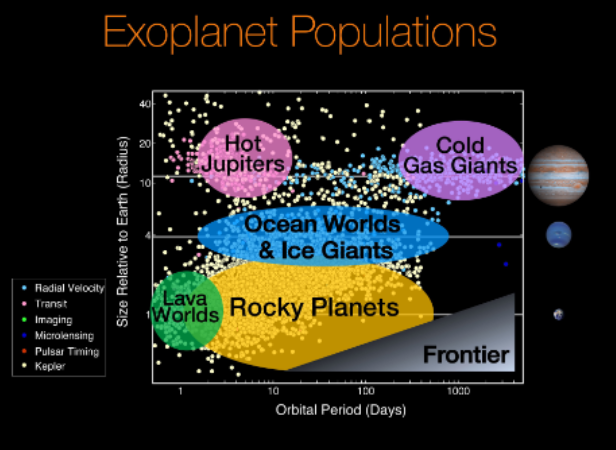
Key Difference:
The transit method gives you the planet's size, and the radial velocity method gives you the mass.
Combining both gives a full picture of the planet's density and composition.
In short: Transit = size, Radial velocity = mass.
The Evolution of a Terrestrial Planet's Atmosphere
🌍 Factors That Influence Atmosphere Evolution
Atmospheric Escape: Gases, especially lighter ones like hydrogen, can escape into space over time.
Gas-Surface Reactions: Volcanoes and other chemical reactions release gases that change the atmosphere.
Star Energy: The type of star and its energy output impact the planet’s temperature and atmospheric conditions.
Geologic Activity: Volcanic eruptions and tectonics release gases that shape the atmosphere.
Initial Volatile Inventory: A planet’s original gases and water heavily influence its atmosphere.
Active Biology: Life forms (like plants) can alter the atmosphere, e.g., oxygen production.
Atmospheric Circulation: Wind and weather patterns help distribute gases and drive climate.
🌕 Venus vs. Earth
Similar in Size & Distance: Venus and Earth look alike to telescopes like Kepler and SIM.
Very Different Conditions: Despite similarities in size and distance from the Sun, Venus and Earth have drastically different climates due to atmospheric composition and geologic activity.
💡 In Short:
The atmosphere of a terrestrial planet evolves due to a mix of atmospheric escape, volcanic activity, star type, biology, and more. Venus and Earth might look alike from space, but their atmospheres are shaped by different factors (that’s also why we have a compound ambiguity)
Planet Composition Lines
Iron Line: Planets with lots of metal, like iron.
Rock & Iron Line: Planets made of a mix of rock and metal.
Rock & Water Line: Planets with rock and water (think Earth!).
Hydrogen Line: Planets rich in hydrogen, often gas giants.
🌌 Exoplanet Distribution
Near the Hydrogen Line: Many exoplanets are gas giants, similar to Jupiter or Saturn.
Jupiter to Neptune: Planets like Jupiter (most hydrogen-rich) are higher up, while Neptune (less hydrogen, more ice) sits lower down on the line.
💡 In Short:
Planets can be classified by their composition—metal-rich, rocky, water-rich, or hydrogen-rich. Many exoplanets are gas giants near the hydrogen line, with Jupiter and Neptune showing the diversity of hydrogen content.
NASA's Terrestrial Planet Finder (Not Yet Funded)
Goal: Find and study Earth-like planets around nearby stars.
Nulling the Parent Star: The mission needs to block out the star’s light by a factor of 10⁶ to 10¹⁰ to focus on the faint planet signals.
Transit Method: Uses the transit method to subtract the star's light and detect atmospheric gases on the planet.
Biomarker Gases: Looking for gases in the atmosphere that could indicate life (biomarkers).
💡 In Short:
The Terrestrial Planet Finder aims to detect Earth-like planets by blocking out star light and analyzing the atmosphere for signs of life, like biomarker gases.
The Problems of Space Travel
Speed of Light: If a spaceship could travel at 99.9% the speed of light, a 50-light-year round-trip to Vega would take only 2 years (due to length contraction from Einstein's Special Relativity).
Time Dilation: While space travelers would only age 2 years, people on Earth would age 50 years. So, on their return, travelers’ children could be older than they are!
Energy Challenge: To accelerate a spaceship like the Enterprise to just half the speed of light, it would require 200 times the Earth’s annual energy expenditure.
💡 In Short:
Space travel near light speed sounds cool, but time dilation and huge energy requirements make it super impractical with today’s technology.