Chapter 5: Sound, Auditory System, and Pitch Perception
Physical Definition: sound as pressure changes in the air or other medium
Perceptual Definition: sound as the experience we have when we hear
Sound as Pressure Changes
Soundwave: pattern of air pressure changes
Amplitude: height of wave
Wavelength: distance from one peak to the next (one full cycle)
Compression: higher pressure
Rarefaction: lower pressure
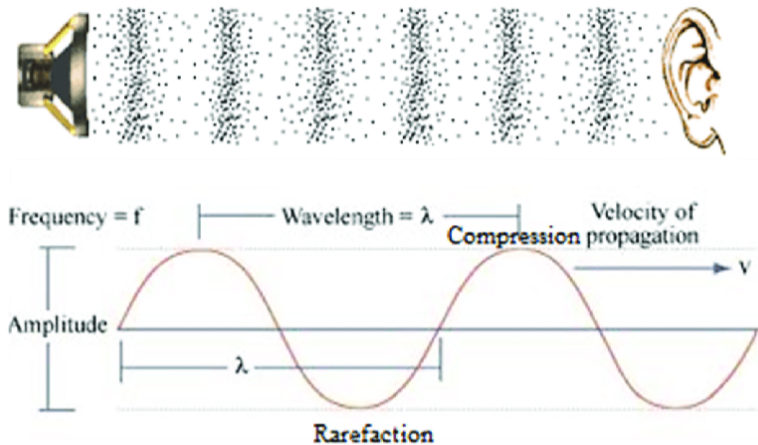
Pure Tones - Frequency
Hertz: cycles per second
how many waves fit in a second
Range of hearing - Humans
20 Hz to 20,000 Hz
Dogs hear up to 45,000 Hz
Frequency is associated with the perception of Pitch
Pure Tones - Amplitude
Amplitude: difference in pressure between the high and low peaks
Loudness: the perceptual quality of amplitude
Decibels (dB): measure of loudness
dB = 20 x logarithm(p/p0)
p = sound of pressure of stimulus
p0 is the sound pressure of the standard
Complex Tones
Comprised of multiple frequencies
Fundamental Frequency - the repetition rate of complex musical tone
Harmonics - multiples of the fundamental frequency
Most sounds are complex
Perceiving Sound
Loudness
Most closely related to amplitude
Decibels are a physical measure
Loudness is a perceptual experience
Pitch
Most closely related to frequency
Hz is the physical measure
Pitch is the perceptual experience
Aspects of Pitch
Tone Height
increasing pitch associated with increasing frequency
Tone Chroma
Notes with the same letter have the same chroma, octave apart
Frequency doubles with each octave
Missing Fundamental
Removing the fundamental changes Timbre
Pitch stays the same
Timbre
Character or quality of a sound separate from pitch and loudness
Quality of waveform
frequencies
number of harmonics
relative intensities
Different instruments and voices produce different timbre
Attack - build-up
Decay - decline
Outer Ear
Pinna
Auditory Canal
Eardrum
Middle Ear
Between eardrum and Oval Window
Inner Ear
After Oval Window
Cochlea
Organ of Corti
Basilar membrane
Tectorial membrane
Hair cells
Inner hair cells - transmit
Out hair cells - amplify sounds
Coding of Frequency in Cochlea
Place Theory
location on Basilar membrane signals frequency
Timing Theory
phase locking and temporal coding
Place Theory
sounds travel down the basilar membrane varying distances
high frequency - travel less distance
low frequency - travel further distance
full range of frequencies not accounted for
Timing Theory
Timing
firing of single neurons
Volley Principle
firing of multiple neurons, phase locking
Primary Auditory Pathway
cochlear nuclei
superior olivary nucleus
inferior colliculus
medial geniculate of thalamus
primary auditory cortex
Auditory Path
main pathway for hearing
information does cross over
SONIC MG
Non-Primary Pathway
cochlear nuclei
reticular formation
non specific thalamus
poly-sensory cortex
Beyond A1
Three main areas
core (A1)
belt area
parabelt area
What pathway - identification
Where pathway - localization
Hearing Loss
conductive hearing loss
sound is blocked from reaching receptors
sensorineural hearing loss
damage to hair cells, auditory nerve, or brain
Presbycusis
loss of hearing associated with aging
most common type of sensorineural hearing loss
loss of higher frequencies
due to gradual changes in the ear
affects men more severely than women
age and work/occupation related
Noise Induced Hearing Loss
can occur at any age
due to exposure to intense sound
damages Organ of Corti
damages hair cells
work place noise - now regulated by OSHA
leisure noise isn’t regulated
Conductive Hearing Loss
hole in eardrum
blockage in ear canal (ear wax, foreign body)
damage or malformed ossicles
ear infections
tumors