Parasitology Introduction
General Information
Lecture details:
Course: Microbiology of Infection and Immunity (MI 2500B)
Instructor: Dr. Stephanie Zukowski
Date: March 24, 2025
Teaching Assistants: Gabby & Tamara
No textbook required; questions about lecture content can be directed to the instructor or TAs.
Learning Outcomes
By the end of this lecture, students will be able to:
Demonstrate an understanding of parasitology as a field of study.
Describe general classifications and characteristics of eukaryotic parasites.
Explain mechanisms of entry, survival, and pathogenesis for parasitic protozoans.
Outline the life cycle, structures, mode of transmission, symptoms, and treatment of giardiasis.
What is a Parasite?
Definition: A parasite is any organism that derives benefits by living on or inside a host of a different species.
Etymology: The term originates from the Greek word "parasitos" which means "one who eats at the side of another" (pará = at, beside; sítos = food).
Types: Parasites can include animals, plants, fungi, bacteria, and viruses.
Phylogenetic Tree of Life
Phylogenetics: The study of evolutionary relationships among biological entities.
Organization of Parasites
Protozoa
proto = first
zoa = animal
single cell microorganisms
Metazoa
meta = after
Helminths = worms
Arthropods = insects
What does a parasitology do ?
studies the parasite itself
studies the host itself
studies the relationship between the two
broad field uses different types of biology to gather more information
Parasitism as a “Lifestyle”
Advantages of Parasitism:
Once a host is located, there is no need for further searching.
Food is permanently available.
Reduced need for complicated food capturing mechanisms.
reduced need for food processing ( not as many enzymes host does it )
Protection from environmental extremes.
protection from predators and diseases
reduced need for dispersal because host carries the parasite
Can allocate more energy to reproduction.
Disadvantages of Parasitism:
extreme host specificity can increase vulnerability of extinction
if something happens to the host something will happen to you
Must find an optimal site on/in the host for food and survival.
Need to adapt to the host's internal environment.
Must overcome the host's immune defenses.
Transmission can be risky; many offspring may not survive.
Different Forms of Parasitism
Facultative Parasites: Can live independently but prefer to have a host.
e.g. Naegleria Fowleri : brain eating amoeba lives alone but can enter humans through the nose and feed on the brain
Obligate Parasites: Completely dependent on a host for survival.
e.g. plasmodium falciparum : cause malaria
e.g head louse : have no wings cant jump therefore need host to disperse
Endoparasites: Live inside the host.
Ectoparasites: Live on the surface of the host.
Parasitic Protozoa
Over 200,000 species of protozoa described; 35,000 currently existing.
10,000 species adapted as parasites, with around 70 infecting humans.
Protozoans are single-celled, eukaryotic organisms occupying diverse ecological niches.
Infect a wide spectrum of vertebrate and invertebrate life
Classification of Parasitic Protozoa
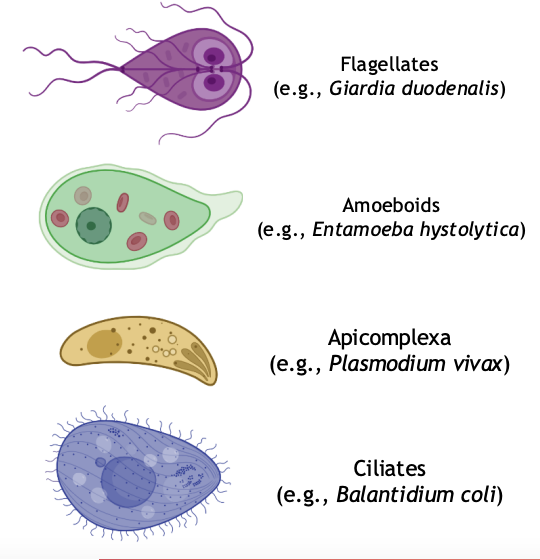
Flagellates (mastigophora) : e.g., Giardia duodenalis
use flagella to move
Amoeboids (sacrodina ) : e.g., Entamoeba histolytica
pushes against cell membrane to move
Apicomplexa: e.g., Plasmodium vivax
myosin motor (protein) to move through environment
Ciliates: e.g., Balantidium coli
cilia helps them move through the environment
Classification considers motility, metabolism, and DNA genotyping.
Mechanisms of Entry for Protozoan Parasites
Oral: e.g., Giardia duodenalis
fecal oral : contaminated food or water
Sexual: e.g., Trichomonas vaginalis
pH or temperature stays consistent good for sensitive organisms
Inhalation: e.g., Toxoplasma gondii
clean cats litter box can breath in this parasite
generally asymptomatic
Direct Contact: e.g., Trypanosoma cruzi
kissing bug will bite you and deficit on the skin
Arthropod Vectors: e.g., Plasmodium falciparum.
part of life cycle takes place in mosquitos and in humans
can be transmitted human to human
Host Classification
Definitive (Final ) Host: Host where the parasite reaches sexual maturity and undergoes reproduction .
or where it completes the most important part of its life cycle
Intermediate Host: Host where asexual reproduction occurs or hosts the parasite at a non-sexual maturity stage.
Reservoir Host: Carries the parasite and can be asymptomatic, serving as an infection source for other hosts.
Divison and Reproduction
Asexual
mitosis or binary fision
Sexual
can be similar to male and female gametes
some genetic variation material
Both
Monoxenous = only one host
Diheteroxenous = part of reproduction happens in final host and some changes in intermediate host
Triheteroxenous = has a final host and at least two intermediate host
Survival and Pathogenesis Mechanisms
What is antigenic variation? A strategy where parasites change surface proteins to avoid recognition by the host's immune system.
What is molecular mimicry in parasites? Parasites produce molecules that mimic host molecules to evade immune detection.
What is immune modulation? A mechanism where the parasite alters or suppresses the host’s immune response to survive.
What is intracellular habitation? Parasites live inside host cells to avoid immune surveillance and destruction.
What is encapsulation in parasitology? A process where parasites form protective outer layers to resist host defenses.
What is protease secretion? The release of proteins that degrade host immune components, aiding parasite survival.
What is thermal tolerance in parasites? The ability to survive in a range of host body temperatures or environmental changes.
What is toxin production in parasites? The release of toxic metabolites that can harm host cells or disrupt normal function.
What is nutrient deprivation in pathogenesis? Parasites absorb or compete for nutrients, depriving the host and contributing to disease.
Historical Context
Antonie van Leeuwenhoek (1681): First observations of protozoa, referring to them as tiny creatures moving in the liquid medium.
Case Study: Giardia duodenalis
Synonyms: G. intestinalis or G. lamblia
Most prevalent binucleated protozoan pathogen affecting humans, inhabiting the upper small intestine of vertebrate .
Obligate parasite with a monoxenous life cycle consisting of trophozoite and cyst stages.
aerotolerant anaerobe = no mitochondria
Transmitted via fecal-oral route.
Trophozoites and Cysts
Trophozoite:
adapted for survival within small intestine
8 μm by 12 to 15 μm in size
binucleate
four pairs of flagella
adhesive disc
what sticks to the small intestine
mitosomes
Cyst:
Environmentally stable
facilitating transmission
needs to be in this form to survive in the environment
5 μm by 7 to 10 μm in size
Tetranucleate
metabolic rate is only 10% to 20% that of the trophozoite
Life Cycle of Giardia duodenalis
Basic
Cysts get into body
people swallow them through dirty water contaminated food, or by touching dirty hands or objects
In the intestines the cyst turns into active parasites
these are called trophozoites and they multiply in the gut
Some turn back into cysts
the body passes them out through poop
Cysts contaminate water, food or surfaces
if others touch or eat these things they can get infected too
Trophozoites can also leave the body in poop
but they die quickly outside and don’t spread the infection
Epidemiology and Pathogenesis of G. duodenalis
Worldwide distribution
Cysts survive longer in cool, moist environments
Trophozoites adhere tightly to the small intestine mucosa resulting in atrophy and flattening of the villi
Beaver fever = beavers are major resorvoir host and often responsible for contaminating public drinking water
Proteases and secreted substances :
excretory secretory products ( ESPs )
Membrane and surface proteins :
variant-specific surface proteins ( VSPs )
Clinical Diagnosis
“Gold standard” for clinical diagnosis consists of microscopy of a fecal sample
Antigen-capture ELISA or direct fluorescent antibody test (DFA)
Nucleic Acid Amplification Tests (NAATs)
Nitroimidazoles (e.g., metronidazole) are primary drugs used for treatment
Produces ROS in anaerobes and damages DNA