Unit 4: Earth Systems and Resources
4.1 Plate Tectonics
Geological time scale: Used to measure Earth’s history
Earth is estimated to be approximately 4.6 Billion years old
Earth formed from cosmic dust and gas in the solar system
Parts of the Earth
Earth’s Interior
The innermost part of the earth
High temperatures are primarily the result of radioactive decay
Earth’s Core
Composed of iron and nickel
Make up 1/3 of Earth’s mass
Made up of two parts
Solid Inner Core
Liquid Outer Core
Iron in outer core generates Earth’s magnetic field
Mantle
Lies just above outer core of the Earth
Thick zone→ Most volume and mass of any Earth Layer
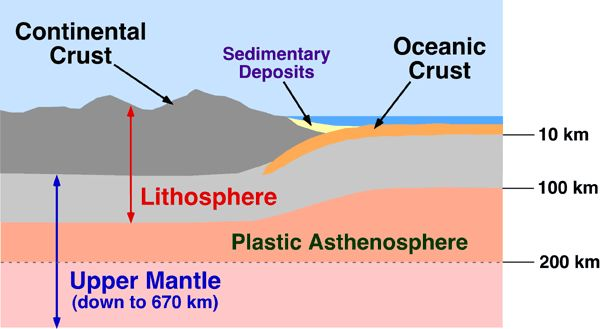
Outermost part is the asthenosphere
Asthenosphere
Very hot, partly melted rock that flows slowly and can be deformed like soft plastic
Overlies with upper mantle (consisting of rigid rock)
Crust
The outermost layer of Earth
Least dense
Nonrenewable resources we use come from the crust
Primarily made of granite and basalt
IMPORTANT:
Inner: Most Dense
Outer: Least Dense
When moving in to out, the less dense materials become
Crusts
Continental Crust | Oceanic Crust | |
Location | Beneath continents | Beneath oceans |
Density | Thick | Thin |
Thickness | Low | High |
Composition | Granite | Basalt |
Age | Older | Younger |
Behavior | Buoyant | Recyclable |
Collision Boundaries
Convergent Plate Boundaries
2 plates collide
Associated with cooling and sinking convection currents
A. Oceanic vs. Continental Plate Collision
Subduction: The denser oceanic plate sinks beneath the less dense continental plate.
Features Formed:
A deep-sea trench forms where the plates meet.
A line of volcanoes forms on land as the sinking ocean plate slowly melts.
Deep, violent earthquakes occur.
Example: The Nazca Plate subducting under the South American Plate, forming the Andes Mountains and a deep sea trench off the west coast of South America

B. Oceanic vs. Oceanic Plate Collision
One oceanic plate subducts under another.
Forms deep ocean trenches and volcanic island arcs.
C. Continental vs. Continental Plate Collision
Process: When two low-density continental plates collide, neither subducts easily. Instead, material is thrust upward.
Features Formed: Massive mountain ranges and high plateaus.
Examples: The Himalayas (formed by the Indian and Asian plates colliding), the Alps, and the Urals.
2. Divergent Plate Boundaries (Plates Pulling Apart)
Definition: Places where tectonic plates pull apart and move in opposite directions.
Key Features & Processes:
New Crust Formation: Magma rises from deep within the asthenosphere to fill the gap, creating brand-new ocean floor/crust (basalt) in the rift zone.
Geological Activity: Characterized by high heat flow, shallow-depth earthquakes, rift valleys, and hydrothermal vents.
Example: The Mid-Atlantic Ridge, where the North American and Eurasian plates are moving apart.
Transform Boundaries
A transform boundary (transform fault) is a place where two tectonic plates slide horizontally past each other in opposite, but parallel, directions along a fault line.
Definition: A transform fault occurs when two tectonic plates move in opposite, but parallel, directions along a fault.
Plate Movement: Plates slide horizontally past one another rather than colliding or pulling apart.
Geological Activity:
Characterized by frequent earthquakes due to friction and the sudden release of stress.
Unlike other boundaries, no new crust is created, and no crust is destroyed.
History of Plate Tectonics
Theory of Plate Tectonics
Major revolution in our understanding of Earth
Explain how earthquakes, volcanoes, etc. work
Proposes that Earth is broken into 15 major rigidplates
Plates move on top of asthenosphere
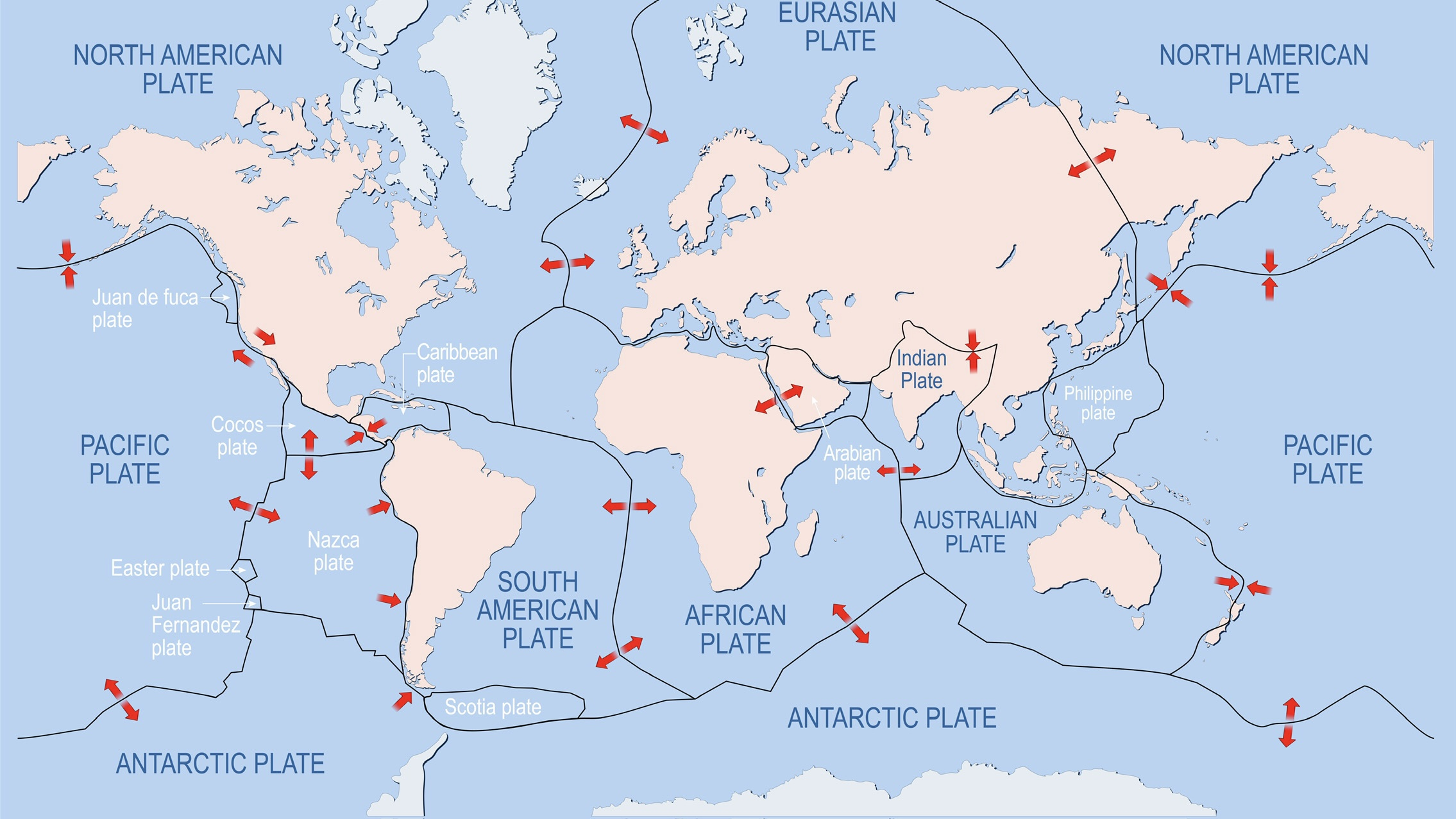
Plate Boundaries: Locations of here there are active volcanos, earthquakes or mountain building
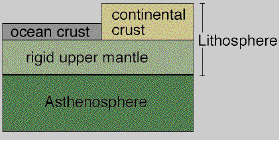
Lithosphere: Includes crust and rigid upper part of mantle
Plate: Huge slab of outer portion of Earth
Composed of crust and the rigid upper mantle
Often referred as lithospheric plates
Alfred Wegener
Proposed that world’s continent was once a single landmass
PANGAEA
Evidence
Observed ancient rock assemblages which aligned where continents put back together
Similar to a Jigsaw Puzzle
Plate Movement
Plates are moved (pushed/pulled) by convection currents within the mantle
Causes asthenosphere to flow slowly
Material will either
Heating: Rise and expand
Cooling: Sink and contracts
Convection Cells
Rising: Plates are pulled apart
Sinking: Pulled back into earth and re-melting
Magma: Moltwn rock inside Earth
Lava: Liquid rock that reaches Earth’s exterior
Volcanoes and Eruptions
Active Volcanoes: Locations where magma reaches Earth’s surface
Ejected Materials
Ejecta: Large lava rocks to glowing ash
Liquid Lava
Gases: water vapor, CO2, sulfur dioxide
Hot Spots
Definition: Stationary regions of upwelling magma underneath moving lithospheric plates
Examples:
Hawaiian Chain: Formed as Pacific Plate moves over fixed hot spot
Loihi: New island currently forming on ocean floor near Hawaii
Fault: Fracture in rock where movement takes place
Fault Zone: Large expanse of rock where fault has occured
Seismic Activity: Frequency and intensity of Earthquakes over time
Volcanic Impacts
Negative Effects
Disruption of air travel
Loss of life
Habitat destruction
Reduced air quality
Short term climate modification
Benefits
Fertile soils
Lake formation
Beautiful Scenery
Earthquakes, Effects, and Hazard Reduction
An earthquake is the shaking of the ground resulting from rock fracturing and displacement to form a fault, or from subsequent movement along the fault.
Richter Scale
Measures strength of earthquake
Operates as logarithmic scale of maximum ground motion
Aftershocks: smaller earthquakes that occur after main earthquake
Gradually decrease in frequency over period of several months
Mapped extensively following events like 2011 Japan Earthquake
Primary Effects:
Ground shaking and permanent vertical or horizontal displacement.
Destroys buildings, bridges, freeway overpasses, dams, and pipelines.
Damage severity is influenced by magnitude and population density (e.g., the 2010 Haiti Earthquake).
Secondary Effects:
Rockslides, mass wasting, urban fires, and flooding caused by subsidence.
Tsunamis: Giant water waves generated by underwater earthquakes that strike coastal areas.
Nuclear Energy & Seismically Active Regions:
Countries like Japan are reassessing their reliance on nuclear power.
The 2011 tsunami caused a meltdown at the Fukushima Dai-ichi plant even though plants are designed to shut down after ground movement exceeds a threshold.
Reducing Earthquake Hazards:
Engineer and build earthquake-resistant homes, buildings, bridges, and freeways.
Locate and map active fault zones to establish strict building codes in high-risk areas.
Develop advanced earthquake prediction techniques and strategies to cope with natural hazards.
The Law of Uniformitarianism
Definition: A basic geological principle which states that the geological processes we see on Earth today are uniform (the same) as the processes that have occurred throughout Earth's history.
Core Application:
Any plate tectonic activity observed or experienced today—such as earthquakes shaking the crust and volcanoes erupting—has been happening continuously since the Earth first began forming its surface.