Module 2
cell mediated transport = movement of molecules across a cell membrane by transport protein
facilitated diffusion
primary active transport
secondary active transport
Transport Proteins
Types:
channel- creates open, water-filled pores
gated channel- channel that opens and closes under various conditions
carrier- binds to substrate and undergoes a conformational change to move substrates across the membrane
ATPase pump- uses ATP as an energy source to trigger the conformational change to move the substrates across the membrane
- # of substrates
uniporter- moves one type of molecule
cotransporter- moves more than one type of molecule per cycle
symporter- same direction
antiporter- opposite directions
- direction
unidirectional- only works in one direction
bidirectional- works in either direction
number and directional terms are NOT mutually exclusive
uniporter does not = unidirectional always and can be unidirectional or bidirectional
cotransporter can move one direction or both direction
uniporter CANNOT be a cotransporter
unidirectional CANNOT be bidirectional
competition for specificity in transport proteins
concentration gradient can effect multiple molecules with the same active site
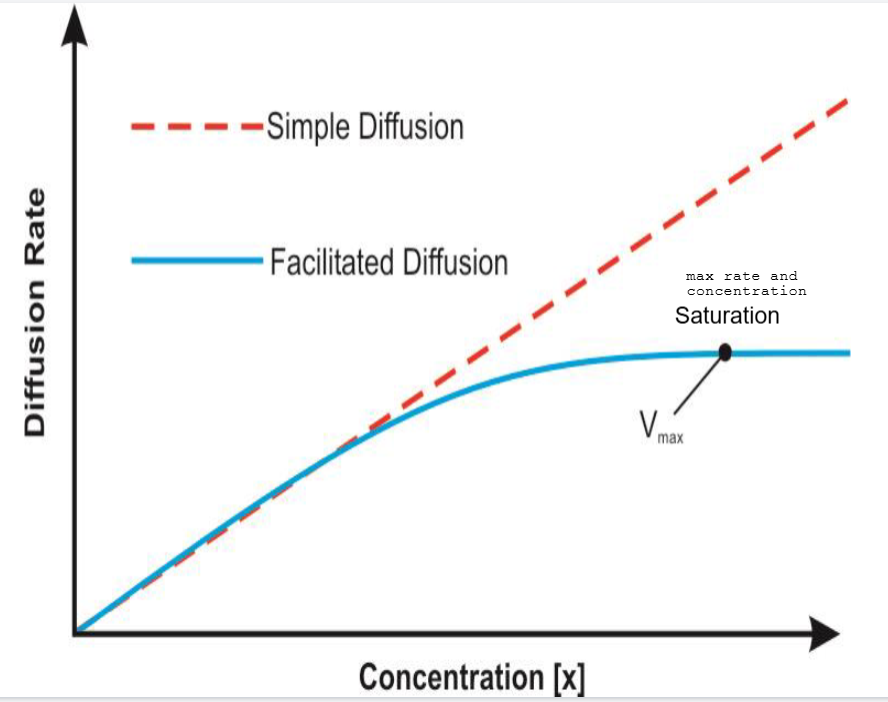
facilitated diffusion
cell mediated diffusion
passive process that relies on the concentration gradient
binding of the substrate will cause the transporter to undergo conformational change
primary (1) active transport
uses ATP as an energy source so it does not rely on the concentration gradient
can pump against the gradient
Na+/K+
2 K+ in and Na + out
utilizes 1 ATP
lacking one component prevents operation
must be in correct location
can go with or against
secondary (2) active transport
cotransporter using the concentration gradient of one molecule as the energy source to move a second molecule
one molecule is moving high to low and the other from low to high concentration
primary active transport must’ve occurred to establish the concentration gradient