Doctrine of precedent
Precedent is … the reported reasoning behind a courts decision that establishes a legal principle or rule. This can be used by the judges as guidance when deciding future cases.
A precedent established by a superior court in the same hierarchy must be followed by judges and magistrates in lower courts when they are deciding future cases with similar material facts.
V
Doctrine of precedent is the theory/process of how we establish precedent and the rules that determine when their principles are applied in other cases. The doctrine depends on the courts being organised in a hierarchy from lowest to highest according to seriousness and complexity of cases they have authority to hear.
When is precedent made ?
When a judge in a superior court makes a judgement on a point of law, usually on appeal. Their ratio decidendi will form a principle of law, referred to as precedent. This precedent is then to be followed in all future situations brought before the courts with similar material facts. A judge is not bound to follow a decision of a judge at the same level.
Caution !
Common law is about the development of legal principles based on applying the laws and not to the sentencing aspect. Precedents are not relevant to the sentence imposed or reason for a sentence but instead the meaning of a law and it’s application.
Reasons for the doctrine of precedent
Like cases are decided in a similar manner
Legal practitioners are able to give advice on the likely outcome of a case
Judges have some guidance by being able to refer to previous cases and decide accordingly .
The same point is not to be decided over and over again
Decisions made by more experienced judges
Key features and elements of the Doctrine of precedent
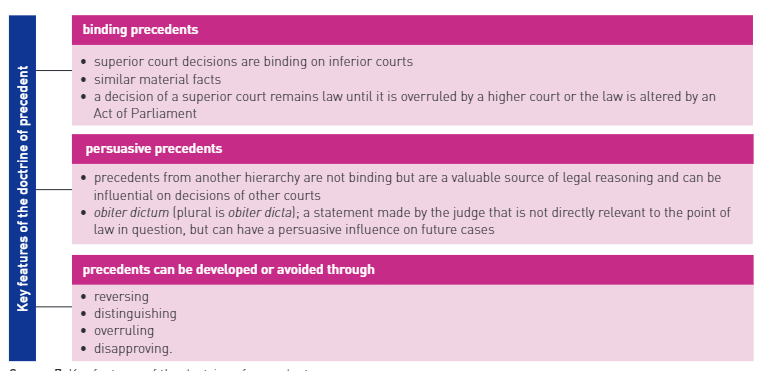
Types of precedent
A precedent can be either binding on other courts or persuasive. The same precedent could be binding on one court and persuasive on another. It is the position of the court which made the decision and court looking to follow the decision that influence whether the precedent is binding or persuasive
Binding precedent is one that has been established in the superior courts and must be followed by lower courts in the same hierarchy when resolving disputes with similar material facts.
-The MC and CC are bound to follow precedents set by the SC-TD, SC-COA or the HC.
-SC-TD is bound to follow precedents sets by the SC-COA or HC
-The HC is not bound to follow the precedent of any state or territory act.
Persuasive precedents are those not binding on a court but may still be considered by a judge and used to influence their decision if it is an important legal principle relevant to the case before the court. Although they are not binding, to maintain consistency judges will almost inevitably follow them.
Persuasive precedents can be:
Set by courts in another court hierarchy
Set by lower courts in the same hierarchy
Set by courts of the same level in the same court hierarchy
Elements
Ratio Decidendi
‘The reason for the decision’. Not everything said by the judge is made binding on lower courts only the reason for the decision forms the legal principle to be applied and followed in future cases.
Stare Decisis
‘Stand by what has been decided’. This principle describes the process of lower courts following the reasons for the decisions of higher courts, it allows for predictability and consistency.
Obiter Dictum
‘Statement made by the way’. A non-binding opinion or statement made by the judge within the judgement. It can form persuasive precedent for future judges to be guided by.
How can a court develop/alter/avoid a precedent
Other than adopting a precedent there are a few ways the court can ‘treat’ precedents (usually to avoid applying them).
Distinguishing
Reversing
Overruling
Disapproving
Method | Definition |
|---|---|
Reversing | In hearing one case when on appeal from a lower court, judge in superior court may disagree and decide to change the previously established precedent set by the lower court. When reversing a new precedent is made by the superior courts decision and this new decision becomes the precedent to follow in future cases. |
Overruling | Applies to changing a precedent in a different and later case. Judge may choose not to follow a previously established precedent by a lower or same level court in a separate earlier case. Overruling makes earlier precedents inexplicable. |
Disapproving | Disagreeing with the precedent but not changing it. Judges in lower courts bound to follow precedents express their dissatisfaction with the precedent |
Distinguishing | Material facts are different enough that the precedent does not apply. |