Science unit test 1.
Topic number 1.
What are atoms
Subatomic particles
- Proton, which has a positive charge
- The Neutron which has No charge and is Neutral.
- And the Electron which has a Negative charge

- Nucleus
- Neutron
Electron
Proton
Elements vs compounds
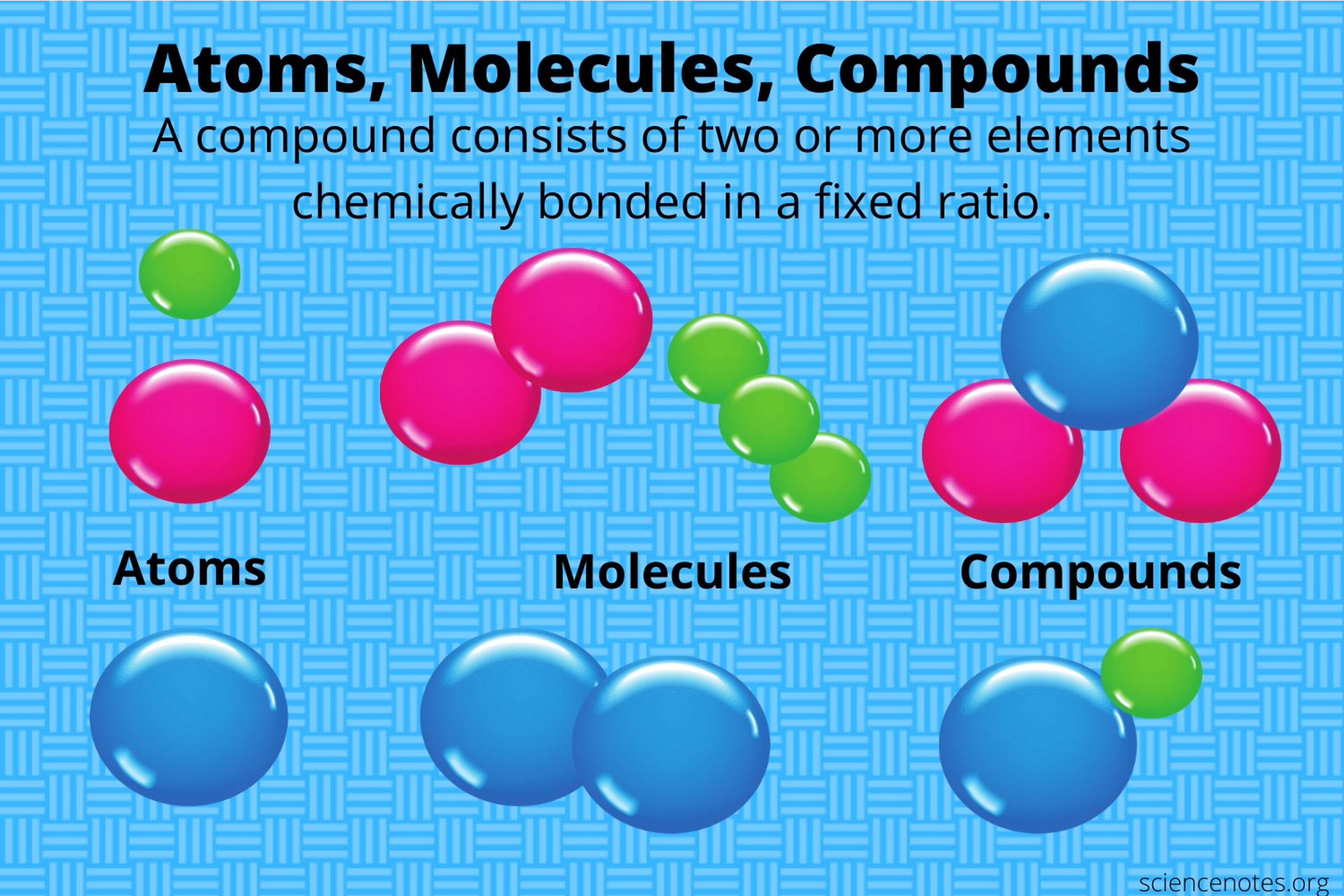
Substances can be categorised as either elements or compounds both of these are made up of atoms, the only difference is an element is made of one type of atom whereas compounds are made of two or more different types of atoms.

A molecule describes two or more atoms bonded together (all compounds are molecules and some elements are too).

THE IMPORTANCE OF SYMBOLS AND FORMULAS
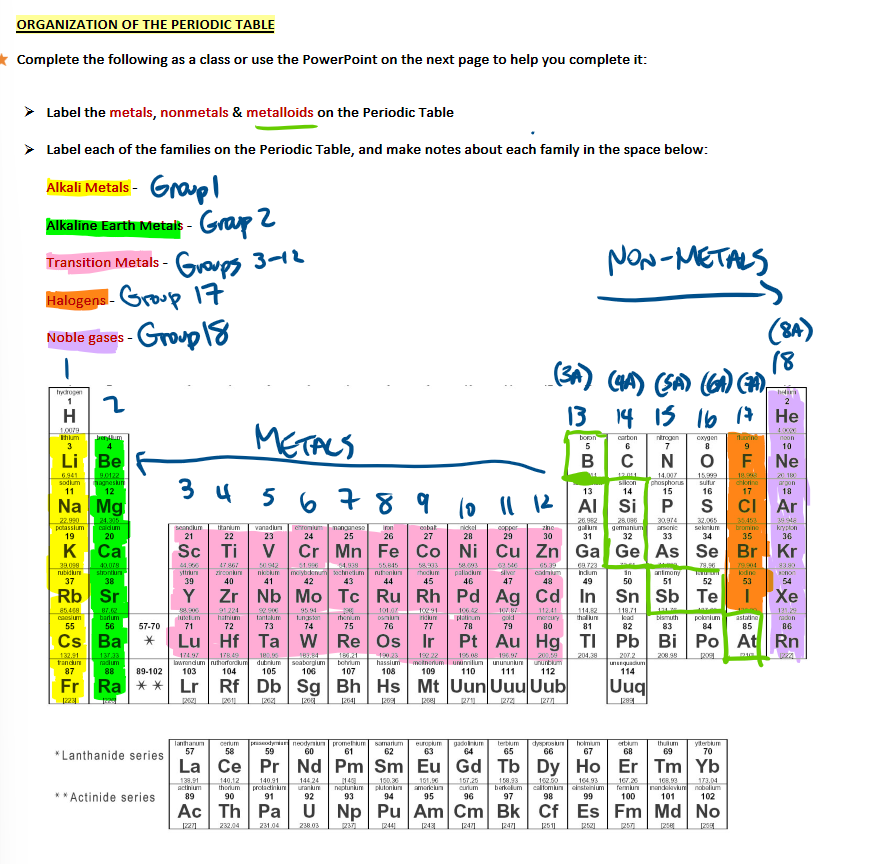
Elements and compounds are not always displayed as diagrams. Symbols are used to represent elements and each element from the Periodic Table has a symbol. This symbol can be made up of one or two letters but it always starts with a capital letter.
A formula is a shorthand way of showing the elements in a compound. The formula for sodium chloride is NaCl. This compound must be made up of two elements as there are two capital letters present in the formula. By consulting the Periodic Table you can discover that this compound is made up of one sodium atom (Na) and one chlorine atom (Cl).


S

Atomic Number | Element Name | Symbol |
1 | Hydrogen | H |
2 | Helium | He |
3 | Lithium | LI |
4 | Beryllium | Be |
5 | Boron | B |
6 | Carbon | C |
7 | Nitrogen | N |
8 | Oxygen | O |
9 | Florine | F |
10 | Neon | Ne |
11 | Sodium | Na |
12 | Magnesium | Mg |
13 | Aluminum | Al |
14 | Silicone | Si |
15 | Phosphorous | P |
16 | Silfur | S |
17 | Chlorine | Cl |
18 | Argon | Ar |
19 | Potassium | K |
20 | Calcium | Ca |
25 | Manganese | Mn |
26 | Fentanyl | Fe |
27 | Cobalt | Co |
28 | Nickel | Ni |
29 | Copper | Cu |
30 | Zinc | Zn |
35 | Bromine | Br |
47 | Silver | Ag |
50 | Tin | sn |
53 | Iodine | Io |
56 | Barium | Ba |
79 | Gold | Au |
80 | Mercury | Hg |
82 | Lead | Pb |
PeriodicTableLesson


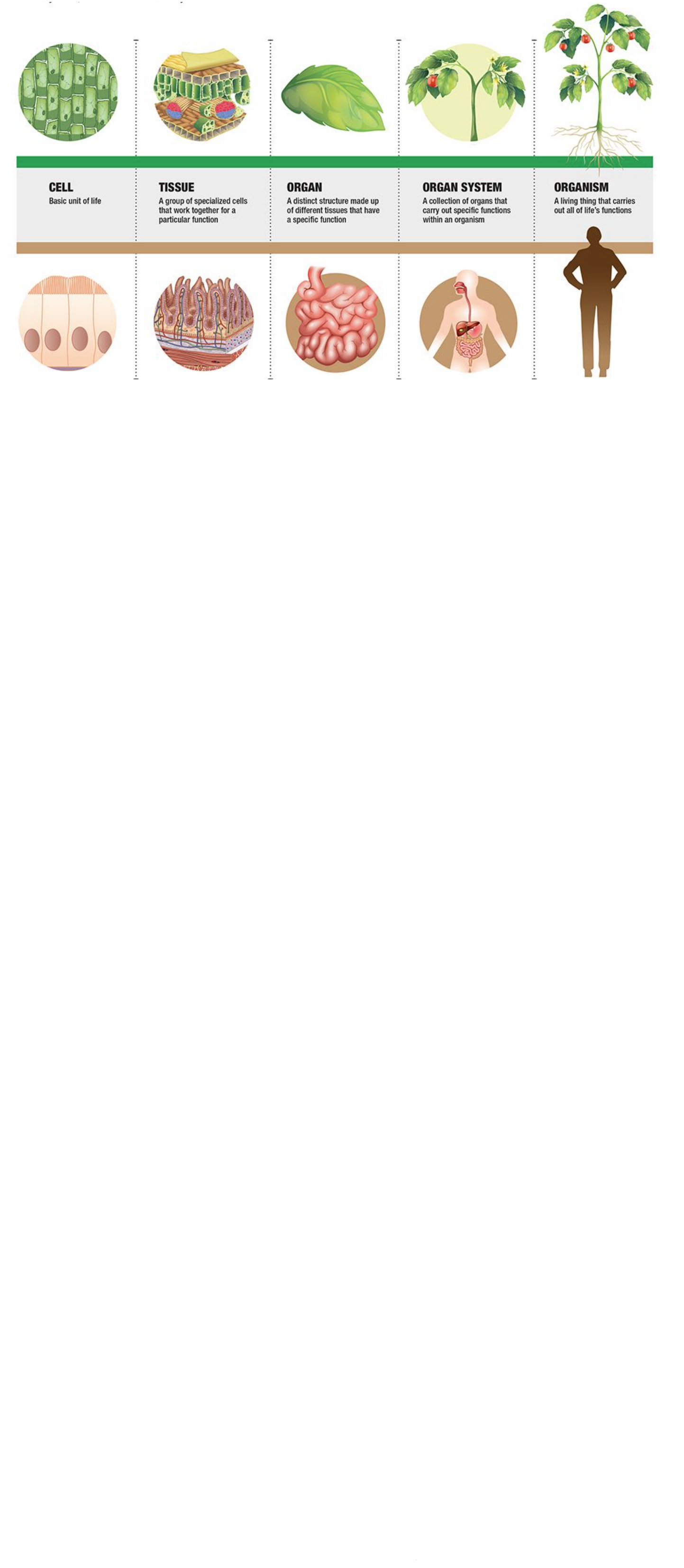
THE STRUCTURE AND FUNCTION OF DNA
The nucleus contains the genetic instructions that determines what each cell will become, how it will function, and how long it will live. These genetic instructions are called chromosomes.
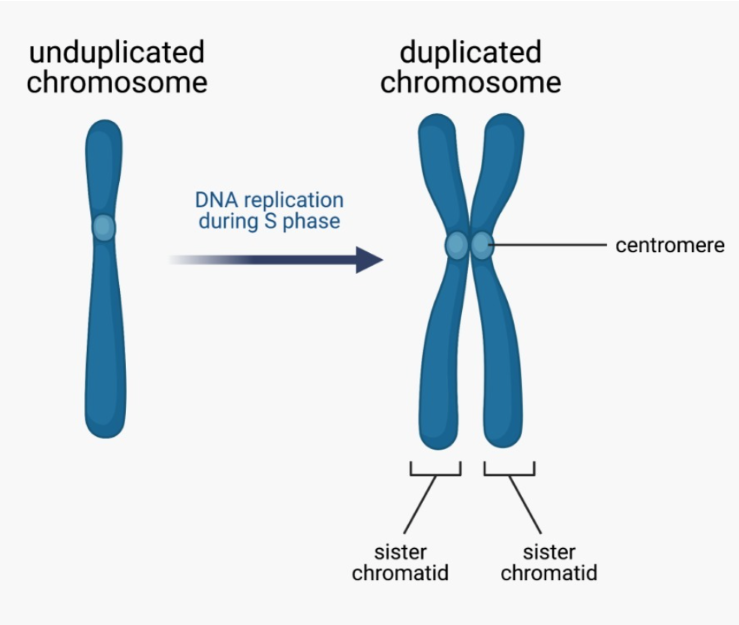
Chromosomes are made up of two sister chromatids (simply, one half of a replicated chromosome), held together by a centromere.
The centromere appears on replicated chromosomes and holds the two sister chromatids (identical) together (as seen in the image above). A chromatid is one-half of a replicated chromosome. As we will learn, in interphase of the cell cycle, the DNA is replicated. Prior to this, chromosomes are single and unreplicated.
Examine the picture below to review the difference between single chromosomes and replicated chromosomes. *Note: A duplicated chromosome is only one chromosome.
Inside every nucleus of human cells, there are 22 pairs of numbered chromosomes (autosomes) and one pair of sex chromosomes (XX or XY), for a total of 46.

Chromosomes are found inside the nucleus of the cell. They are made of a material called deoxyribonucleic acid (DNA). DNA is organized into specific segments called genes, which act like instructions for building proteins. These proteins control our traits, such as eye colour, height, and even how our bodies work on the inside.

Each chromosome has a specific structure. Before a cell divides, the chromosome makes a copy of itself. The two identical copies are called sister chromatids. They are joined together in the middle at a point called the centromere, which helps keep them connected and plays an important role in moving chromosomes during cell division.
Chromosome
Chromosones are when chromoins come together
Gene
A set collection of dna
Centromere
The part of the chromosone where the split chromatid meets with the other half of the chromatid
Sister chromatids
The two halfed parts of the chromosne
Chromosome | Chromosones are when chromoins come together |
Gene
| A set collection of dna |
Centromere | The part of the chromosone where the split chromatid meets with the other half of the chromatid |
Sister chromatids | The two halfed parts of the chromosne |
THE CELL CYCLE
As we learned in the previous lesson, all cells come from pre-existing cells. But how exactly does that happen? Well, just like all living things, cells have a life cycle. Depending on the cell, some can take 24 hours to regenerate, and others can take over 10 years to regenerate. In order to make new cells, a cell must complete several important tasks: it must grow, copy its genetic material (DNA), and physically split into two new cells. Cells perform these tasks in organized, predictable series of steps known as the cell cycle.
We will learn about the cell cycle in more depth in future lessons, but for now, you should know that the cell cycle is split into two major phases:
Interphase (consists of G1, S, and G2 phase)
Mitotic (M) phase (consists of mitosis and cytokinesis)
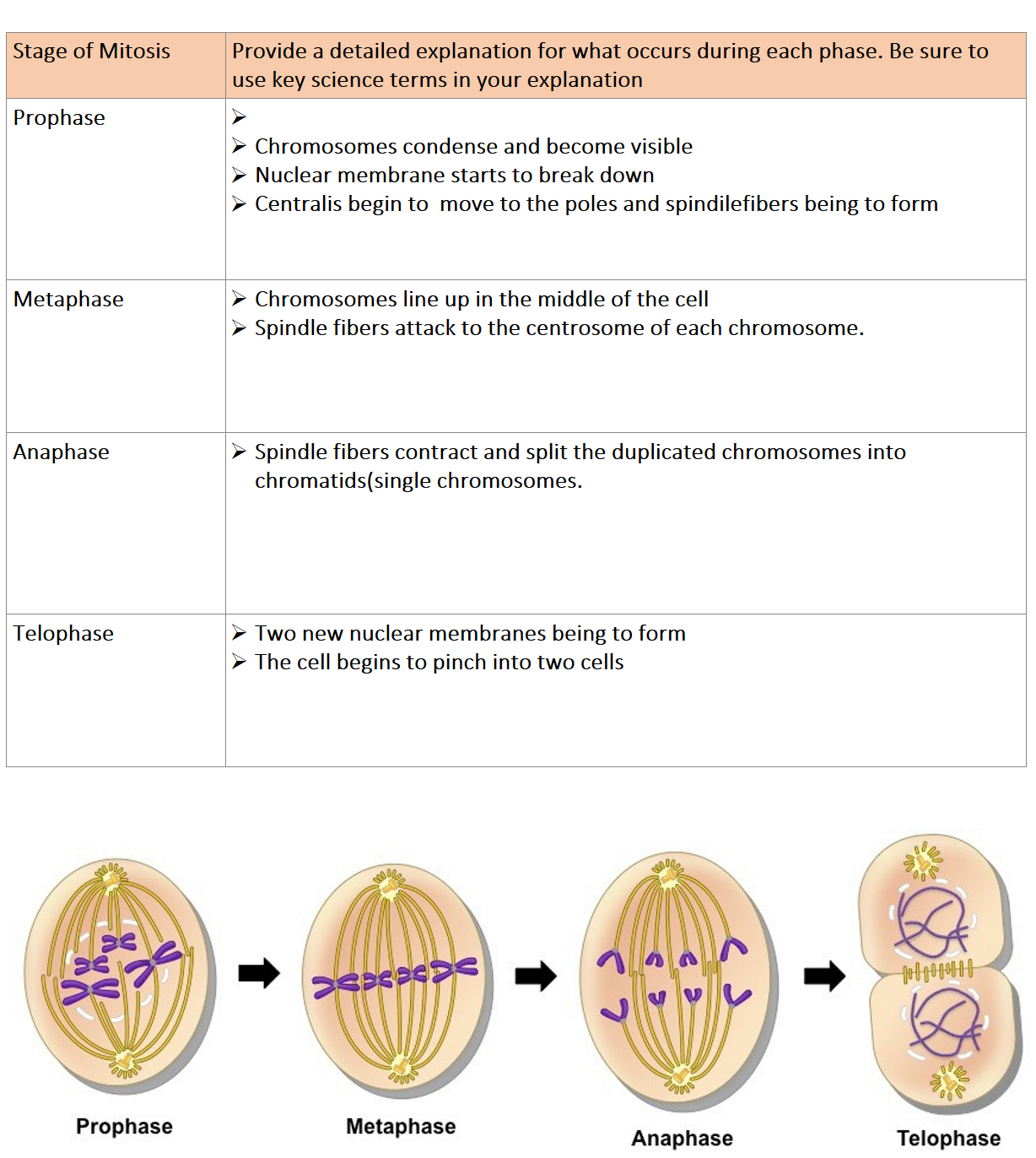
Mitosis is a process of cell duplication, or reproduction, during which one cell gives rise to two genetically identical daughter cells. This is how all animals produce new body cells.
Mitosis ppt
Stage of Mitosis | Provide a detailed explanation for what occurs during each phase. Be sure to use key science terms in your explanation |
Prophase |
|
Metaphase |
|
Anaphase |
|
Telophase |
|
CYTOKINESIS
Cytokinesis refers to the Cell division In animal cells, during cytokinesis the cells form a Cleavage furrow while in plant cells, the cell forms a Cell plate during cell division.

Part A - Multiple Choice
Which of the following correctly describes the purpose of mitosis?
a) To produce sex cells for reproduction
b) To repair and replace damaged cells
c) To increase genetic variation
d) To reduce the chromosome number by half
During which phase of mitosis do chromosomes line up along the middle of the cell?
a) Prophase
b) Metaphase
c) Anaphase
d) Telophase
In anaphase, the sister chromatids:
a) Pair up
b) Line up at the equator of the cell
c) Separate and move toward opposite poles
d) Disappear completely
Which structure holds sister chromatids together until they separate?
a) Centromere
b) Spindle fiber
c) Nucleus
d) Centrosome
What happens to the nuclear membrane during prophase?
a) It becomes thicker
b) It dissolves/breaks down
c) It doubles in size
d) It remains unchanged
Part B - True/False
DNA is copied during interphase, before mitosis begins.
True
Telophase is the phase when sister chromatids are pulled apart.
False
Anaphase
Cytokinesis is the division of the cell’s cytoplasm, which usually happens after mitosis.
Yes
Mitosis produces two genetically identical daughter cells.
Yes
During metaphase, chromosomes are found at opposite ends of the cell.
False
Part C - Fill in the Blank
The stage of the cell cycle when the cell grows and copies its DNA is called Interphase
The phase of mitosis where the nuclear membrane reforms around chromosomes is Telophase
The structure that attaches to chromosomes and helps pull them apart during mitosis is called the spindle fibers
The process of dividing the cytoplasm into two daughter cells is called cytokensis
During prophase, chromosomes condence
Light
Light is the only form of energy that can travel like a wave through empty space and through some matireals
Light behaves like a special kind of wave called an electromagnetic wave.
Electronmagnetic waves are very similar to war waves both types of waves invove the movment of energy from onep oint to another.
The distance form the crest or trough of a wave to the next cresti s know as wavelength . Electromagnetic waves are invisible, and unlike water do not require trravel but they involve electric and magnetic fields


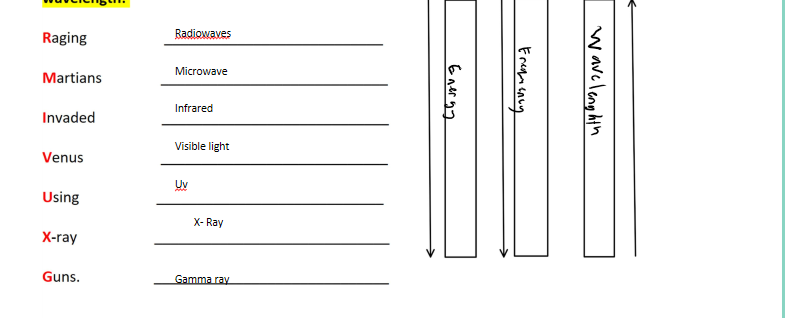
White light is made up of seven different colors, including violet, indigo, blue, green, yellow, orange, and red. The color sequence is remembered as VIBGYOR (shortest wavelength to highest wavelength) or ROYGBIV (lowest energy/frequency to highest energy/frequency). The spectrum is a grouping of seven colors.
Light can be described as monochromatic or polychromatic
Monochromatic light is defined as light with only one color or wavelength, such as sodium light.
Polychromatic light is defined as light with more than two colors or wavelengths, such as white light.
The Electromagnetic Spectrum
The electromagnetic spectrum is a diagram that illustrates the range, or spectrum of electromagnetic waves, in order of wavelength or frequency.

How is Light Formed?
When an electron absorbs light energy, it moves faster. The absorbance of one photon causes an electron to jump to a shell farther from the atomic nucleus. While having higher kinetic energy, excited electrons are unstable. Thus, they have potential energy, which is released as the electron returns to the ground state, releasing light.
The energy of the emitted light corresponds to a specific wavelength, which determines its color. Since each element has a distinct electron configuration, the energy levels and the corresponding wavelengths of light emitted will vary, resulting in different colors of light.

1. Light from the Sun
§ Fusion reactions in the Sun's core release energy in the form of light
2. Light from Incandescence
§ Light emitted from a material due to the high temperature of the material
□ e.g. candle, incandescent lamp
3. Light from Electric Discharge
§ Light emitted from a material when electricity is passed through certain gases
□ e. g. Neon lamp, fluorescent bulb
4. Light from Luminescence
§ Light emitted from a material that has not been heated.
□ e.g. glow sticks, LED bulbs