Methods in context
Research methods in the context of education
👥 1. Characteristics of the group (Craig Gelling emphasis)
Pupils
Vulnerable group → safeguarding, consent, parental permission.
Power imbalance → may give socially desirable answers to please teachers/researchers.
Speech codes (Bernstein) → structured interviews/questionnaires may disadvantage WC pupils.
Peer pressure → affects validity in group settings.
Teachers
Professional identity → impression management, may hide bad practice.
Suspicious of outsiders → access issues.
High cultural capital → more articulate in interviews.
Workload/timetable → practical constraints.
Parents
Harder to access, especially WC parents.
May feel judged → low validity.
🏫 2. School as a research setting
Gatekeepers: headteachers control access.
Timetables restrict observations/interviews.
School policies (behaviour, safeguarding) limit what can be studied.
Hawthorne effect: pupils/teachers change behaviour when observed.
Subcultures: anti‑school groups may avoid researchers.
🔧 3. Practical issues (Craig’s key points)
Access: hardest part; schools protect reputation.
Time: interviews/observations must fit timetable.
Sample: schools are small → low representativeness.
Researcher identity: age, gender, ethnicity affect rapport with pupils.
⚖ 4. Ethical issues
Consent: pupils need parental consent.
Protection from harm: avoid sensitive topics (bullying, racism).
Confidentiality: schools fear negative publicity.
Power imbalance: avoid coercion.
📊 5. Theoretical issues
Validity: unstructured interviews & observations = high validity for studying meanings (labelling, pupil identity).
Reliability: structured interviews & questionnaires = more reliable but less valid.
Representativeness: schools are unique → low generalisability.
Bias: researcher values influence interpretation.
🧪 6. How each method performs in MIC
Unstructured interviews
Strengths:
Build rapport with pupils → richer data.
Good for sensitive topics (labelling, racism).
Limits:
Time‑consuming.
Pupils may go off‑task.
Hard to access parents.
Structured interviews
Strengths:
Quic k, reliable, easy to compare.
Teachers respond well due to professionalism.
Limits:
Pupils struggle with fixed questions.
Low validity for complex meanings.
Questionnaires
Strengths: cheap, quick, anonymous → good for sensitive topics.
Limits: pupils may not understand questions; low response rates from parents.
Observations
Strengths:
Great for studying labelling, classroom interaction, subcultures.
High validity.
Limits:
Hawthorne effect.
Hard to observe sensitive issues (racism, bullying).
Covert observation often unethical in schools.
Secondary data
School records = reliable, large scale.
But may be incomplete or manipulated for league tables.
Overall, MIC is decent because it forces you to actually think about how a method works in a real school, not just in theory. But the problem is that it can feel a bit repetitive — every method basically comes down to the same issues: access, safeguarding, timetables, and people acting differently because they’re being watched. It’s useful for showing you understand the context, but sometimes it feels like the mark scheme just wants you to say the obvious. Still, if you know how pupils, teachers, and schools behave, you can twist almost any method into a solid answer.
6 marker in mic answer 20 marker 30 mins
P+ P- E+ E- T+ T-
P+ Higher response rate because it is easier to build rapport.
P- Unstructured interviews are very time consuming as you have to build trust and bond alongside this the answers have be made up with thought.
E+ Unstructured interviews give the pupil way more control than structured interviews.
E- It may put the anonymity at jeopardy.
T+ Provides validity, as the answers rich in detail, providing a more true, meaningful image.
T-Not easily replicatable as the answers are not standardised and cannot be consistently replicated.
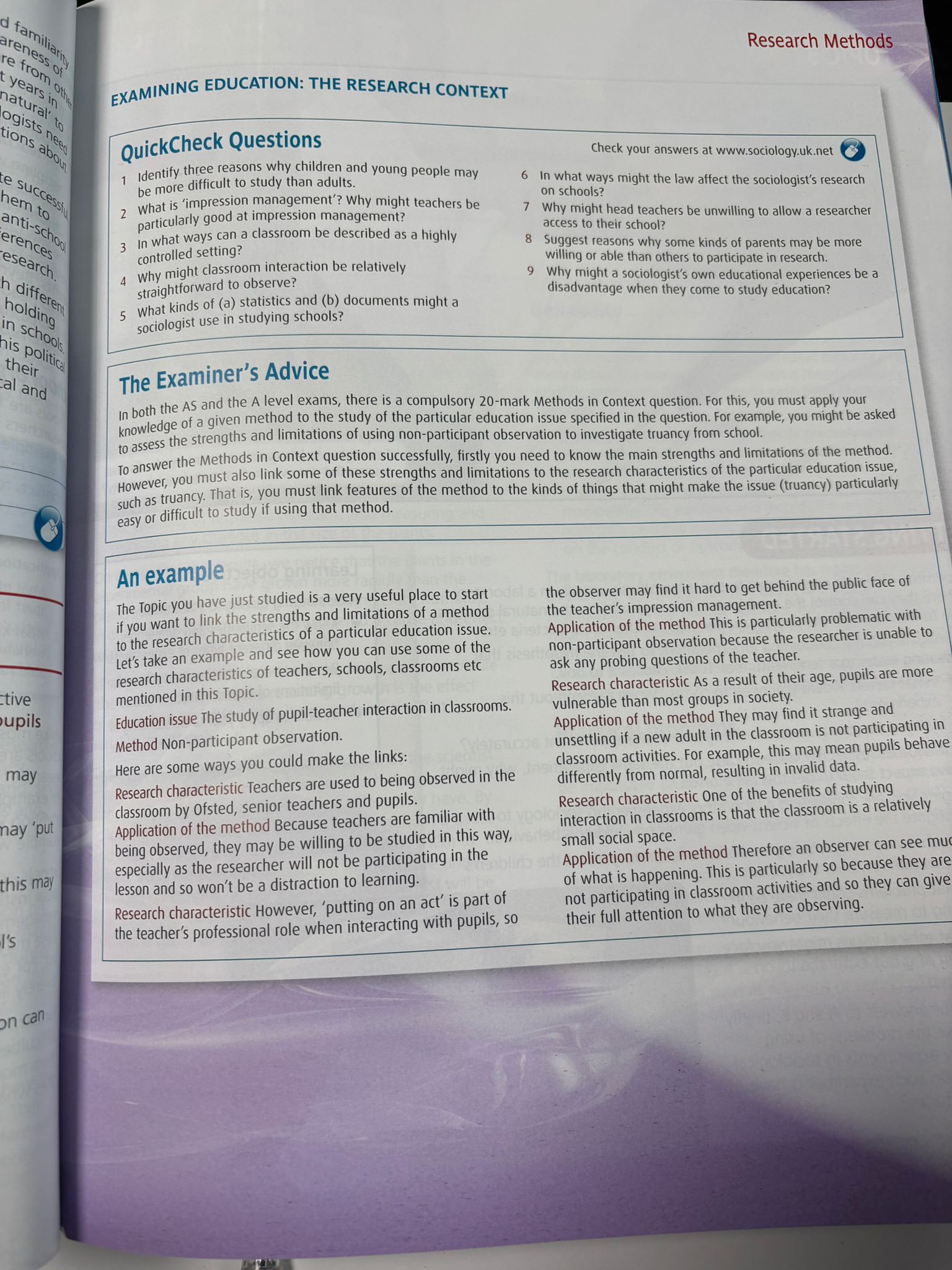
1. Three reasons children may find it harder to study than adults
Children are harder to study because they have less power and status, meaning they must follow school rules which restricts natural behaviour. They are also more easily influenced, so they may change their behaviour due to the Hawthorne effect when being researched. In addition, children have lower levels of understanding and concentration, especially younger pupils, which can reduce the validity of methods like questionnaires or interviews.
2. Impression management & why teachers are good at it
Impression management refers to individuals controlling how others perceive them. Teachers are particularly skilled at this because they are regularly observed by Ofsted and senior staff, so they are used to presenting themselves in a professional way. This can be a limitation for research as teachers may act differently when being studied, reducing the validity of observational methods.
3. Why classrooms are a highly controlled setting
Classrooms are highly controlled because teachers hold authority over pupils, creating a clear power hierarchy. Schools also have strict rules, timetables, and behaviour policies, which regulate pupil behaviour. This makes the classroom a structured environment, which can make it easier for researchers to observe but may limit how natural behaviour is.
4. Why classroom interaction is relatively straightforward to observe
Classroom interaction is easy to observe because it takes place in a small, enclosed space where both teachers and pupils are visible. There are also clear roles (teacher vs pupil), making interactions easier to identify. This benefits methods like non-participant observation as researchers can clearly see patterns of behaviour without participating.
5. Types of statistics and documents used
Sociologists may use official statistics such as exam results, attendance records, and exclusion rates, which are easily accessible and allow comparisons between schools. They may also use documents such as school policies, Ofsted reports, and pupil records. However, these may be influenced by impression management, as schools may present themselves positively to protect their reputation.
6. How the law may affect research in schools
The law affects research because pupils are minors and considered vulnerable, so researchers must gain parental consent and follow safeguarding rules. There are also confidentiality and child protection laws, which can limit what data can be collected. This may restrict access and make research more difficult.
7. Why headteachers may refuse access
Headteachers act as gatekeepers and may refuse access because they are concerned about disruption to learning. They may also worry that negative findings could damage the school’s reputation, especially due to league tables and Ofsted inspections. Safeguarding concerns about protecting pupils may also lead to refusal.
8. Why some parents are more willing to participate
Middle-class parents may be more willing to participate because they value education and research more and may have more time. In contrast, working-class parents may be less likely due to time constraints (work commitments) or language barriers, which can affect the representativeness of the sample.
9. Why a sociologist’s own education may be a disadvantage
A sociologist’s own educational experience may lead to bias, as they may interpret behaviour based on personal experiences. This can reduce objectivity and validity. They may also take certain aspects of school life for granted, meaning they overlook important behaviours or interactions.