Drugs/Consciousness Quiz - PSYCH 1
4.1 What is Consciousness?
Consciousness - describes our awareness of internal and external stimuli
Internal Stimuli | External Stimuli |
senses from inside body | senses from outside body |
feeling pain, hunger, thirst, sleepiness aware of thoughts/emotions | seeing the light from the sun feeling the warmth of a room hearing the voice of a friend |
Sleep - low levels of physical activities & reduced sensory awareness
Wakefulness - high levels of sensory awareness, thought, and behavior
Biological rhythms - internal rhythms of biological activity
circadian rhythm - biological rhythm, takes place over a period of about 24 hours
chronotype - individual differences in circadian rhythms (i.e night owl and early birds)
Sleep regulation - brain’s control of switching between sleep & wakefulness + coordinating this cycle with the outside world
Rotating shift work - work schedule that changes from early to late on a daily or weekly basis…resulting in sleep disorders b/c regular circadian rhythm cannot be maintained
Sleep debt - not getting sufficient sleep on a chronic basis.
4.2 Sleep & Why we Sleep
Sleep rebound - people who are sleep deprived fall asleep quicker than those who aren’t
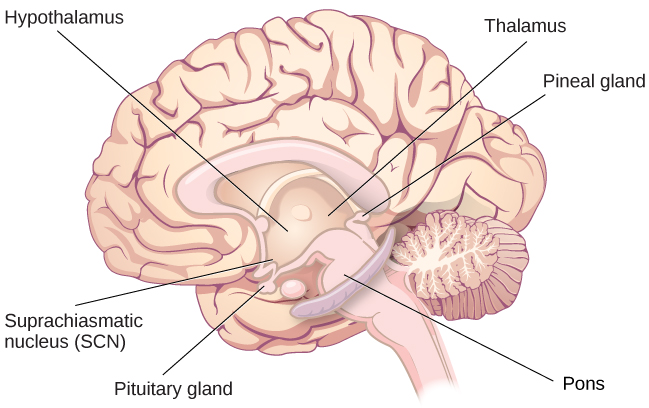
Areas of the Brain involved w/ sleep
Hypothalamus - contains suprachiasmatic nucleus (SCN) - Our internal clock
Thalamus - regulates slow-wave sleep
pons - important for regulating REM
pineal gland - releases melatonin
Five Reasons We Sleep
Evolutionary - early humans survived by sleeping when dark & waking during light
Recuperation - sleep restores our immune system, neurons help repair themselves
Build memories - strengthens neural connections. reactivates recent experiences (hippocampus) and transfers them to permanent memory
Creativity - “Sleep on it” can actually see connections, unconscious mind continues to work on things
Growth and STRENGTH - during REM growth hormones are released + helps w/ muscle memory
4.3 Stages of Sleep
stage 1 sleep - first stage of sleep; transitional phase that occurs between wakefulness and sleep; the period during which a person drifts off to sleep
stage 2 sleep - second stage of sleep; the body goes into deep relaxation; characterized by the appearance of sleep spindles
stage 3 sleep - third stage of sleep; deep sleep characterized by low frequency, high amplitude delta waves
Alpha waves - awake
NREM1 - hypagogic sensations, heart rate decreases, breathing decreases, easily awaken
NREM2 - (about 20 mins) sleep spindles, asleep, rapid bursts of brain activity, easily awaken
sleep spindle - rapid burst of high frequency brain waves during stage 2 sleep that may be important for learning and memory
NREM3 - delta waves, slow wave sleep, “deep sleep” bed wetting, disorientation. pituitary gland releases human growth (+ muscle development) & muscle memory
REM - rapid eye movement. paradoxical asleep b/c the brain waves mirror awake brain waves & eyes seem awake (like NREM1). Increased heart rate & breathing rapid and irregular
4.4 Sleep Problems & Disorders
parasomnia - one of a group of sleep disorders characterized by unwanted, disruptive motor activity and/or experiences during sleep
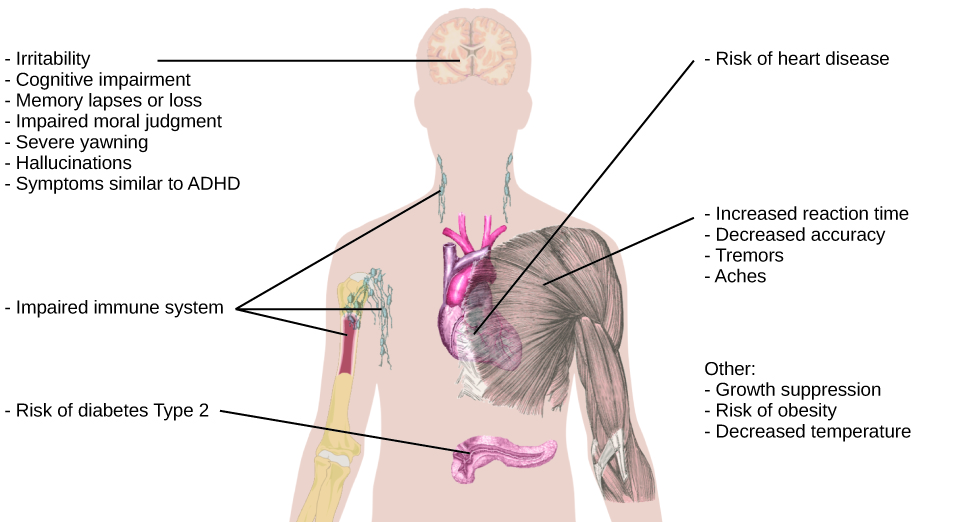
Sleep Deprivation - more conflict in relationships, easier to become sick. depression, less production + accuracy + cognition. slows response times. Increased weight (b/c feeling hungry, snack instead of sleep, less full feeling, slower metabolism).
Insomnia - can’t sleep most nights (“quick fixes” sleeping pills and alcohol reduces REM & create tolerance)
Sleep Apnea - stop breathing during sleep & snort air / snoring. stops slow wave sleep. associated with obesity & men. High blood pressure (leading to heart attack/stroke) the person afflicted does not remember it & is tired.
REM sleep behavior disorder (RBD) - sleep disorder in which the muscle paralysis associated with the REM sleep phase does not occur; sleepers have high levels of physical activity during REM sleep, especially during disturbing dreams
Night Terrors - exclusive to NREM3. doubles heart & breathing rate. may sit up & talk incoherently.
Somnambulsim - sleep walking
4.5 Substance Abuse & Abuse
Drug use disorders - addictive disorders, and the criteria for specific substance (drug) use disorders are described in DSM-5
Physical dependence - involves changes in normal bodily functions
Psychological dependence - has an emotional need for the drug, may use the drug to relieve psychological distress
Tolerance - a person requires more and more drug to achieve effects previously experienced at lower doses
Withdrawal - a variety of negative symptoms experienced when drug use is discontinued
Drug Categories
Depressants - suppresses CNS
Stimulants - excite neural activity; speed up functions (SNS), decreased appetite, increased energy and confidence
Hallucinogens - distort perception, evoke sensory images w/o input
Opiates - sub category of depressants opium derivatives (used as painkillers)
Specific Drugs I need to know
Alcohol - GABA agonist
Barbiturates - GABA agonist
Opiates - (pain killers) endorphine agonist; heroin, morphine, methadone, and codeine
Nicotine - increase epinephrine, norepinephrine and dopamine. exerts its effects through its interaction with acetylcholine receptors.
Cocaine - dopamine, serotonin & norepinephrine
Methamphetamine - triggers 10x dopamine & norepinephrine
Ecstasy (MDMA) - triggers stores serotonin & blocking reuptake →longer effects
LSD - antagonists of the NMDA glutamate receptor (not the same abuse potential as other drugs)
Marijuana - very much based in the expectancy effect so it has hallucinogen, depressant and stimulant properties
Methadone - synthetic opioid that is less euphorigenic than heroin and similar drugs
Codeine - opioid with relatively low potency (for minor pain)
4.6 Etc. States of Consciousness
Hypnosis - state of extreme self-focus and attention in which minimal attention is given to external stimuli
Meditation - the act of focusing on a single target (such as the breath or a repeated sound) to increase awareness of the moment