L6 Mock revision - Paper 2
Psychopathology
Definitions of abnormality
1. What is Statistical deviation?
- Statistical deviation is when a behaviour is numerically or statistically rare. Only a small percentage of the population is exhibiting this behaviour.
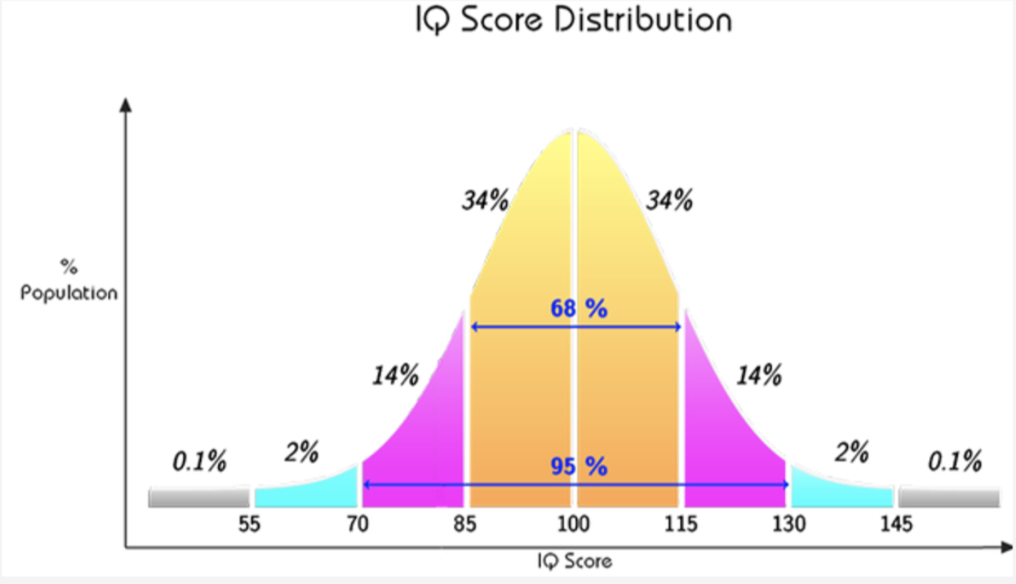
- Using a normal distribution such as the graph, we can identify people who are far from the mean. In the statistical definition, abnormality is annything that is far away from the mean or avergae. In the statistical definition, the ‘mean’ or ‘average’ is what is considered ‘normal’.
What are some Strengths and Weaknesses of Statistical Deviation?
- A strength of defining abnormality as ’Statistical Deviation’ is that there is real world application of it in the diagnosis of intellectual disability disorder. There is therefore a place for statistical deviation in thinking about what normal and abnormal behaviours are.
- A disadvantage of Statistical Deviation is that unusual characteristics can be positive. For example, IQ scores that are above 130 are just as rare as IQ scores that are below 70. However, high intelligence is not something that would be deemed undesirable. Just because very few people exhibit a certain behaviour does not mean that the behaviour requires treatment to bring it back down to normal.
- Another disadvantage is that not everyone will benefit from being labelled as abnormal. For example if someone is living a decent life whilst having a behaviour that is statistically rare, then they do not benefit from being labelled as abnormal regardless of how abnormal the condition or behaviour is. For example, someone who has a very low IQ but who is not distressed or suffering from it and is capable of working, would not need a diagnosis of intellectual disability.
2. What is Deviation from Social Norms?
- Deviation from Social Norms defines abnormality as departing or deviating from what society considers as normal. For example, if you were to witness a man that was walking naked in the street, the man would be considered as abnormal as this breaks societies norms of what normal is.
What are 5 Criteria to examine before judging a behaviour as Deviating From Social Norms?
- The five criteria to examine before judging a behaviour as deviating from social norms are:
- Culture - what may be seen as normal in one culture may be abnormal in another.
- Situation and Context - The situation and context that one is placed in can determine whether a behaviour is normal or deviating from what society deems as normal. For example, going to the toilet is a normal human act, however, going to the toilet in the middle of a supermarket is considered as highly abnormal.
- Age - Certain behaviours can be deemed normal or at least not abnormal for certain age groups, but then would be deemed highly abnormal for other age groups. For example, it would not be deemed highly abnormal if a baby were not be toilet trained, however, if an adult aged 20 was not toilet trained, this would be considered very abnormal.
- Gender - Certain behaviours are deemed more or less normal depending on the geneder of the individual carrying out the behaviour.
- Historical context - standards of what behaviours are deemed as normal can change over time in a society.
What is the difference between eccentric behaviour and Deviating from Social Norms?
- Eccentric behaviour may be defined as behaviour that is normal but taken to a higher extent, where as deviating from social norms is displaying behaviour that goes against what society deems as normal.
What are some Advantages and Disadvantages of defining abnormality as ‘Deviating from Social Norms’?
- One advantage of explaining abnormality as deviating from social norms is that it has real life application in the diagnosis of anti-social personality disorder. This therefore shows that there is a place for deviation from social norms in thinking about what is normal and what is abnormal.
- A disadvantage of explaing abnormality through deviation from social norms is that social norms can vary from one generation to another and from one community to another. This would mean that a researcher from one social grouo may label someone from another social group as abnormal based on the standards of the researchers own social group.
- Another disadvantage of explaining abnormality through deviation of social norms is that it can lead to human rights abuses. Too much reliance on deviation from social norms to understand abnormality can also lead to systematic abuse of human rights. For example, things such as racism and the suffragettes show that these diagnosises were really there just to maintain control over minority ethnic groups and women, and so deviating from these social norms, in reality, was not abnormal, but necessary.
3. What is Failure to Function Adequately?
- Failure to Function adequately was put forward by Rosenhan and Seligman (1989) in which there were seven criteria for failing to function adequately. The seven criteria for failure to function adequately are:
- Suffering - patient may be suffering from their condition or may inflict suffering on others
- Maladaptiveness - the behaviour prevents the person from reaching their desired goals
- Irrational - The behaviour seems to defy logical sense
- Observer discomfort - the bheaviour makes those around them feel uncomfortable
- Vividness - others find the beaviour to be odd
- Violation of moral codes - The behaviour is not in accordance of societies norms
- Unpredictability - the behaviour is unexpected or predictable
What are some Strengths and Weaknesses of Failure to Function adequately?
- An advantage of failure to function adequately is that it attempts to include the experience of the individual. Failure to function adequately may not be a satisfactory approach because it can be difficult to assess vividness, but at least this definition acknowledges that teh experience of the patient is important
- A disadvantage of Failure to Function Adequately is that it may just be deviation from socialn norms. If behaviours such as people living alternate lifestyles are treated as failures of adequate functioning, then there is a risk of limiting personal freedom and discriminating against certain groups. In practice, it can be hard to say when someone is failing to function adequately and when tehy are just deviating from social norms. For example, it may be thought that someone not having a job may be a sign of failure to function. However, this person may choose to not work because they are able to make that decision. This is a disadvantage of failure to function adequately as there are blurred lines between what behaviours specifically show a failure of adequate functioning, and what behaviours are simply deviating from social norms.
What is Deviation from Ideal Mental Health?
- \
- Jahoda (1958) proposed that there should be a list of behaviours that are considered normal, and so any deviation from what this list classes and normal, is therefore abnormal.
- The 8 criteria in deviating from Ideal Mental Health are:
- We have no symptoms of any disorders
- We are rational and can perceive ourselves accurately
- We self actualise and reach our full potential
- We can cope with stress
- We have a realist view of the world
- We have good self esteem and lack guilt
- We are independent of other people
- We can successfully work, love and enjoy our leisure.
What are some Strengths and Weakness of deviation from Ideal Mental Health?
- One advantage of deviation from ideal mental health is that it is bery comprehensive. Deviation from Ideal Mental Health covers a broad range of criteria for mental health. The range of factors discussed in relation to Jahoda’s ideal mental health makes it a good tool for thinking about mental health.
- A disadvantage of Jahoda’s Deviation from Ideal Mental Health is that it sets an unrealistically high standard for mental health. Very few people can attain Jahoda’s criteria for mental health, and many people will never be able to achieve all of them at the same time, therefore, by this criteria, a large number of people will be abnormal in this context.
What are the Behavioural explanations to Phobias?
- The behavioural approach of how phobias are acquired is by Classical conditioning which was put forward by Watson and Rayner (1920)
- Classical Conditioning explains how phobias are acquired as in classical conditioning, the phobic stimulus initially begins as the neutral stimulus and when presented to the individual, it will produce the neutral response (which is nothing). The unconditioned stimulus (which could be a loud noise) would produce the unconditioned response (which is fear) when presented to the individual. When the neutral stimulus and the unconditioned stimulus are then paired together and presented to the individual together, they will produce the unconditioned response (fear). The neutral stimulus and the unconditioned stimulus are then paired together and presented to the individual on multiple occasions. So after this when the neutral stimulus is presented to the individual without the conditioned stimulus, the individual will produce the unconditioned response of fear. The unconditioned response has now become the conditioned response and the neutral stimulus has now become the conditioned stimulus. The individual has now acquired a phobia. This phobia may generalise to other things.
- The behavioural approach then state that through Operant Conditioning, phobias are maintained. As when the phobic stimulus is presented to the individual, the individual will then avoid the phobic stimulus and this is positive reinforcement which reinforces the phobia as when the individual avoids the phobic stimulus, they feel a sense of relief which is more pleasurable than the feeling of anxiety when in the presence of the phobic stimulus. By avoiding the phobic stimulus, there is also negative reinforcement as removing the phobic stimulus from the individuals presence avoids and removes the negative emotions of panic and fear.
What are the advantages and disadvantages of the behavioural approach of explaining phobias?
- An advantage of the Behavioural Approach of explaining phobias is that it has good explanatory power as it was a step forward from Watson and Rayners classical conditioning and explained how phobias are maintained over time which then has important implications on therapies as it explains why patients need to be exposed to the phobic stimulus.
- A disadvantage of the behavioural approach to explaining phobias is that there may be an alternative explanation to avoidance behaviour. Not all behaviour that is associated with phobias seems to be the result of anxiety reduction, at least not in more complex phobias like agoraphobia. There is evidence to suggest that at least some avoidance behaviour appears to be motivated by positive feelings of safety. This means that avoidance behaviour is less to do with actually avoiding the phobic stimulus, but instead to remain with the feeling of safety.
What is the First Behavioural approach to treating phobias?
- One behavioural approach to treating phobais is Systematic Desensitisation. Systematic Desensitisation is based on the theory of ‘Reciprocal Inhibition’ which is the theory that it is impossible to be both relaxed and afraid at the same time, as one emotion blocks out the other.
- The process of Systematic Desensitisation involves:
- \
- The creation of a Anxiety Hierarchy that is formed with the patient and therapist, with the most frightening stimulus at the bottom and the least frightening at the top. For example
- \
- Think about spiders (spiders is the phobic stimulus in this case)
- \
- See a picture of a spider
- \
- Be in the same room as a spider in a glass tank
- \
- Sit next to a spider that is in a glass tank with the lid closed
- \
- Sit next to a spider that is in a glass tank with the lid open
- \
- Put hand in the tank that the spider is in
- \
- Hold the spider in hands
- \
- Relaxation training - As part of the process of Systematic Desensitisation, the therapist teaches the patient to relax as deeply as possible. This might involve breathing exercises or, alternatively, the patient might learn mental imagery techniques where the patient can be taught to imagine themselves in relaxing situations. Drugs such as valium can also be used to make the patient relax.
- \
- Exposure to phobic stimulus - the final part of the Systematic Desensitisation process is that the patient is exposed to the phobic stimulus whilst in a relaxed state. This will take place across several sessions, using the Anxiety Hierarchy and starting at the top of the hierarchy and woking towards the highest anxiety enducing situation. Treatment is successful when the patient can stay relaxed in situations high on the anxiety hierarchy.
What are some advantages and disadvantages of using Systematic Desensitisation to treat phobias?
- An advantage of Systematic Desensitisation is that it is very effective. Research done by Gilroy followed up 42 patients who had been treated for arachnophobia (fear of spiders) in 3 fourty five minute sessions of SD. Spider phobia was assessed by the individuals response to spiders and answering a spider questionnaire. A control group was treated by relaxation without the exposure to the phobic stimulus. At both 3 months and 33 monnths after the treatment, the SD group were much less scared of spiders than the control group.
- Another advantage of SD is that it is suitable for a range of patients. Alternatives to SD such as flooding are not well suited for some patients, for example, patients with learning disability may find it hard to understand what is happening during flooding. For these patients, SD is probably the most appropriate treatment.
What is the Second Behavioural Approach to treating phobias?
- A second behavioural approach to treating phobias is Flooding. Flooding is the process of immediate exposure to the phobic stimulus in an attempt to cure and get rid of the phobia. Flooding is done in one long session where the participant has given their fully informed consent to be immediately exposed to their phobic stimulus. The aim and desired outcome of Flooding is extinction of the phobia, where the participants phobia has gone entirely. However, although full informed consent has been given, there are still some ethical issues as the process is quite stressful for participants, and may even result in the participant becoming traumatised. The participant is encouraged to use relaxation techniques if they feel their anxiety level is too high.
What are some Advantages and Disadvantages of Flooding to Treat Phobias?
- An advantage of Flooding to treat phobias is that it is cost effective. Flooding is at least effective as other treatments for specific phobias. Studies comparing flooding to cognitive therapies have found that Flooding is highly effective and quicker than other methods such as SD.
- A dusadvantage of Flooding is that it is highly traumatic for some patients. The problem with flooding is that although participants give their consent, they are often unwilling to see it through till the end. This is a limitation as time and money is wasted in preparing patients for it, only for them to not finish it.
What are the Cognitive Explanations of Depression?
- The first cognitive explanation of depression is Beck’s cognitive theory of depression which had three parts to explain why some people were kmore vulnerable to depression than others. The firdt part of Beck’s Cognitive Theory of Depression is ‘Faulty Information Processing’.Faulty Information Processing is a type of thinking that can lead individuals to pay more attention to the negative aspects of a situation and ignore the positive aspects. For example, if a depressed individual had won £1 million, they would focus more on the fact that last week someone had won £10 million instead of focusing on what they could do with the £1 million that they already have. Faulty Information Processing also leads individuals to think in ‘black and white terms’ and that everything is either all good or all bad. The second part of Beck’s cognitive theory is ’Negative Schema’s’. A schema is a package of information that acts as a mental framework for the interpretation of sensory information. A self schema is a package of the information that we have about ourselves. Schemas are what we use to interpret ourselves ad the world, so if this schem is negative, then all the information that we have of ourselves will be viewed negatively also. Negative Schemas can then cause people to think negative things about themselves. The third part of Beck’s Cognitive Theory of Depression is the ’Negative Triad’. The Negative Triad is the idea that people with depression are trapped in a cycle of negative thoughts that first begin with a negative view of self, then a negative view of the world, and then a negative view of the future.
What are some Advantages and Disadvantages of of Beck’s Cognitive Theory of Depression?
An advantage of Beck’s cognitive theory of depression is that there is practical application for it in CBT. All aspects of depression can be identified and challenged in CBT and includes the components of the negative triad. This is an advantage of Becks theory because it translates well into a successful therapy.
A disadvantage of Beck’s Cognitive Theory of Depression is that it does not explain the more complex symptoms of depression such as hallucinations, deep anger and bizzare beliefs. Beck’s theory fails to explain those things.
The second cognitive explanation of Depression is Ellis’ ABC model. Ellis argued that there are common irrational beliefs that underline much of depression and that sufferers of depression base their lives off of those irrational beliefs. A in the model stands for ‘Activating Event’ which refers to the event that starts of the individuals depression. The activating event is usually an event or an experience that was negative. ‘B’ in the model stands for ‘Beliefs’ which means that once the activating event has happened, this leads to the individual having irrational beliefs which were caused by the Activating Event. ‘C’ in the model stands for ‘Consequences’ of the irration beliefs. The consequences can usually be emotional and behavioural which is what leads to the depression.
What are some Advantages and Disadvantages of Ellis’ ABC model?
- A disadvantage of Ellis’ ABC model is that it is only a partial explanation for depression as there are many cases where depression has been caused by biologcal and hormonal issues in the brain which means that Ellis’ model only applies to depression that has been caused by an specific event.
- Another disadvantage of Ellis’ ABC model is that the model also does not explain the more complex symptoms of depression such as hallucinations, bizzare beliefs and deepn anger.
What is the Cognitive Approach to Treating Depression?
The Cognitive Approach to treating depression is CBT (Cognitive Behavioural Therapy) which follows on from Beck’s explaantion of depression.
In order to treat depression, the root cause of the depression needs to be discovered, and this may lie in the way that people think about themselves and the world.
CBT aims to change the way a client thinks by challenging irrational and maladaptive thought processes and this will lead to a change in behaviour as a result of new thinking patterns.
Most CBT therapists draw on Ellis’ and Beck’s models of depression. CBT focuses on challenging the negative thoughts about ones self, the workd and the future (Negative Triad). These thoughts can be directly challenged and the client is encouraged to test the reality of their negative beliefs.
Clients, after a session of CBT, may be given homework tasks such as record when they last enjoyed an event or when people were nice to them. This is sometimes referref to as the ‘patient as a scientist’., as the patient is investigating their beliefs in the way a scientist would.
In Ellis’ REBT therapy, there is an added ‘D’ and ‘E’ to the ABC model. The ‘D’ stands for disputing and the ‘E’ stands for Effective New Beliefs that replace the old irrational ones.
Beck had put forward three different types of disputing:
- Empirical disputing - which is disputing whether there is actual evidence to support the negative belief.
- Logical Disputing - Involves disputing whether the negative thoughts logically follows from the facts of their situation
- Pragmatic disputing - involves disputing how the negative thought is going to helo the person.
What are the Advantages and Disadvantages of Cognitive Therapies to treat Depression?
- An advantage of Beck’s CBT is that it is effective. March comapred the effects of CBT with antidepressant drugs and a combination of the two in 327 adolescents with a main diagnosis of depression. After 36 weeks, 81% of the CBT group, 81% of the antidepressent group and 86% of the CBT plus antidepressant group were significantly improved. This therefore shows that CBT is just as effective as medication, and works better alongside medication.
- A disadvantage of CBT is that it may not work for the most severe cases of depression. In some cases, depression can be so severe that patients cannot motivate themselves to engage with the hard cognitive work of CBT. They may not even be able tp pay attention to what is happening in the session. Where this is the case, it is possible to treat the patient with antidepressan medication and commence CBT whe they are more alert and motivated. This is a disadvantage as it shows that CBT can not be used as the sole treatment for all cases of depression.
- A disadvantage of Ellis’ REBT therapy is that because it flows from Ellis’ ABC model of depression, it means that the REBT therapy is unlikely to cure the more complex symptoms of depression such as, deep anger, bizzare beliefs and hallucinations
- Another disadvantage is that because the REBT therapy flows from the ABC model of depression, REBT therpay also will not be able to treat depression that has been caused by biological and hormonal imbalances in the brain, meaning that REBT can not be used for all cases of depression.
Approaches
Behaviourist Approach
What is the Key Assumption of the Behaviourist Approach?
- The Key Assumption of the Behaviourist Approach is that the mind is a ‘black box’ and that we cannot scientifically investigate internal mental processes. Instead the focus should beon what we can see, observe and measure.
What is the Process of Classical Conditioning?
- The process of classical conditioning is that there is first the neutral stimulus, and the unconditioned stimulus. The unconditioned stimulus is first presented to an individual which will produce the unconditioned response from the individual. The neutral stimulus is then presented to the individual in which the neutral stimulus produces the neutral response,which is nothing. The neutral and unconditioned stimulus are then paired together on multiple occassions. Then the neutral stimulus is then presented to the individual and now the neutral stimulus will produce the unconditioned response from the individual. The neutral stimulus is now the conditioned stimulus and the unconditioned response is now the conditioned response. The individual has now been conditioned.
What is the Process of Operant conditioning?
- Operant conditioning involves positive reinforcement where something is given after and action has been done. For example, this can be praise from a teacher for answering a question correctly. Also involves negative reinforcement where something is taken away as a result of an action being done. This could be your phone being taken away as a result of using it in class.
- Operant conditioning may also involve punishment. Positive punishment is when an action has been done, positive punishment would be to give something negative or unpleasant. Negative punishment is when an action has been done, negative punishment would be to take something pleasant away.
What are the Advantages and Disadvantages of the Behaviourist Approach?
- One advantage of the Behavioural Approach is that there is real-life application to it as when applied to real life situations, things such as classical conditioning can help people with conditions such as phobias or other mental health issues that can be resolved through psychology.
- Another advantage of the Behaviourist Approach is that it is scientifically credible. The behaviourist Approach is scientifically credible when used in research as there is high control of the variables meaning that there is less chance of the results being influenced by any thing other than the independent vairable. This therefore means that the results from the experiment must be true.
Social Learning Theory Approach
What is the Key Assumption in the Social Learning Theory Approach?
- The Key assumption of the social learning theiry is that we can learn indirectly by observing ithers in a social setting, we do this by imitating others.
What are the Mediational Processes in the Social Learning Theory?
- Social learning theory is often described as the birdge between traditional learning theory and the cognitive approach because it focuses on how mental (cognitive) factors are involved in learning. These mental factors intervene in the learning process to determine whether a new response is required. there are four mental or mediational processes in learning that have been identified which are:
- \
- Attention - this is the extnet to which we notice certain behaviours
- \
- Retention - this is how well the behaviour is remembered
- \
- Motor reproduction - this is the ability of the observer to perform the behaviour
- \
- Motivation - this is the will to perform the behaviour, which is often dtermined by whether the behaviour was rewarded or punished
What is ‘Vicarious Reinforcement’ in the Social Learning Theory Approach?
- Vicarious Reinforcement in the social learning theory approach is when we see the results of someone else’s actions and learn from it
What is Identification and the importance of role models in the Social Learning Theory Approach?
- Identification and the importance of role models in the Social Learning Theory Approach is that children are more likely to copy the actions of an adult (role model) who is of the same gender as the child (identification).
What are the advantages and disadvantages of the Social Learning Theory Approach?
- An advantage of the social learning theory approach is that it shows the importane of cognitive factors in learning. This is an advantage for the social learning theory as it shows the cognitive factors of watching someone else’s actions and learning from it directly has an affect on behaviour and also shows that learning can be done without having to learin directly from our own actions.
- Another advantage of social learning theory is that it is less deterministic than the behaviourist approach. This is an advantage of social learning theory because it shows how people have free will in the way that they behave and are not merely influenced by our environment=t but that people also exert an influence on their environment through the behaviours that the people have chosen to perform.
Cognitive Approach
What are the Key Assumptions of the Cognitive Approach?
- The Key Assumptions of the Cognitive Approach are that internal processes can, and should be studied scientifically
- The mind is not a black box
- Cognitive psychologists can investigate things such as memory, perception and though which are things that are neglected by behaviourist psychologists
- Since things such as perception and thought cannot be observed directly, inferrences are made about the internal mental processes by examining behaviour.
What is a ’Schema’ in the Cognitive Approach?
- The schema in the cognitive approach are packages of ideas and information that have been developed through experiences. Schemas act as a mental framework for the interpretation of incoming information. For example, you may have a schema for a chair, which is something with legs that you are able to sit on. These packages of information that have been learned through experiences help you to respond to an object appropriately. Babies are born with a simple ‘motor schema’, for innate behaviours such as grasping objectss. As we get older, our schema becomes more complex and developed and more detailed and more sophisticated. Adults have developed mental representations for almost everything. Schemas enable us to processes lots of information quickly and this is useful for all time
What is the Emergence of Cognitive Neuroscience?
- The cognitive neuroscience has been developed with things such as EUG where there are electrodes attached to the persons head which are then connected to a computer and this allows for brainwaves of ther persons brain to be seen by and this helps to analyse the activity going on in the persons brain. Ther emergence of cognitive neuroscience was developed through fMRI scans. fMRI scans are when the brain has been scanned to show the different areas where there is increased blood flow in the brain. This then shows us what different parts of the brain that may be used for different things
What are some Strengths and Weaknesses of the Cognitive Approach?
- One advantage of the Cognitive Approach is thatthere is real life application. Cognitive Psychology has made an impact on the contribution in the field of Artificial Intelligence and the development of robots meaning that this may revolutionise the way that we live in the future.
- One disadvantage of the Cognitive Approach is that there is limited everyday application. This is because cognitive psychologists are only able to infer mental processes from the behaviour that they observe in the lab experiments. As a consequence, the cognitive approach can suffer from being too abstract and theoretical, as these things that are being observed in the lab, may not necessarily be able to be reproduce in real life.
Biological Approach
What is the Key Assumption of the Biological Approach?
- The Key Assumption of the biological approach is that it the biological approach seeks to explain behaviour in terms of genetics, biochemical imbalances and brain anatomy.
What is the use of Twin Studies in the Biological Approach?
- In twin studies, we examine concordance rates, which is the likelihood that if one twin has a disorder, the other twin will also have the same disorder. If only one twin develops the disorder then genses cannot be the sole determining cause and the environment the twins group up the same or group uo different.
- Furthermore, it is useful to compare the concordance rates of identical twins to non-identical twins. Identical twins share 100% of the same genes, where as non-identical twins share 50% of their genes. Non-identical twins actually share the same amount of genes as normal siblings but we use non-identical twins because their environment is more similar as they shared the same womb, are of the same age and are more likely to be treated equally. If both identical twins are more likely to share a disorder than both non-identical twins, we attribute this difference to their genes being more similar.
What is the use of Family Studies in the biological Approach?
- Family studies in the biological approach look at if the prevelance of a disorder is more common in the immediate family of an individual compared to the whole population. However, in family studies, it can be difficult to separate the influence of genes from the influence of the environment. Family members share more similar environments than other members of the whole population do, for example, they may share the same traumatic events which may make them more likely to experience depression.
What is the use of Adoption studies in the Biological approach?
- In adoption studies, we compare identical twins that have been brought up in different homes.
- Here we see if a behaviour or characteristic is present in identical twins whe their environment is different, and if it is, we attribute it to them having the same genes.
What are some Advantages and Disadvantages of the biological approach?
- One disadvantage of the biological approach is that it is reductionist as biologiocal psychologists attempt to reduce behaviour to a physical level and then explain it through neuron’s, neurotransmitters, hormones and brain structure, when there are more factors that affect behaviour
- An advantage of the biological approach is that the scanning techniques such as the fMRI scan to take a deeper look into the brain is useful for investigating the functions of the brain, and so the approach has plenty of real world application.