AP Comparative Gov: Executive & Legislative Systems Analysis
Executive and Legislative Systems in Comparative Politics
Political institutions act as the machinery of government, structuring how power is distributed and exercised. In AP Comparative Government, you must understand not just the definitions of these systems, but specifically how they manifest in the six course countries: the UK, Russia, China, Mexico, Nigeria, and Iran.
Classifying Executive-Legislative Relations
Broadly, democratic (and some authoritarian) regimes organize the relationship between the law-making body (legislature) and the law-enforcing body (executive) in three ways.
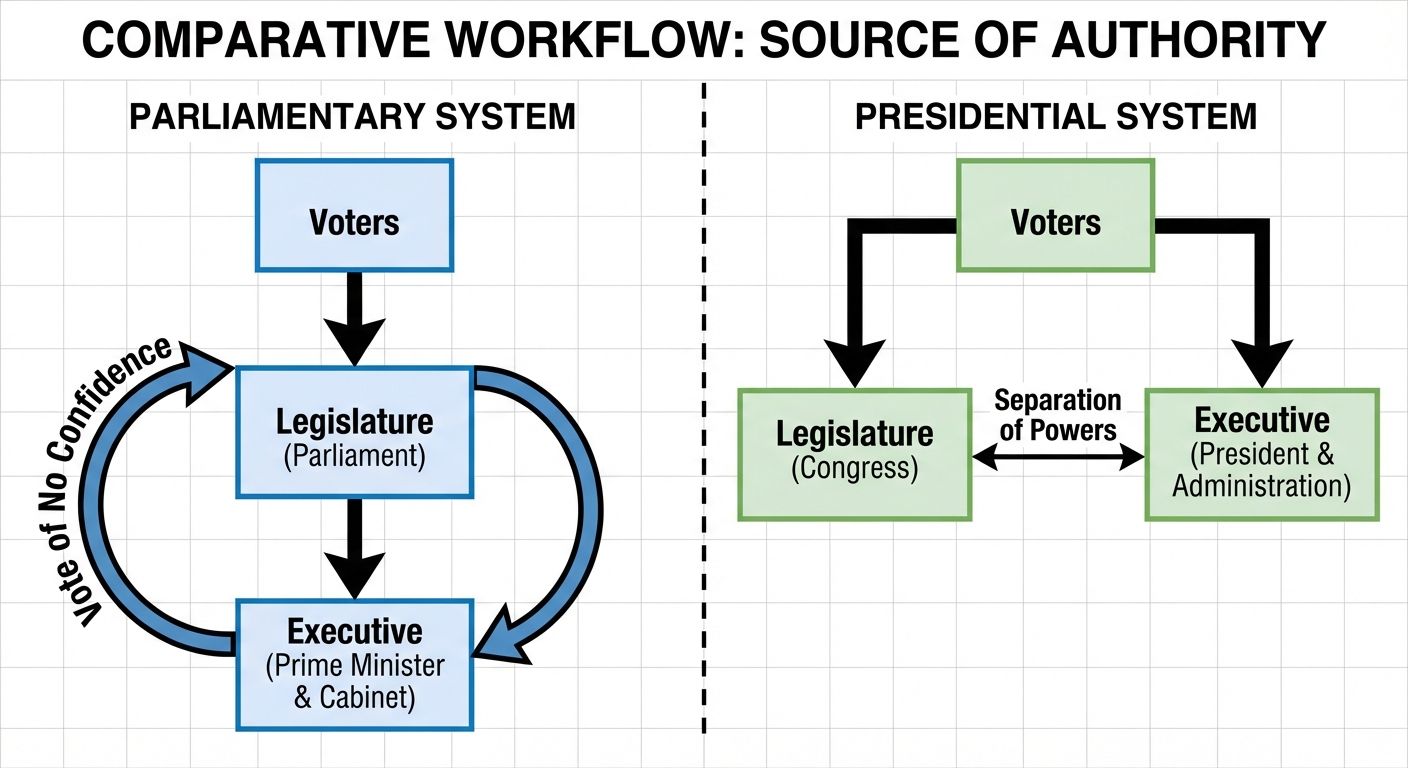
1. Parliamentary Systems
- Definition: A system where the executive branch acts as an agent of the legislature. There is a fusion of power rather than a strict separation.
- Key Features:
- Selection: The Chief Executive (usually the Prime Minister) is not directly elected by the people but emerges from the majority party in the legislature.
- Accountability: The executive is directly responsible to the legislature.
- Removal: The legislature can remove the executive at any time through a Vote of No Confidence.
- Dual Executive: Distinct separate roles for Head of State (Ceremonial) and Head of Government (Policy).
- AP Example: United Kingdom.
2. Presidential Systems
- Definition: A system where the executive and legislative branches are separate, independent, and co-equal.
- Key Features:
- Selection: The President is usually directly elected by the people.
- Separation of Powers: Members of the executive cabinet generally cannot sit in the legislature.
- Fixed Terms: The executive serves for a specific period and cannot be removed merely for political disagreement.
- Removal: Removal requires Impeachment, a legal process for misconduct, not just a loss of political support.
- AP Examples: Mexico, Nigeria.
3. Semi-Presidential Systems
- Definition: A hybrid system that combines a directly elected President with a Prime Minister responsible to the legislature.
- Key Features:
- Dual Executive: Both a President (Head of State) and a Prime Minister (Head of Government) possess significant policy power.
- Power Balance: The President usually handles foreign policy and defense; the PM handles domestic policy and the legislature.
- AP Example: Russia.
Executive Institutions in the AP6 Countries
You must differentiate between the Head of State (symbolic representative of the sovereign people) and the Head of Government (official who runs the day-to-day administration).
The United Kingdom (Parliamentary)
- Head of State: The Monarch (King Charles III). Strictly ceremonial; gives "Royal Assent" to laws but cannot reject them.
- Head of Government: The Prime Minister (PM). Leader of the majority party in the House of Commons.
- Cabinet: Chosen by the PM from MPs. Bound by Collective Responsibility (all cabinet members must support decisions publicly or resign).
Russia (Semi-Presidential)
- Head of State: President (Vladimir Putin). Directly elected. Holds the real power (decrees, controls security ministries, appoints PM).
- Head of Government: Prime Minister. Appointed by the President; approved by the Duma. Can be removed by the President at any time.
- Power Dynamic: While technically semi-presidential, the executive completely dominates the legislature. The President can dissolve the Duma if they reject his PM nominee three times.
China (Authoritarian / Party-State)
In China, state institutions parallel the Communist Party (CCP) institutions, but the Party holds supreme authority.
- Head of State: President of the PRC (Xi Jinping). Historically ceremonial, but powerful now because the officeholder is also the Party leader.
- Head of Government: Premier (Li Qiang). Manages the bureaucracy (State Council) and economic policy.
- The Real Power: The General Secretary (CCP leader) and Chair of the Central Military Commission. Usually, the President is also the General Secretary.
Mexico (Presidential)
- Head of State & Government: The President.
- Term Limit: One single six-year term, known as the Sexenio. No re-election is allowed (designed to prevent dictatorship like the Porfiriato).
- Powers: Initiates legislation, leads foreign policy, creates government agencies. Power has diminished slightly since the end of PRI dominance in 2000, as the legislature is no longer a rubber stamp.
Nigeria (Presidential)
- Head of State & Government: The President.
- Election Rules: Modeled on the US, but with a twist to ensure legitimacy in a divided nation. To win, a candidate must get:
- A majority of the overall vote.
- At least 25% of the vote in 2/3 of the states.
- Zoning: An informal agreement to rotate the presidency between the Muslim North and Christian South every two terms.
Iran (Theocratic Republic)
Iran has a unique dual executive structure blending religious and republican authority.
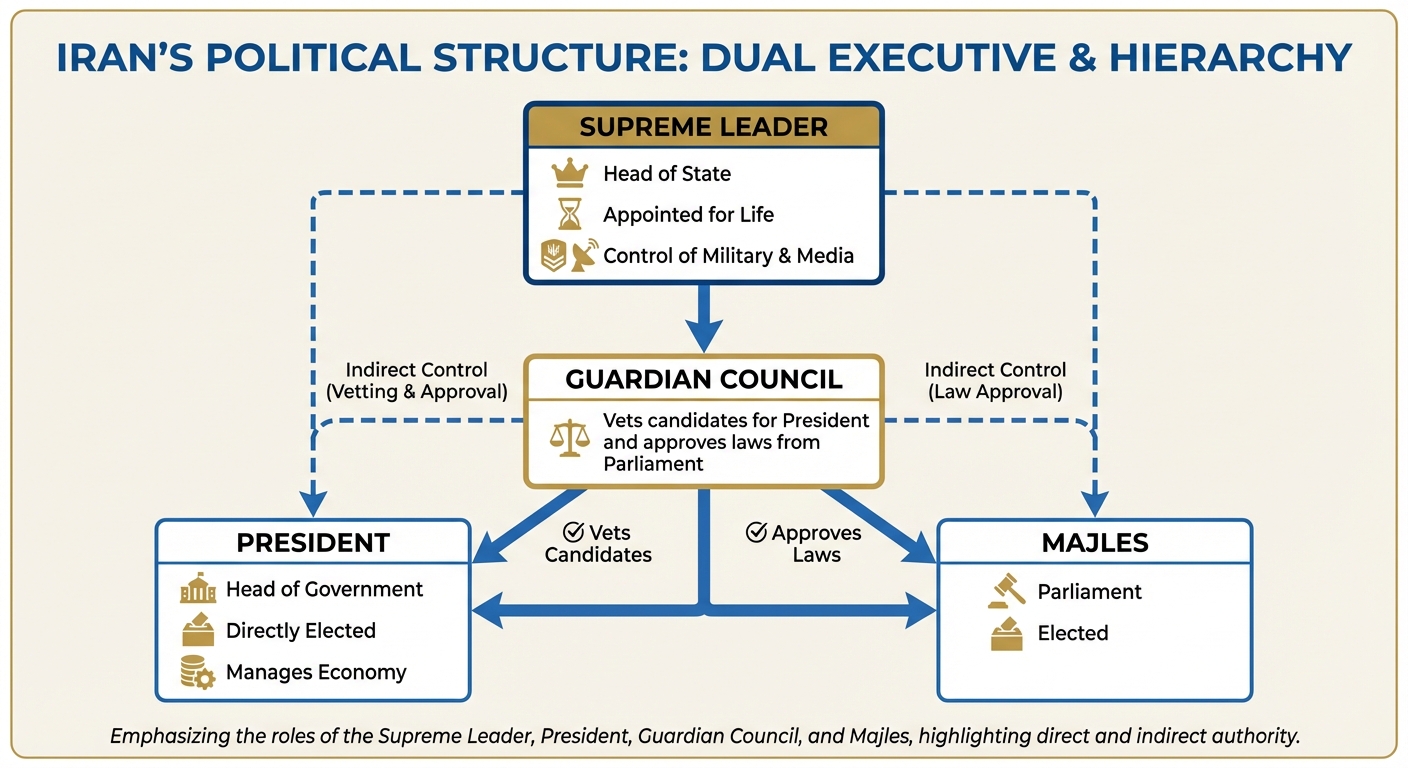
- Head of State (Theocratic): Supreme Leader. Appointed for life by the Assembly of Experts. Commander-in-Chief, appoints judges, controls media, can vet candidates.
- Head of Government (Republican): President. Directly elected (restricted choice). Manages the budget and cabinet but answers to the Supreme Leader.
Legislative Institutions and Representation
Unicameral vs. Bicameral Legislatures
- Bicameral (Two Chambers): Used to check power or represent different constituencies (e.g., federal states vs. population).
- UK: House of Commons (Elected/Powerful) + House of Lords (Appointed/Weak).
- Russia: State Duma (Lower) + Federation Council (Upper).
- Mexico: Chamber of Deputies (Lower) + Senate (Upper).
- Nigeria: House of Representatives (Lower) + Senate (Upper).
- Unicameral (One Chamber): Often found in unitary or authoritarian states to centralize efficiency.
- China: National People's Congress (NPC).
- Iran: The Majles.
Legislature Functions & Constraints
1. Independent Legislatures (UK, Nigeria, Mexico)
- UK: The House of Commons is sovereign. Through Question Time, MPs rigorously question the PM and cabinet.
- Nigeria: The National Assembly has successfully rejected presidential attempts to extend term limits (e.g., Obasanjo in 2006).
- Mexico: Since 2000, the legislature often blocks or forces compromise on Presidential initiatives.
2. Rubber Stamp Legislatures (China, Russia)
- China (NPC): The largest parliament in the world (~3,000 members). Meets once a year for two weeks. It ratifies decisions already made by the CCP's Politburo Standing Committee.
- Russia (Duma): Dominated by the pro-Putin party (United Russia). While it technically passes laws, it rarely opposes the Executive.
3. Restricted Legislatures (Iran)
- The Majles: Elected by the people and has significant debating power over the budget and ministers. However, all legislation must be approved by the Guardian Council to ensure it aligns with Islamic law (Sharia) and the constitution. The Guardian Council also vets all candidates running for the Majles.
Common Mistakes & Pitfalls
Confusing Impeachment with Removal:
- Mistake: "The President was impeached, so they had to leave office."
- Correction: Impeachment is only the charge or accusation of misconduct. The trial (and conviction) comes second. In US/Nigeria/Mexico, you can be impeached but acquitted.
No Confidence vs. Impeachment:
- Mistake: "The UK Parliament impeached the Prime Minister because they disliked his tax plan."
- Correction: Parliamentary systems use Vote of No Confidence for political removal (no crime needed). Presidential systems use Impeachment for legal removal (crime usually needed).
Head of State vs. Head of Government:
- Mistake: "The Queen runs the UK government."
- Correction: In Parliamentary systems, the Head of State is ceremonial. The Head of Government (PM) has the power.
Bicameralism and Federalism:
- Mistake: "The UK is bicameral, so it must be a federal system."
- Correction: The UK is a Unitary state. It has two chambers for tradition and scrutiny, not to represent local states.
Iran's Power Structure:
- Mistake: "The President of Iran is the most powerful figure."
- Correction: The Supreme Leader holds ultimate authority. The President is subordinate.