THE GENETIC CODE
Universal Genetic Code
The universal genetic code dictates how information from DNA and RNA translates into proteins.
Focus is on interpreting data rather than memorizing the entire genetic code table.
Core Concept
It is a set of rules that dictates how information from DNA and RNA is converted into protein.
Universality and Exceptions
Shared by almost all organisms, some exceptions exist.
Composition of Codons
Composed of codons, which are three-letter nucleotide sequences.
These codons code for the 20 amino acids, which ultimately form proteins.
Non-Overlapping Nature
Codons are non-overlapping, meaning each nucleotide sequence codes for only one specific amino acid.
The reading frame determines how the sequence is interpreted.
Accessibility of Sequencing Data
Sequencing data, including entire genomes, is often available online.
Interpreting this data requires understanding how to identify start and end points.
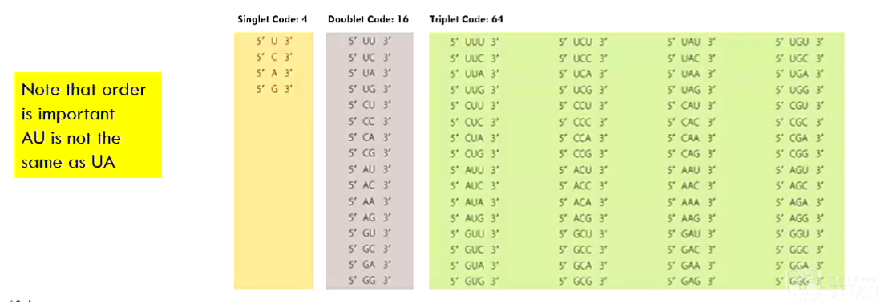
Singlet Codes
Composed of the four bases: A, G, C, and U (in RNA).
DNA Tables
DNA tables may be used, where Thymine (T) replaces Uracil (U).
This implies a translation from DNA to RNA first.
Doublet Codes
Doublets consist of the first two letters of the code (e.g., AU).
Order is crucial; AU is different from UA.
16 possible doublet codes exist.
Triplet Codes
Triplet codes consist of three letters, resulting in 64 possible outcomes.
This large variety contributes to life's diversity.
Redundancy
The code is redundant; multiple codons can code for the same amino acid.
Non-Overlapping Triplet Code
Combination of three bases code for a specific amino acid.
DNA's template strand is used to create mRNA.
Codon
A three-digit code on the mRNA.
Read in the 5' to 3' direction, based on the carbons on the sugar-phosphate backbone.
mRNA codons provide a specific code to produce a protein (e.g., UAC for tyrosine).
Codons are read sequentially without overlap (UAC followed by a new codon, not ACU).
Reading the Genetic Code
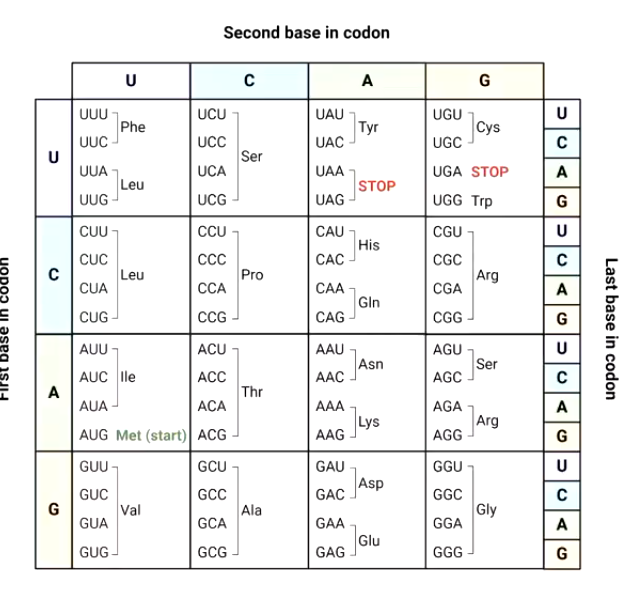
Genetic code tables can be represented in various formats, but the underlying concept remains the same.
Reading The Code
First Read: the first base is read from the left of the table.
Second Read: the second base is read from the top of the table.
Third Read: the third base is read from the right of the table.
Example: AUG codes for methionine (MET).
Start Codon
Methionine (AUG) is typically the start codon, initiating translation.
Example: CAU codes for histidine.
Some amino acids have multiple codons due to redundancy.
Leucine has six codons, serine has six codons, some initiate transcription/translation.
Consider Methionine as the start codon for this subject for now.
Can appear in middle of sequence
Stop Codons
Stop codons (e.g., UAA) signal the end of protein synthesis. Does not actually make an amino acid.
Reading Frames
It is important to understand reading frames in order interpret genetic codes.
Reading Frames in English
Example: "The rat saw the fat cat and big dog and rat." Shifting the reading frame results in nonsense.
Reading Frames in Amino Acid Translation
Shifting the reading frame by one or two nucleotides can result in a completely different (often non-functional) protein.
There are three possible reading frames in the 5' to 3' direction.
Example
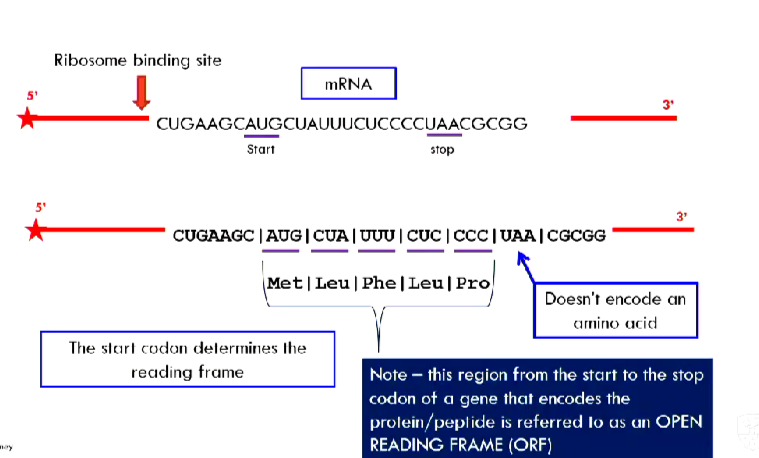
mRNA sequence: Multiple reading frames yield different amino acid sequences. Start codons determine the reading frame.
The region between the start and stop codons is the open reading frame, encoding the peptide or protein.
Mutations
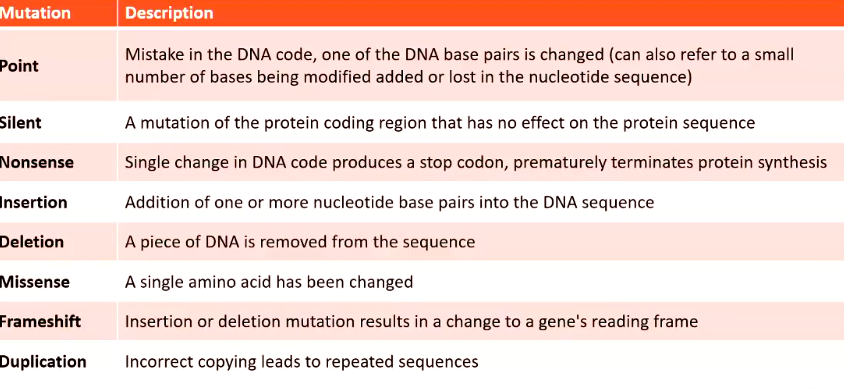
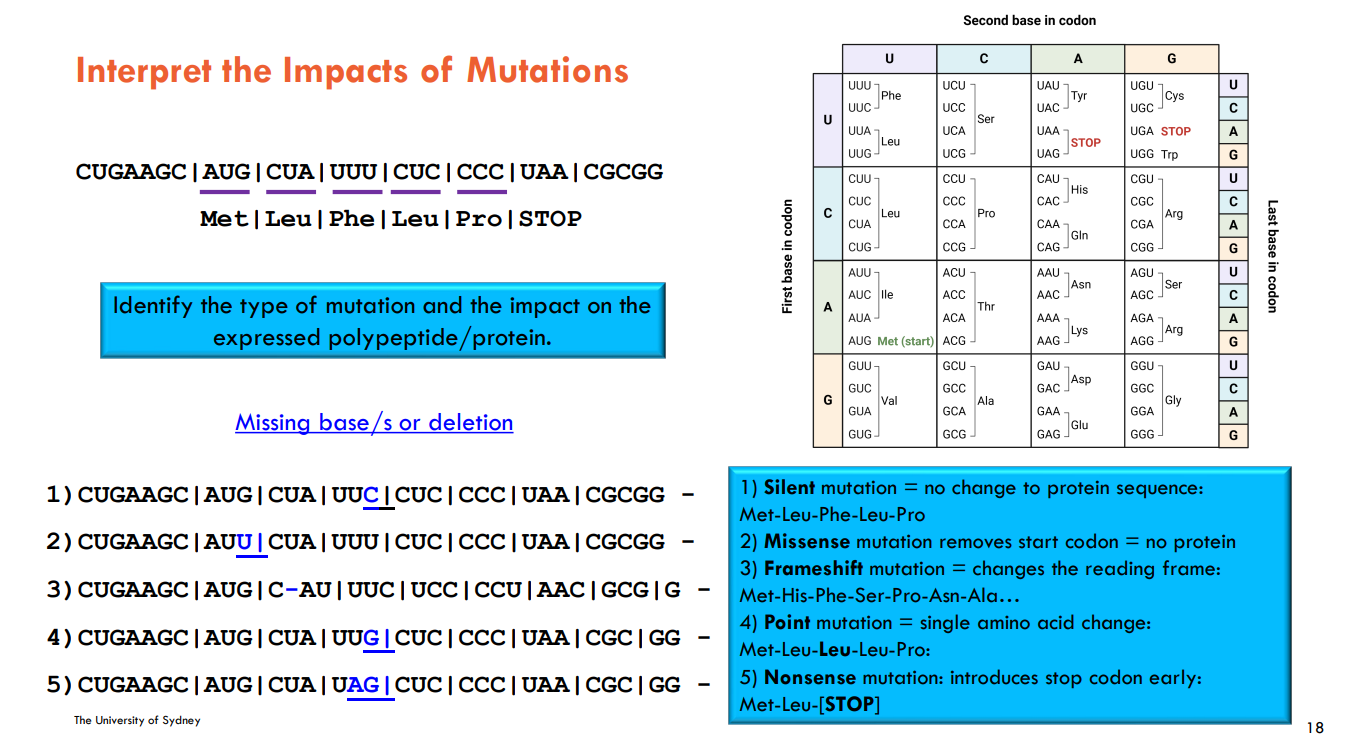
Mutations are alterations in the sequence. They can be beneficial, detrimental, or neutral.
Point Mutation
A single mutation in a single nucleotide that will cause a change in a single amino acid change.
Silent Mutation
Change in the genetic code that does not change the amnio acid.
Nonsense Mutation
Results in a stop codon too early which does not produce protein.
Insertions and Deletions
Insertion: Add nucleotides
Deletion: Cut out nucleotides, can be detrimental or beneficial.
Frameshift Mutations: caused by adding one, two, deleting one, or two nucleotides.
Missense Mutation
A single amino acid is changed. Can have detrimental or beneficial impacts.
Duplications
Bigger changes, generally lead to additions where bunches of genes are copied.