Chapter 8. Variations in Chromosome Structure and Number
homologous: same relation, position, or structure
cytogenics: study of normal and abnormal chromosomes and their behaviour
chromosomal mutation: variations from the normal wild type chromosome structure and number
- mutations can arise spontaneously or be induced experimentally by radiation or certain chemicals
telomeres: sequences at the end of chromosomes
polytene chromosomes: special kind of chromosome found in cells of salivary glands of some insects
chromocenter: proteinaceous structure that joins polytene chromosomes tgt
acentric: without a centromere
dicentric: two centromeres
pseudodominance: unexpected appearance of the recessive phenotype due to the deletion of the dominant allele
tandem: one in front of the other
position effect: inversion or translocation can change position of gene in genome so that expression is altered
euchromatin: condensed during cell division but uncoiled during interphase
heterochromatin: stays condensed during interphase and transcriptionally inactive
euploids: cells/organisms with one complete set of chromosomes or exact multiple of complete sets
aneuploids: organisms with chromosome numbers that are not exact multiples of the haploid set of chromosomes
nondisjunction: failure of chromosomes to separate during meiosis
Variations in Chromosome Structure
polytene chromosomes
- chromatin bundles resulting from repeated cycles of chromosome duplication without nuclear division
- can be 1000 times thicker than normal meiotic chromosomes
- study has contributed much to our knowledge of chromosomal structure
- chromosomal abnormalities = easily seen under light microscope
- polytene chromosomes = joined together at their centromeres by a proteinaceous structure called chromocenter
Types of mutations
deletions
- chromosomal mutation in which part of a chromosome is missing
- starts with chromosomal breakage
- induced by
- heat
- ionizing radiation
- viruses
- chemicals
- transposable elements
- do not revert back to wildtype
- individuals heterozygous for deletion may be normal, but if homolog contains deleterious recessive genes, consequences may be drastic
- if deletion involves loss of centromere, it results in an acentric chromosome
- acentric chromosomes are lost during meiosis
- deletion of an entire chromosome is lethal
- no living humans with entire autosomal chromosome missing
- in some organisms, can be detected through karyotyping
- heterozygotes will have mismatched homologous pair
- during meiosis, unmatched DNA can be seen looping out during synapsis
- pseudodominance can occur if dominant allele is deleted
- deletions can be used to physically map genes to chromosomes
- Deletion mapping is commonly done with Drosophila polytene chromosomes
- used to construct a detailed map of Drosophila polytene chromosomes
- if deletions = large, its likely they are lethal
Cri-du-chat
- heterozygous for deletion of part of short arm of chromosome 5
- their cries sound like the mew of a cat
- affects 1/50000 live births
Prader-Willi syndrome
- heterozygous for deletion on the long arm of chromosome 15
- affects 1/10000-25000 (mostly males)
- weak due to poor sucking reflex
- 5-6 years old, patients = compulsive eaters
- eventually develops obesity and other health related problems
- left untreated, individuals can feed themselves to death
- other symptoms
- mental retardation
duplications
- chromosomal mutation that results in a doubling of a segment of a chromosome
- size of duplication varies considerably and may occur at different locations/tandem config
- tandem duplications can be a reverse tandem duplication
- terminal tandem duplications are duplicated segments located at the end of the chromosome
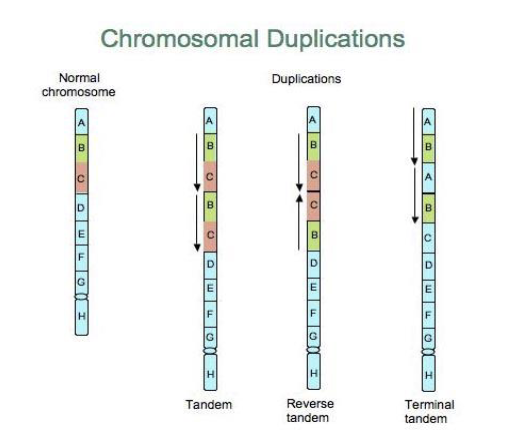
- heterozygous duplications result in unpaired loops in prophase I and can be detected cytologically
- duplicated genes can diverge and acquire new functions
- multi-gene families come from duplication events and subsequent diversification
- most genes belong to multigene families
- ex. actins, globins, and collagens
- members of a family may perform slightly diff functions
- ex. in humans, there are 35 different collagen genes, each making diff structures such as bones, cartilage, tendons, and ligaments
ex. Bar eye mutant in Drosophila
- results from duplicated region on the X chromosome
- homozygous for Bar? less eye facets than normal eyes resulting in slit-like appearance rather than oval
inversions
- chromosomal mutation that arises when a segment of a chromosome is excised and then reintegrated at an orientation 180 degrees from the original
- no loss of genetic material
- can be phenotypic effects resulting if breakpoints are within a gene or its regulatory region
- homozygous inversions can be detected because the linkage arrangement of genes can be altered
- ex. ABCDEFG → ADCBEFG
- homozygous for inversion? meiosis is normal, no problems
- heterozygous for inversion + no crossover in inverted region? meiosis is normal, no problems
- heterozygous for inversion + crossover in inverted region? meiosis effed, big problems
Paracentric inversions + heterozygote with crossover?
- homologous chromosomes try to pair up as best as they can, inversion loop forms
- crossover within inversion loop forms dicentric bridge
- results when two centromeres of resultant chromosome migrate to opposite poles during anaphase I
- dicentric chromosome breaks apart
- acentric chromosome is lost
- after meiosis II, two of the gametes receive DNA with many missing genes, these gametes aren’t viable
- viable progeny can only arise from gametes where the chromosomes did not involve a crossover in the inversion loop
- for paracentric inversion heterozygotes, viable recombinants are reduced or totally suppressed
Pericentric inversions + heterozygote with crossover?
- homologues also pair by forming inversion loops
- results in two viable gametes with non-recombinant chromosomes and two recombinant gametes that are inviable with non-recombinant chromosomes
- inviable ones resulting from deletion of some genes and the duplication of other genes
- no dicentric bridge is formed
- no acentric chromosomes formed
- if there are two crossovers, all four resulting gametes are viable
translocation
- chromosomal mutation in which there is a change in position of chromosomal segments to a different location in the genome
- no genetic material gained or lost
Nonreciprocal intrachromosomal translocation
- chromosomal segment changes position within same chromosome
Nonreciprocal interchromosomal translocation
- chromosomal segment changes position from one chromosome to another
Reciprocal interchromosomal translocation
- exchange of segments between two chromosomes
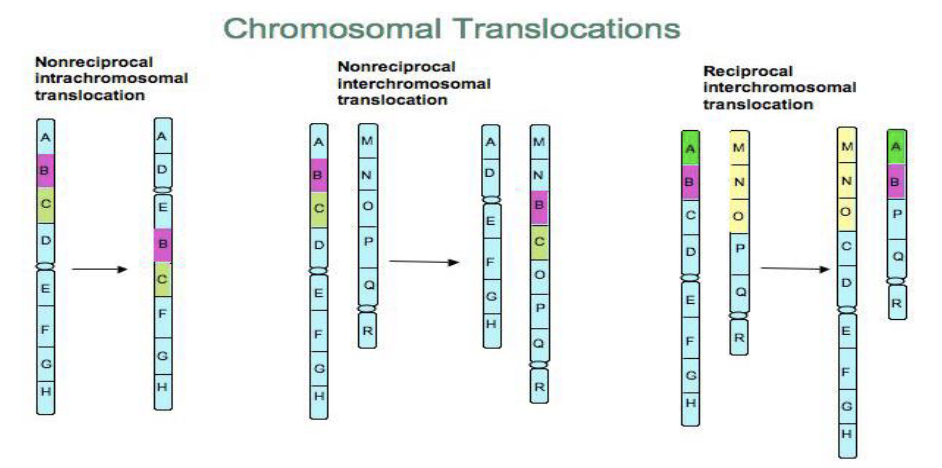
- translocations typically affect the products of meiosis
- in some cases, gametes are produced with either duplications or deletions and consequently are inviable
- in other cases, duplications stemming from translocation can yield viable gametes such as in familial Down syndrome
- in homozygotes for reciprocal translocation
- meiosis = normal
- crossovers do not produce abnormal chromatids
heterozygotic for reciprocal translocation
- chromosomes pair up as best they can, which results in a cross-like configuration in prophase I
- made of 4-paired up chromosomes, each partially homologous to the others
- semi sterile, because only about half of the gametes produced are viable
- many gametes with duplications/deletions = viable BUT resultant zygotes are not
- in plants, pollen grains with deletions or duplications do not develop and are nonfunctional
- segregation at anaphase I occurs in 3 possible ways
Alternate segregation:
- alternate centromeres migrate to the same pole
- ex. N1 and N2 to one pole, T1 and T2 to the other
- no information is deleted/duplicated
- viable gametes
- half have two normal chromosomes
- other half has two translocated chromosomes
Adjacent 1 segregation:
- adjacent non-homologous centromeres migrate to same pole
- ex. N1, T2 to one and N2, T1 to the other
- both gametes contain deletions and duplications
- usually inviable
- occurs as frequently as alternate segregation
Adjacent 2 segregation:
- adjacent non-homologous centromeres migrate to same pole
- ex. N1, T1 to one pole, N2, T2 to the other
- always occurs in inviable gametes
Chromosomal Mutations and Human Tumours
- most human tumours have chromosomal mutations, translocations = most common
- some tumours = associated with specific chromosomal mutation
Chronic myelogenous leukemia
- cancer involving uncontrolled proliferation of myoblasts
- stem cells of white blood cells
- 90 percent CML patients have Philadelphia chromosome, a result from reciprocal translocation between csome 22 and 9
- translocation converts proto-oncogene to oncogene
- ABL gene on csome 22 becomes fused to BCR gene on csome 9
- fusion protein causes cells to proliferate
- Gleevec = recent drug targets the fusion protein and shows promise in treatment of this cancer
Burkitt Lymphoma
- viral-induced tumour that affects B cells of immune system
- common in Africa
- 90 percent of tumours in this condition related to a reciprocal translocation between csome 8 and 14
- brings MYC gene to regulatory region of an antibody gene, resulting in the overexpression of the MYC gene producing an oncogene
Position effect
- inversions and translocations do not usually produce mutant phenotypes unless chromosomal breakpoints occur within a gene
- usually limited to meiosis in heterozygotes
- COULD change position of gene in genome so that the expression is altered
- called position effect
- can occur if gene is normally in euchromatin is moved to heterochromatin
ex. Aniridia
- congenital eye condition char. by severe underdevelopment of iris
- caused by lack of function of the PAX6 gene (necessary for eye development)
- expression of PAX6 is suppressed by position effect resulting from translocation
ex. fragile sites
- when human chromosomes develop narrowing or unstained areas
- csomes can break at these sites, causing deletions
- more than 40 fragile sites have been identified
ex. Fragile X syndrome
- second leading genetic cause of mental retardation
- occurs 1/1250 males
- occurs 1/2500 females
- inherited in Mendelian manner
- However, only 80 percent males with this condition are mentally disabled
- phenotypically normal males are called normal transmitting males and they can pass the condition to their daughters
- add the rest of the info about fragile X cause wtf
Variations in Chromosome Number
- euploids
- aneuploids
Changes in one or a few chromosomes
- generation of aneuploidy occurs when cells with abnormal numbers of chromosomes are generated from nondisjunction
- in aneuploidy, cells have more or less chromosomes than normal
- in animals, mostly lethal
- in plants, more tolerant to aneuploidy
- in diploids, 4 types
- nullisomy: loss of one homologous chromosome pair (2N-2). results from nondisjunction for the same chromosome during meiosis in both parents
- monosomy: loss of a single chromosome (2N-1)
- produce N as well as N+1 gametes
- trisomy: single extra chromosome (2N+1)
- produce 4 types of gametes
- tetrasomy: extra chromosome pair(2N+2)
- can result in double monosomic and double tetrasomics
- can cause serious problems during meiosis
- in humans, autosomal monosomy is extremely rare
- embryos do not develop significantly and are lost in early pregnancy
Trisomy 21
- Down Syndrome occurs with a frequency of 3.5/1000
- characteristics
- low IQ
- epicanthal folds
- short broad hands
- short stature
- correlation with maternal age
- nondisjunction increases with the length of time primary oocyte is in ovary
- mothers over age 35 are encouraged to undergo amniocentesis/ chorionic villus sampling
- amniocentesis: removing and testing a small sample of cells from amniotic fluid
- chorionic villus sampling: taking cell sample from chorionic villi
- there is very small correlation with paternal age if mother is over 35
- can also be caused by Robertsonian translocation, known as Familial Down Syndrome involving 14-21
- this produces 3 copies of long arm of chromosome 21
Trisomy 13
- Pateau syndrome
- occurs with a frequency of 2/10000 live births
- characteristics
- cleft lip and palate
- small eyes
- extra fingers
- extra toes
- mental and developmental disability
- cardiac anomalies
- Usually death occurs within 3 months
Trisomy 18
- Edwards syndrome
- occurs in 2.5/10000
- reasons unknown: 80 percent patients = female
- characteristics
- small size at birth
- multiple congenital malformations
- clenched fists
- elongated skull
- low-set malformed ears
- mental and developmental disability
- 90 percent die within 6 months due to cardiac problems
Changes in Complete sets of Chronosomes
- euploidy
- monoploidy = one set of chromosomes
- polyploidy = more than the normal set of chromosomes such as
- triploidy (3N)
- tetraploidy (4N)
- lethal in most species, less consequential in plants
- played important role in plant evolution
Monoploidy
- results from unfertilized eggs
- found in haploid organisms such as fungi and algae
- rarely observed in adult diploids because of recessive lethal genes
- normal part of life in male bees, wasps, and ants
- can be useful for isolating mutants because there is only dose for each gene
Polyploidy
- arises spontaneously or can be experimentally induced
- it often occurs as a result in the breakdown of the spindle apparatus in meiosis or mitosis
- almost all plants and animals have some polyploidy tissues including plant endosperm (triploid)
- liver of mammals = polyploid
- abdominal neuron of Aplysia has about 75000 copies of the genome\
- ex. Wheat (6N)
- ex. Strawberries (8N)
- ex. North American sucker fish, salmon, some salamanders
- Polyploids can either have an even number or odd number of chromosome sets
- in an even number, there is a better chance of being partially fertile because homologs can pair up
- in an odd number, sterility usually occurs as it is difficult for homologues to pair up and segregate
- in triploids, the probability of producing a haploid gamete is (1/2)^n
- where n = number of haploid chromosomes
- triploidy is seen in 15-20 percent of spontaneous abortions and 1/10000 live births
- triploidy is always fatal
- tetraploidy in humans is seen in 5 percent of spontaneous abortions
Autoploidy
- occurs when all sets of chromosomes originate in the same species
- results from defects in meiosis
- produces diploid/triploid
- occurs in bananas which are triploid and seedless as the seeds aren’t fertile due to problems with meiosis
- seedless fruit such as watermelon and grapes results from odd-number polyploidy
Allopolyploidy
- occurs when all sets of chromosomes come from different, but usually related, species
- results from interbreeding of two different species to produce a diploid with two different sets of chromosomes
- cell usually sterile, sometimes each set of chromosomes doubles
- cell contains diploid set of chromosomes from each parent, thus allowing pairing at meiosis
- results in viable gametes
- fusion of these gametes produces an allotetraploid
- ex. allohexaploid with 42 chromosomes, derived from three distinct species each species with a diploid set of 14 chromosomes
- many agricultural and horticultural plants = allopolyploids