4b: renal physio, urine formation, electrolyte balance, and hormonal regulation
Renal Physiology
Introduction
Topics Covered:
- Urine formation
- Electrolyte balance
- Hormonal regulation
- Presented by Kathleen Miles
Learning Outcomes
Understand the process of urine formation.
Identify transport mechanisms in the nephron:
- Active transport
- Osmosis
- Facilitated diffusion
- Passive electrochemical gradientsDescribe nephron processes for fluid and electrolyte balance.
Identify electrolytes reabsorbed and secreted by proximal and distal tubules.
Explain the urine concentration system.
Identify hormones related to kidney function and their effects.
Tubular Processing of Glomerular Filtrate
how the nephron modifies the raw filtrate through reabsorption and secretion to produce final urine
Tubular Reabsorption
- Definition: The process that moves solutes and water out of the filtrate and back into the bloodstream.Tubular Secretion
- Definition: Waste products and substances are moved from the blood into the urine.
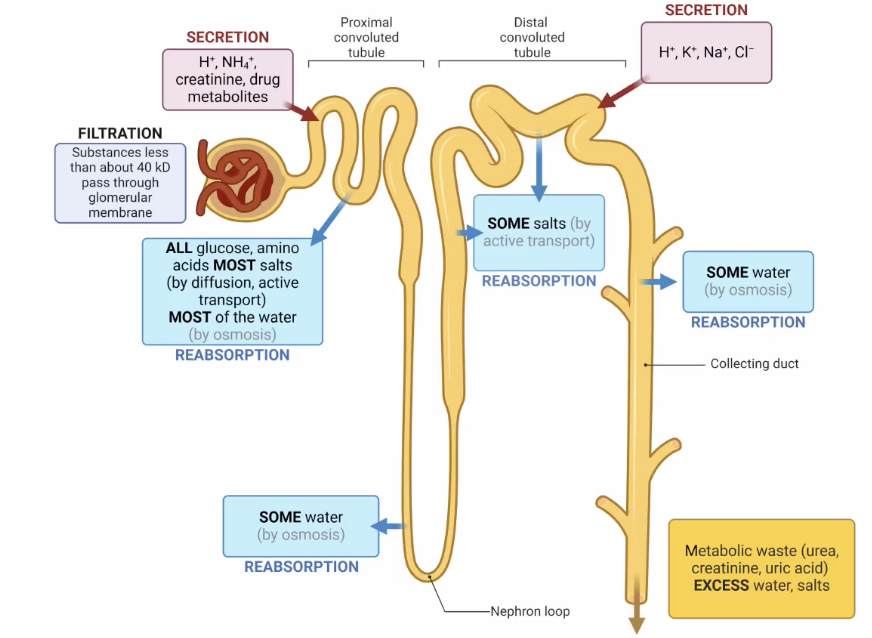
Tubular Reabsorption - Transport Mechanisms
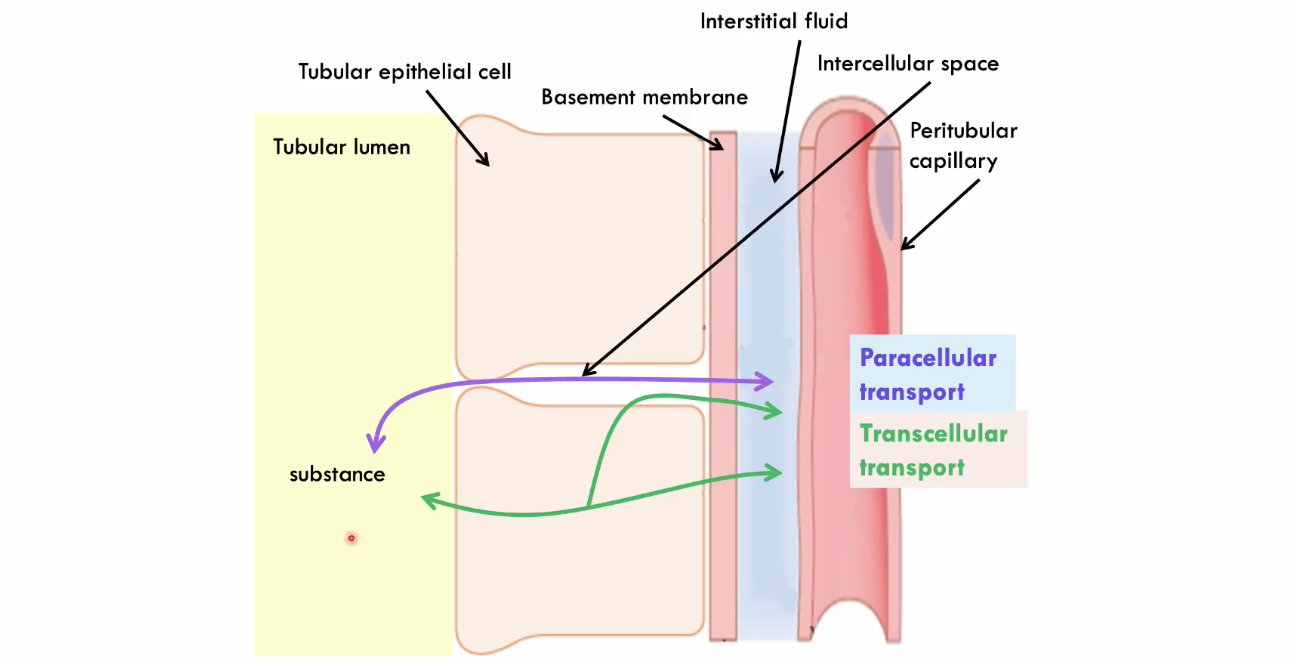
Components involved in reabsorption:
- Interstitial fluid
- Tubular epithelial cell
- Basement membrane
- Tubular lumen
- Intercellular space
- Peritubular capillary
Transport Mechanisms
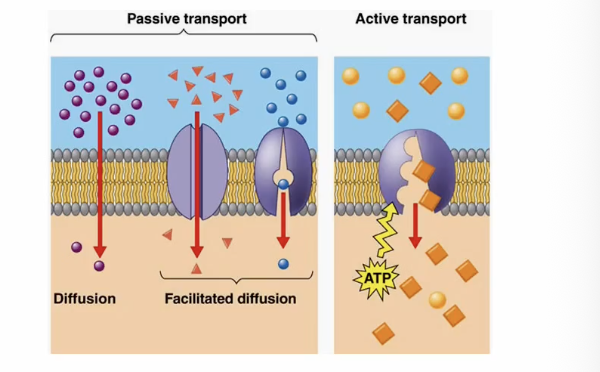
Types of Transport:
- Passive Transport: Moves substances without energy.
- Simple Diffusion: Movement of molecules from high to low concentration.
- Facilitated Diffusion: Involves carrier proteins or channels.
- Active Transport: Requires energy (ATP).
- Primary Active Transport: Directly uses ATP.
- Secondary Active Transport: Uses electrochemical gradients.
- Contrasport (symport): Moves substances in the same direction.
- Countertransport (antiport): Moves substances in opposite directions.
- Pinocytosis: Cell drinking, ingesting liquid.
Bulk Flow
Definition: Movement of large volumes of fluid and solutes due to a pressure gradient.
Driven by hydrostatic and osmotic pressures.
Water and electrolytes are reabsorbed through bulk flow in peritubular capillaries.
Additional Definitions
Tubular Transport Maximum (Tm)
- Maximum rate for the transport of a substance by renal tubules (mg/min) before it starts appearing in the urine.
- Saturation: Specific carriers and enzyme systems become saturated during active transport.Examples of Tm-limited Reabsorption:
- Glucose, amino acids, phosphates, sulphates.Examples of Tm-limited Secretion:
- Para-aminohippuric acid (PAH), penicillin.
Renal Threshold: (mg/dl)
for substances that have reobsorption Tm
plasma concentration where a substance first begins to appear in the urine
reflects the point where its filtered load starts to exceed the nephron’s Tm
Handling of Sodium (Na+)
More than 99% of filtered Na+ is reabsorbed along the renal tubule.
Handling of Glucose by renal tubules
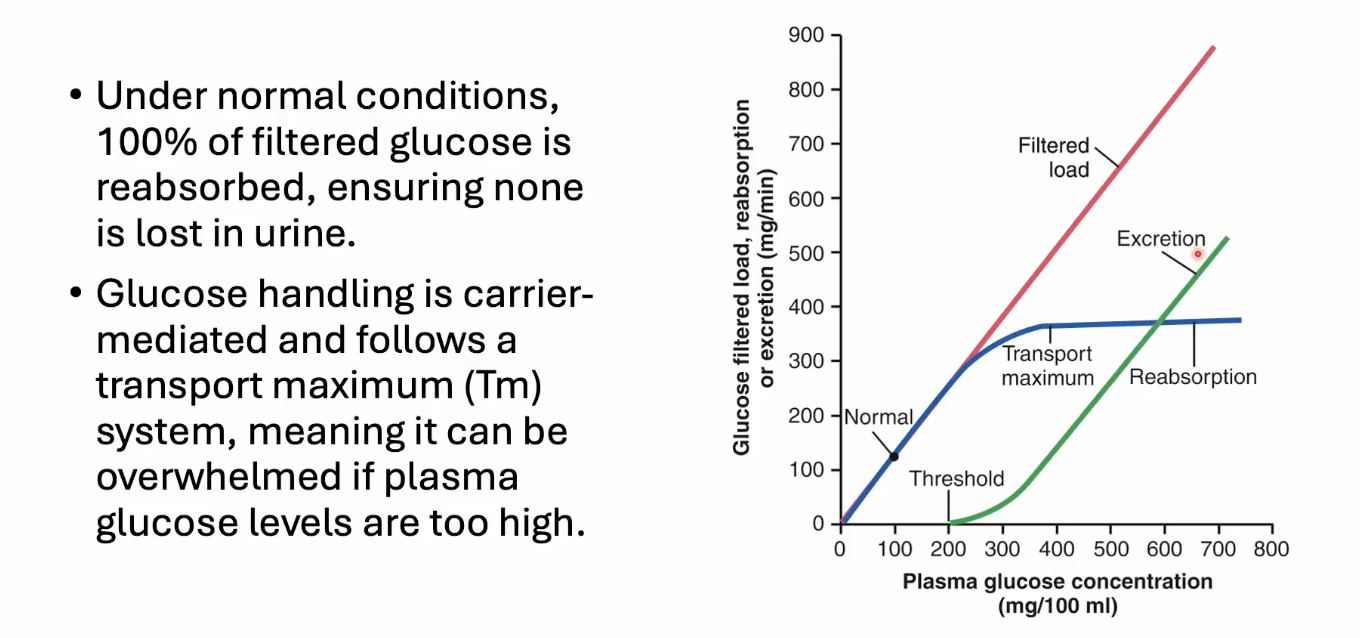
Under normal conditions, 100% of filtered glucose is reabsorbed to prevent urinary loss.
Glucose is reaborbed in the proximal tubule by specific transport proteins
each transporter can only move glucose at a certain rate
extra glucose above the threshold is excreted into the urine
Handling of Water
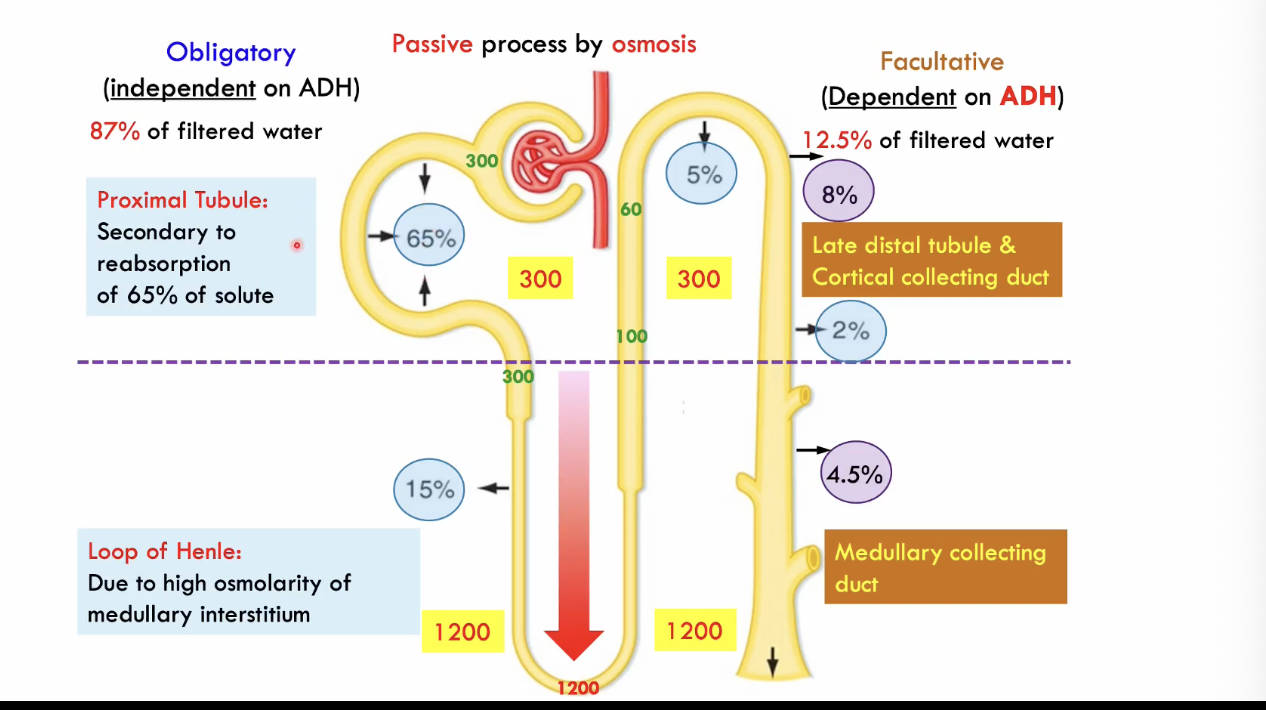
Obligatory Reabsorption:
- Independent of Antidiuretic Hormone (ADH)
- 87% of filtered water reabsorbed passively by osmosis.Facultative Reabsorption:
- Dependent on ADH
- 12.5% of filtered water reabsorbed in certain renal segments.
Summary of Water Handling in Different Tubule Segments:
Proximal Tubule: Reabsorbs 65% of filtered water secondary to solute reabsorption.
Loop of Henle: Drives reabsorption due to high osmolarity of medullary interstitium; approximately 15% reabsorbed here.
Late Distal Tubule & Cortical Collecting Duct: 2% of filtered water reabsorbed.
Medullary Collecting Duct: Can reabsorb water under the influence of ADH.
Urine Concentration and Dilution
Requirements for Concentrated Urine Excretion:
Adequate ADH to increase permeability of late distal tubule, collecting tubule, and medullary duct.
Hyperosmotic Renal Medulla:
- Countercurrent Multiplier: Function of Loop of Henle.
- Countercurrent Exchanger: Function of vasa recta.
- Passive Urea Diffusion: From the medullary duct.
- Sluggish Medullary Blood Flow: About 1-2% of renal blood flow.
Countercurrent Multiplier and Exchanger
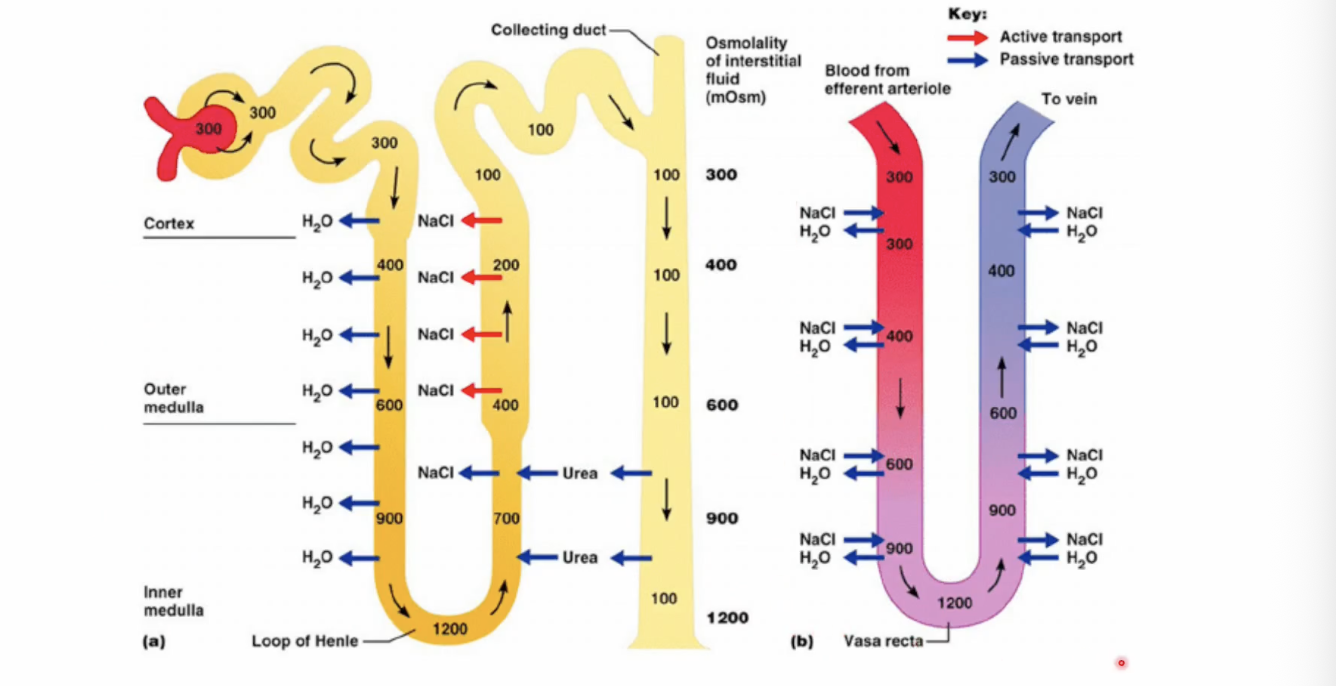
Mechanisms:
- Active and passive transport processes occurring in the Loop of Henle and vasa recta managing osmotic concentration.
Handling of Urea
Proximal Tubule: Reabsorbs about 40% of filtered urea via passive diffusion.
Approximately 40-60% of filtered urea is excreted, particularly from the late distal tubule and collecting duct that become impermeable to urea, raising its concentration.
Handling of Potassium (K+)
Reabsorption primarily occurs in the proximal tubule and loop of Henle.
Regulation: Final excretion is conducted by the distal tubule and collecting duct, which maintains serum K+ levels to prevent hyperkalemia or hypokalemia.
Handling of Calcium (Ca++)
Reabsorption:
- Proximal Tubule: 60-70% (transcellular)
- Loop of Henle: 5% (paracellular)
- Distal Convoluted Tubule: 10% (transcellular)
- Connecting Tubule: 3-10% (transcellular)
Secretion of Hydrogen (H+) & Reabsorption of Bicarbonate (HCO₃)
Proximal Tubule: Reabsorbs 85% of filtered HCO₃.
Thick Ascending Limb of Loop of Henle: Reabsorbs 10% of filtered HCO₃.
Collecting Duct: Reabsorbs 4.9% of filtered HCO₃.
Plasma Renal Clearance
volume of plasma comopletely cleared of a substance by the kidneys per unit time
reflectts how effectively the kidneys remove that substance
Formula:
- Cr: Renal Clearance
- U: Urine concentration of the substance (mg/mL)
- V: Urine flow rate (mL/min)
- P: Plasma concentration of the substance (mg/mL)
high clearance → kidneys removes plasma efficiently
low clearance → kidneys retain in
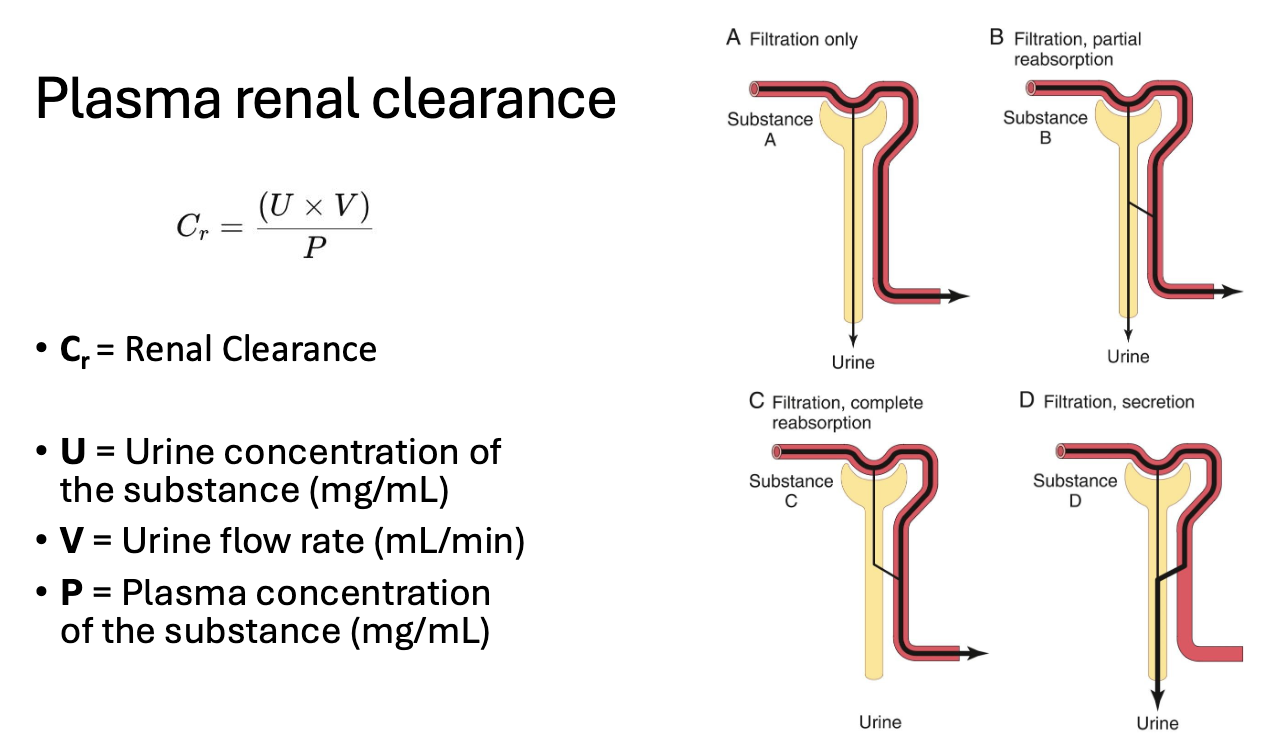
a. substance is filtered at the glomerulus - whatever is filtered is excreted = GFR
b. filtration + partial absorption = less than GFR
c. iltration + complete reaborption = clearance 0, nothing appears in the urine
d. fitration + secretion - additional amounts are actively secreted = larger than GFR
Hormonal Regulation and Effects on the Kidneys
Hormone | Site of Action | Effects |
|---|---|---|
Aldosterone | Collecting tubule and duct | Increases NaCl and H₂O reabsorption, increases K+ secretion |
Angiotensin II | Proximal tubule, thick ascending limb/distal tubule/collecting tubule | Increases NaCl and H₂O reabsorption, increases H+ secretion |
Antidiuretic Hormone (ADH) | Distal tubule/collecting tubule and duct | Increases H₂O reabsorption and permeability |
Atrial Natriuretic Peptide | Distal tubule/collecting tubule and duct | Decreases NaCl reabsorption |
Parathyroid Hormone | Proximal tubule, thick ascending loop/distal tubule | Increases PO reabsorption, increases Ca++ reabsorption |
Additional Hormonal Functions of the Kidneys
Renin: Regulates blood pressure.
Erythropoietin (EPO):Stimulates red blood cell production in bone marrow.
Vitamin D: Activation in kidneys supports calcium absorption in the gut, crucial for bone and muscle health.
Acknowledgments
Thanks to the contributors for their information and insights on renal physiology.